
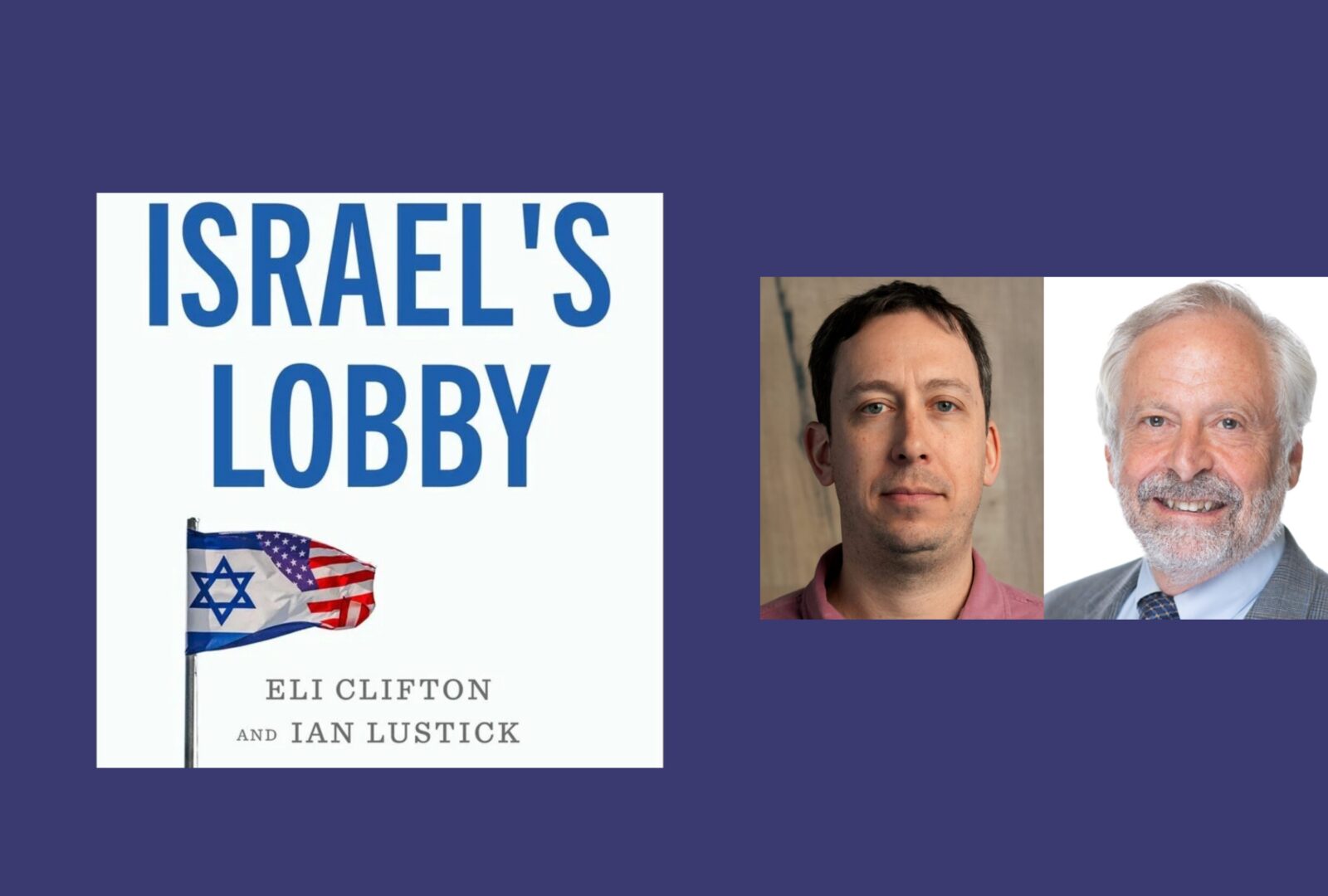
New Book Arrives as Israel Splits the Democratic Party — and Reshapes American Politics
FOR IMMEDIATE RELEASE
August 11, 2026
Eli Clifton and Ian Lustick’s “Israel’s Lobby” traces the money and mechanisms behind a foreign influence network now colliding with a restive electorate.
WASHINGTON DC— This primary season has delivered a stark warning to Washington’s political establishment: Several Democratic Socialist candidates calling for the cut off of military and economic aid to Israel unseated incumbent and establishment-backed Democrats. The result has not been uniform but the fault line drawn is now impossible to ignore heading into the midterms, with strategists on both sides bracing for the electoral impact of what may be a genuine paradigm shift in how Americans consider the US-Israel relationship.
Today, that fault line gets a book-length explanation. Israel’s Lobby: America in the Grip of a Foreign Power, a new work of political analysis and investigative journalism by Eli Clifton and Ian Lustick, is published today by One Signal/Simon & Schuster — arguing that the very network now being tested at the ballot box has spent decades building the financial and political machinery to prevent exactly this kind of dissent. Eli Clifton is a co-founder and senior advisor at the Quincy Institute. Ian Lustick is a non-resident Fellow at the Quincy Institute and a professor emeritus at the University of Pennsylvania.
The book combines investigative journalism and political science to examine how a network of organizations, activists, and wealthy donors — collectively referred to as “Israel’s Lobby” — has come to exert outsized influence over American foreign policy, often in ways that serve a foreign government’s interests over America’s own. Drawing on original reporting, the authors trace the Lobby’s mechanisms, its financial scale, and the threat it poses across four areas of American life.
Foreign policy distortion. The authors document what one national security official called the “anticipatory reflex” — the tendency of administrations to preemptively shape Middle East policy to avoid confronting the Lobby rather than following independent strategic judgment. The result, they argue, has been decades of policy misaligned with core U.S. interests.
Diminished international standing. The book contends that unconditional diplomatic cover for Israel at the UN and the ICC has undercut America’s credibility as a defender of international law and multilateral institutions.
Squelching dissent on campuses and beyond. The authors detail coordinated campaigns to brand criticism of Israel as antisemitism, resulting in professors fired, students disciplined, and legislation introduced that would restrict political speech — effects the book frames as a direct challenge to First Amendment protections.
Corrupted campaign finance. Perhaps the book’s central concern: the authors argue that Citizens United, combined with concentrated donor wealth, has let a small number of politically influential donors shape American elections, with lawmakers privately acknowledging they vote against their own convictions out of fear of retaliation — the same dynamic now being tested, and in some races overturned, by primary voters.
“Even as its hammerlock on Washington loosens, the lobby grows more desperate — and more dangerous,” said Lustick. “This book traces its changing tactics, and shows how, in the best traditions of American politics, open debate and countervailing power can defend our fundamental interests and freedoms.”
The authors are careful to distinguish the Lobby from Jewish Americans broadly, citing survey data showing Israel ranks low among American Jewish voters’ policy priorities and noting that many of the Lobby’s sharpest critics are themselves Jewish.
“This year’s primaries are the clearest sign yet that the Lobby’s grip is no longer absolute,” said Clifton. “This book explains exactly how that grip was built, what it has cost the country, and why the politics are finally starting to shift.”