
Prospects and Problems for Reinvigorating Superpower Nuclear Cooperation
Executive Summary
A three-way nuclear arms race between the United States, China, and Russia looms — an escalation that would erode global nonproliferation and usher in an era of unchecked nuclear proliferation. This brief offers a path to preventing this destabilizing outcome through pragmatic nuclear cooperation — an approach that has strong historical precedent and accords with the strategic interests of all three nuclear superpowers.
Superpower cooperation historically underpinned the global nuclear nonproliferation regime, but increasing great power competition erodes this entire system of international security. China and Russia have each modernized and expanded their nuclear programs and adopted more aggressive nuclear postures. The United States, in turn, has approved a nearly $2 trillion nuclear modernization program. This burgeoning arms race heightens risks of inadvertent escalation, as each of the superpowers become increasingly reliant on nuclear brinkmanship to hold off the growing capabilities of their adversaries.
The deteriorating nuclear security environment places pressure on other states to similarly seek their own nuclear arsenals while weakening the nonproliferation tool kit that previously prevented these states from breaking out. As more armed states join the fray, they in turn multiply the number of potential nuclear flashpoints around the world.
Reinvesting in superpower cooperation on nuclear security is not an idealistic bid for goodwill. Rather, halting unchecked competition is a pragmatic strategy that serves the interests of the United States, Russia, and China. It preserves a global nuclear system that has safeguarded the superpowers’ dominance for decades. Weakening it, on the other hand, undermines the international marketplace that has preserved U.S. dominance in private industry and innovation. Russia and China, in turn, risk a multifront nuclear competition, as proximate U.S. allies choose uncontrolled independent arsenals over existing security umbrellas.
The superpowers can still step back from the abyss by reviving nuclear cooperation. Toward that objective, this brief recommends that the Trump administration:
- Accept Russia’s offer to extend New START for a year, paired with verification pathways and transparency measures.
- Reinvigorate existing direct lines of communication (i.e., hotline systems) with both Russia and China.
- Initiate trilateral nuclear discussions with Russia and China toward the goal of capping arsenals at parity on specific warheads and delivery systems.
Introduction
Nuclear nonproliferation cooperation between superpowers served as a catalyst for global nuclear security for decades, but these efforts have faltered in recent years. Without the leadership of today’s nuclear superpowers — the United States, Russia, and China — global nuclear nonproliferation (meaning efforts to deter the spread of nuclear weapons to unarmed states and prevent the growth of existing arsenals in nuclear states) grinds to a halt, increasing the risks of a superpower arms race and eroding regional security controls.1
Arms control agreements that previously limited vertical proliferation in existing arsenals have ended with no replacements in sight. Russia and China now act as spoilers to the counterproliferation sanctions they once supported. Hallmarks of the superpowers’ international leadership have faltered, as differences over international regulatory controls have undermined their historically unified commitment to the global nonproliferation regime. In the competitive nuclear climate, the United States is now poised to enter the race, approving almost a trillion dollars in nuclear modernization and plans for nearly $2 trillion that would explode the number and size of operational warheads far beyond those of any adversary.2This looming three-way superpower arms race increases proliferation pressures globally, generating incentives for scores of abstaining states to similarly arm themselves in a desperate bid for balance.
Despite these challenges, the superpowers still have good reason to cooperate on nuclear policies, and international nonproliferation efforts have a better chance when they all work together as partners. There now exists a small window of opportunity to reverse the slide toward a global nuclear sprint, before the U.S. juggernaut truly enters the fray with its planned nuclear expansion or the traditional third-party abstainers set off regional cascades of their own.
This brief explains how nuclear cooperation succeeded in the past and how it might be revived, considering both the benefits and current challenges. It begins with a background on nuclear cooperation, describing “vertical nonproliferation” arms control efforts that mutually limit growth in existing arsenals, “horizontal nonproliferation” efforts to constrain new weapons-seekers from breaking out, and the “global nonproliferation system” built on international rules and incentives to encourage abstinence in unarmed states. I then explain how nuclear cooperation has fallen apart in recent years, detailing the incentives for three-peer competition, perverse alliance arrangements with new proliferators, and challenges to the global nonproliferation system. I argue that, despite growing challenges, nuclear cooperation remains firmly in the strategic interests of all three powers and outline how it can be revived to bolster superpower and global security alike.
The history of nonproliferation cooperation
Nuclear cooperation efforts have varied over the years, spanning three different types that I outline below. These are mutual arms control agreements that limit vertical growth of existing arsenals, counterproliferation efforts to curtail horizontal spread to new proliferators, and global nonproliferation leadership through international institutions. These efforts were each executed through different diplomatic channels and relied on different oversight mechanisms, some relying on bilateral diplomacy and backchannel negotiations, others on broad intergovernmental institutions and public discourse. Yet all these efforts supported the broad efforts of controlling the spread of nuclear weapons, and many were concluded despite periods of intense distrust and even active conflict between the powers.3Revisiting the different parameters and methods of these agreements can therefore shed light on how new efforts can be resuscitated.
Vertical nonproliferation efforts like mutual arms control agreements helped limit the growth of existing arsenals.4These agreements were primarily concluded between the United States and the Soviet Union/Russia, the states with the world’s two largest arsenals,5while China and other nuclear powers usually abstained but maintained smaller forces that did not encroach on the U.S.–Soviet/Russian bilateral limits. Key examples include the Strategic Arms Limitation Talks Agreement, or SALT I; the Anti-Ballistic Missile Treaty, or ABM; and the New Strategic Arms Reduction Treaty, or New START, which were used to reduce the numbers of deployed warheads, increase bilateral verification capabilities, and eliminate trip wires into nuclear conflict. These agreements were generally limited in scope — such as addressing only one type of weapon or delivery system — but robust in verification measures, thereby allowing the two warring superpowers to trust the other was abiding by the agreement and reducing the pressure for either to preemptively violate their obligations.6
Horizontal nonproliferation efforts sought to prevent the spread of nuclear weapons to new states. These included indirect prevention efforts that limited the spread of sensitive materials and technology, as well as more direct counterproliferation interventions against potential weapons-seekers. These direct counterproliferation efforts have included superpower collaboration on joint sanctions and multilateral negotiations with Libya, North Korea, and Iran in recent decades and have usually involved a mix of negative sanctions and positive inducements. All of these strategies have proven more successful when done with support from other nuclear powers: multilateral sanctions impose more coercive damage because they cut weapons-seekers’ access to materials and markets from multiple angles; inducements are more enticing when backed by multiple suppliers and guarantors.7Preventive measures, by contrast, can facilitate nonnuclear states’ access to proliferation-resistant nuclear materials — for example, through the Nuclear Suppliers Group, or NSG, and the International Atomic Energy Agency, or IAEA, Fuel Bank — or strengthen export controls that limit the spread of dual-use or weapons-grade alternatives.8
In all these efforts, superpower cooperation (despite political differences and even periods of open animosity) has helped pave the way for a global nuclear nonproliferation system that has benefited the nuclear powers for more than 50 years. Agreements like the Nuclear Nonproliferation Treaty, or NPT, which entered into force in 1970, spearheaded the nuclear nonproliferation movement with buy-in from the vast majority of states while cementing the United States, Soviet Union/Russia, China, France, and the United Kingdom as the only recognized nuclear powers in the world. For this order to persist, however, nonnuclear-weapon states must abstain from proliferating in order to receive benefits like ease of access to nuclear energy facilitated by the NSG; global nuclear policing through organizations like the IAEA; and the restraint of nuclear-weapons states. If today’s superpowers — the United States, Russia, and China — fail to provide those benefits or violate the expectations of restraint, they stand to undermine the very system that helped sustain their superpower status.
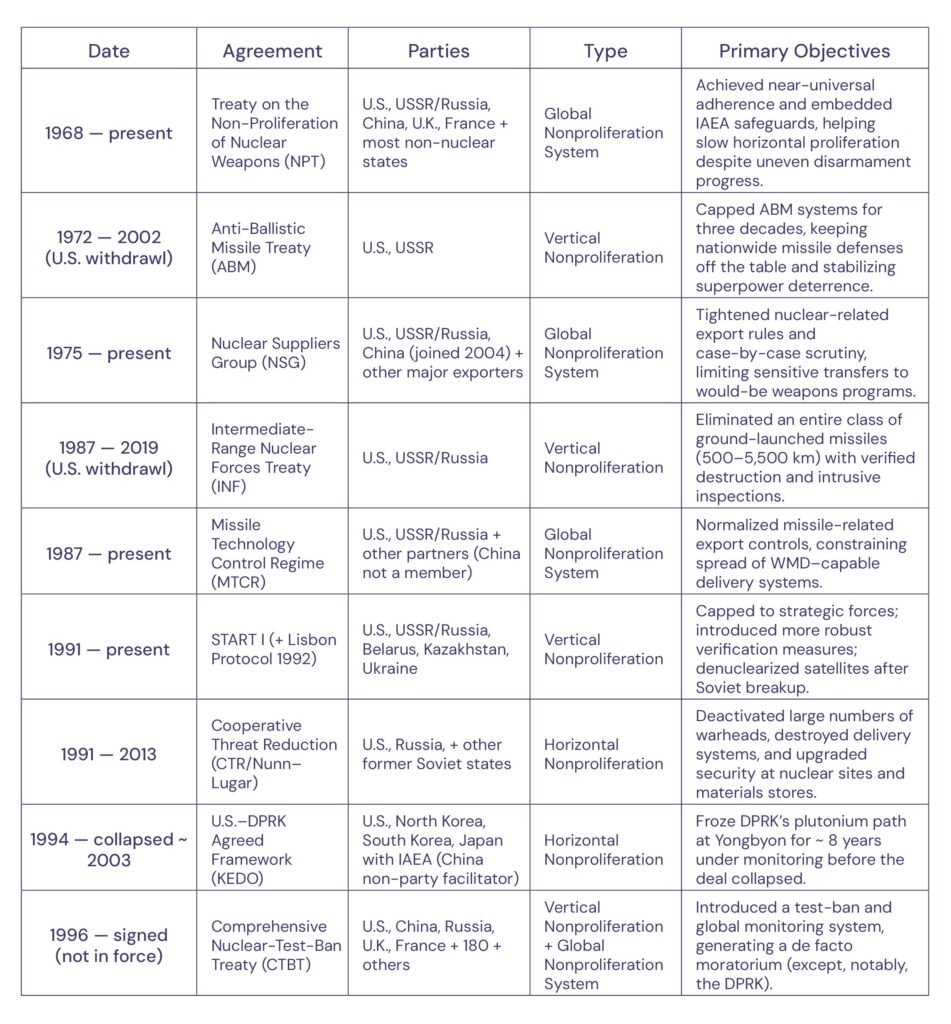
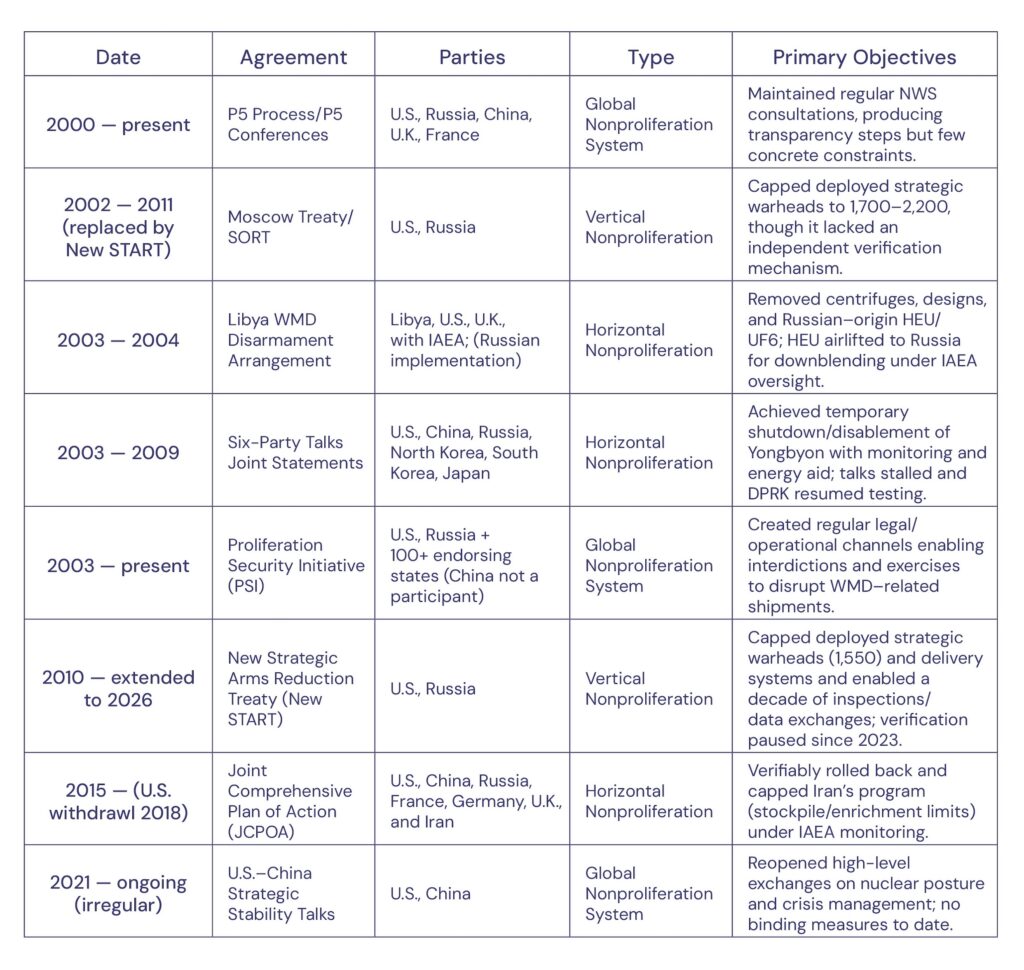
The table “multilateral superpower nuclear agreements since 1968” in the appendix lists key examples of nuclear cooperation agreements between superpowers in chronological order, including mutual arms control agreements that limited vertical growth and counterproliferation efforts that limited horizontal spread to new proliferators.9This list is not comprehensive, but demonstrates the breadth and regularity of cooperation.
Challenges to nuclear cooperation
While nonproliferation cooperation conferred strategic benefits for the United States, Russia, and China, it faced challenges even at its height and has seen increasing skepticism in recent years. Today, skeptics in the United States argue that Russia and China do not have a good track record of abiding by their agreements — either in spirit or letter of the law — pushing boundaries of mutual arms control limits or inadequately policing targets of nuclear sanctions. They argue Washington should not tie its hands to unreliable partners if its counterparts cannot be trusted.
Others argue that, even if cooperative nonproliferation has been effective in the past, Russia and China are no longer willing to commit themselves to such efforts with the United States today. They reason that Washington — by unilaterally abandoning the Joint Comprehensive Plan of Action, or JCPOA, in 2018; withdrawing from the Intermediate-Range Nuclear Forces Treaty, or INF, in 2019; and air strikes against Iran’s nuclear sites in June 2025 — have eroded the other powers’ trust in the U.S. commitment to cooperative nonproliferation. They point to the three-peer environment reinvigorating great power competition and to the potential for U.S. missile defense systems to weaken the principles of mutual vulnerability that previously underpinned cooperative nonproliferation.
Despite these setbacks, nuclear cooperation is still in the superpowers’ pragmatic self-interest. While vertical arms control agreements may not have entirely constrained U.S. adversaries, they did repeatedly slow and even halt their nuclear developments, helping stave off an uncontrollable arms race. Multilateral support for horizontal nonproliferation made both nuclear sanctions and incentives more credible while limiting Russia and China’s support for top proliferation risks. Unified leadership in the global nonproliferation system has deterred many potential proliferators from entering the fray, thereby reducing the cost of international nuclear security immeasurably. So, while Russia and China may often test limits or shirk their obligations, these lapses pale in comparison to the current system of unchecked nuclear growth and foreign transfers.
Vertical proliferation risks
While nuclear cooperation has long benefited today’s three nuclear superpowers, the return to great power competition — beginning in the 2010s but accelerating in recent years — has spread to the nuclear realm. This spread to nuclear competition is most obviously highlighted by the failure of vertical nonproliferation, as all three powers embark on dramatic expansions of their existing arsenals. Russia and China have already made significant strides in their nuclear modernization programs, throwing off old limits and pursuing larger and more survivable arsenals that could outstrip those of the United States and its allies’ regional capabilities.10Both major competitors have also coupled their expanded forces with more aggressive nuclear postures. Russia has implemented an “escalate to de-escalate” nuclear doctrine — threatening to go nuclear early in a crisis as a way to deter the United States and its allies from using their superior conventional forces — coupled with more explicit threats of nuclear use to defend its interests in Ukraine.11Meanwhile, China has departed from its decades-long no-first-use policy and its reliance on a small mobile arsenal to instead pursue greater nuclear parity and a more overtly aggressive posture. These changes threaten to rapidly undermine U.S. missile defense and extended deterrence commitments in the Asia-Pacific region.
This return to nuclear competition has predictably challenged vertical nonproliferation efforts, with existing arms control agreements crumbling or aging out with no replacements yet in sight. China traditionally avoided the need for mutual arms control limits, claiming its quantitative and qualitative inferiority to Russian and U.S. forces exempted it from participation in the mutual caps that arms control imposed. But China’s current drive to grow its arsenal will put many of its forces outside those limits within a few short years, and Beijing still refuses to engage in arms control dialogues, making even the bilateral agreements between Washington and Moscow more difficult.
Russia, due in part to China’s looming parity and in part to its own conventional inferiority highlighted by failures in the Ukraine war, has also increasingly moved away from the bilateral arms control agreements with the United States that historically prevented vertical growth in the world’s largest nuclear arsenals. Russia suspended its participation in New START — the last remaining arms control agreement — and withdrew from the Strategic Stability Dialogue intended to generate new agreements before existing limits timed out.
Taken together, these changes in U.S. adversaries’ nuclear developments create strong incentives for the United States to join the race.12Washington has responded by promising even greater and more costly developments than either adversary, approving a $1.7 trillion modernization program that would grow the U.S. arsenal beyond that of any other country within several decades. It has coupled this with work on a vastly expanded missile defense system, one that adversaries claim would weaken second-strike deterrence principles and introduce risky technologies to new domains.13While the United States has not yet broken ground on its nuclear expansion, there are already proposals for further growth that would triple the number of U.S. deployed weapons.14Any of these plans would ignite a trilateral arms race in earnest, likely triggering reactive proliferation cascades in regional powers as well.
Horizontal proliferation risks
The current environment of military competition has created secondary problems for horizontal nonproliferation. Both Russia and China have deepened economic and security ties with Iran and North Korea in recent years, gradually moving from active supporters and critical partners in nonproliferation efforts to now aggressively blocking international attempts to limit the nuclear programs and military buildup in the two top proliferation-risk states.15
Russia has begun relying on arms sales from North Korea and Iran to support its ongoing war in Ukraine. Dependence on these acquisitions has made Moscow increasingly resistant to nonproliferation pressure against its allies. While Russia has traditionally differed from the United States in its willingness to sanction or punish proliferators, it was a consistent and critical supporter in negotiating and implementing nonproliferation efforts in the post–Cold War years. Russia was a lead collaborator on the JCPOA with Iran and U.N. sanctions against North Korea’s nuclear program. But these efforts began to falter after the United States pulled out of the JCPOA in 2018 and largely collapsed following the invasion of Ukraine in 2022. Russia now opposes U.S. counterproliferation efforts and refuses to leverage its economic or political ties with Iran and North Korea to facilitate multilateral nuclear negotiations. Instead, it has ramped up technology sharing, supporting North Korea’s space program and signing the Comprehensive Strategic Partnership Treaty with Iran.16
China has likewise increased its diplomatic, security, and economic engagement with these key proliferation cases over the last 10 years. China and Iran initially announced plans to increase cooperation in 2016, but security and economic ties deepened in 2021 with a 25–year Strategic Cooperation Plan.17In the succeeding years, joint military drills have increased, and Iran is now one of China’s largest oil suppliers, with imports more than double what they were before 2020.18These ties have also generated spillover effects into international forums, with China increasingly protecting Iran in international forums, blocking U.S. efforts at further embargos against the latter’s nuclear program, and promoting Iran’s political legitimacy by pushing for its inclusion in BRICS+ and the Shanghai Cooperation Organisation.19
While China’s growing relationship with Iran is relatively new, the superpower has a history of using kid gloves with North Korea, resisting significant pressure that could destabilize the Kim regime and risk initiating a refugee crisis across its shared border. Yet despite its reluctance for extreme coercion, Beijing critically facilitated past counterproliferation efforts against Pyongyang. Beginning in 2018, however, China increasingly called for sanctions relief, actively hindering further U.N. sanctions efforts against North Korea’s nuclear and ballistic missile programs and arguing that these and Pyongyang’s growing space program (including spy satellites and dual-use technology to aid its nuclear program) are legitimate state rights. Without Beijing’s support, any efforts to constrain Pyongyang are unlikely to succeed, and all the while North Korea’s growing arsenal continues to generate proliferation pressures in regional adversaries and beyond.
Global nonproliferation system
The combined erosion of vertical arms control agreements and individual horizontal nonproliferation efforts has also undermined the global nonproliferation system that helped solidify the superpowers’ primacy for decades. The NPT and U.N. Security Council have largely served as the stewards of the global nonproliferation system — a system that grants Russia and China (along with the United States, Great Britain, and France) codified power as the only recognized nuclear powers in the world and permanent positions on the U.N. Security Council. Yet the NPT Review Conference in 2022 ended without agreement, as Russia (and, to a lesser extent, China) blocked consensus on paths forward.20Both Russia and China have also been increasingly uninterested in supporting the system’s specific sources of power, resisting U.S. or European initiatives to enhance U.N. NPT controls and framing this resistance as support for state sovereignty against Western encroachment.21This has included rejecting U.S. demands for the stricter Additional Protocol requirements for recipients of nuclear material and technology as well as opposing the use of third-party information sharing to support IAEA intelligence operations.
Undermining the global nonproliferation system has also included the repeated resistance to invoking positions of power on the U.N. Security Council against infractions. Instead, Russia and China have used these positions to consistently hamper regulatory enforcement, signaling that NPT compliance is negotiable and that regulatory bodies are toothless. While the NPT and the nonproliferation capabilities of the international community have long been debated, their deterrent powers stem from the promise of reliable and widespread retribution for obvious infractions.22
Together, the faltering traditions of vertical, horizontal, and global nonproliferation traditions increase financial costs, undermine nuclear security, and weaken the geostrategic leadership of the superpowers. Reinvigorating the powers’ leadership in nonproliferation instead offers a path forward, buttressing their own domestic security and reducing the political and financial costs of maintaining their positions of international primacy.
Renewing nuclear cooperation is both beneficial and feasible
While there are clear impediments to renewed cooperation between the superpowers today, there are also pragmatic benefits for all parties. Normative and ideological arguments favoring cooperation and nonproliferation abound, but these efforts can only succeed when each state finds that it is in its individual self-interest. I therefore set aside the wide range of value-based discussions in favor of a rationalist evaluation, which demonstrates that nuclear cooperation is both attainable and optimal in the current security climate.
First, nuclear cooperation is and must continue to be in Russia’s and China’s individual self-interest for these efforts to succeed. Though nuclear cooperative efforts have often been spearheaded by the United States and sometimes couched in normative arguments, the results of these efforts support Russia’s and China’s pragmatic security, economic, and geopolitical needs. The rival powers’ growing nuclear arsenals and more aggressive postures are already catalyzing similar nuclear developments in the United States, inviting a three-way arms race that creates significant risks both directly between the three superpowers and indirectly through global nuclear cascades, which risk arming not only U.S. adversaries but a number of U.S.–allied near-nuclear powerhouses as well.23All of this undermines global nonproliferation systems that have long served the strategic needs of all three superpowers. These risks could be used to help catalyze renewed trilateral support for vertical and horizontal nonproliferation efforts and for preserving the superpowers’ global strategic dominance.
Vertical nonproliferation
Russia’s and China’s nuclear activities are even now drawing the United States into joining a three-way superpower nuclear arms race. While the United States has yet to deploy major nuclear armament increases as Russia and China have done, the Congressional Budget Office estimates the U.S. will spend nearly $1 trillion on nuclear force developments before 2034, and has committed to spend $1.7 trillion within 30 years.24Predictably, these plans call not for parity with either rival power but for technical and numerical superiority over both powers combined, an outcome neither Russia nor China would relish.25
The growing perception of the Russian and Chinese nuclear threats has also fomented greater U.S. public support for defense spending and military competition. As support for a more competitive defense sector grows, it can likewise galvanize private sector contributions to the effort, disproportionately favoring the United States with its hypercompetitive civilian industries.26The burgeoning U.S. industries in artificial intelligence, or AI, and the space sector in particular promise to upend existing power balances, having the potential to quickly propel states like the U.S. — with massive private sector funding, venture capital opportunities, and a vibrant startup ecosystem — to the front of a superpower race.27All of the top 10 AI companies in the world today are headquartered in the United States, and many are making significant headway in robotics, perception, and accelerated decision-making that have direct applications to military environments.28This latent potential can be used to help remind Russia and China that mutual arms control limits and public support for the global nonproliferation regime are in their respective self-interests.
Horizontal nonproliferation
Wider efforts at controlling horizontal proliferation risks are also pragmatic choices for U.S. adversaries. The burgeoning arms race and crumbling global nonproliferation order have generated increasing incentives for power balancing in third-party states, many of which are solidly allied with the United States. These pressures have translated into both greater support for U.S. forward power projection and for developing weapons of their own. For example, Russia’s nuclear modernization has helped reinvigorate nuclear deterrence debates in NATO states. Member states, including Poland and Germany, have called for forward deployments of U.S. weapons, and France has recently offered new extended deterrence commitments to nonnuclear European allies.29Simultaneously, China’s rapid buildup, coupled with North Korea’s growing capabilities, has increased U.S. regional allies’ demand for a more robust nuclear deterrent.30Support for U.S. forward deployment has increased in both Japan and South Korea, as have discussions for growing indigenous nuclear capabilities exemplified most recently in the latter’s nuclear-powered submarine proposal.31
While Russia and China have increasingly forged ties with nuclear risks like Iran and North Korea and have bowed out of nonproliferation pressures against these allies of convenience, the fruit of their disinterest here may in fact be the explosion of U.S. and U.S.–friendly nuclear forces in their own backyards. NATO forward deployments would mean U.S. or U.S.–allied weapons closer to Russia and better able to deter Russia’s activity on its western borders. Likewise, U.S. weapons stationed in Japan and South Korea, or even more the development of new nuclear arsenals in either of these U.S. allies, would undermine Chinese force projection and leadership in its own region.
Global nonproliferation
While cooperating on vertical and horizontal nonproliferation efforts would go a long way toward safeguarding the global system of nuclear controls, more overt support and cooperative leadership in this effort would help both Russia and China cement their positions as responsible governors. As long as the NPT and global nonproliferation system are strong, the U.N. Security Council and its permanent members wield outsized power in setting the course for international operations. China and Russia have both used their veto power at the Security Council to help shape adversaries’ military activities, and they have wielded their role in peacekeeping operations as a mantle of legitimacy for greater global leadership.
Nuclear cooperation is in U.S. interests too
Finally, renewing nuclear cooperation with Russia and China is also in U.S. interests. While it is possible that an arms race might increase U.S. relative nuclear power vis-à-vis Russia and China, it would certainly generate absolute losses for the United States both financially and politically, undermine horizontal nonproliferation efforts against adversaries like Iran and North Korea, and weaken the global nonproliferation system that has helped maintain America’s position as the leader in nuclear security and regulation.32A superpower arms race would be financially costly and hinder domestic investment in social goods and services; undercut decades of support for global nonproliferation goals, thereby hindering future nonproliferation efforts; and increase incentives for nuclear first use.
Vertical nonproliferation
First, nuclear arms races are especially financially costly, as demonstrated by the trillion-dollar budget the Trump administration has already approved to cover only nine years of nuclear costs. Outcompeting two near-peers — as some policy planners have called for — would cost significantly more resources, which could not be devoted to other military and geostrategic needs. On top of these, estimates suggest that ballistic missile defense systems would cost at least eight times more for the United States to field as the defender than it would cost for its attacker to counter, making defending against Russian, Chinese, or even North Korean attacks an enormous resource drain.33
A global nuclear arms race would also generate significant secondary costs. While trade and tariff wars can and do occur for civilian reasons, like the Trump administration’s recent efforts to renegotiate more favorable trade arrangements, losses from a global arms race would be less controlled and likely more enduring. Unplanned loss of trade from geopolitical conflict and especially military tensions result in increased consumer prices, disrupt global supply chains, and reduce U.S. and global economic output over the long term. All of these changes affect not only individual households but also, by extension, the U.S. Treasury and its ability to fund increasingly expensive military research and development. While it is possible the United States could maintain this war of attrition longer than its principal adversaries, it leads to loss in critical areas of long-term growth. By contrast, strengthening nuclear security and nonproliferation globally can generate a sizable peace dividend by freeing up economic support for civilian sectors such as science and technology research, allowing for public investments in growth-generating capabilities like education and infrastructure programs, and reducing national debt.34And because a U.S. comparative advantage is its competitive and diverse private sector growth — particularly in areas of science and technology — maintaining funding and human resources to these sectors with a robust civilian economy makes good security sense as well.
In addition to being financially expensive, nuclear arms races can increase risks of nuclear catastrophe by incentivizing adversaries to increasingly focus on their nuclear deployments in conflicts, leading to greater reliance on nuclear threats that can heighten tensions and motivating early nuclear use in a crisis. A famous example of this is the Cuban Missile Crisis of 1962, but more recent examples like Russia’s threats of nuclear first use in the Ukraine War demonstrate that these risks increase as arsenals and capabilities grow. It is this risk that generated the joint statement by U.S. President Ronald Reagan and USSR General Secretary Mikhail Gorbachev in 1987 that “a nuclear war cannot be won and must never be fought” — a sentiment that holds today more than ever, as more states now wield nuclear arsenals with global force projection.
Horizontal nonproliferation
Limiting the horizontal proliferation of nuclear arsenals to new states is another important part of reducing nuclear risks and limiting the number of trip wires into nuclear conflict. Not only would increasing the number of nuclear armed states increase the number of flash points that could turn radioactive in a crisis but new nuclear armed states more often lack the command-and-control structure or hardened nuclear security infrastructure of more established nuclear powers. While the United States has made horizontal nonproliferation a priority for decades, Washington has often used support from Moscow and Beijing to reduce its share of the financial burden and magnify its leverage against potential proliferators.
States like North Korea, Iran, Iraq, and Libya have not relied on trade and sales to the United States to fund their military programs. They have, at times, significantly benefited from Russian and Chinese direct support or transfers in their military developments. When Russia and China support U.N. economic sanctions, uphold bans on technology transfers, and help monitor potential proliferation risks, they complete the noose of coercive leverage and reduce the United States’ share of the burden. Even military threats are more effective when the potential targets know they cannot turn to another nuclear superpower for support. While curtailing proliferation in renegade regimes has been a spotty endeavor at best, often carried disproportionately by the United States, these efforts are still more effective and much cheaper with the support of other nuclear powers.
Global nonproliferation system
Both vertical and horizontal proliferation also have the added disadvantage of hamstringing future global nonproliferation efforts. Since the introduction of the nuclear nonproliferation norm codified by the NPT in 1970, many states that could have quickly developed their own nuclear arsenals have opted not to, choosing the benefits of abstinence over those of an arsenal.35Nuclear abstinence offers unique benefits within the nonproliferation system: technology benefits like scientific and material assistance with civilian energy programs, economic benefits like favorable trade status and foreign aid access, and security benefits like access to collective and extended deterrence.36 But many of these incentives could collapse if the primary defenders of the nonproliferation regime were to actively undermine its principles.37
As Russia, China, and now the United States double down on vertical proliferation, it erodes international buy-in to the system of constraints and rewards that has underpinned nuclear responsibility for the last 50 years. Without the system of rewards and constraints supported by the global nonproliferation system — NPT compliance and the U.N. Security Council’s international legitimacy, the nuclear watchdog of the IAEA, and reward systems of the NSG — nonproliferation efforts would devolve into individual horizontal nonproliferation transactions akin to the negotiations with Iran and North Korea but on a global scale.
In short, nuclear cooperation is possible, in part, because it continues to serve the pragmatic self-interest of all three major nuclear powers. These efforts are practical precisely because of the tensions that make negotiating them so difficult. For this reason, nuclear cooperation has often begun in times of greater tension, not just as a product of warmer relations. Some of the broadest and most enduring examples of past successes came at times of international tensions, including the NPT in 1970; eight U.S.–USSR/Russian bilateral arms control agreements between 1963 and 2010; the United Nations’s Permanent 5 process; NPT Review Conferences; and joint nonproliferation efforts against North Korea, Iran, and Libya.38All of these occurred despite heightened tensions during the Cold War, fallout from the war in Iraq, China’s activity in Taiwan and the South China Sea, and Russia’s 2014 invasion of Crimea.39Breakdown of the nuclear order is not guaranteed, but it is the de facto outcome without prompt intervention.
Paths forward
Reinstating nuclear cooperation between the United States, Russia, and China will not occur overnight, but there are realistic, measurable steps the superpowers can take to begin rebuilding the infrastructure of vertical, horizontal, and global nonproliferation cooperation. Beginning with mutually beneficial, low-cost measures (but gradually building to more comprehensive and rewarding endeavors) has the advantage of shoring up the crumbling nuclear order while working toward longer-term solutions. While each of the efforts outlined below are possible and certainly advantageous for all three superpowers, the order and scope matter for any one to be successful.
First, reinvigorating existing low-cost, low-maintenance efforts can be done immediately, since they work through existing channels, are largely apolitical, and escape the relative-gain fears that hamper the more comprehensive agreements. Though usually limited in scope, these efforts serve as rapid stopgaps, achievable even in the current environment of poor communication and low trust. These can include issue-specific reengagement, like cooperative threat reduction or nuclear supply networks, bilateral communication hotlines for rapid crisis de-escalation, and even nonbinding negative security assurances that can make space for more involved security discussions.40A promising first step would be for the United States to accept Russia’s offer of extending New START for a year, buying time and signaling a return to responsible nuclear leadership, while new initiatives take root.
Reinvigorating other existing low-cost efforts is already a possibility with the capabilities and communication pathways that exist today. For example, limiting global nuclear supply chains is already possible through existing channels like the Proliferation Security Initiative and its objectives of reducing spread to non-state actors and black markets. This is in all three powers’ interests. Likewise, hotline systems have already been used to great effect during times of extreme tension in the Cold War. Reinvigorating these direct lines of communication can help circumvent risks from public brinksmanship and delays from backchannel diplomacy, when minutes decide between crisis diffusion and nuclear detonation. Finally, negative security assurances can offer low-risk commitments — such as mutual commitments to forbid nuclear weapons in space or limits to forward deployment on one another’s borders — while simultaneously demonstrating an interest in cooperation.
These limited efforts are insufficient on their own, however, so work should concurrently begin on more comprehensive options that require greater negotiation effort. These can include limited arms control agreements, recommitting to nonproliferation safeguards, and reinvigorating global nonproliferation leadership. For example, recommitting to New START with only voluntary limits would add little to the nuclear cooperation effort without including pathways for verification and transparency measures. Work could therefore begin to reinstate on-site inspections and data exchange, even while the formal acceptance of the extension is underway. Because trade-offs and pathways for these transparency measures existed until 2023, reinstatement can be simpler than negotiating new trilateral measures.
Trilateral limits among the United States, Russia, and China will be necessary, however, for nuclear cooperation to succeed. Like the United States and Soviet Union achieved during the Cold War, trilateral agreements can later be built upon to expand scope or dismantle particularly risky capabilities. Initial agreements can, for example, cap arsenals at parity on specific warheads or delivery systems; even such limited steps can help reestablish commitments to global nonproliferation norms and make room for arms race off-ramps. Similarly, recommitting to leading global nonproliferation safeguards, such as NSG export controls and IAEA information sharing, require some compromise, but nothing on the order of the comprehensive counterproliferation controls the three powers supported against Iran or North Korea in recent decades. Better yet, by reinvigorating these public signs of joint nonproliferation leadership, these steps can help shore up international commitment to the nuclear order that has benefited all three powers for more than 50 years.
Conclusion
Nuclear cooperation between the superpowers provides a rare opportunity for current adversaries to mutually benefit from collaboration, preserving their positions of global dominance while managing escalation risks and associated economic costs. Preventing further vertical proliferation through mutual arms control efforts can help escape the economic costs and international fallout of a trilateral arms race. Avoiding horizontal proliferation by preventing the spread of nuclear capabilities to nonnuclear states can stave off proliferation cascades that create incentives for more aggressive postures while increasing the risk of nuclear crises and accidents. Reinvigorating the global nonproliferation system increases the effectiveness and reduces costs of future nonproliferation efforts while helping preserve the global primacy and international legitimacy of the three superpowers.
Despite the souring relations between all three superpowers, such efforts are still possible, beginning with low-cost negative assurances and communication hotlines, and then progressing to vertical agreements and horizontal nonproliferation in areas of mutual concern. History has demonstrated that these efforts are often not the product of amicable relations but, rather, are born out of the necessity of mutual hostility and the risk of nuclear crises. As a result, the mutual dangers facing all three superpowers generate windows of opportunity that Beijing, Moscow, and Washington can capitalize on — if they act now.
Appendix: Multilateral superpower nuclear agreements since 1968
Related
Extending New START and Revitalizing Great Power Nuclear Cooperation
A discussion of the urgent need for the renewal of New START and broader nuclear cooperation amongst great powers.
Ukraine Peace Talks and the Pitfalls of Maximalism in a Multipolar World
How to bring the Ukraine War to a close in a multipolar world.
Book Talk | Retrench, Defend, Compete: Securing America’s Future Against a Rising China
A discussion of Charles Glaser’s new book.
Program
Topics
Countries/Territories
Entities
Authors

Ariel Petrovics is a non-resident fellow at the Quincy Institute, a research fellow with Managing the Atom at Harvard Kennedy School’s Belfer Center for Science and International Affairs, and a research associate and Lecturer at University of Maryland’s School of…
Citations
“Pacific Northwest National Laboratory,” U.S. Department of Energy, www.pnnl.gov/nuclear-nonproliferation. ↩
Michael Bennett with David Mosher and Edward G. Keating, “Projected Costs of U.S. Nuclear Forces, 2025 to 2034,” Congressional Budget Office, April 25, 2025, http://www.cbo.gov/publication/61224; Geoff Wilson, Christopher Preble, and Lucas Ruiz, “Gambling with Armageddon: How U.S. Nuclear Policies are Undercutting Security and Lowering the Threshold for Nuclear War,” Stimson Center, Feb. 19, 2025, https://www.stimson.org/2025/gambling-on-armageddon-nuclear-deterrence-threshold-for-nuclear-war. ↩
William C. Potter and Sarah Bidgood, eds., Once and Future Partners: The United States, Russia, and Nuclear Non-Proliferation (London: Routledge, 2018). ↩
Samuel Charap and Christian Curriden, “U.S. Options for Post–New START Arms Control with Russia” RAND Corporation, July 30, 2024, https://www.rand.org/t/PEA739-1. ↩
“Arms Control Treaties,” Atomic Archive, https://www.atomicarchive.com/resources/treaties/index.html. ↩
Amy F. Woolf, The Past and Future of Bilateral Nuclear Arms Control (Geneva: U.N. Institute for Disarmament Research, 2023), https://unidir.org/files/2023-03/UNIDIR_past_future_bilateral_nuclear_arms_control.pdf. ↩
Stephen Costello, “Trump Could Get a Win with North Korea This Time, by Taking Lessons from His First Term,” Quincy Institute for Responsible Statecraft, May 5, 2025, https://quincyinst.org/research/trump-could-get-a-win-with-north-korea-this-time-by-taking-lessons-from-his-first-term. ↩
Nuclear Suppliers Group, https://www.nuclearsuppliersgroup.org/index.php/en; “IAEA Low Enriched Uranium (LEU) Bank,” International Atomic Energy Agency, https://www.iaea.org/topics/iaea-low-enriched-uranium-bank. ↩
For more information on these and other efforts, see Anya L. Fink, Paul K. Kerr, and Mary Beth D. Nikitin, Arms Control and Nonproliferation: A Catalog of Treaties and Agreements, CRS Report RL33865, updated regularly via U.S. Congress, Congressional Research Service, https://crsreports.congress.gov/product/pdf/RL/RL33865; “Treaties and Agreements,” Arms Control Association, https://www.armscontrol.org/treaties; Woolf, The Past and Future of Bilateral Nuclear Arms Control; Robert Einhorn, U.S. Nonproliferation Cooperation with Russia and China: A Call for Finding Common Ground with Great Power Rivals (Monterey: Middlebury Institute for International Studies, 2020), https://nonproliferation.org/wp-content/uploads/2020/10/US-Nonproliferation-Cooperation-with-Russia-and-China-1.pdf. ↩
Center for Global Security Research, China’s Emergence as a Second Nuclear Peer: Implications for U.S. Nuclear Deterrence Strategy (Livermore: Lawrence Livermore National Laboratory, 2024), https://cgsr.llnl.gov/sites/cgsr/files/2024-08/CGSR_Two_Peer_230314.pdf. ↩
Daniel R. Post, “Escalating to De-Escalate with Nuclear Weapons: Research Shows It’s a Particularly Bad Idea,” Bulletin of the Atomic Scientists, Feb. 9, 2024, https://thebulletin.org/2024/02/escalating-to-de-escalate-with-nuclear-weapons-research-shows-its-a-particularly-bad-idea. ↩
C. Todd Lopez, “With 2 Nuclear-Armed Strategic Competitors, U.S. Modernization Top Priority,” U.S. Department of War, Sept. 18, 2024, https://www.war.gov/News/News-Stories/Article/Article/3910495/with-2-nuclear-armed-strategic-competitors-us-modernization-top-priority. ↩
Hannah D. Dennis, “Defense Primer: The Golden Dome for America,” Congressional Research Service, Sept. 29, 2025, https://www.congress.gov/crs-product/IF13115. ↩
Robert Peters, “The U.S. Nuclear Arsenal of 2050: A Proposal for American Survival,” Heritage Foundation, Oct. 3, 2025, https://report.heritage.org/bg3934. ↩
Michelle Grisé and Alexandra T. Evans, “The Drivers of and Outlooks for Russian–Iranian Cooperation,” RAND Corporation, Oct. 4, 2023, https://www.rand.org/t/PEA2829-1. ↩
Edward Howell, “North Korea and Russia’s Dangerous Partnership: The Threat to Global Security from the Kim–Putin Axis and How to Respond,” Chatham House, Dec. 2024, https://doi.org/10.55317/9781784136321; Park Chan-kyong, “Is North Korea Set to Become World’s ‘Fourth ICBM Power’ after Missile Breakthrough?” South China Morning Post, Sept. 10, 2025, https://www.scmp.com/week-asia/politics/article/3324998/north-korea-set-become-worlds-fourth-icbm-power-after-missile-breakthrough; Julian G. Waller et al., The Evolving Russia–Iran Relationship: Political, Military, and Economic Dimensions of an Improving Partnership (Arlington: Center for Naval Analyses, 2025), https://www.cna.org/reports/2025/01/The-Evolving-Russia-Iran-Relationship.pdf. ↩
Lubna Abid Ali, Hussain Abbas, and Saira Nawaz Abbasi, “China–Iran Comprehensive Strategic Partnership: An Evolving New Security Complex and Its Implications,” Central European Journal of Management 31, no. 2 (2023): 388–95, https://doi.org/10.57030/23364890.cemj.31.2.43. ↩
Nectar Gan, “Iran, China and Russia Launch Annual Joint Naval Drills as Trump Upends Western Alliances,” CNN, March 10, 2025, https://www.cnn.com/2025/03/10/asia/iran-china-russia-joint-navy-drills-intl-hnk. ↩
Xinhua News Agency, “Xi Says China to Develop Friendly Cooperation with Iran Despite Int’l Situation Changes,” State Council, People’s Republic of China, Oct. 24, 2024, https://english.www.gov.cn/news/202410/24/content_WS671969dac6d0868f4e8ec3bd.html. ↩
Marion Messmer, “Why a Stalling NPT Is a Wake-Up Call for Global Security,” Chatham House, Oct. 2, 2023, https://www.chathamhouse.org/2023/10/why-stalling-npt-wake-call-global-security. ↩
Nicole Grajewski, Russia and the Global Nuclear Order (Arlington: Center for Naval Analyses, 2024), https://www.cna.org/reports/2024/03/Russia-and-the-Global-Nuclear-Order.pdf. ↩
Nicholas L. Miller, Stopping the Bomb: The Sources and Effectiveness of U.S. Nonproliferation Policy (Ithaca: Cornell University Press, 2018). ↩
Vipin Narang, Seeking the Bomb: Strategies of Nuclear Proliferation (Princeton: Princeton University Press, 2022). ↩
Bennett with Mosher and Keating, “Projected Costs of U.S. Nuclear Forces, 2025 to 2034”; Wilson, Preble, and Ruiz, Gambling on Armageddon. ↩
Robert O’Brien, “The Return of Peace through Strength: Making the Case for Trump’s Foreign Policy,” Foreign Affairs, June 18, 2024, https://www.foreignaffairs.com/united-states/return-peace-strength-trump-obrien. ↩
Jane Vaynman and Tristan Volpe, “Dual Use Deception: How Technology Shapes Cooperation in International Relations,” International Organization 77, no. 3 (Summer 2023): 599–632, https://doi.org/10.1017/S0020818323000140. ↩
Stefka Schmid, Thea Riebe, and Christian Reuter, “Dual-Use and Trustworthy? A Mixed Methods Analysis of AI Diffusion between Civilian and Defense R&D,” Science and Engineering Ethics 28 (2022), https://doi.org/10.1007/s11948-022-00364-7; James Black et al., Strategic Competition in the Age of AI: Emerging Risks and Opportunities from Military Use of Artificial Intelligence (Santa Monica: Rand Corporation, 2024), https://www.rand.org/t/RRA3295-1. ↩
Marcus Law, “Top 10: AI Companies,” AI Magazine, July 3, 2025, https://aimagazine.com/top10/top-10-ai-companies-2025. ↩
“Poland’s Bid to Participate in NATO Nuclear Sharing,” Strategic Comments 29, no. 7 (2023): iv–vi, https://doi.org/10.1080/13567888.2023.2258045; Astrid Cherveuil, “France’s Nuclear Offer to Europe,” Center for Strategic and International Studies, Oct. 23, 2024, https://www.csis.org/analysis/frances-nuclear-offer-europe. ↩
James Park and Mike Mochizuki, “The U.S.–Japan–South Korea Trilateral Partnership: Pursuing Regional Stability and Avoiding Military Escalation,” Quincy Institute for Responsible Statecraft, April 22, 2024, https://quincyinst.org/research/the-u-s-japan-south-korea-trilateral-partnership-pursuing-regional-stability-and-avoiding-military-escalation. ↩
Robert McKinnon, “Seoul’s Nuclear Submarine Breakthrough,” German Marshall Fund, Nov. 4, 2025, https://www.gmfus.org/news/seouls-nuclear-submarine-breakthrough. ↩
Joseph Cirincione, “Achieving a Safer U.S. Nuclear Posture,” Quincy Institute for Responsible Statecraft, Feb. 7, 2022, https://quincyinst.org/research/achieving-a-safer-u-s-nuclear-posture. ↩
Narang, Seeking the Bomb. ↩
Sanjeev Gupta et al., “The Elusive Peace Dividend: How Armed Conflict and Terrorism Undermine Economic Performance,” Finance and Development 39, no. 4 (Dec. 2002), https://www.imf.org/external/pubs/ft/fandd/2002/12/gupta.htm. ↩
Manseok Lee and Michael Nacht, “Challenges to the Nuclear Non-Proliferation Treaty,” Strategic Studies Quarterly 14, no. 3 (Fall 2020): 95–120, https://www.airuniversity.af.edu/Portals/10/SSQ/documents/Volume-14_Issue-3/Lee.pdf. ↩
Jennifer Bradley, “Preventing the Nuclear Jungle: Extended Deterrence, Assurance, and Nonproliferation,” Joint Force Quarterly 112 (2024): 70–75, https://digitalcommons.ndu.edu/joint-force-quarterly/vol112/iss1/10. ↩
Potter and Bidgood, eds., Once and Future Partners. ↩
Vally Koubi, “International Tensions and Arms Control Agreements,” American Journal of Political Science 37, no. 1 (Feb. 1993): 148–64, https://doi.org/10.2307/2111527; Council on Foreign Relations, “U.S.–Russia Nuclear Arms Control: A Timeline,” 2024, https://www.cfr.org/timeline/us-russia-nuclear-arms-control. ↩
Jon Brook Wolfsthal, “Why Arms Control?” Dædalus 149, no. 2 (Spring 2020): 138–50, https://doi.org/10.1162/daed_a_01792. ↩
Samuel Charap, John J. Drennan, and Julia Masterson, eds., Scenarios for the Future of U.S.–Russia Strategic Stability and Arms Control: Results from a Track II Dialogue (Santa Monica: RAND Corporation, 2025), https://www.rand.org/t/CFA1896-1. ↩