
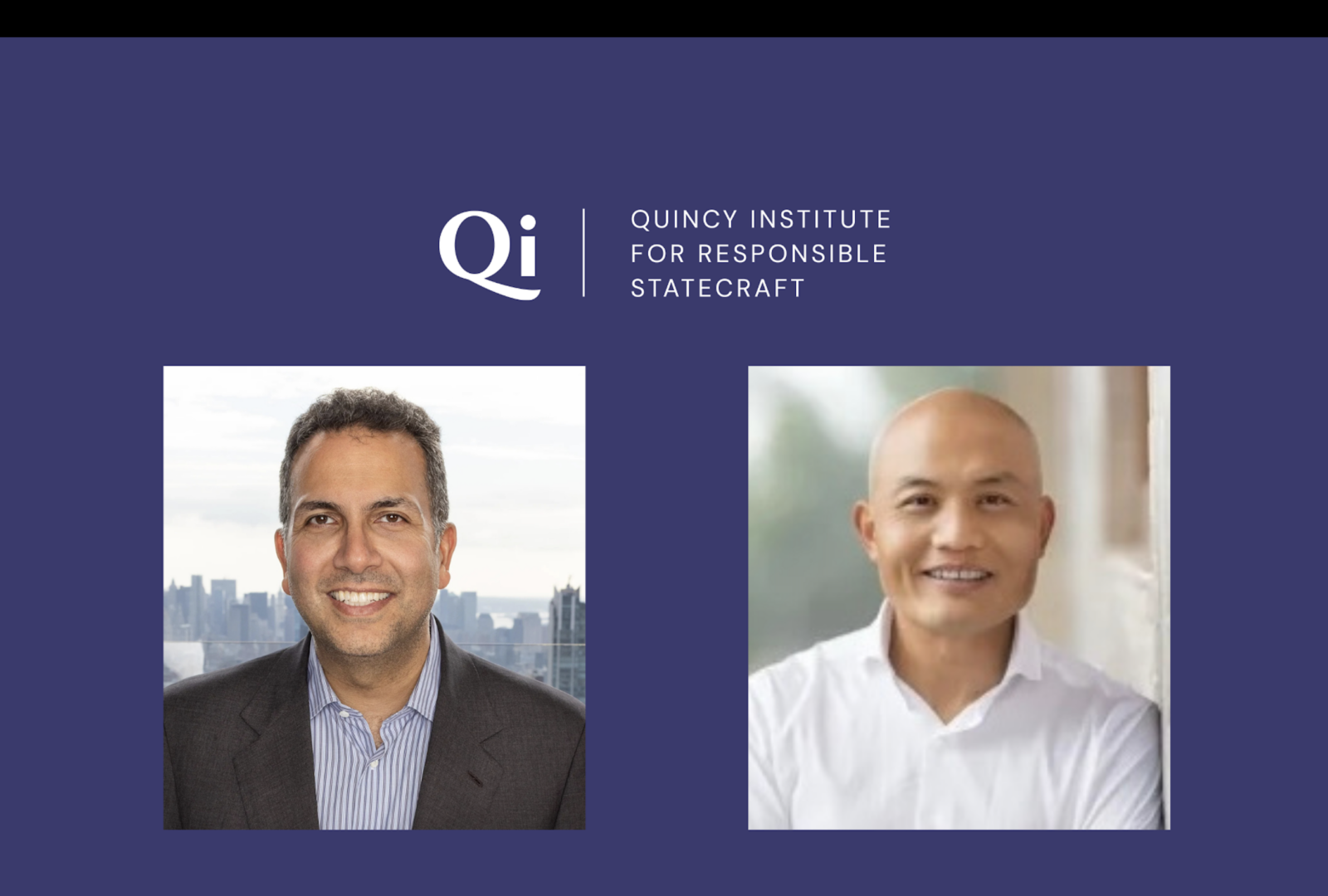
Quincy Institute Adds Two Accomplished Businessmen-Philanthropists to Its Governing Board
FOR IMMEDIATE RELEASE
CONTACT: Jessica Rosenblum, [email protected]
WASHINGTON, DC — The Quincy Institute is pleased to announce the appointment of Zhengyu Huang and Amir Handjani to its governing board.
“Amir and Zhengyu bring years of philanthropic and business experience and an acute understanding of the multipolar global landscape”, said Quincy Institute chairman Stephen Heintz. “Their perspectives will be vital as QI continues to advance solutions towards peaceful great power co-existence”.
Amir Handjani is a partner at Karv Global, a strategic communications firm with a focus on corporate communications, crisis management, and public affairs. He previously served as a non-resident fellow at the Quincy Institute. Handjani was a founder, general counsel, and a board member of RAK Petroleum PCL, playing a key role in corporate governance and international transactions. His expertise in US foreign policy, economic sanctions, and diplomatic engagement has been featured in Reuters, Bloomberg, Foreign Affairs, Foreign Policy, Responsible Statecraft, and CNBC.
Zhengyu “Z” Huang is the chairman of Yu Capital, an education-focused investment firm. He has spent his professional career working in both the United States and China, giving him a unique perspective on the globalization of business, finance, and technology. Prior to founding Yu Capital, Huang served as President of the Committee of 100 (C100)—a nonprofit organization of prominent Chinese Americans—from 2021 to 2024. There he led their effort to advance Chinese American inclusion and civil rights in the United States and promote a more productive US–China relationship. He is the author of five books, including most recently Rethinking China, published by Palgrave in March 2026.
“We are honored and excited to have Amir and Z on our governing board; they are experienced international professionals whose life-long commitment to cooperative co-existence aligns with QI’s mission and purpose”, said Quincy Institute CEO Lora Lumpe.