
A New Government in Israel: What the Future Might Hold
Executive Summary
Washington is waiting out Israeli Prime Minister Benjamin Netanyahu. The implicit assumption is that he alone is responsible for policy differences between the United States and Israel. A new government under former Prime Minister Naftali Bennett or former army chief of staff Gadi Eisenkot would set things right and revive Israel’s reputation in American public opinion. It is a comfortable assumption — but also a deep misreading of what has gone wrong and what fixing it requires.
The crisis in US–Israel relations does not originate solely with Netanyahu or his partners. It comes from policies with broad Israeli backing that his successors would likely continue, whatever personal reservations they might harbor. Bennett supports building in the E1 corridor, which would sever the northern West Bank from the southern and make a Palestinian state deeply impractical. Eisenkot has recently said that to do so would be “a mistake” but without pledging to drop it.
On the Gaza Strip, a new cabinet would likely oppose renewed Jewish settlement in the enclave but still leave governance bound to President Donald Trump’s peace plan through 2027, as the Board of Peace slips and reconstruction shrinks to a pilot program in Rafah.
On Iran, there is a strong Israeli consensus to continue to confront Tehran. Divisions are about competence and alliance management, not core strategies.
Settler violence in the West Bank is where a new government would move fastest, but the ceiling is low. Removing Finance Minister Bezalel Smotrich and National Security Minister Itamar Ben-Gvir would reduce state cover for extremist networks and lax enforcement. But today only three percent of cases against Israeli settler violence end in conviction; a situation that Bennett or Eisenkot could remedy.
The sharpest measure is the benchmark of normalization with Arab states. Saudi Arabia’s threshold for normalization is a “clear and irreversible path” toward Palestinian statehood. Bennett and Eisenkot oppose statehood. Eisenkot wants to keep the Jordan Valley and every settlement bloc under Israeli control. Neither reaches the Saudi threshold.
American public opinion is further out of reach. Gallup shows sympathy for Israel over Palestinians has flipped for the first time since 2001: 60 percent of Americans view Israel unfavorably. Pollsters call the shift structural, having accumulated over years of war rather than in response to any one leader. A friendlier face in Jerusalem will not reverse a long-term trend accelerated by the Gaza death toll, West Bank violence, and war with Iran.
None of this makes Bennett or Eisenkot another Netanyahu. Either of the former would be easier to work with, more predictable, and less inclined to meddle in American politics. That is worth something. However, it is not a reset. Policies serving American interests in peace and stability in the region will still need to be at the center of bilateral diplomacy.
Israeli Elections: Old Wine in New Bottles?
Does it make a difference to US interests who wins this October’s election for the Israeli parliament, the Knesset? There is a view that the US–Israel relationship would improve if the election produces a new government. This reflects the view of experienced hands as well, who anticipate that a new government will either introduce policy changes that bring the United States and Israel into closer alignment or that Prime Minister Benjamin Netanyahu’s anticipated departure would change the mood of the relationship such that Israel’s policy choices, where they conflict with American preferences, will not generate the heat they do now. The following analysis primarily addresses the first of these assumptions, namely, if the winning coalition in the upcoming election will make meaningful changes to the foreign and security policies pursued by successive Netanyahu–led governments. The question of whether a post-election mood swing will take the sting out of a new government’s continuation of Netanyahu–era policies cannot be determined just yet, but the answer will likely be painted in some shade of “no.”
After a brief discussion of the political state of play, this brief analyzes the likely shifts (or lack thereof) that are likely to occur in Israeli policies across crucial areas under a new government. It then concludes with a short discussion of implications for US policymakers and for the likelihood of expanding the Abraham Accords through rapprochement between Israel and Saudi Arabia. The areas covered include the Gaza Strip, settlement policy on the West Bank, and the conflicts in Lebanon and Iran. Relations between Israel and the post–Assad government in Syria are not covered due to space constraints, although they also have significant implications for US interests.
The Political State of Play
As of mid–July polling, no single “center coalition” exists yet: Former Prime Minister Naftali Bennett’s Together alliance, which includes Opposition Chair Yair Lapid, and former army chief of staff Gadi Eisenkot’s Yashar are rivals for the same anti–Netanyahu space. Any government — whether led by Bennett, Lapid, Netanyahu, or someone else — would be assembled only after the Oct. 27 vote and what would likely be weeks of coalition talks that would follow it. Under Israeli law, the ceremonial president (currently Isaac Herzog) has up to 7 days after results are certified to task someone — traditionally, a party leader — with forming a government coalition. That person then gets 28 days, with an optional 14–day extension, and, if that fails, a second candidate or the Knesset itself gets more time. In practice, recent governments have taken four to eight weeks to form, even given less complex arithmetic than this bloc faces. A realistic inauguration date for any new government, therefore, would be December at the earliest, quite possibly later, and every postulated time frame for government formation that follows should be measured against that starting point.
Assuming Netanyahu is defeated and the current opposition emerges triumphant, the likely cast of ministers remains fluid. Lapid sits with Bennett, while Eisenkot has courted former Deputy Prime Minister Avigdor Liberman of the Yisrael Beytenu party and former Deputy Economy Minister Yair Golan of the center-left Democrats. Finance Minister Bezalel Smotrich has warned his supporters on the right that “Yair Golan will be the defense minister in an Eisenkot government,” a claim Eisenkot has not denied, though he has objected to Smotrich’s framing of it as a route to Palestinian statehood.1Former Alternate Prime Minister Benny Gantz’s Blue and White party is currently polling below the electoral threshold for representation in the Knesset and may not factor in at all. Moreover, the possibility of Netanyahu’s Likud party being able to form another right-wing or right-of-center government cannot be ruled out. The old saying that “Israelis are scrupulously honest with pollsters, but when they enter the voting booth they lie like Hell” reflects the reality of consequential elections in the past, especially in 2015, 2019, and 2022.2Compounding these uncertainties, the security situation in Iran and, to a lesser extent, in Syria and Lebanon, is currently in flux. The Iran war restarted this July, so whatever government eventually takes office will likely inherit the current state of that conflict, not the quieter status quo that seemed to be emerging earlier in the summer.
The Key Issues
A range of policy issues has divided the Israeli and US governments and public opinion in both countries. Some of these issues are relatively new or have drawn renewed attention, such as the future of Gaza, which emerged only in the wake of the Israeli response to the Hamas assault of Oct. 7, 2023. Others have longer histories, especially those pertaining to the West Bank, Lebanon, and, of course, Iran. The ongoing war in the Persian Gulf has both elevated and combined this wide range of issues into a unified challenge to the US–Israel relationship.
In assessing the prospects for new Israeli policies, one might usefully bear in mind that a new government will face tangible constraints. Either Bennett or Eisenkot — or both, if they should have to combine forces to form a government — will face a highly motivated opposition that will retain strong support from a right-leaning and diverse constituent base. Whatever departures from existing policy they desire, those forming a post–Netanyahu government will be under constant, fierce attack by those seeking to undermine their base of support. Post–Oct. 7 angst will be revived and intensified by the commission of inquiry that a new government would almost certainly set in motion. Any new Israeli government would also be hostage, to some extent, to the plans of the country’s adversaries and potential allies, including the Palestinian Authority, or PA, and Hamas in the Gaza context; Tehran in the case of Lebanon and Iran itself; and, with respect to Syria, Turkey’s desire to force Israeli forces out of Suwayda. The Trump administration’s stance will be a factor as well, whether it is focused on shaping outcomes by pushing Israel to depart from Netanyahu–era policies or is simply indifferent. Thus far, the United States has criticized Israel in some instances, while turning a blind eye in others. Furthermore, the conservative orientation of a post–Netanyahu government’s expected leader, whether Bennett or Eisenkot, and their need to demonstrate toughness and determination in the face of rightwing efforts to paint them as weak liberals who will expose Israel to severe security risks, will constrain their ability to change the basic direction of Israel’s foreign and defense policy.
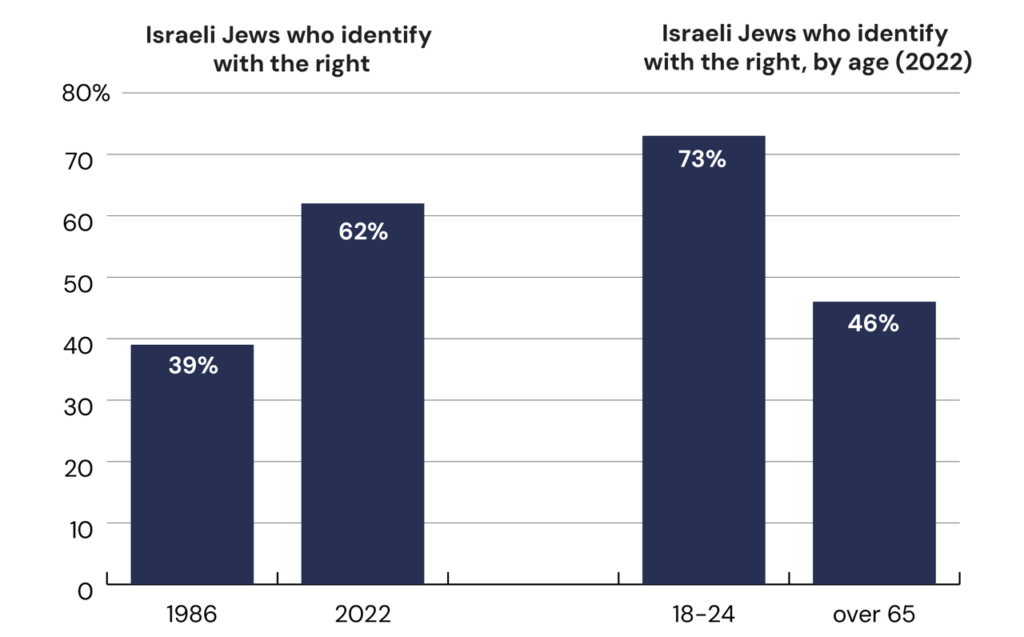
This conservative impulse is virtually structural. Sudden, wide swings in Israeli opinion do have precedents (e.g., after Egyptian President Anwar al-Sadat’s visit in 1977 or in the era of the 1993 Oslo Peace Agreement) but have historically been driven by shifts in perceived security outcomes, not diplomatic or economic incentives, and both ended up unwinding within a few years. The rightward trend in Israeli society is stark and generationally entrenched: 39 percent of Israeli Jews identified with the right in 1986, which had mushroomed to 62 percent by 2022, the year of the most recent Knesset election.3The demographic breakdown of a survey in the latter year confirms that the trend is not going to be reversed soon: 73 percent of Israeli Jews aged 18–24 identify with the right versus 46 percent of those over 65.4This is more than a mood swing. “Economic peace” as a substitute for political settlement was already tried once, circa 2009, with a poor track record, and the live test case, former Congressman Rahm Emanuel’s July 2026 Tel Aviv speech pitching an economic corridor for concessions, was received by the Israeli right as pressure to resist, not an incentive to embrace.5
Figure 1: The rightward trend in Israeli society
With these things in mind, this policy brief will take each of the key issues in turn, place them in their historical context, assess the likelihood that a new government will change the relevant Israeli policy, and, to the extent change is in the cards, how it might be realized.
Gaza governance
Gaza’s current governance track dates to the ceasefire and hostage-release framework that was built around US President Donald Trump’s 20–point plan and formalized through United Nations Security Council Resolution 2803 last November. That resolution authorized an international “Board of Peace,” chaired by Trump and including figures such as former British Prime Minister Tony Blair, with a mandate that runs to Dec. 31, 2027, pending renewal. Under it, a National Committee for the Administration of Gaza, or NCAG, is being backstopped by an International Stabilization Force, or ISF, under US Major General Jasper Jeffers.6Hamas formally dissolved its own governing apparatus in early July 2026, which cleared the way for the handover.7In practice, however, the Board of Peace has had what reporting describes as a “rocky first six months.” Members reportedly convened at a Cyprus resort earlier this year to “recalibrate,” and the reconstruction effort has already been scaled back from a Gaza Strip–wide undertaking to a limited pilot project focused on Rafah.8
Governance in Gaza is the single issue that, for Israelis, will determine whether more than two years of war produce a durable outcome or a reset to the prewar status quo under a different label. It is also the fulcrum for almost everything else in this analysis; since Gaza governance is the most visible test of whether Palestinian self-administration can work at all, it is the precondition that the international community and reconstruction donors have set for funding. Furthermore, as the concluding section discusses, Gaza governance is functionally inseparable from the question of Palestinian statehood, which Saudi Arabia has upheld as a precondition for normalizing relations with Israel.
Eisenkot has articulated the most fully worked-out position on Gaza, one that pairs a long-term ceasefire and full hostage return with dismantling Hamas’s military capability, Israel retaining “security responsibility,” and reconstruction efforts, including the building of a new seaport, which would be initiated only once those conditions are met. He has explicitly ruled out any return of Jewish settlement to Gaza, attacking Israeli politicians who attended a resettlement conference as having “learned nothing” from the war.9This position maps reasonably well onto the NCAG, Board of Peace, and ISF architecture that is already in place.
Continuity, not transformation, will be the likely result. A Bennett/Eisenkot government would very likely keep Israeli security vetoes, buffer zones, and demilitarization conditions in place indefinitely, since none of the likely coalition partners are pushing to hand Gaza to the PA on any accelerated timeline. Smotrich’s line of attack against a prospective Eisenkot–Golan government, that “Palestinian autonomy will be established that will lead to the establishment of a Palestinian state,” has tenuous connection with any stated Eisenkot policy and, in any case, runs counter to the former general’s explicit instincts.10
The mechanics here are almost entirely executive, running through the decisions of Israel’s security cabinet and the posture of the Southern Command of the Israel Defense Forces, or IDF, which plug into a US– and UN–brokered international structure via military and diplomatic channels rather than anything Jerusalem can unilaterally redesign. The one lever a new government could pull unilaterally is a cabinet decision formally barring renewed Jewish settlement inside Gaza, which would codify what Eisenkot has already said informally.11
Given that the Board of Peace is already behind its own schedule and that a new Israeli government likely will not exist before December, the realistic, best case is stabilization of the current framework through 2027, not an acceleration of it. Gaza governance should still be substantially unresolved — with reconstruction still at pilot scale, PA reform still incomplete, and the ISF still developing capacity — for the whole of a new Israeli coalition’s first year. This would conform to the Board of Peace’s own late–2027 mandate horizon rather than any faster timeline that a new Israeli government could impose on its own.12In the meantime, Israel is constructing an enormous berm along the length of the Yellow Line, the limit that Israel agreed to withdraw its forces to in the Oct. 2025 ceasefire. This construction is an investment that signals Israel’s current (and, presumably, post-election) determination to occupy half of Gaza’s surface area over the long term or until Hamas is out of the picture and Gaza is pacified.13International interest, in any case, has faded with the end of major combat operations, the decline in allegations of deliberate starvation, and the spreading of war to Lebanon and the Persian Gulf. Whether Trump’s July 30 announcement of a “historic” Israel–Hamas agreement regarding Hamas’s disarmament and Israeli withdrawal alters this reality remains to be seen, but neither party has confirmed the substance of the US claim.14
The E1 Corridor
The E1 zone, roughly 12 square kilometers (5 square miles) of hilly land in the West Bank between the expanded boundaries of Jerusalem and the Ma’ale Adumim settlement bloc, has been contested since the Oslo era of the 1990s. Every Israeli government since has considered building there and, until recently, every US administration (even that of the first Trump term) objected, because a built-up E1 would physically sever the northern West Bank, including the Ramallah area, from the southern parts of the territory, including the cities of Bethlehem and Hebron. Bisecting the West Bank would make a geographically viable Palestinian state very difficult to construct. A seminal 2007 study by the RAND Corporation showed that territorial contiguity in the West Bank is essential to the Palestinian state’s viability.15Israel understands this as well. As defense minister in 2020, Bennett ordered the paving of what was described as a “sovereignty road” to specifically enable “uninhibited E1 construction.”16That project cleared its final planning hurdle in 2025, when the Civil Administration’s Higher Planning Council approved roughly 3,412 housing units, and the US State Department itself has since backed E1 as “essential to Israel’s stability and regional peace,” breaking with three decades of consistent US objection across both parties.17
E1 is widely regarded by Palestinian statehood planners as the single most consequential settlement project in the West Bank, precisely because of its location. The construction of Israeli settlements on this patch of land would, as a practical matter, make a unitary Palestinian state a geographical impossibility and thus a political one. That is also why the 2025–26 US reversal on E1 was treated as such a significant break from prior American policy.
As of late August 2026, some daylight exists among the likely post–Netanyahu coalition partners on this question. Bennett’s own 2026 framework, in which “Area C will be part of the State of Israel,” referring to areas of the West Bank still under full Israeli control per the Oslo Accords, puts E1 squarely on the “keep and build” side of his ledger.18This objective would be accomplished through administrative processes rather than legislation, moving through the Civil Administration’s Higher Planning Council, a Defense Ministry body, and Housing Ministry construction tenders. Eisenkot, however, has criticized the government’s decision to proceed with construction in E1, saying that building there is not appropriate “at this time” and calling it “a mistake that comes at an international cost.”19
This is one of the fastest moving items on the list but its trajectory now depends on who leads the next government. Still, because the last planning hurdles have already been cleared, construction tenders issued, and Washington’s position shifted in favor, visible construction progress could still appear within the first year of a new government.20
Settler violence
Settler violence against Palestinians on the West Bank has been documented for decades, but it has escalated sharply since the Oct. 7, 2023 attack and again after the Iran war reopened in early 2026, as security forces were pulled toward the northern and Iranian fronts. IDF sources have said openly that political and religious pressure, not a lack of operational capacity, is what currently limits enforcement against more radical settler “hilltop youth” and organized outpost networks.21The scale is now large enough to draw outside intervention. This year, six countries have already sanctioned networks that enable settler violence, and Amnesty International’s June 2026 report describes specific patterns of Israeli action directed against Palestinian Bedouin and herding communities in terms of ethnic cleansing.22UN–cited figures indicate that settler attacks and demolitions have displaced more than 3,200 Palestinians this year alone, roughly 17 people per day and about double the prior three-year average, with at least six Palestinians killed by settlers since the Iran war began at the end of February.23
For Israel, this is simultaneously a legal and reputational liability, since it exposes the country to investigation and possible prosecution at the International Criminal Court and in allied capitals, as well as a strategic one, because it fuels Palestinian radicalization and undercuts security cooperation. Furthermore, settler violence is a direct irritant in exactly the relationships that a new Israeli coalition would most want to repair, with Washington and the Gulf Arab states. It is also one of the few items on this list where meaningful administrative action is already technically possible without new legislation, which makes the gap between rhetoric and results especially visible.
Once the leader of the Yesha Council, the largest West Bank settlement organization, Bennett has condemned Jewish extremists in blunt terms this March, saying “we did not establish a Jewish state so that violent gangs would operate within it,” and he has demanded that the government “let the IDF and police work” to quash their activities.24Meanwhile, in April, Eisenkot visited Shuvael, an illegal settlement outpost (i.e., unauthorized per Israeli law; all West Bank settlements are considered against international law) where an Israeli lawyer was beaten, which signaled a willingness to engage with these settler elements directly.25Regardless of who gains power in Jerusalem later this year, this spring already saw a shift of primary enforcement in the settlements from the IDF, whose soldiers are not trained or authorized to arrest Israeli civilians, to the Border Police, with the IDF’s Central Command retaining overall authority.26
The anticipated departure of Smotrich and National Security Minister Itamar Ben-Gvir from government would remove a large share of the settlers’ political cover, which IDF sources blame for nonenforcement, so some improvement is plausible. Yet neither Bennett nor Eisenkot opposes the settlement enterprise as such. Israeli reporting describes Eisenkot as holding “great appreciation for settlers, the values that guide them, [and] their high rate of IDF enlistment,” and Haaretz commentary has pointedly asked when, if ever, he has condemned settler terrorism by name.27The structural numbers are stark, since only about 3 percent of ideologically motivated criminal charges against Israelis in the West Bank currently end in full or partial conviction, and the frequency of attacks by June 2026 was already running about 30 percent above the same period last year.28
The recent handoff of jurisdiction and enforcement responsibility to the Border Police is an executive reorganization rather than legislation, and a new government could deepen it immediately. Improving prosecution rates requires the State Attorney’s Office to commit resources and the Civil Administration to follow through on demolition and eviction orders, administrative and budgetary levers that lie within cabinet control but that have historically depended on political will that has been inconsistent even among centrist figures.29
Visible, quick wins are realistic within months of taking office. A new government could launch more prosecutions and formally expand the jurisdiction of Border Police very quickly. Nonetheless, boosting the 3–percent conviction rate, let alone separating a new coalition’s own electoral base from the outpost networks it (likely) historically tolerated, is a different undertaking altogether. It would entail a multiyear judicial and cultural project that is very unlikely to show large results within a single government term.
The settlement enterprise
West Bank settlement approvals and outpost legalization have accelerated dramatically under the current government. A record 34 new settlements were formally approved in March, thousands of housing units have advanced weekly through the Higher Planning Council, and “Settlement Administration” authority was moved from the Defense Ministry into Smotrich’s Finance Ministry as part of the 2022–23 coalition agreements.30A Feb. 2026 land registration program, which converts surveyed land into “state land,” eligible for building permits, was hailed by the Yesha Council as “the most important decision in 58 years” and denounced by eight Muslim–majority states as de facto annexation.31
This is the underlying material structure of every diplomatic conversation about Palestinian self-governance, since Israeli settlement policy determines whether any future two-state arrangement will be geographically viable. It is also, as the concluding section lays out, functionally the same issue that Saudi Arabia has maintained as its own threshold condition for normalizing relations with Israel, which arguably makes this the highest-leverage item on the entire list, even though it is discussed within Israel as a West Bank planning question.
Bennett has staked out the clearest framework and the one that is the most controversial for the Israeli right. Bennett’s plan envisages the continuation of authorized settlement in Area C, which would ultimately be annexed to Israel, but also the evacuation of “illegal construction” and outposts on Palestinian land or inside Areas A and B (i.e., those parts of the West Bank under direct PA rule and under PA civil rule with joint Israeli–Palestinian security, respectively), because, as he put it, “ultimately … Areas A and B will be part of the Palestinian autonomy.”32Asked directly in June whether this would mean forcible evacuation of Israeli settlers from those areas, he said, “Of course.”33Eisenkot’s version is, by comparison, vague and possibly narrower in some respects, encompassing settlement “in line with Israel’s interests,” retention of the Jordan Valley and existing settlement blocs, explicit opposition to Smotrich’s “aggressive” expansion strategy, and a stated wish to see Ben-Gvir out of politics altogether.*34
At this stage, a post–Netanyahu government’s approach is too hard to pin down, but growth inside existing blocs and Area C will very likely continue uninterrupted, since both prospective leaders support it. However, the growth of Israeli presence in and possible annexation of Area C would undermine the contiguity of a Palestinian state on the West Bank, disrupting economic activity in a way that would likely eliminate the viability of Palestinian statehood.
On the other hand, the machinery that has driven the post–2023 acceleration of the settlements — including the record number of outpost legalizations, the weekly Higher Planning Council pipeline, and the Feb. 2026 land registration program — is due to Smotrich, whom Eisenkot has ruled out as a coalition partner.35As such, it would likely slow sharply or stop. Bennett’s outpost evacuation idea serves as something of a preview of the coalition fight likely to come. Smotrich has accused the former prime minister of planning to “establish a terror state in the heart of the country” and a local settler leader called the remark evidence that Bennett is “on the far left,” a sign that any actual evacuation attempt would be fought hard, not only on the Knesset floor but on West Bank ground.36
There is an administrative pathway to a change in policy. Continued Area C construction runs through the same Civil Administration and Higher Planning Council process as E1. Evacuating illegal outposts is legally straightforward, since these shantytowns are already against Israeli law, but implementation requires Civil Administration demolition orders backed by police enforcement against resistant settlers, and it is often litigated at the High Court of Justice by both sides. Moving Settlement Administration authority back under Defense Ministry oversight involves a cabinet-level, coalition-agreement decision rather than new legislation, but it is politically loaded and therefore likely to be an early flashpoint in coalition talks.
The Smotrich–era settlement acceleration machine will likely grind to a halt with the electoral defeat of the government in which he is a minister and the shift in authority over Settlement Administration to his replacement. Actually reversing legalized outposts or evacuating farming or other installations in Areas A and B is a different order of difficulty, since it would be litigated and physically resisted, and there is no timeline for it even in Bennett’s own public statements.37Realistically, this is, at best, a multiyear project that a potential Bennett/Eisenkot government would only begin, not complete. Such a project could just as easily stall entirely once it meets organized resistance from the settler movement and even, as is likely, from within the new coalition itself.
Lebanon
The current phase of the conflict in Lebanon traces back through Operation Northern Arrows in Sept. 2024 and the resumption of fighting this March to the framework agreement of June 26, 2026, which stipulated a phased IDF withdrawal from “pilot zones” in southern Lebanon, with Israeli troops being replaced by the Lebanese Armed Forces, or LAF, and tied to verified Hezbollah disarmament.38This year, the US military has credited the LAF with gaining, for the first time in roughly 40 years, real operational control south of the Litani River, with more than 9,000 soldiers being deployed.39But the LAF also had to request four-to-eight-month extensions in February just to complete the second of four phases, and Hezbollah Secretary–General Naim Qassem has flatly rejected the disarmament linkage as “null and void,” vowing that the group will not disarm.40
Lebanon is Israel’s most operationally active front, and Hezbollah remains Iran’s most significant regional proxy, so the trajectory here shapes Israel’s entire two-front calculus with Iran. A genuinely disarmed, stable south Lebanon is the explicit precondition that Israel has set for a lasting drawdown of its own forces there.
Under a potential post–Netanyahu government, Israel could build on the existing “pilot zone” framework, using the Lebanese government’s own stated desire for a permanent no-war arrangement. This June, veteran Israeli military commentator Ron Ben-Yishai laid out a widely circulated framework that reflects establishment security thinking rather than any one party’s line, though it corresponds to Eisenkot’s position.41Ben-Yishai warned against confronting Trump directly but recommended using the IDF’s working relationship with US Central Command to press Washington, through Secretary of State Marco Rubio and Secretary of Defense Pete Hegseth, to compel Iran to rein in Hezbollah. Ben-Yishai would offer a public explanation of why a phased withdrawal serves Israel’s security requirements while persuading the United States, Saudi Arabia, the United Arab Emirates, and France to rapidly reinforce the LAF so that it can actually hold ground vacated by the IDF.42
If this aspirational program is embraced by a new Israeli government, any results will be slow, contested, and incomplete. The LAF itself undercut the deal’s optics by saying that it already patrols the “pilot zones,” which means the IDF is not really withdrawing from anywhere it was not already absent, and Israel was reportedly intensifying strikes inside the area even as talks continued in Rome in mid–July.43Given Eisenkot’s repeated complaint that “a pattern is developing where a ceasefire is imposed on us” in virtually every theater of Israeli operations, a centrist-led government should be expected to continue to reserve the right to strike Hezbollah reconstitution efforts regardless of the framework agreement’s formal status.44The fundamental challenge is that neither Iran nor Israel believes its interests are served by the agreement, and outside powers, especially the United States, lack the focus, interest, and resolve to provide the resources and support required by the Lebanese government to play its role or to apply diplomatic incentives on Iran and Israel to secure their cooperation.
If these conditions were to shift, Israel’s compliance would necessitate only security cabinet decisions and IDF Northern Command orders, implemented through the US–mediated trilateral mechanism with Lebanon and international monitors. No Knesset legislation would be involved. The obstacles are thus substantive, rather than procedural.
Given the LAF’s own timeline slippage, which has already required extensions just to finish phase two of four, a realistic forecast would anticipate the completion of only phase one, south of the Litani, by the time a new Israeli government takes office, while phases two through four, which cover Hezbollah’s political and social heartland in Beirut’s southern suburbs and the Beqaa Valley, will remain unresolved for years rather than months.45A new governing coalition in Jerusalem would likely inherit essentially the same partial, contested status quo that exists today, with full disarmament not being achieved before 2028 even in a best-case scenario.46
Iran
The war that reignited in Feb. 2026 produced, on June 17, the Islamabad Memorandum of Understanding between the US and Iranian presidents, a 60-day framework that reaffirmed Iran would downgrade its enriched uranium stockpile and not pursue nuclear weapons, against the backdrop of the Aug. 2025 reimposition of UN sanctions by the EU three, or E3 — France, Germany, and Italy — through the snapback mechanism of the 2015 Iran nuclear deal.47The memorandum lasted barely three weeks. On July 8, Trump declared the ceasefire “over” and dismissed talks as “a waste of time” after renewed Iranian attacks on shipping in the Strait of Hormuz.48
Iran’s nuclear and missile programs are the one issue on which the mainstream Israeli political spectrum, from Eisenkot to Netanyahu, is most unified. It is also the issue most likely to draw the United States directly into a wider regional war. From Israel’s perspective, it is perhaps the issue most subject to factors outside any Israeli government’s control, including Iranian regime decisions, US domestic politics, and Gulf state reactions.
Both Bennett and Eisenkot have already articulated their respective doctrines. Eisenkot wants any future ceasefire to “come from a position of strength and from an Israeli decision … in order to serve the negotiations” rather than one that is “imposed,” and he has called Israel’s dependence on the United States’ sign-off for military action as “humiliating.”49Meanwhile, Bennett has faulted the current government for having “prepared no military plan against Iran” and for building policy entirely “on a president who currently supports Israel.”50What this means is hard to say, and it would be unsurprising if Bennett or Eisenkot had little notion of what they would do vis-à-vis Iran, given Israel’s apparent lack of autonomy and the United States’ incoherent policy-making process.
Whatever a post–Netanyahu government might inherit, it will not be a blank slate. Nothing suggests that any plausible Israeli coalition would pursue de-escalation with Iran as a matter of principle. The argument between the camps is about competence and alliance management, not about whether to confront Iran. Since March, Eisenkot has been on record as supporting direct action inside Iran to neutralize its nuclear, missile, and proxy capabilities but opposing making regime change a military objective, arguing that airpower could not reliably deliver it.51In contrast, Bennett’s “Octopus Doctrine,” dating back to 2018, holds that Israel should attack Iran, the head of a metaphorical mollusk, rather than continually fighting its expendable proxies, or “tentacles,” across the region. It therefore makes direct action inside Iran, including long-range strikes, sabotage, cyber operations, and targeted killings, central to Israeli strategy. Bennett explicitly endorsed pursuing regime change through sustained military, economic, diplomatic, covert, and informational pressure combined with support for internal opposition.52This distinguishes him from Eisenkot, who accepts direct strikes against concrete Iranian threats but rejects overthrowing the regime as a practicable military objective.
Regardless of its composition, any new Israeli government would manage its Iran policy through an entirely executive process, resting on the prime minister’s and security cabinet’s existing authority to authorize military action, IDF General Staff planning, and direct coordination with US Central Command. No Knesset legislative process governs strike decisions. The one lever specific to a change of government is relationship management with the White House, rebuilding trust with the Trump administration (something that Eisenkot in particular has acknowledged he currently lacks), which is a diplomatic project rather than a legal one.53
A post–Netanyahu government’s posture toward Iran remains, for the moment, unpredictable, almost by definition. A new government’s “success” on Iran will be judged less by anything it does than by what state the conflict happens to be in when it takes office, in December or later, ranging anywhere from a decisively degraded Iranian nuclear program to a grinding, unresolved war. No realistic Israeli governing coalition, including a centrist one, is likely to abandon direct pressure on Iran and return to a policy based solely on containing it. Consequently, Iran policy is one area in which a centrist government may not look very different from the incumbent right-wing administration.
Does any of this change US opinion or Saudi Arabia’s calculus?
US public opinion
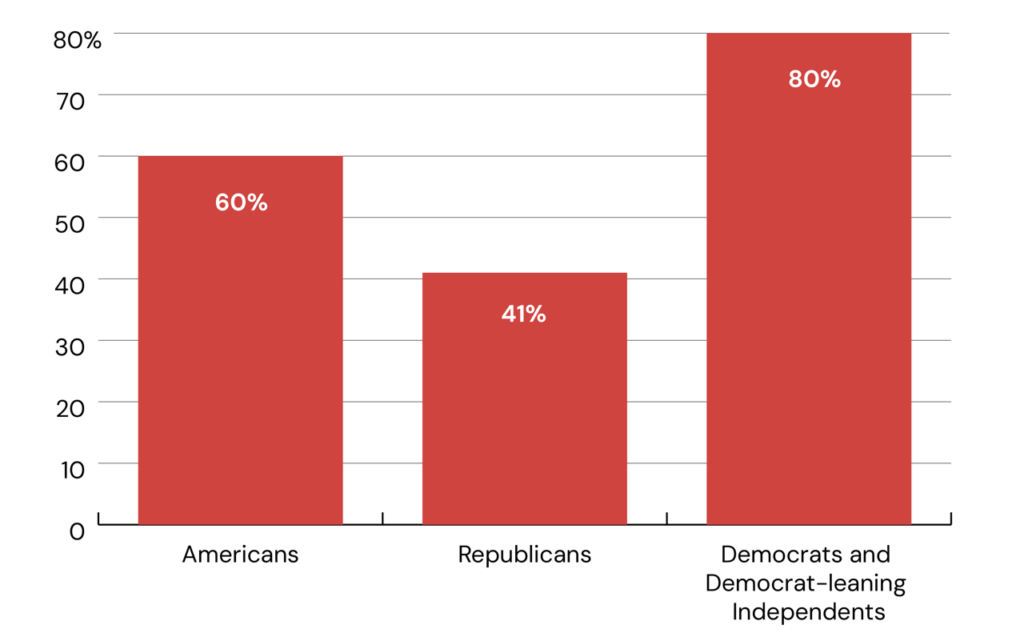
The backdrop here is a genuinely historic shift, not a partisan blip. This February, before the resumption of the war with Iran, for the first time since Gallup began asking the question in 2001, Americans no longer sympathize more with Israelis than with Palestinians: 41 percent now say they sympathize more with Palestinians, against 36 percent for Israelis.54This came months after Gallup had already found approval of Israel’s military conduct in Gaza had reached a new low: 32 percent.55The Pew Research Center’s March 2026 survey found that 60 percent of Americans hold an unfavorable view of Israel, including 41 percent of Republicans, which represents a genuine crack in what had been the most reliably pro–Israel American constituency.56The same survey found that 80 percent of Democrats and Democratic–leaning independents view Israel negatively, up sharply from 69 percent in 2025 and 53 percent three years before that.57The generational gap is stark. In a May 2026 survey, Pew found Americans under 30 were more than twice as likely to view Palestinians favorably, at 58 percent, as they are to view Israelis favorably, at 32 percent.58This is no longer just an attitudinal shift, since, in April 2026, all but seven members of the Senate’s Democratic caucus backed at least one resolution to block a US arms sale to Israel, a vote widely covered as showing “massive cracks” in the traditional bipartisan consensus on military aid.59
Figure 2: Percentage of Americans with unfavorable views of Israel, 2026
Set against the prognosis above, it is fair to say that a Bennett/Eisenkot government could shift tone and elite narrative quickly. A personnel change away from Netanyahu, Smotrich, and Ben-Gvir would itself be newsworthy, and visible condemnations of settler violence or a more conciliatory posture toward Lebanon would likely register favorably in coverage. The material facts that pollsters identify as actually driving the shift in US opinion toward Israel, however — including the human and physical toll of the Gaza war, continued West Bank settlement and outpost expansion, and repeated rounds of fighting in Lebanon and against Iran — are unlikely to change substantially within the first year of any new government, as the analysis above shows. At best, Gaza governance stays in pilot-project mode through 2027, the settlement machinery slowdown is measurable but partial, Lebanon and Syria stay frozen, and Iran is being driven by events that no Israeli government controls. Pew and Gallup researchers describe the shift among Democrats and young adults as structural, accumulated over the multiyear course of the war, rather than a reaction to any single leader, which means it is unlikely to reverse quickly even under a different Israeli government.60The most plausible near-term effect of a coalition change would be a modest improvement in elite perceptions and media tone, since removing Netanyahu’s self-presentation and strident assertions regarding Israel’s objectives and its adversaries (perceived and actual within the region and within both American and Israeli society) have themselves soured public opinion and since Arab leaders have claimed the Israeli prime minister is “an obstacle to regional peace.”61
Saudi Arabia
Diplomatic normalization between Saudi Arabia and Israel has been a longtime goal of US policy, pursued by both the Biden and Trump administrations. Most recently, President Trump added a condition to the US–Saudi 123 Agreement, stating the nuclear deal would be null and void without normalization with Israel.62However, Riyadh’s position has been unambiguous, with Crown Prince Mohammed bin Salman telling the Shura Council in Sept. 2024 that “[t]he kingdom will not stop its tireless work towards the establishment of an independent Palestinian state with East Jerusalem as its capital … [and] will not establish diplomatic relations with Israel without that.”63Saudi officials restated this in 2026 in slightly broader terms, requiring both an end to Israeli military operations in Gaza and a “clear and irreversible path” to Palestinian statehood, with any resumption of the normalization track being “contingent on developments in the Palestinian arena, as well as on shifts in the regional balance of power and in perceptions of Israel,” giving Riyadh maximum flexibility to say no.64
Little if anything that a Bennett/Eisenkot government could realistically achieve would clear that bar. Continued Israeli security control over Gaza — even if framed, as Eisenkot does, as conditional and responsible rather than open ended — is not an end to Israeli military operations there, as Riyadh has demanded. A slowdown in Smotrich–era outpost legalization is a marginal, reversible administrative change rather than a path to statehood. Meanwhile, E1 construction, which will continue regardless of the coalition in power in Jerusalem, moves in exactly the opposite direction from what Riyadh is asking for. Bennett’s own repeated formulation, that “I am against a Palestinian state, against giving away territory … period,” is arguably a bigger obstacle to the stated Saudi threshold than Netanyahu’s position.65Of the likely next prime ministers in Israel, Eisenkot is alone in even nominally endorsing a two-state-shaped outcome, and even his version explicitly keeps the Jordan Valley and the settlement blocs in Israeli hands, well short of what Saudi Arabia has specified.
The realistic conclusion is that nothing in a new Israeli coalition’s plausible policy program meets Saudi Arabia’s stated threshold, and nothing indicates that either Bennett or Eisenkot intends to try. The more plausible path back to Saudi engagement, if one exists on any foreseeable timeline, runs through developments largely outside the Israeli government’s control. These would either be an internationally verified handover of Gaza to the PA, which is nominally on the Board of Peace’s own schedule for Dec. 2027 but already behind pace and scaled back to a pilot project, or a separate US–brokered package that offers Saudi Arabia a face-saving substitute for actual statehood, such as security guarantees or civilian nuclear cooperation. Trump has already floated such ideas to Saudi Arabia, Qatar, and others as part of expanding the Abraham Accords, but Riyadh has so far rejected them. On the trajectory mapped out above, and given both Bennett’s and Eisenkot’s stated positions, Saudi normalization should be expected to remain out of reach through the full term of whatever government forms after Oct. 2026, not because Washington or Riyadh lack interest, but because neither Bennett’s nor Eisenkot’s platform offers the one thing that Saudi Arabia has said, repeatedly and specifically, that it requires.
Implications for US Policy
The broad political spectrum in Israel grasps the accelerating erosion of the country’s standing in American opinion. The current government is allocating relatively large sums to turn back the tide while it seeks to revamp a long-standing aid relationship that many voters reject.66Israeli decision-makers also understand that, unlike his predecessors, President Trump faces no meaningful congressional constraints in this policy domain and is demonstrably both volatile and biddable. These conditions give Washington some room for maneuver.
This space is limited. The constituency for a strong US–Israel relationship remains well funded and currently comprises the presidency, a unified Senate Republican caucus, primary-election gatekeeping, and a multiyear appropriations law that translates most directly into durable policy. But it is a structurally powerful minority position rather than a majority public consensus, and the one number that could eventually undermine every other lever is Israel’s 57 percent unfavorable rating among Republicans under 50.67Over time, this will narrow the base that makes the primary threat, the donor pipeline, and party unity in Congress so effective.
For policymakers, therefore, the focus should be issues that are still in play: what a new Israeli government will want to change, where US pressure will provide the necessary political cover, and issues where Washington has veto power or where there are tradeoffs that work for Jerusalem. The likeliest gains will accrue through constraints on Israeli operations on the West Bank, a halt to settler violence, and reining in new settlements; pressing for Israeli compliance with its obligations under the Lebanon–Israel Framework Agreement; blocking Israeli air operations in Iran, along the lines of the George HW Bush administration’s policy in Operation Desert Storm; and, perhaps most difficult, facilitating progress in Gaza by humanitarian assistance, the deployment of the ISF there, and meeting Israel’s withdrawal commitments for Phase 2.
The priorities of a potential new Israeli government, its perceived political space for action or restraint, and the activities of Israel’s regional adversaries are not the only variables in this complex equation. There is also the Trump administration’s capacity for sustained focus, coherent policy coordination, implementation, and consistent purpose. In the absence of these qualities, Israel’s policies under a new government will more likely resemble that of the current administration, even if a new leadership itself would prefer change. And for those in the Democratic Party wrestling with the question of how to address the crisis in the US–Israel relationship, they should not expect a change in the Israeli government to solve the problem for them.
Program
Authors

Steven Simon is a senior research fellow at the Quincy Institute. He studied theology at Harvard and public policy at Princeton before government service at the State Department and the NSC.
Citations
Hezki Baruch, “Smotrich Warns: Yair Golan Will Be Eisenkot’s Defense Minister,” Israel National News, June 22, 2026, https://www.israelnationalnews.com/news/429019. ↩
“Early Elections in Israel: A Reality Check,” Middle East Institute, Dec. 5, 2014, https://mei.edu/publication/early-elections-israel-reality-check. ↩
Carrie Keller-Lynn, “Jewish Israeli Voters Have Moved Significantly Rightward in Recent Years, Data Shows,” Times of Israel, Aug. 29, 2022, https://www.timesofisrael.com/israeli-jewish-voters-moved-significantly-rightward-in-recent-years-data-shows. ↩
Tamar Hermann et al., “20th Edition of the Israeli Democracy Index,” Israel Democracy Institute, Jan. 15, 2023, https://en.idi.org.il/articles/47344. ↩
For example, see Daniel Winston, “The Patronizing Gospel According to Rahm Emanuel,” Jerusalem News Syndicate, July 10, 2026, https://www.jns.org/opinion/daniel-winston/the-patronizing-gospel-according-to-rahm-emanuel; Adam Louis-Klein, “Rahm Emanuel’s Shocking Speech to Fracture the Bond Between Israel and the Diaspora,” Jewish Chronicle, July 9, 2026, https://www.thejc.com/opinion/rahm-emanuels-shocking-speech-to-fracture-the-bond-between-israel-and-the-diaspora-g0ou20x0. ↩
House of Commons Library, “Gaza 2026: Board of Peace and National Transitional Committee,” Research Briefing no. 10492, Feb. 17, 2026, https://commonslibrary.parliament.uk/research-briefings/cbp-10492. ↩
Shola Lawal, “What Is the New Gaza Administration as Hamas Dissolves Government?” Al Jazeera, July 7, 2026, https://aje.news/uvyyv9. ↩
Jacob Magid, “Board of Peace Members to ‘Recalibrate’ at Cyprus Resort after Rocky First Six Months,” Times of Israel, June 23, 2026, https://www.timesofisrael.com/board-of-peace-members-to-recalibrate-at-cyprus-resort-after-rocky-first-six-months; Jacob Magid, “Board of Peace Finalizing Plans for Gaza, but Implementation Timeline Up in the Air,” Times of Israel, June 29, 2026, https://www.timesofisrael.com/board-of-peace-finalizing-plans-for-gaza-but-implementation-timeline-up-in-the-air; Julian Borger, “Trump’s Board of Peace Drops Full Gaza Recovery Plan in Favour of Tiny Pilot Scheme,” The Guardian, July 16, 2026, https://www.theguardian.com/world/2026/jul/16/trumps-board-of-peace-drops-full-gaza-recovery-plan-for-tiny-pilot-scheme. ↩
Chantal Da Silva, “Right-Wing Israeli Ministers Join Thousands at Event Calling for Resettlement of Gaza,” NBC News, Jan. 28, 2024, https://www.nbcnews.com/news/world/right-wing-israeli-ministers-join-thousands-event-calling-countrys-res-rcna135863. ↩
Baruch, “Smotrich Warns.” ↩
Sam Sokol and Jacob Magid, “Katz Vows Israel Will Build Settlements in Northern Gaza, Later Walks Back on Comments,” Times of Israel, Dec. 22, 2025, https://www.timesofisrael.com/katz-vows-israel-will-build-settlements-in-northern-gaza-later-walks-back-comments. ↩
House of Commons Library, “Gaza 2026”; Magid, “Board of Peace Finalizing Plans. ↩
Lee Keath and Julia Frankel, “Israel Is Building a Miles-Long Earthen Barrier Inside Gaza, Entrenching Its Division,” Associated Press, July 21, 2026, https://apnews.com/article/941ed80f6d4398ce88916f6b08753dd8. ↩
Steve Holland and Nidal Al-Mughrabi, “Trump Hails Gaza Deal, While Hamas and Israeli Officials See Hurdles,” Reuters, July 31, 2026, https://www.reuters.com/world/middle-east/israel-must-approve-disarmament-agreement-before-hamas-will-implement-says-hamas-2026-07-31; Alexander Ward et al., “US Says Hamas Has Agreed to Broad Plan to Disarm,” Wall Street Journal, July 30, 2026, https://www.wsj.com/world/middle-east/u-s-says-hamas-has-agreed-to-broad-plan-to-disarm-71a446c2; Donald J. Trump (@realDonaldTrump), “Today, the Board of Peace reached a HISTORIC agreement,” Truth Social, July 30, 2026, https://truthsocial.com/@realDonaldTrump/posts/117011270507732212. ↩
Justin L. Adams et al., Helping a Palestinian State Succeed: Key Findings (Santa Monica: RAND Corporation, 2007), https://www.rand.org/pubs/monographs/MG146z1-1.html. ↩
Jacob Magid, “Bennett Orders Paving of ‘Sovereignty Road’ Allowing Uninhibited E1 Construction,” Times of Israel, March 9, 2020, https://www.timesofisrael.com/bennett-orders-paving-of-sovereignty-road-allowing-uninhibited-e1-construction. ↩
“Last Hurdle Cleared to Start Controversial E1 Settlement Project Near Jerusalem,” Times of Israel, Jan. 7, 2026, https://www.timesofisrael.com/last-hurdle-cleared-to-start-controversial-settlement-project-near-jerusalem. ↩
“Bennett Calls to Dismantle Illegal Settlement Outposts, Draws Right-Wing Leaders’ Ire,” Times of Israel, June 23, 2026, https://www.timesofisrael.com/bennett-calls-to-dismantle-illegal-settlement-outposts-draws-right-wing-leaders-ire. ↩
Noa Shpigel, “Netanyahu Rival Eisenkot Says E1 West Bank Settlement Plan ‘a Mistake,’” Haaretz, Aug. 27, 2026, https://www.haaretz.com/israel-news/elections/2026-08-27/ty-article/.premium/netanyahu-rival-eisenkot-says-e1-west-bank-settlement-plan-a-mistake/000001a0-426b-d02f-a9ed-5e6bdace0000. ↩
“Last Hurdle Cleared,” Times of Israel. ↩
Yaniv Kubovich, “Political Pressure on IDF High Command Hampers Enforcement against Settler Violence, Source Says,” Haaretz, March 31, 2026, https://www.haaretz.com/0000019d-4284-d14d-a7fd-f7bcde3b0000. ↩
“Six Countries Sanction Enablers of Settler Violence in Occupied West Bank,” Al Jazeera, June 9, 2026, https://aje.news/khpw7t; “Erasing Anything Palestinian: Israel’s Ethnic Cleansing of West Bank Bedouin and Herding Communities,” Amnesty International, June 10, 2026, https://www.amnesty.org/en/latest/research/2026/06/israel-west-bank-ethnic-cleansing. ↩
“Terror Escalates in the West Bank as Settler Violence Intensifies,” Soufan Center, June 12, 2026, https://thesoufancenter.org/intelbrief-2026-june-12. ↩
“Ex–PM Bennett Condemns Israeli Settler Attacks by ‘Violent Gangs’ in West Bank,” Haaretz, March 19, 2026, https://www.haaretz.com/0000019d-0591-d65b-abfd-95dd44d60000. ↩
Jeremy Sharon, “Eisenkot Visits Illegal Settlement Outpost, Site of Severe Assault against Israeli Lawyer,” Times of Israel, April 16, 2026, https://www.timesofisrael.com/eisenkot-visits-illegal-settlement-outpost-site-of-severe-assault-against-israeli-lawyer. ↩
Elisha Ben Kimon, “West Bank Settler Violence Enforcement Shifts from IDF to Border Police,” Ynet, April 26, 2026, https://www.ynetnews.com/article/hj8zg8sp11x. ↩
Kubovich, “Political Pressure on IDF High Command Hampers Enforcement.” ↩
“Terror Escalates in the West Bank,” Soufan Center. ↩
Ben Kimon, “West Bank Settler Violence Enforcement Shifts.” ↩
Jeremy Sharon, “Government Approves a Record 34 New Settlements as It Acts to Deepen Hold on West Bank,” Times of Israel, April 9, 2026, https://www.timesofisrael.com/government-formally-approves-34-new-settlements-as-it-acts-to-deepen-hold-on-west-bank. ↩
Nava Freiberg, “Security Cabinet Okays Deepened Israeli Control of West Bank; Hamas Urges ‘Escalation,’” Times of Israel, Feb. 8, 2026, https://www.timesofisrael.com/security-cabinet-okays-dramatic-west-bank-policy-overhaul-deepening-israeli-control. ↩
“Bennett Calls to Dismantle Illegal Settlement Outposts,” Times of Israel. ↩
Yehuda Dov, “Bennett Says Farms in Areas A and B Must Be Dismantled: ‘Part of Palestinian Autonomy,’” VINnews, June 23, 2026, https://vinnews.com/2026/06/23/bennett-says-farms-in-areas-a-and-b-must-be-dismantled-part-of-palestinian-autonomy. ↩
Dan Williams, “Former General Who Lost Son in Gaza War Emerges as Netanyahu’s Main Rival,” Japan Times, July 16, 2026, https://www.japantimes.co.jp/news/2026/07/16/world/general-netanyahu-rival. ↩
“Eisenkot Accusses Bennett and Lapid of Weakening Zionist Opposition with Merger,” Times of Israel, June 30, 2026, https://www.timesofisrael.com/eisenkot-accuses-bennett-and-lapid-of-weakening-zionist-opposition-with-merger. ↩
“Bennett Sparks Outrage: Outposts Will Be Evacuated, Areas A and B Not Part of Israel,” Israel National News, June 23, 2026, https://www.israelnationalnews.com/news/429042. ↩
Dov, “Bennett Says Farms in Areas A and B Must Be Dismantled.” ↩
Yashraj Sharma, “Israel–Lebanon Deal Ties Ceasefire to Hezbollah Disarmament: Will It Work?” Al Jazeera, June 27, 2026, https://aje.news/ievurf. ↩
Yossi Hurst, “Israel, US Cannot Miss the Chance to Disarm Hezbollah – Opinion,” Jerusalem Post, March 29, 2026, https://www.jpost.com/opinion/article-891286. ↩
Seth J. Frantzman, “State vs. Militia: Why Lebanon Is Struggling to Meet Hezbollah Disarmament Deadlines,” Jerusalem Post, Feb. 24, 2026, https://www.jpost.com/middle-east/article-887789; Sharma, “Israel–Lebanon Deal Ties Ceasefire.” ↩
Ron Ben-Yishai, “5 tse‘adim le-hilluts Medinat Yisra’el me-ha-shefel ha-estrategi” [“The 5 Steps Israel Needs to Climb Out of Its Strategic Low Point”], Ynet, June 21, 2026, https://www.ynet.co.il/news/article/rku11aqbzgg; Elisha Ben Kimon, “Eisenkot: ‘If Government Doesn’t Allow Freedom of Operation in Lebanon, It Will Be Generational Regret,” Ynet, May 31, 2026, https://www.ynetnews.com/article/2f4y6p7ul. ↩
Ben-Yishai, “5 tse‘adim” [“5 Steps”]. ↩
Nada Homsi, “‘We Never Left’: Lebanese Army Says It Already Patrols Pilot Zone as Talks with Israel Move Forward,” The National (UAE), July 16, 2026, https://www.thenationalnews.com/news/mena/2026/07/16/we-never-left-lebanese-army-says-it-already-patrols-pilot-zone-as-talks-with-israel-move-forward. ↩
Moran Azulay, “Eisenkot: ‘A Pattern Is Developing Where a Ceasefire Is Imposed on Us in Gaza, Iran, and Now in Lebanon,’” Ynet, April 16, 2026, https://www.ynetnews.com/article/pxikxi0mb. ↩
Frantzman, “State vs. Militia.” ↩
Mona Yacoubian and Elisa Catalano Ewers, “Lebanon Is Disarming Hezbollah. The US and Israel Can Do More to Help,” Foreign Policy, Jan. 8, 2026, https://foreignpolicy.com/2026/01/08/lebanon-hezbollah-israel-litani-disarmament. ↩
“Read the Full Text of Trump’s Preliminary US–Iran Agreement to End the War,” NPR, June 18, 2026, https://www.npr.org/2026/06/18/nx-s1-5863027/us-iran-trump-memorandum-of-understanding-full-text. ↩
Ben Berkowitz, “Trump Says Iran Ceasefire ‘Over’ and Talks a ‘Waste of Time,’” Axios, July 8, 2026, https://www.axios.com/2026/07/08/trump-iran-ceasefire-over. ↩
Azulay, “Eisenkot: ‘A Pattern Is Developing’”; Alexander Cornwell, “Netanyahu Faces Criticism after Trump Halts Israeli Strikes on Beirut,” Reuters, June 2, 2026, https://www.reuters.com/business/aerospace-defense/netanyahu-faces-criticism-after-trump-halts-israeli-strikes-beirut-2026-06-02. ↩
“Naftali Bennett Says Israel–US Alliances Is at Risk, Calls for Stronger Public Diplomacy,” Jerusalem Post, June 23, 2026, https://www.jpost.com/israel-news/politics-and-diplomacy/article-900306. ↩
“Gadi Ayzenkot moteah bikkoret: ‘Ha-memshela mafgina manhigut ‘al Zum” [“Gadi Eisenkot extends criticism: ‘The government exhibits leadership on Zoom’”], Walla, March 18, 2026, https://news.walla.co.il/item/3824560; Luc Bronner, “After the US–Iran Deal, Israel Revels in Its Military Might but Finds Itself at a Strategic Impasse,” Le Monde, June 16, 2026, https://www.lemonde.fr/en/international/article/2026/06/16/after-the-us-iran-deal-israel-revels-in-its-military-might-but-finds-itself-at-a-strategic-impasse_6754523_4.html. ↩
“Gadi Ayzenkot moteah bikkoret: ‘Ha-memshela mafgina manhigut ‘al Zum” [“Gadi Eisenkot extends criticism: ‘The government exhibits leadership on Zoom’”], Walla, March 18, 2026, https://news.walla.co.il/item/3824560; Luc Bronner, “After the US–Iran Deal, Israel Revels in Its Military Might but Finds Itself at a Strategic Impasse,” Le Monde, June 16, 2026, https://www.lemonde.fr/en/international/article/2026/06/16/after-the-us-iran-deal-israel-revels-in-its-military-might-but-finds-itself-at-a-strategic-impasse_6754523_4.html. ↩
Williams, “Former General Who Lost Son in Gaza War.” ↩
Benedict Vigers, “Israelis No Longer Ahead in Americans’ Middle East Sympathies,” Gallup, Feb. 27, 2026, https://news.gallup.com/poll/702440/israelis-no-longer-ahead-americans-middle-east-sympathies.aspx. ↩
Megan Brenan, “32% in US Back Israel’s Military Action in Gaza, a New Low,” Gallup, July 29, 2025, https://news.gallup.com/poll/692948/u.s.-back-israel-military-action-gaza-new-low.aspx. ↩
David Israel, “Pew: 60% of Americans Unfavorable Toward Israel, Including 41% of Republicans,” Jewish Edition, April 12, 2026, https://thejewishedition.com/news/us/2026/04/12/pew-60-of-americans-unfavorable-toward-israel-including-41-of-republicans. ↩
Laura Silver, “Negative Views of Israel, Netanyahu Continue to Rise Among Americans, Especially Young People,” Pew Research Center, April 7, 2026, https://www.pewresearch.org/short-reads/2026/04/07/negative-views-of-israel-netanyahu-continue-to-rise-among-americans-especially-young-people. ↩
Becka A. Alper and Laura Silver, “Americans’ Views of Israelis Have Grown Increasingly Negative, but Views of Palestinians Have Held Fairly Steady,” Pew Research Center, July 9, 2026, https://www.pewresearch.org/short-reads/2026/07/09/americans-views-of-israelis-have-grown-increasingly-negative-but-views-of-palestinians-have-held-fairly-steady. ↩
Ali Harb, “Senate Vote on Arms Sale Shows ‘Massive Cracks’ in US Support for Israel,” Al Jazeera, April 16, 2026, https://aje.news/9tp0q1. ↩
Silver, “Negative Views of Israel, Netanyahu Continue to Rise”; Alper and Silver, “Americans’ Views of Israelis Have Grown Increasingly Negative”; Amy Hawthorne, “Among US Democrats, Support for Israel Continues to Erode,” Arab Center Washington DC, April 24, 2026, https://arabcenterdc.org/resource/among-us-democrats-support-for-israel-continues-to-erode. ↩
“Trump Reportedly Being Swayed by Arab Leaders Telling Him PM Obstacle to Regional Peace,” Times of Israel, July 15, 2026, https://www.timesofisrael.com/liveblog_entry/trump-reportedly-being-swayed-by-arab-leaders-telling-him-pm-obstacle-to-regional-peace. ↩
Aamer Madhani, Collin Binkley, and Michelle L. Price, “Trump Adds New Condition to Saudi Nuclear Deal, Says Kingdom Must Normalize Relations with Israel,” Associated Press, July 23, 2026, https://apnews.com/6d498a1e851f226c04831bbedf979ec9. ↩
Annelle Sheline, “MBS: No Saudi–Israel Normalization until Palestinians Get a State,” Responsible Statecraft, Sept. 20, 2024, https://responsiblestatecraft.org/saudi-normalization-israel. ↩
“Saudi Source Says Normalisation with Israel Still Tied to Palestinian Statehood,” Middle East Monitor, May 26, 2026, https://www.middleeastmonitor.com/20260526-saudi-source-says-normalisation-with-israel-still-tied-to-palestinian-statehood; Yoel Guzansky, “Saudi Arabia’s New Approach to Israel and the Normalization Process,” Institute for National Security Studies, Feb. 23, 2026, https://www.inss.org.il/publication/saudi-israel-2026. ↩
Dahlia Scheindlin, “In His Own Words: Naftali Bennett Is Committed to Annexing the West Bank,” Haaretz, June 30, 2026, https://www.haaretz.com/0000019f-1896-d222-a9ff-9e9779530000. ↩
Steven Simon, “Cooperation without Oversight: The United States–Israel Defense Technology Cooperation Initiative,” Quincy Institute for Responsible Statecraft, June 16, 2026, https://quincyinst.org/research/cooperation-without-oversight-the-united-states-israel-defense-technology-cooperation-initiative. ↩
Nick Cleveland-Stout, “The Eighth Front: Inside Israel’s $1 Billion Influence Campaign,” Quincy Institute for Responsible Statecraft, July 24, 2026, https://quincyinst.org/research/the-eighth-front-inside-israels-1-billion-influence-campaign; Silver, “Negative Views of Israel, Netanyahu Continue to Rise.” ↩