
Are Qatar and Saudi Arabia Reassessing Their Reliance on the US?
Executive Summary
America’s Arab partners once viewed the United States as their primary security provider. Yet since President Trump returned to the White House in 2025, the Middle East has experienced increasing volatility, much of it driven by Israeli and American aggression. Saudi Arabia and Qatar, the two largest purchasers of American defense articles, have been reassessing the value of the US security guarantee, especially as Washington threatens to attack Iran and plunge the region again into war. Based on the author’s interviews with Qatari and Saudi officials, academics, and think tank experts, this brief examines the evolving state of Qatari and Saudi foreign policy and the future impact on US alliance structures and involvement in the Middle East.
Israel’s bombing of a civilian building in a residential neighborhood in Doha, Qatar on Sept. 9, 2025, was both the first Israeli attack on a member of the Gulf Cooperation Council, or GCC, and the first time a major non–NATO US ally attacked another. In response, Trump enhanced the US–Qatari relationship, pledging to provide Qatar with a NATO Article 5-like security guarantee. While the US may have tacitly allowed the attack, Qatar nonetheless reaffirmed its strong partnership with Washington. Yet Qatar has also turned to regional balancing in recent years, building a stronger military relationship with Turkey and strengthening ties with the United Kingdom and France. Qatar wishes to avoid a public rift with Trump, while quietly expanding its partnerships to prepare for a more regionally oriented security landscape.
Although Saudi Arabia would welcome an iron-clad security guarantee from the US, the relationship between Riyadh and Washington is complicated by the two countries’ different, and at times incompatible, goals. The Saudi government has condemned Israel’s war on Gaza as genocide, and remains steadfast on Israel’s recognition of a Palestinian state as a requirement for Saudi–Israeli normalization. Although Riyadh has tried to accommodate Washington’s demands to reduce exposure to Chinese technology in order to secure access to cutting-edge American technology, China remains a critical trade partner; Riyadh is wary of the US pressuring it to take sides between the US and China. Saudi Arabia is no longer as dependent on Washington, having strengthened relations with Pakistan and Egypt and mended ties with Iran and Turkey. Crown Prince Mohammed bin Salman’s efforts to transform the Kingdom’s economy and society require the free flow of investment and capital as well as regional stability. But President Trump’s push for global economic protectionism — as well as a US war on Iran — threatens the success of Vision 2030 and the future viability of the Saudi economy.
Saudi Arabia’s and Qatar’s efforts to maintain close ties to the US while also enhancing their capacity to provide for their own security reflect a broader reconsideration among Gulf countries of an excessive reliance on US security patronage and a move toward greater self-sufficiency. Yet ongoing tensions among GCC members have thwarted periodic efforts to empower the GCC as a security institution. Israel and the United States are increasingly seen as the main sources of destabilization in the region, rather than Iran, a perception that would become undeniable if the US follows through on its threats and again embarks on a war of choice in the Middle East.
Introduction
For years, America’s Arab partners wanted more from Washington: more weapons, more assurances, and more pushback against destabilizing actions by adversaries like Iran and its affiliates. Yet in the year since President Trump returned to the White House, additional involvement by the US — especially when supporting Israel — has undermined, rather than supported, regional stability.
Since Trump’s return, the region has experienced repeated violence, largely originating from Israel, which bombed seven different countries between January and September 2025. Last year witnessed unprecedented events in the Gulf: Trump conducted the first US attack on the Iranian homeland, then Iran attacked Qatar, and later Israel did as well.1The early weeks of 2026 were fraught with fears of additional violence, as the Trump administration contemplated new strikes on Iran. Meanwhile, several of America’s Arab partners pushed for diplomacy. US partners in the Persian Gulf are at particular risk of Iranian retaliation, and Saudi Arabia, Qatar, and Oman joined Turkey and Egypt in trying to convince Trump not to plunge the region into yet another war.
America’s increasing appetite for aggression alarmed many in the region. In a survey of 40,000 individuals across 15 Middle Eastern countries, 77 percent of respondents said US policies threaten regional security and stability. Even more, 84 percent, felt that Israeli policies endanger the region; meanwhile, 53 percent felt that Iranian policies likewise present a threat.2Two years earlier, in 2022, the same survey found that only 21 percent of respondents saw the US as a threat, while 38 percent said the same of Israel, and a mere 7 percent named Iran.3Historical experience shows that in the face of increased international aggression, states will either balance against the aggressor or bandwagon with it.
With Trump’s recent military build-up in the region reiterating the unpredictable nature of US involvement, America’s Arab partners are looking for alternative sources of security. Yet the members of the Gulf Cooperation Council, or GCC, have massively invested in their relationship with the US defense industry. It is not clear whether these countries have many viable options: For example, although China represents the region’s most significant trade partner, it does not offer security guarantees.4Partnerships with other middle powers likely offer the most immediate alternatives, but cannot replace the US. Meanwhile, several GCC countries have built up their own defense industrial base but remain reliant on American systems.5
The following report focuses on two crucial US partners, Qatar and Saudi Arabia, the largest importers of American weapons in the world.6The analysis is based on conversations with officials in Riyadh and Doha conducted between December 1 and 9, 2025, as well as with academics and think tank experts. Given that Qatar experienced two attacks in 2025, Doha has good reason to reassess its existing security strategy. Saudi Arabia is relying on tourism and investment to transform its economy; this transition depends on stability.7The report then examines how the GCC as a whole has responded to rising regional volatility. In light of American and Israeli aggression, US partners in the GCC are taking steps to diversify their security partners, while also continuing to align closely with the United States.
Qatar’s response: Maintain position
At first, Qatar’s response appears to indicate that it has no choice but to continue relying on the US. And yet, Doha’s previous experiences with regional upheaval had already prompted it to seek alternative partners, such as Turkey, and to strengthen bonds with existing partners, such as the United Kingdom. By publicly stating that it has no intention of seeking (additional) new partners, Doha may be savvily managing Trump, who places a premium on loyalty, while maintaining existing relationships.
The US failure to protect Qatar provoked, at a minimum, a reexamination of the relationship. On Sept. 9, 2025, Israel bombed a civilian building in a residential area of the Qatari capital of Doha. The attack killed six people, including a member of the Qatari internal security forces, and sent shockwaves through the region.8Never before had Israel attacked a GCC member, and one major non–NATO US ally had never previously committed an act of military aggression against another. The bombing was also the first time a country mediating a conflict was attacked by one of the parties to that conflict. Furthermore, Washington had justified its decision to move Israel into Central Command in 2021 on the basis of increasing Arab–Israeli interoperability, and yet this did not stop one CENTCOM member from bombing another, all within miles of the command’s forward headquarters.9
Almost three months earlier, on June 23, Iran had also attacked Qatar. Tehran launched short- and medium-range ballistic missiles at Al-Udeid, America’s largest military base in the Middle East. Similar to Iranian attacks on Israel in April and October 2024, and on the US base in Iraq in January 2020, Iran sent advance warning of its intentions, allowing the US to evacuate personnel and aircraft.10Iran was retaliating for US strikes on Iranian nuclear facilities on June 22; Iran’s airstrike on Al-Udeid marked the final stage of the so-called 12-Day War between Israel and Iran that began with Israeli air strikes on Iranian nuclear facilities on June 13, 2025.
Qatari officials condemned Israel’s Sept. 9 attack as a violation of the highest order. Qatari Emir Sheikh Tamim bin Hamad Al-Thani called the attack “a flagrant violation of sovereignty and security, and a clear violation of the rules and principles of international law.”11Prime Minister Mohammed bin Abdulrahman Al-Thani, who also serves as foreign minister, called Israel’s strike on a civilian neighborhood in Doha “state terrorism.” He stated, “Netanyahu needs to be brought to justice. He’s the one who’s wanted at the International Criminal Court. He broke every international law,” tying Netanyahu’s impunity for crimes committed in Gaza to his brazen strike on Qatar.12
Another crucial aspect, reiterated by many Qatari officials, was that this was the first time a country in conflict had attacked a country acting as a mediator to that conflict. During the Doha Forum, an annual gathering of policymakers, journalists, and analysts, Prime Minister Al-Thani told American commentator Tucker Carlson, “The concept of mediation is that it is a safe place for the two parties … To have the mediator hit by one of the parties is unprecedented.”13The spokesperson for the Qatari Foreign Ministry, Dr. Majed al-Ansari, said during the forum, “Today, those who are trying to mediate are under threat, while the aggressors have carte blanche.”14Conversations with Qatari officials reiterated their sense of outrage, given that in 2011, the United States asked Doha to host a Hamas delegation in order to facilitate engagement with the group. Similarly, Israel allowed Qatar to provide funds to the Hamas–led government beginning in 2018. Since Oct. 7, Israeli officials had repeatedly traveled to Doha for negotiations with Hamas over the release of prisoners.15The US had previously expressed gratitude to Qatar for its role in negotiations with Hamas.16From Qatar’s perspective, for Israel to strike Doha, apparently without the US trying to prevent it, constituted a monumental betrayal. Many wondered if Qatar would be willing to continue to act as a mediator following the attack. After Trump compelled Israel to apologize, Qatar agreed to continue mediating.17
The condemnation of the Iranian attack was significantly more muted. This is partly because the Qatari government viewed Iran’s military action in June and Israel’s action in September very differently. Conversations with interlocutors conveyed the distinction: Iran attacked a US base, whereas Israel struck a civilian neighborhood, endangering nearby schools and embassies. Although Qatar viewed both attacks as unacceptable, the Iranian strike on a military target was in a different category than the Israeli strike on a civilian residential area.
On Sept. 15, Qatar hosted an emergency summit of the Organization of Islamic Cooperation and the Arab League to respond to the attack. The Qatari prime minister expressed his desire that the summit produce concrete action: “We are hoping for something meaningful that deters Israel from continuing this bullying,” he said.18Yet despite Qatar’s hopes, the emergency summit ultimately produced little more than rhetoric. In statements, several foreign leaders identified possible actions that states could take to punish Israel: President Erdoğan of Turkey repeated the need for economic pressure on Israel, while Egypt’s President Sisi threatened dire consequences to existing peace agreements.19Speculation swirled over whether the UAE or Bahrain would withdraw from the Abraham Accords; neither did. Ultimately, Israel experienced almost no consequences — Trump merely insisted that Netanyahu apologize — reiterating the continued dependence of many Middle Eastern countries on Washington, which would not tolerate measures to punish Israel.
Instead, the United States took the lead. Due to concerns that the attack would cause America’s partners to rethink their reliance on the US, Trump issued an executive order that echoed the language from Article 5 of the North Atlantic Treaty, pledging that “an attack on Qatar will be treated as an attack on the US.” In Doha, Trump’s order was seen as decisive, the equivalent of a treaty commitment from the US. Yet the executive order does not carry the same weight as a Senate–ratified treaty commitment, and will only last as long as Trump’s presidency unless his successors choose to maintain it. Furthermore, even Article 5 cannot compel NATO members to defend each other.
Despite Trump’s efforts to reassure Doha, the Israeli attack raised questions as to why the US allowed it to occur, or, if Israel had not obtained Washington’s permission, what would dissuade Israel from future aggression. According to the White House, Israel notified the US just minutes before the missiles struck, and Washington then contacted Doha. But anonymous Israeli officials asserted that Trump had been told early enough to stop the attack, but chose not to.20Speculation also circulated as to why US–made Qatari air defenses had not been triggered. The lack of clear answers weakened the United States’ credibility as a security guarantor.
Still, Qatar indicated that it did not intend to downgrade its dependence on the US. Conversations with interlocutors affirmed the official position that the partnership with the US was strong, and Doha had no intention of hedging or diversifying, especially after the reassuring response from President Trump. Qatar’s international media office refuted Axios reporting alleging that Doha was re-evaluating the relationship.21While this may appear to reflect an inability to pivot due to the lack of alternatives, it may instead demonstrate savvy management of Doha’s relationship with Trump, where expressions of fealty carry particular weight. Doha is also aware that Israel seeks a public falling out between Qatar and the United States. Following the Israeli attack, Doha appears to have doubled down on its relationship with Washington. In October, Doha established a training facility for Qatari pilots at a US base in Idaho linked to Qatar’s F-15 program.22In January, CENTCOM and partners opened a new combined air defense coordination cell at Al-Udeid.23
Yet Qatar can maintain that it need not adopt a new policy because it had already begun to diversify its security relationships years ago. In the aftermath of the 2011 Arab uprisings, Qatar and Turkey supported Islamist movements that struggled to assert control across the region; in contrast, the UAE and Saudi Arabia bolstered anti–Islamist forces in Tunisia, Libya, Egypt, and Syria. In 2014, tensions erupted in the first Gulf diplomatic crisis, where the UAE, Saudi Arabia, and Bahrain withdrew their ambassadors from Doha and demanded that Qatar cease its support for Islamist groups.24
Doha agreed but soon after signed a mutual defense treaty with Ankara, which led to Turkey’s first military base in the Middle East in 2016. Meanwhile, Qatar signed a $7 billion deal to purchase French fighter planes in 2015.25In 2017, the UAE and Saudi Arabia led a blockade of Qatar; they had initially contemplated a full invasion, with a perceived green light from Trump.26The blockade lasted for three and a half years, during which Qatar relied primarily on Turkey, Iran, and Kuwait. During this period, Qatar purchased British as well as additional American fighter planes worth billions of dollars.27Qatar has stayed within the NATO umbrella when buying armaments — ostensibly to avoid alarming Washington — but it has deepened relationships with other partners. At present, no country has the capacity or interest to offer a security guarantee like that ostensibly provided by the United States. While Qatar may continue to quietly expand its pool of partners, it appears determined to avoid a public rift with Trump.28
Saudi Arabia’s response: Trust but diversify
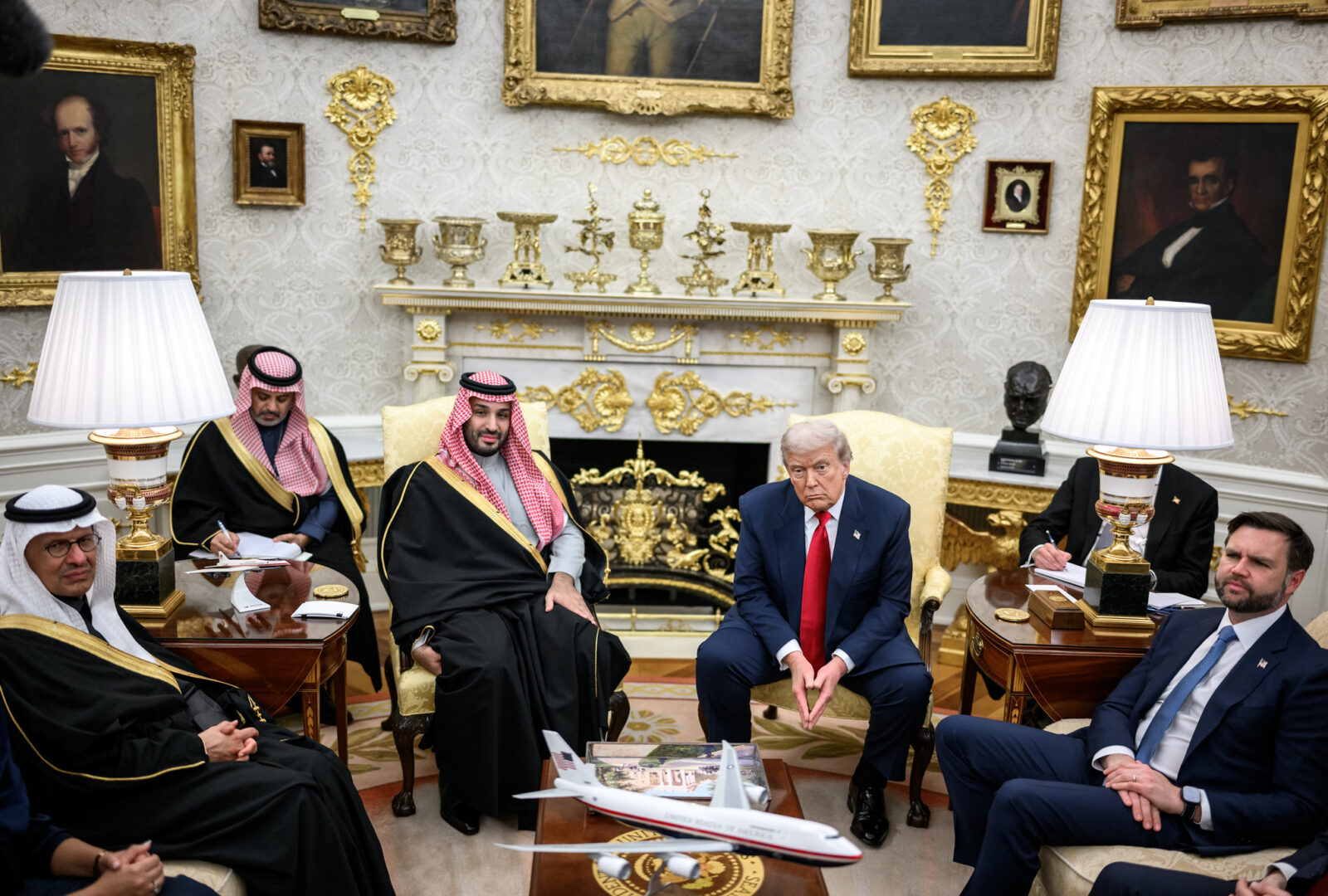
In contrast to Qatar’s willingness to maintain its existing reliance on the US, caveated by a few existing relationships, Saudi Arabia took a somewhat different approach. While a sense of optimism followed Crown Prince Mohamed bin Salman’s visit to Washington in November 2025, certain incompatibilities between American and Saudi objectives persist.
First, Mohamed bin Salman, or MBS, views the success of Vision 2030 as existential. The promised transformation of Saudi Arabia’s economy and society depends on tourism and investment, which require stability. The Kingdom has long relied on the United States for security, yet in recent years, Washington has repeatedly disappointed Riyadh on this front. The Iranian attacks on Saudi oil facilities in September 2019 — to which Trump responded with indifference — represented a critical juncture. In response, Saudi Arabia concluded it could not rely on the US to contain Iran and began to reduce tensions itself, ultimately leading to the Beijing Agreement in 2023, which normalized relations between Riyadh and Tehran. This, along with the truce with the Houthis in April 2022, were components of a broader policy aimed at reducing conflict and promoting regional stability.29
Saudi foreign policy officials and experts expressed support for the initiative to resolve the region’s conflicts, specifically to de-escalate with Tehran. If America and Israel declared war on Iran, they would not have to deal with the consequences if the Islamic Republic collapsed entirely, whereas Saudi Arabia and the rest of the GCC would. Researcher and lecturer Aziz al-Ghashian described the US attack on Iran as unhelpful: “By definition, this is what the Saudis don’t want: a short-term measure where the Saudis inherit long-term ramifications. This is the Saudi problem with the US approach … It’s actually counterproductive, now the Iranians are even more paranoid.”30While Riyadh struggled to ease tensions, Washington and Tel Aviv seemed increasingly eager to inflame them.
Saudi interlocutors also expressed frustration with Washington’s willful determination to ignore Riyadh’s stated commitment to a state of Palestine. The US and Israel continued to push for Saudi normalization. Yet Riyadh had made clear that the Kingdom would only normalize relations with Israel if it agreed to establish a Palestinian state. Israelis appeared increasingly to believe their own fiction that Saudi Arabia was on the cusp of normalization. In conversation, Israel was described as “delusional” for ignoring the issue of Palestine. Israel’s desire to have total security a few kilometers from where they impose total insecurity was compared to Iran’s approach, which also sought perpetual instability everywhere in the region but stability at home. Iran had learned that was not possible, and Israel may learn the same.
Saudi Arabia agreed with the regional consensus that Israel has replaced Iran as the most significant threat to regional security: When asked in a public forum, the former head of Saudi intelligence, Prince Turki al-Faisal replied, “For the moment, definitely it is Israel.”31However, while acknowledging Israel as dangerous, Saudis said that they did not view the Kingdom itself as likely to be targeted, as it has hosted no representatives of Hamas. There was some concern that Israel would continue to behave belligerently, but hopes that it had been deterred by international solidarity with Qatar, which demonstrated the deeper isolation Israel would face if it attacked a state like Qatar again.
Other Saudi analysts voiced more significant concerns about the implications of Israeli aggression. Israel’s ever-expanding definition of what is required in order to protect its national security was highlighted by Asaad al-Shamlan, the director of the European Studies Center at the Prince Saud Alfaisal Institute for Diplomatic Studies, an institution affiliated with the Foreign Ministry. He explained that the presence of such a heavily armed state as Israel was itself concerning: “It is a militarized society, a political culture [that] now is capable of exercising a massive amount of violence upon anyone who threatens their self-definition of their security … And their definition of their security keeps expanding … When you have a country with such a huge capability, even if today they’re not going to do anything to me, I don’t know about five years from now.”32Al-Shamlan also expressed shock that, in contrast to the horrors committed by Arab authoritarian regimes against civilian populations, from Saddam Hussein to Bashar al-Assad, the atrocities committed against Palestinians remained massively popular in Israel, an ostensibly democratic society where the actions of the government reflect the will of the people.
Multiple interlocutors voiced dissatisfaction with America’s ongoing support for Israeli atrocities against Palestinians. In its official response to Israel’s attack, Riyadh condemned Israeli aggression, specifically as a violation of international law. Similar to other states, Riyadh drew a clear connection between the impunity Israel enjoyed while violating international law in Palestine and its willingness to do the same in Qatar.33Still, from the perspective of Saudi leadership, the problem of Gaza was primarily domestic. The inability or unwillingness of Arab leaders to meaningfully ease the suffering of Palestinians reinforced a perception of state impotence. In contrast, surveys showed that 39 percent of Saudis supported Houthi attacks on Red Sea shipping aimed at blockading Israel, despite maintaining a dim view of the group for the rockets they previously launched at Saudi Arabia.34
Another disconnect between the Saudi and US approach was the timescale. While Gulf monarchs always operate on a longer time frame than term-limited American presidents, this dynamic was compounded by the age of the countries’ leaders. Saudi analyst Al-Ghashian pointed out that Trump was nearly 80 years old and Netanyahu was 76, whereas MBS was 40, which gave him a longer time horizon.35The crown prince’s eye to the future was evident during his visit to Washington, when he demurred in response to Trump’s question about which American president had been best for US–Saudi relations. MBS also named Franklin Delano Roosevelt and Reagan.36The crown prince may be wary of the 2020 US election dynamic, when Americans’ frustration with Trump transferred to MBS — and was amplified by the brutal murder of journalist Jamal Khashoggi — causing Biden to view a tough line on Saudi Arabia as a useful campaign strategy. Riyadh wishes to avoid its relationship with Washington again being a casualty of American political polarization.
China represented another crucial disconnect between Saudi and American policy preferences. China is Saudi Arabia’s most important customer, purchasing between 14 and 25 percent of Saudi oil; the Kingdom is also a significant importer of Chinese goods. Yet increasingly, the US demands that its partners and customers forswear Chinese technology if they want continued access to sensitive American technology. During Trump’s first term, a US official raised concerns to Gulf partners about the Chinese company Huawei’s role in the region’s 5G networks; Gulf countries subsequently worked to limit their exposure to Chinese tech.37
Under Trump and then Biden, the US signaled that it would expand its security commitment to Riyadh if it normalized relations with Israel. After Israel’s assault on Gaza made normalization unlikely, the US prepared to move forward with a security pact merely on the basis of Riyadh restricting investment and arms purchases from Beijing; ultimately, this deal failed to materialize, but it signaled Biden’s commitment to excluding China.38Riyadh wants a formal treaty commitment; however, the Senate would likely only agree to ratify such a commitment if Saudi Arabia normalized relations with Israel.
In October 2025, the CEO of Saudi tech firm Humain pledged not to purchase Huawei equipment; as a result, Trump pledged to sell advanced semiconductor chips to Humain.39Although the US has not extended a treaty-level commitment to Riyadh, as Trump did via executive order to Qatar following Israel’s attack, any such guarantee would undoubtedly require the Kingdom to significantly curtail its defense and technological partnerships with China.
Despite Riyadh’s pledge to avoid Chinese technology, China remained a point of contention. In December 2025, the author attended a discussion of the US–Saudi relationship at the Prince Saud Alfaisal Institute for Diplomatic Studies in Riyadh. The general tone was optimistic due to the crown prince’s recent trip to the US, which marked the first time MBS had visited since the murder of Khashoggi in the Saudi consulate in Istanbul in 2018. Yet participants acknowledged areas of irreconcilability: If the US were to confront China, Washington would demand its partners pick sides. However, in that circumstance, Saudi Arabia would not be alone, as the whole world would face the same choice. Participants also pointed out that Vision 2030 was premised on the assumption of open travel, trade, and investment. Trump’s pressure to close the global economy threatened the Vision’s success and the future viability of the Saudi state.
Saudi–Chinese trade consists primarily of commercial goods rather than armaments, but at times Riyadh has looked to Beijing for defense items, especially when the US failed to provide them. For example, during the Iran–Iraq War, Riyadh sought to purchase American Pershing missiles but was refused and instead bought 50 Dong Feng-3/CSS-2 ballistic missiles in 1986.40More recently, the Saudi–led war on Yemen (2015–2022) and Khashoggi’s murder strained US–Saudi relations, prompting Congress to attempt to limit the provision of weapons to the Kingdom. In 2021, news broke that China was assisting Saudi Arabia to manufacture its own ballistic missiles.41The Kingdom uses surveillance drones, short-range anti-aircraft missiles, and the “Silent Hunter” drone defense laser weapon, all manufactured by China.42In 2023, a planned deal for defense industrial co-production with Raytheon and the Saudi company Scopa Defense fell through due to Scopa’s ties to Chinese and Russian firms.43One of the goals of Vision 2030 is for the Kingdom to manufacture half its own defense equipment by 2030; the implosion of the deal demonstrated how American demands undermined Saudi efforts to localize its own defense.44
Saudi Arabia also seeks partnerships with other middle powers as a means of avoiding US–China tensions, a practice some scholars have dubbed “workarounding.”45Eight days after Israel’s attack on Doha, Saudi Arabia announced a defense pact with Pakistan. Evidently, the pact had been in development, and its timing had no relation to Israel’s attack; Turkey had expressed interest in potentially joining the pact as well, as media later reported. Early 2026 witnessed thawing ties with Turkey, as well as between Egypt and Turkey, with President Erdoğan visiting both Riyadh and Cairo after years of frosty relations. Rumors swirled about a possible defense pact between Riyadh, Cairo, Ankara, and Islamabad.46In 2023, Saudi Arabia bought a medium-range air defense system from South Korea for $3.2 billion.47Saudi Arabia is also in talks to purchase Sino–Pakistani JF-17 planes.48Yet whether Riyadh is looking to reduce its dependence on a partner who has previously proven unreliable, or merely to signal to the US that it has other options, remains unclear.
Saudi Arabia appears to be bargaining for a more explicit commitment from the US. Yet, following the crown prince’s visit, it was unclear whether this had been achieved. Trump declared Saudi Arabia a major non–NATO ally, a status already conferred on other regional partners Bahrain, Egypt, Israel, Jordan, Kuwait, Morocco, Qatar, and Tunisia. Trump promised to move forward with a civilian nuclear agreement, and in February, Trump notified Congress of a civilian nuclear deal that did not include enrichment safeguards, per Riyadh’s request.49Trump pledged to sell MBS F-35 fighter jets, although he had also promised to sell the F-35s to the UAE in a deal that ultimately broke down due to concerns over China. Reports of the November meeting indicate that Trump expressed frustration over MBS’s refusal to normalize relations with Israel. His inability to pressure the crown prince into agreeing to join the Abraham Accords signaled Washington’s waning leverage and Riyadh’s eroded confidence.50Saudi analyst Al-Ghashian characterized Saudi dissatisfaction with the US as longstanding, describing America’s “inherent unreliability.” As more alternatives present themselves, Riyadh is likely to continue diversifying its security partners.
GCC response: Resistance to integration persists
While both Qatar and Saudi Arabia have, in a limited manner, worked to reduce their dependence on the US, the Gulf Cooperation Council has not developed the capacity for collective defense. Formed in 1981 partly in response to the fall of the Shah, the GCC was initially envisioned as a fully integrated economic and security bloc. In 1982, each member contributed troops to the Peninsula Shield Force, which began holding military exercises.51However, the force proved incapable of preventing Saddam Hussein’s 1990 invasion of Kuwait, which was instead repelled by a US–led coalition. In 2000, the members signed a joint defense agreement, and in 2013, the Gulf leaders committed to establishing a joint military command, but progress remained slow.
The United States has repeatedly pressed GCC members to integrate their defenses.52Yet tensions within the GCC persist, with the 2017 Saudi– and Emirati–led blockade of Qatar as the most prominent example and the Saudi–Emirati squabble in Yemen as the most recent, but also previous spats such as between Qatar and Oman in 1999 and between Qatar and Bahrain that was only resolved by the International Court of Justice in 2001.53The six wealthy Arab monarchies have tended to prefer enhancing bilateral relations with the US rather than building a stronger multilateral institution.
Even during Israel’s assault on Gaza after Oct. 7, which reinforced widespread public condemnation of Israel across the Middle East, six Arab states secretly increased their security cooperation with Israel and the US, primarily oriented around countering threats posed by Iran. The “Regional Security Construct” included Bahrain, Egypt, Jordan, Qatar, Saudi Arabia, and the UAE alongside Israel and the US, following an agreement during a 2022 security conference to coordinate military exercises. In 2024, CENTCOM linked many of the states to its systems. Yet even this did not prevent Israel’s attack, allegedly because the system is only focused on threats coming from Iran.54Yet despite increased security cooperation, Saudi Arabia, Qatar, Kuwait, and even the UAE stated that as of January 2026, they would not allow the US to use their airspace to attack Iran, signaling that their partnership with Washington has limits.55
The attack on Qatar demonstrated the need for greater integration among the GCC members and perhaps less dependence on the US. The members agreed to increase intelligence exchanges; develop an early warning system against ballistic missiles; update joint defense plans; and conduct joint exercises.56Saudi diplomacy expert Al-Shamlan said, “There’s a feeling that there is a common threat and a serious one. Qatar is just a revelation of a threat that has been there for some time. Is this about the security of Israel or the instability of Israel’s neighbors?”57During a private session at the Doha Forum, a Gulf expert stated, “The brutal attack on Qatar … Reaffirmed an important fact for the GCC countries: do not trust US promises.” He pointed out that while the United States would clearly mobilize all resources to protect Israel, it did not do the same for the Gulf countries. During the session, a Gulf official pointed out that US efforts to cripple Iran’s security also damage the security of the region as a whole.58 The mood in the session reflected skepticism about continuing to rely on the US, although a viable alternative remained unclear.
Many Middle Eastern countries began to depend on the United States as a security guarantor following the British withdrawal from the region after World War II. This dependence was reinforced by the so-called Carter Doctrine, established in the wake of the Islamic Revolution in Iran and the Soviet invasion of Afghanistan, which asserted that the US would intervene militarily to protect the flow of oil. By extension, many regional leaders believed that the US was committed to stability. This faith was deeply shaken by America’s invasion of Iraq in 2003, and then by its unwillingness to save the presidency of Egypt’s Hosni Mubarak in the face of mass popular unrest in 2011. The Iran nuclear deal in 2015 further tarnished the confidence of Gulf leaders in the US, and the attack on Saudi Arabia by Iran in 2019 and by the Houthis on Abu Dhabi in 2022 affirmed their suspicions that the US could not be trusted. Yet frustration with inadequate US responses historically caused partners to push for greater US involvement, whereas now, the actions of the US and Israel are increasingly a source of concern.
Several interlocutors acknowledged the need for GCC countries to stop outsourcing their security. While this was reflected in the push to develop local defense industries, it could also be achieved through an integrated, inclusive security architecture. Such a structure would need to include the major Arab countries as well as Turkey, Iran, and Israel, although Israel’s inclusion would be predicated on the establishment of a Palestinian state or equal rights for all people under Israel’s control. For the security architecture to become a functioning institution, the region would need to take the lead in its development, anchoring it in the UN Security Council rather than in American guarantees. While the possible defense agreement between Saudi Arabia, Pakistan, Turkey, and Egypt would approximate this, in order to reduce the threat posed by both Iran and Israel to each other and the region, they would need to be included.
The GCC countries have tried to expand their role as mediators. Kuwait and Oman had previously played this role, although recent internal turmoil in Kuwait has constrained their capacity to mediate. Oman hosted the secret negotiations that eventually led to the 2015 Iran nuclear deal, as well as recent talks between Iran and the US. The UAE is mediating between Ukraine and Russia. Qatar continues to serve as a mediator between Hamas and Israel, despite Israel’s attack.
The implications of attacking mediators extend far beyond Qatar: they reflect an assault on the international order that was established in the aftermath of World War II. To try to prevent the recurrence of such devastation, and to stave off the then-nascent threat of nuclear annihilation, new institutions like the United Nations posited “aggression” as among the greatest evils a state could commit.59Israel’s attack on a mediator reflects its general disregard for international law and institutions. As Itonde Kakoma said at the Doha Forum, “The attack on Doha is a violation of the sanctity of peacemakers. It’s not surprising at a moment when you see humanitarian workers in the carnage, that peacemakers are in the same vein.”60Israel has long viewed itself as outside the scope of international law, and has treated the UN as uniquely focused on Israeli crimes, when in fact the UN’s sustained critique of Israel reflects the fact that Israel’s occupation of Palestine is one of the world’s longest-running violations of international law.61
In contrast, until recently, the United States continued to gesture toward the importance of international law and institutions, despite repeatedly flouting them. Yet Trump no longer even bothers with the pretense that the United States respects international law. He frequently criticizes the UN, and withdrew the US from 66 international organizations described as “contrary to the interests of the United States,” including the Global Counterterrorism Forum as well as numerous UN agencies.62Many view Trump’s Board of Peace as intended to replace or subvert the UN.63
Members of the GCC, in contrast, tend to view international institutions as valuable. Like other small and medium states, the Gulf countries would prefer a global order governed by international law. Qatar, in particular, wishes to preserve international institutions and actively participates in them. As Foreign Ministry Spokesperson Majed al-Ansari said during an event at the Qatari Embassy in Washington, “Qatar went to the International Criminal Court and the International Court of Justice and the UN Security Council, to show that Qatar is a member of the international community, and that we are following protocol.”64Like other small states, Qatar views a world governed by international law as preferable to one where might makes right.
And yet when faced with an increasingly aggressive and powerful regional neighbor that clearly disregards international law, the members of the GCC may decide that it is easier to bandwagon, or align with the powerful state, rather than try to balance against it.
Conclusion
America’s unconditional support for Israel put Qatar, as well as the rest of the GCC, in the crosshairs of Iranian and even possibly future Israeli attacks. The immediate implication, therefore, was whether Israeli and American aggression had caused Qatar to question the value of the US security guarantee, and whether other GCC members, specifically Saudi Arabia, were also reassessing the wisdom of relying on America.
The events of 2025 reinforced the suspicions of many Gulf countries that the United States may not, in fact, be a reliable source of regional stability. Washington’s and Riyadh’s conflicting priorities have already driven the Kingdom to diminish its reliance on the United States to some extent, though this may primarily be intended to goad Washington into providing the iron-clad security guarantee Riyadh has long sought.
In the meantime, there are some signs of deepening bilateral ties within the GCC, including a planned high-speed rail line between Riyadh and Doha, a project that would have been unthinkable during the acrimonious height of the Gulf crisis that began in 2017.65In contrast, the increasingly antagonistic Saudi–UAE rivalry is likely to continue to influence regional outcomes from Sudan to Yemen and perhaps beyond.
For years, Iran was seen as the greatest threat to regional stability and security. Yet recent events have demonstrated that Iran presents less of a threat than many believed, and the danger to stability is actually Israeli and American. And yet, faced with few viable alternatives, America’s Gulf partners have primarily looked to other middle powers to diversify their defense partners while maintaining close ties to the United States. An American war on Iran, however, would significantly increase the urgency with which these states could look to limit their reliance on Washington.
Program
Countries/Territories
Authors

Annelle Sheline is a research fellow in the Middle East program at the Quincy Institute, an expert on religious and political authority in the Middle East and North Africa. She received her doctorate from George Washington University.
Citations
The U.S. conducted a military operation against the Iranian navy in 1988. “Operation Praying Mantis,” Naval History and Heritage Command, Sept. 20, 2023, https://www.history.navy.mil/browse-by-topic/wars-conflicts-and-operations/middle-east/praying-mantis.html. ↩
“2024-2025 Arab Opinion Index,” The Arab Center for Research and Policy Studies in Doha, June 1, 2026, https://www.dohainstitute.org/en/Lists/ACRPS-PDFDocumentLibrary/arab-index-2025-press-release-en.pdf. ↩
“2022 Arab Opinion Index,” The Arab Center for Research and Policy Studies in Doha, Jan. 19, 2023, https://arabcenterdc.org/resource/arab-opinion-index-2022-executive-summary. ↩
See. e.g., John Alterman, “China and the Middle East,” Center for Strategic and International Studies, April 19, 2024, https://www.csis.org/analysis/china-and-middle-east; Rosemary Kelanic, “China Can’t Dominate the Middle East,” Defense Priorities, May 5, 2025, https://www.defensepriorities.org/explainers/china-cant-dominate-the-middle-east/. ↩
Shana Marshall, “The Role of the Gulf States in Expanded Weapons Production in the Global South,” PRISME Initiative, November 2024, https://prismeinitiative.org/publications/role-gulf-states-expanded-weapons-production-global-south-shana-marshall/. ↩
Zain Hussain and Alaa Tartir, “Recent Trends in International Arms Transfers in the Middle East and North Africa,” Stockholm International Peace Research Institute, April 10, 2025, https://www.sipri.org/commentary/topical-backgrounder/2025/recent-trends-international-arms-transfers-middle-east-and-north-africa. ↩
Annelle Sheline and Kristian Coates Ulrichsen, “Saudi Arabia’s Vision 2030 and a Nation in Transition,” Rice University’s Baker Institute for Public Policy, July 24, 2025, https://www.bakerinstitute.org/research/saudi-arabias-vision-2030-and-nation-transition. ↩
Andrew Mills, Jana Choukeir, Ahmed Elimam and Jeff Mason, “Israel Attacks Hamas Leaders in Qatar, Trump Says He’s ‘Very Unhappy’ About Strike,” Reuters, Sept. 9, 2025, https://www.reuters.com/world/middle-east/israel-attacks-hamas-leaders-qatar-trump-says-hes-very-unhappy-about-strike-2025-09-09/. ↩
“US Central Command Statement on the Realignment of the State of Israel,” US Central Command Public Affairs, Sept. 1, 2021, https://www.centcom.mil/MEDIA/STATEMENTS/Statements-View/Article/2762272/us-central-command-statement-on-the-realignment-of-the-state-of-israel/. ↩
Mostafa Salem, “How Qatar Defused Iran’s Attack on the Largest US–Run Base in the Region,” CNN, June 28, 2025, https://www.cnn.com/2025/06/28/middleeast/qatar-iran-attack-israel-latam-intl. ↩
“Qatar’s Emir Condemns Israel’s ‘Reckless Criminal Attack’ in Doha,” Al Jazeera, Sept. 9, 2025, https://www.aljazeera.com/news/2025/9/9/qatar-condemns-cowardly-israeli-attack-in-doha. ↩
“‘Gulf Region at Risk: Qatar Seeks ‘Collective Response’ to Israeli Attack,” Al Jazeera, Sept. 10, 2025, https://www.aljazeera.com/news/2025/9/10/gulf-region-at-risk-qatar-seeks-collective-response-to-israeli-attack. ↩
Mohammed bin Abdulrahman Al-Thani, Doha Forum, “Newsmaker Interview: H.E. Sheikh Mohammed bin Abdulrahman bin Jassim Al-Thani,” Dec. 7, 2025. https://www.youtube.com/watch?v=gGZ3-C4JaVw ↩
Spokesperson for the Qatari Foreign Ministry Majed al-Ansari, Doha Forum event, Dec. 8, 2025 (attended by the author). ↩
Nima Elbagir, Barbara Arvanitidis, Alex Platt, Raja Razek, Nadeen Ebrahim, and Uri Blau, “Qatar Sent Millions to Gaza for Years – With Israel’s Backing. Here’s What We Know About the Controversial Deal,” CNN, Dec. 12, 2023, https://www.cnn.com/2023/12/11/middleeast/qatar-hamas-funds-israel-backing-intl. ↩
Catherine Lucey, “Biden Thanks Qatar for Helping to Negotiate Hostage Releases,” The Wall Street Journal, Nov. 12, 2023, https://www.wsj.com/livecoverage/israel-hamas-war-gaza-strip-2023-11-11/card/biden-thanks-qatar-for-helping-to-negotiate-hostage-releases-pUIObpdZj0TR6Mi9dL6B. ↩
“Qatar to Continue Mediation After Israel Expresses Regret Over Strike on Hamas,” BBC, Sept. 30, 2025, https://www.bbc.com/news/articles/c20z3ykyxwzo. ↩
“Arab Ministers Meet on Response to Israeli Attack in Qatar,” The New York Times, Sept. 14, 2025, https://www.nytimes.com/2025/09/14/world/middleeast/arab-ministers-qatar-israel.html. ↩
“GCC to Activate Defence Mechanism; Doha Summit Slams Israel’s Qatar Attack,” Al Jazeera, Sept. 16, 2025, https://www.aljazeera.com/news/2025/9/16/gcc-vows-joint-defence-but-arab-islamic-summit-short-on-concrete-action. ↩
Barak Ravid, “Scoop: Netanyahu Spoke to Trump Before Israel Bombed Qatar,” Axios, Sept. 15, 2025, https://www.axios.com/2025/09/15/trump-netanyahu-call-israel-strike-qatar. ↩
“Statement from the International Media Office of the State of Qatar in response to false claims in American media,” X, Sept 11, 2025, https://x.com/IMO_Qatar/status/1966115246248178063. ↩
Andrew Jeong, “Why Qatar is Building an Air Force Training Facility at a US Military Base,” The Washington Post, Oct. 11, 2025, https://www.washingtonpost.com/national-security/2025/10/11/qatar-air-foce-facility-us-idaho/. ↩
“US, Regional Partners Establish New Air Defense Operations Cell in Qatar,” US Central Command Public Affairs, Jan. 14, 2026, https://www.af.mil/News/Article-Display/Article/4381701/us-regional-partners-establish-new-air-defense-operations-cell-in-qatar/. ↩
Islam Khalid Hassan, “GCC’s 2014 Crisis: Causes, Issues, and Solutions,” Al Jazeera, March 31, 2025, https://studies.aljazeera.net/en/dossiers/2015/03/201533172623652531.html. ↩
John Irish and Cyril Altmeyer, “France and Qatar Seal $7 billion Rafale Fighter Jet Deal,” Reuters, April 30, 2015, https://www.reuters.com/article/world/france-and-qatar-seal-7-billion-rafale-fighter-jet-deal-idUSKBN0NL0RD/. ↩
Alex Emmons, “Saudi Arabia Planned to Invade Qatar Last Summer. Rex Tillerson’s Efforts to Stop It May Have Cost Him His Job,” The Intercept, Aug. 1, 2018, https://theintercept.com/2018/08/01/rex-tillerson-qatar-saudi-uae/. ↩
“Qatar Goes Ahead With $6.7 Billion Typhoon Combat Jets Deal With UK’s BAE Systems,” Reuters, Dec. 10, 2017, https://www.reuters.com/article/us-britain-qatar-typhoons/idea-goes-ahead-with-6-7-billion-typhoon-combat-jets-deal-with-uks-bae-systems-idUSKBN1E40QM/. ↩
Melissa Khurma and Giorgio Cafiero, “Doha is Still Counting on Washington,” Foreign Policy, Nov. 12, 2025, https://foreignpolicy.com/2025/11/12/qatar-gulf-saudi-trump-israel-nato-france-turkey/. ↩
Sultan al-Amer, “Saudi Arabia’s Break With Interventionism,” Newlines Magazine, Feb. 6, 2026, https://newlinesmag.com/essays/saudi-arabias-break-with-interventionism/. ↩
Author interview with Aziz al-Ghashian, Riyadh, Dec. 3, 2025. ↩
“A Conversation with King Faisal Center for Research and Islamic Studies Chairman His Royal Highness Prince Turki al-Faisal Al-Saud,” The Milken Institute, Dec. 4, 2025, https://milkeninstitute.org/content-hub/event-panels/conversation-king-faisal-center-research-and-islamic-studies-chairman-his-royal-highness-prince. ↩
Author interview with Asaad al-Shamlan, Prince Saud Alfaisal Institute for Diplomatic Studies, Riyadh, Dec. 4, 2025. ↩
“Israel Attacks Hamas Leadership in Qatar: What We Know,” Al Jazeera, Sept. 9, 2025, https://www.aljazeera.com/news/2025/9/9/israel-attacks-hamas-leadership-in-qatar-all-to-know. ↩
Catherine Cleveland, “Saudi Public Opinion in a Changing Middle East: Great Powers, the Gaza War, Pathways for the Kingdom,” Washington Institute for Near East Policy, August 2025, https://www.washingtoninstitute.org/sites/default/files/pdf/PolicyNote160Cleveland.pdf. ↩
Author interview with Aziz al-Ghashian, Riyadh, Dec. 3, 2025. ↩
Katie Rogers and Vivian Nereim, “Trump Dismisses Journalist’s Murder While Praising Saudi Crown Prince,” The New York Times, Nov. 19, 2025, https://www.nytimes.com/live/2025/11/18/world/trump-saudi-crown-prince-visit. ↩
Alexander Cornwell, “US Flags Huawei 5G Network Security Concerns to Gulf Allies,” Reuters, Sept. 12, 2019, https://www.reuters.com/article/world/us-flags-huawei-5g-network-security-concerns-to-gulf-allies-idUSKCN1VX23P/. ↩
Humeyra Pamuk, Alexander Cornwell and Matt Spetalnick, “US and Saudi Arabia Nearing Agreement on Security Pact, Sources Say,” Reuters, May 2, 2024, https://www.reuters.com/world/us-saudi-arabia-nearing-agreement-security-pact-sources-say-2024-05-02. ↩
Mackenzie Hawkins, “US Plans to Approve Sale of Chips to Saudi AI Venture Humain,” Bloomberg, Nov. 18, 2025, https://www.bloomberg.com/news/articles/2025-11-18/us-plans-to-approve-sale-of-chips-to-saudi-ai-venture-humain. ↩
Hesham Alghannam, “How China Aligned Itself with Saudi Arabia’s Vision 2030,” Carnegie Endowment for International Peace, Jan. 21, 2025, https://carnegieendowment.org/russia-eurasia/posts/2025/01/how-china-aligned-itself-with-saudi-arabias-vision-2030. ↩
Zachary Cohen, “CNN Exclusive: US Intel and Satellite Images Show Saudi Arabia is Now Building Its Own Ballistic Missiles With Help of China,” CNN, Dec. 23, 2021,
https://www.cnn.com/2021/12/23/politics/saudi-ballistic-missiles-china. ↩
Kawala Xie, “Why is Saudi Arabia Looking to China to Buy Weapons After Years of Arms Deals With the US?,” South China Morning Post, Dec. 8, 2022, https://www.scmp.com/news/china/diplomacy/article/3202245/why-saudi-arabia-looking-china-buy-weapons-after-years-arms-deals-us. ↩
Stephan Kalin, “Arms Megadeal Collapsed When China, Russia Links Emerged,” The Wall Street Journal, Sept. 15, 2023, https://www.wsj.com/politics/national-security/a-saudi-defense-contractor-courted-russia-and-china-then-its-u-s-business-partners-fled-962527ad. ↩
“Vision 2023,” Kingdom of Saudi Arabia, 2016, https://www.vision2030.gov.sa/media/rc0b5oy1/saudi_vision203.pdf. ↩
Maximilian Mayer, Laura Mahrenbach, Johannes Doerfert, Mara Nazaretyan, “Tech Middle Power Cooperation and Workarounding,” Harvard Dataverse, Sept. 19, 2025, https://dataverse.harvard.edu/dataset.xhtml?persistentId=doi:10.7910/DVN/CDUVJN. ↩
Saad Sayeed, Asif Shahzad and Jonathan Spicer, ”Pakistan–Saudi–Turkey Defence Deal in Pipeline, Pakistani Minister Says,” Reuters, Jan. 15, 2026, https://www.reuters.com/world/asia-pacific/pakistan-saudi-turkey-defence-deal-pipeline-pakistani-minister-says-2026-01-15/. ↩
Gordon Arthur, “Saudi Arabia Signs $3.2B Deal for South Korean Air Defense Systems,” Defense News, Feb. 7, 2024, https://www.defensenews.com/land/2024/02/07/saudi-arabia-signs-32b-deal-for-south-korean-air-defense-systems/. ↩
Ariba Shahid and Saad Sayeed, “Exclusive: Pakistan, Saudi in Talks on JF-17 Jets-for-Loans Deal, Sources Say,” Reuters, Jan. 8, 2026, https://www.reuters.com/world/asia-pacific/pakistan-saudi-talks-jf-17-jets-for-loans-deal-sources-say-2026-01-07/; Tanya Goudsouzian and Ibrahim al-Marashi, “How Pakistan Is Busting the Great Power Monopoly on Air Power,” Responsible Statecraft, Feb. 20, 2026, https://responsiblestatecraft.org/pakistan-air-force-fighter-jets/ ↩
Timothy Gardner and Jonathan Landay, “US Removing Guardrails from Proposed Saudi Nuclear Deal, Document Says,” Reuters, Feb. 20, 2026, https://www.reuters.com/world/us/us-removing-guardrails-proposed-saudi-nuclear-deal-document-says-2026-02-19/ ↩
H.A. Hellyer, “The US–Saudi Reconfiguration Is Real and It No Longer Depends on Israel,” War on the Rocks, Dec. 5, 2025, https://warontherocks.com/2025/12/the-u-s-saudi-reconfiguration-is-real-and-it-no-longer-depends-on-israel/. ↩
Kristian Coates Ulrichsen, “Israel’s Attack on Qatar and the Failure of GCC Defense Cooperation,” The Arab Center of Washington DC, Oct. 14, 2025, https://arabcenterdc.org/resource/israels-attack-on-qatar-and-the-failure-of-gcc-defense-cooperation/. ↩
Bilal Saab, “Israel’s Attack on Qatar Shows Why It’s Time for a Gulf Defence Union,” Chatham House, Sept. 19, 2025, https://www.chathamhouse.org/2025/09/israels-attack-qatar-shows-why-its-time-gulf-defence-union. ↩
William Roebuck, “The Saudi–UAE Rift: Taking the Measure of the Gulf That Separates and Unites Them,” The Arab Gulf States Institute, Feb. 4, 2026, https://agsi.org/analysis/the-saudi-uae-rift-taking-the-measure-of-the-gulf-that-separates-and-unites-them/. ↩
David Kenner, “Arab States Expanded Cooperation With Israeli Military During Gaza War, Files Show,” The Washington Post, Oct. 11, 2025, https://www.washingtonpost.com/national-security/2025/10/11/us-israel-arab-military-leaked-documents/. ↩
Michael Gordon, Shelby Holliday, and Alexander Ward, “Key Gulf Allies Say They Won’t Aid US in an Iran Strike, Limiting Trump’s Options,” The Wall Street Journal, Jan. 27, 2026, https://www.wsj.com/world/middle-east/key-gulf-allies-say-they-wont-aid-u-s-in-an-iran-strike-limiting-trumps-options-47e1ce3d. ↩
“Statement of the Special Session of the Joint Defense Council,” GCC General Secretariat, Sept. 18, 2025, https://www.gcc-sg.org/ar/MediaCenter/News/Pages/news2025-9-18-5.aspx. ↩
Author interview with Asaad al-Shamlan, Prince Saud Alfaisal Institute for Diplomatic Studies, Riyadh, Dec. 4, 2025. ↩
Doha Forum private session, Doha, Dec. 7, 2025 (attended by the author). ↩
“Charter of the United Nations, Articles 39–51,” United Nations, https://www.un.org/en/about-us/un-charter/chapter-7. ↩
Doha Forum event, Dec. 8, 2025. ↩
Legal Consequences Arising from the Policies and Practices of Israel in the Occupied Palestinian Territory, Including East Jerusalem, Advisory Opinion, ICJ Reports 2024 (July 19, 2024), https://www.icj-cij.org/node/204176. ↩
“Withdrawing the United States from International Organizations, Conventions, and Treaties that Are Contrary to the Interests of the United States,” The White House, Jan. 7, 2025, https://www.whitehouse.gov/presidential-actions/2026/01/withdrawing-the-united-states-from-international-organizations-conventions-and-treaties-that-are-contrary-to-the-interests-of-the-united-states/. ↩
Edward Elmendorf, “Trump’s Board of Peace Explained: Mandate, Power, and Global Implications,” Impakter, Feb. 13, 2026, https://impakter.com/trumps-board-of-peace-explained-mandate-power-and-global-implications/. ↩
Event at Qatar Embassy, Washington DC, Sept. 18, 2025 (attended by the author). ↩
“Saudi Cabinet Approves High-Speed Rail Link with Qatar,” Gulf Business, Feb. 12, 2026, https://gulfbusiness.com/saudi-approves-high-speed-rail-link-with-qatar/. ↩