
Crying Wolf? The United States and BRICS in the Global Order
Executive Summary
BRICS — the growing transcontinental coalition of major Global South states such as Brazil, India, Indonesia, and South Africa, and the “Global East” of China and Russia — is not the anti–American alliance Washington fears. It is a reformist, not radical, group. But the more the US disrupts the multilateral framework, the more it reinforces the very rationale — hedging against American unpredictability and global uncertainty — that fuels the grouping’s growth.
BRICS is not a formal alliance and will never be one. It is made up of states with very different political systems, bound by a few common interests. The most important of these are respect for state sovereignty, endorsement of the UN system, and focusing on shared challenges such as economic development. The newly expanded BRICS now spans practically all regions of the Global South and includes 10 member states and 10 “partner countries.” Collectively, BRICS surpassed the GDP of the G7 countries — Canada, France, Germany, Italy, Japan, the United Kingdom, and the United States — in 2019.
The New Development Bank is BRICS’ most successful institution. Notably, no member of the NDB has individual veto power, nor are loans conditioned on standards imposed from above — a stark departure from the intrusive practices of the World Bank. Other initiatives are still a work-in-progress.
Washington swings between two unhelpful poles on BRICS: contemptuous dismissal or overhyping the threat of BRICS’ alleged attempts at de-dollarization. But most BRICS members have not supported de-dollarization. While the upcoming BRICS summit in New Delhi will continue work on a member-wide payment system, it is still far from completion, and political will to adopt it remains limited.
BRICS is neither irrelevant to the global order nor currently a threat to US interests. Washington should respond proportionately to the signal it represents. Despite emerging internal rifts, BRICS is likely to expand its developmental impact slowly. BRICS’ reformism and developmentalism can align with US interests, opening new markets for US businesses, stabilizing regions, and curbing global migration flows as a byproduct. The United States will benefit by repairing ties with BRICS states, most notably Brazil and India. Washington could also reduce the chances of BRICS emerging as the nucleus of a multi-order world through a selective return to multilateralism and avoiding blunders, like military interventionism, which alienate much of the Global South.
The rise of BRICS amid declining unipolarity
The global order has shifted significantly since the 1990s and the 2000s, two decades of American security and economic dominance. The last 10 years or so have been a period of transition. The United States is still the most powerful actor in the world, but other powers are making their presence and influence increasingly felt. Of these, China is by far the most important. But a set of middle powers from the Global South have also become much more relevant to the global power map, not as a unified bloc, but as realist actors relentlessly pursuing their own interests.1It is increasingly harder to deny the signs of unipolarity’s decline and the considerable distance the world has traveled since the 1990s.2
These shifts provide the key context in which a new grouping of Brazil, Russia, India, China, and South Africa, or BRICS, has risen in recent years, seemingly challenging the US–led order in important respects. BRICS is decidedly not an alliance in any shape or form, and it will never be one. But one of its distinguishing features is the complete absence of any Western state or US treaty ally. Though sometimes erroneously categorized as a Global South grouping, BRICS is best described as a loose coalition of what I have previously called the “Global East” — Russia and China — with a set of Global South states.3With its recent expansion to 10 core members and 10 additional partner countries, a large majority of its member states are now from the Global South.
Commentary in the United States and the West has often been dismissive of BRICS, seeing it as too heterogeneous to amount to anything other than a talk shop.4Reputed scholar Joseph Nye has argued that states join BRICS for specific, self-interested purposes (e.g., the group allows China to demonstrate global leadership), but these disparate motivations do not amount to anything like transformative joint action.5The list of naysayers also includes Jim O’Neill, the investment banker who originally coined the term BRIC (later expanded to BRICS following the addition of South Africa).6The Trump administration, for its part, has taken a hostile approach toward the grouping, accusing it of trying to dethrone the US dollar.7
At the other extreme, there is a celebratory and uber-optimistic view of BRICS as heralding a new global order of Global South unity and leadership.8No less than Brazilian President Lula da Silva, while opening the 2025 summit, said that BRICS was the heir to the spirit of Bandung and the Non–Aligned Movement.9
This brief argues that the middle ground is where the reality and significance of BRICS lies, and that the United States should strategize accordingly. BRICS is neither a revolutionary grouping trying, as yet, to explicitly counter Washington, nor is it irrelevant to shifts in the global order.
BRICS is a heterogeneous coalition with a major Global South component, focused on certain common but limited interests. It has generated a modest impact on the ground and is creating the scaffolding for potentially more transformative actions in the future. While China and Russia play major roles within the grouping, BRICS is not simply a vehicle for the rivalry of these two great powers with the United States. Global South states see it as a part of their longstanding strategies of hedging and multialignment.10
However, if the United States continues to needlessly alienate key Global South middle powers in its bilateral dealings and also pulls back on multilateralism for the long haul, the incentives for states to make deeper investments in BRICS will only grow. Over an extended period, BRICS could then emerge as a coalition that proactively counters and balances Washington, not in the security plane, but in arenas of global governance, economic coordination, and certain normative spaces, heightening chances of a multiorder world. Such a world will not be in the United States’ interests.
Growth and expansion
BRICS is not a formal international organization. It has no charter in the treaty sense, no permanent secretariat, and no binding dispute resolution mechanism. All decisions are taken by consensus. As stated above, the term itself traces back to Goldman Sachs economist Jim O’Neill, who created BRIC in 2001 as investment bank shorthand for four large emerging economies he expected to drive global growth.11The first BRIC leaders’ summit in 2009 in Yekaterinburg, Russia kicked off the grouping in a concrete form.12South Africa’s inclusion in 2011 made it BRICS. For years afterward, BRICS pitched itself as primarily a club of new, rising destinations for global investment and trade.
In its early phase, BRICS stayed out of the international headlines. But as the world order began to transform in the years after the global financial crisis, BRICS began to think bigger.
Following an innovative Indian proposal during the 2012 New Delhi summit, leaders agreed to form a new development finance institution at the next summit in Durban, South Africa.13The hard work for crafting the institution was done in the months leading up to the Fortaleza summit in Brazil in 2014.14A financial stability mechanism was also announced at Fortaleza, based on a Brazilian proposal. Accordingly, the New Development Bank, the NDB, and the Contingent Reserve Arrangement, or CRA, were inaugurated during the 2015 summit in Ufa, Russia. The CRA is a currency swap arrangement for member states to call upon for liquidity to overcome financial crises. Ufa also articulated the goal of trading in local currencies.15
Two years later, during the 2017 summit in Xiamen, host China introduced the “BRICS–Plus” proposal of formally widening BRICS’ circle of engagement to other emerging economies.16The leaders of Egypt, Guinea, Mexico, Tajikistan, and Thailand were invited as part of this widening.17South Africa advanced this outreach framework at the 2018 summit.18
The pandemic slowed momentum, but the push to broaden engagement to more Global South countries was revived at the 2022 summit, hosted virtually by China.19BRICS later announced a major expansion of its membership during its 2023 summit in Johannesburg. Six new states, namely Argentina, Egypt, Ethiopia, Iran, Saudi Arabia, and the UAE, were invited to join as full members. Argentina had a change of government and declined the invitation. Saudi Arabia remains undecided, though it has participated in some BRICS meetings.20Indonesia’s joining in 2025 made it 10 core members.
During the 2024 summit in Kazan, Russia, BRICS announced a new tier of membership below that of full members called “partner countries.” Currently, there are 10 BRICS partner countries, namely Belarus, Bolivia, Kazakhstan, Cuba, Malaysia, Nigeria, Thailand, Uganda, Uzbekistan, and Vietnam (see Figure 1).21About 30 additional countries have expressed interest in joining.22
Figure 1: BRICS member states and partner countries
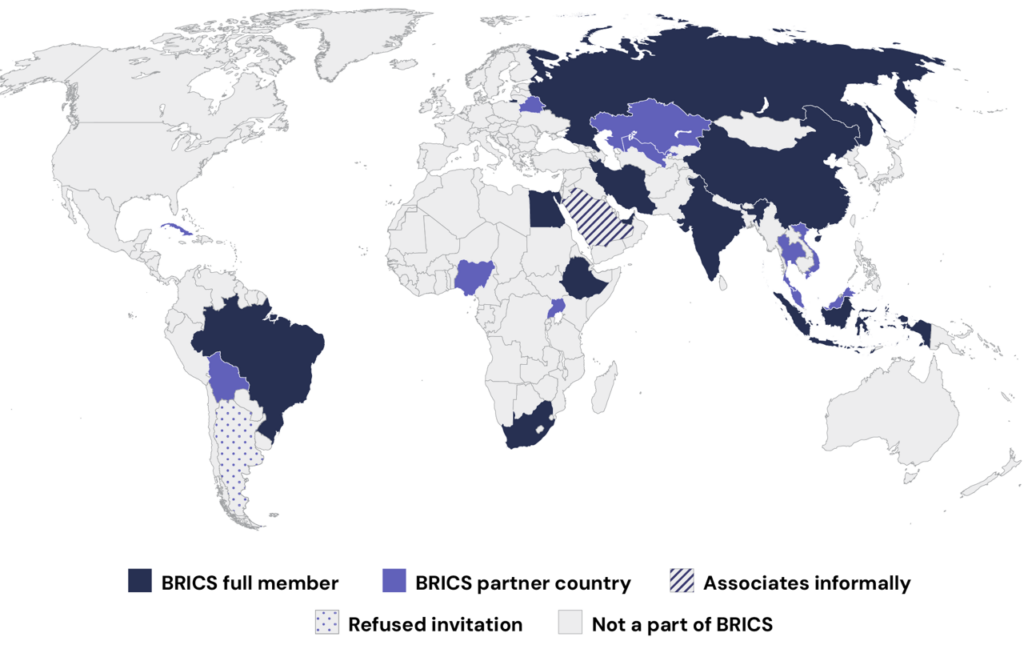
The expansion of BRICS has not just increased its headcount; it has also included entirely new regions in its mix. With Indonesia’s full membership, the largest state in Southeast Asia — among the most economically dynamic regions of the world — is now at the table. Additionally, Vietnam, Malaysia, and Thailand are now partner countries. Nigeria and Bolivia have expanded Africa and Latin America’s footprints in the club. Kazakhstan and Uzbekistan’s presence adds a Central Asian dimension.23The argument that BRICS is not sufficiently representative of the non–West is no longer tenable.
Economic emergence
BRICS is also emerging as an economically significant club. BRICS member states represented 48 percent of the world’s population and 39 percent of world GDP (Purchasing Power Parity, or PPP) as of 2025.24They achieved an average annual GDP growth rate of 6.2 percent between 2003 and 2024, significantly outpacing the global average of 3.0 percent during the same period. Intra–BRICS exports grew to $1.17 trillion in 2024 from $84.2 billion in 2003, a 13.3 percent growth rate; the world’s equivalent was 5.7 percent.25
How much economic heft does BRICS pack compared to the Western core of advanced economies? Comparing BRICS to the G7 makes the most sense to answer this question. Made up of Canada, France, Germany, Italy, Japan, the United Kingdom, and the United States, the G7 is well representative of the most consequential Western states, all being US allies as well.26
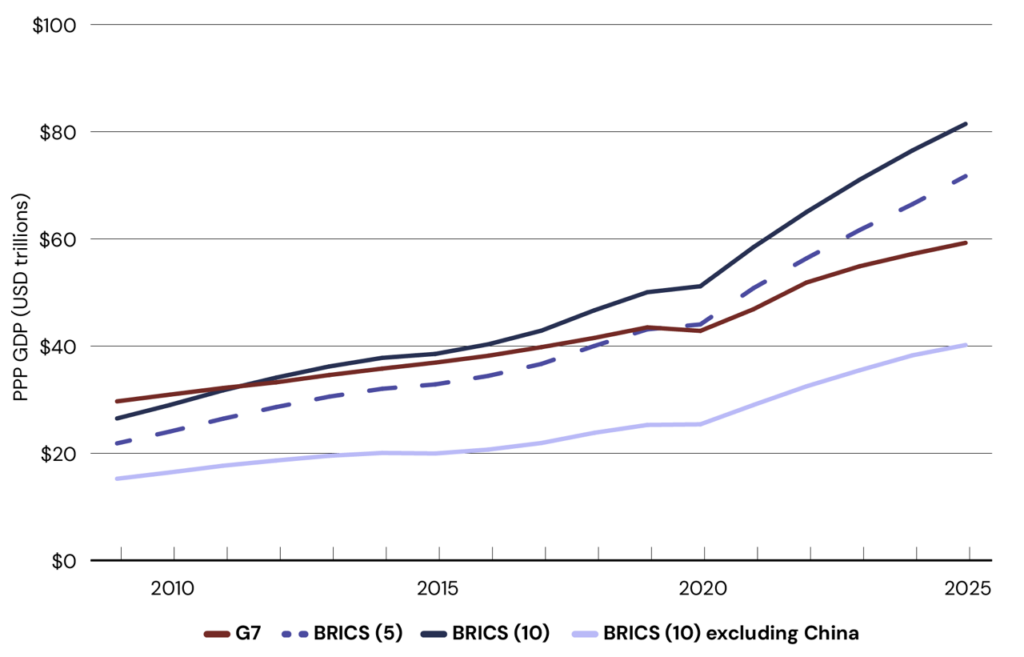
In terms of GDP (PPP), the original five BRICS members overtook the G7 in 2019, and their lead is increasing with time.27The addition of five new members since 2025 has only accentuated this trend (See Figure 2).
This catch-up is also reflected in intra-group trade figures. Whereas intra–G7 trade has fallen from 25 percent of the world’s total in 2000 to 12 percent in 2024, intra–BRICS trade grew from about 1 percent to almost 5 percent in the same time period.28
With Beijing’s spectacular rise over the past two decades, it is not surprising that China makes up the largest fraction of BRICS’ economic footprint. If the Chinese contribution is removed, the rest of BRICS still lags behind the G7 (See Figure 2). Still, expressed as a percentage of G7 output, BRICS excluding China is catching up with the G7 (48 percent to 77 percent from 2009 to 2025). In other words, while China is, unsurprisingly, the dominant economic component of BRICS, other members are also doing their part.
Figure 2: BRICS economies have established a lead over G7
Thus, BRICS has now emerged as an important new coalition in the global order. BRICS’ expansion is also significant by itself: if BRICS was an irrelevant coalition, so many states would not be seeking to join it. But this raises the next question: Why is BRICS rising, and why do its members, current and prospective, find it so attractive?
Why is BRICS rising?
BRICS should not be romanticized as some sort of revival of Third-World solidarity of the 1950s, 1960s, and 1970s. The Non–Aligned Movement’s themes of nuclear disarmament, a sweeping redistribution of global wealth, and massive technology transfer to the Global South are all missing or marginal to BRICS summit conversations and joint statements. The focus is the pursuit of a limited and common set of national interests, often private-sector driven, which are mainly developmental, coupled with an advocacy of multipolarity and multilateralism. Thus, rather than uniting around common ideological ambitions as they tried to do in the past, Global South states have joined (or seek to join) BRICS for more pragmatic reasons, in pursuit of their individual national interests.29
Two factors explain BRICS’ increased attractiveness to the Global South. The first is the result of Washington squandering its reputation as a role model for the world. The global financial crisis, the global war on terror, and other missteps by Washington and some of its allies have contributed to the rise of instability in the international system. Moreover, the turn toward greater unilateralism in US policies since the advent of the second Trump administration has only entrenched the sense that the United States is an unreliable actor.
The US–led global order has also failed to deliver on the two things Global South states have most consistently wanted from it: support for economic development and respect for their sovereignty. When existing systems fail to deliver, states naturally tend to “forum shop,” meaning they try to use other institutions and clubs to advance their interests. Global South states, as weaker actors, rely especially on multilateralism in their attempts to achieve security and prosperity for their people.
The second driver of the rise of BRICS is a perceptible sense across much of the world that unipolarity is in secular decline, opening up a highly uncertain future. The United States remains the most powerful actor in the international system, but it can no longer dominate or define many agendas as it did in the 1990s. When the dominance of the current steward of the global order, the United States, cannot be taken for granted in the future, the rational response is to hedge against this uncertainty. The Global South’s increased investment in BRICS is a part of what I have previously called “hedge-mony.”30
More than a talk shop
The scope and breadth of membership, and measures of economic strength, are important ways to gauge the relevance of a group like BRICS. But it is also important to ask deeper questions related to impact. Have BRICS initiatives led to significant policy convergence between its members? How have they improved the prospects of Global South states? And how, if at all, is BRICS beginning to shape the future global order?
Over the years, the BRICS agenda has expanded to cover a kitchen sink of issues. Many remain at a rhetorical level in summit declarations and in early-stage working groups. This is not entirely irrelevant. Continuous communication creates deeper understanding of issue areas across member states and helps build a community through socialization, which can pay off as concrete actions down the road.
Mapping policy themes aggregated across BRICS summit declarations from its very first summit in 2009 is a useful way to understand its leaders’ priority areas (presented as a word cloud in Figure 3).31
Figure 3: Key policy themes in BRICS summit declarations (2009–2025)
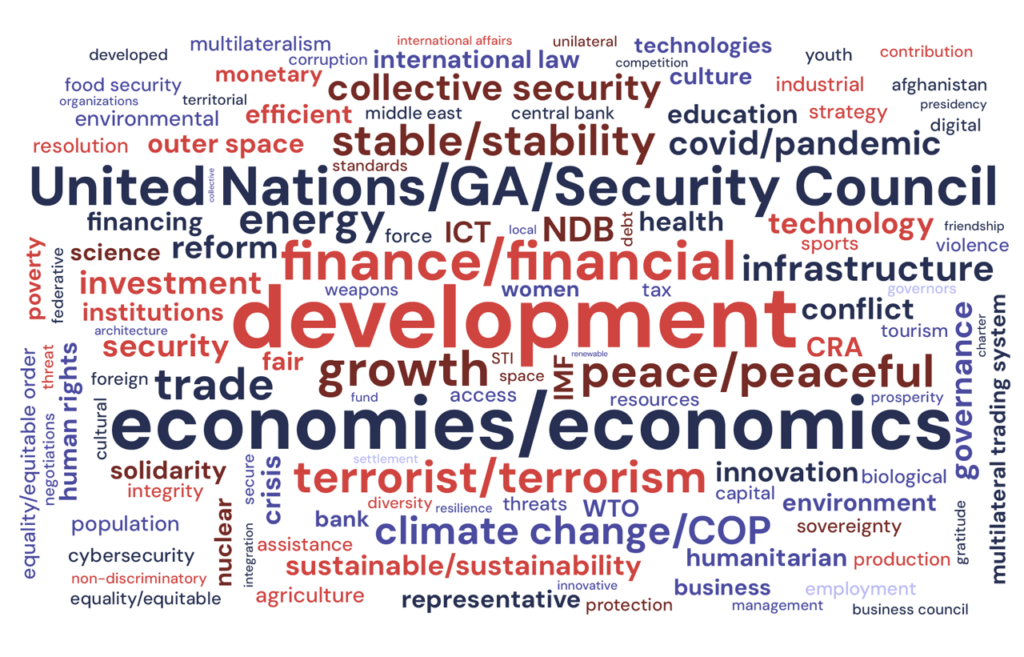
The theme of economic development tops the list of BRICS priorities (with growth, energy, trade, the NDB, climate change, and infrastructure as its most important sub-themes). But a focus on the UN system is a close second (with collective security, terrorism, stability, and peace also taking a prominent place within the security bucket). This indicates that, while BRICS is typically seen as a developmental grouping, several geopolitical and security issues are almost as much on the mind of its member states.
Within the developmental theme, there is also evidence that intra–BRICS interactions have, over time, led to policy harmonization within its members in several issue areas, but especially in finance, industrial development, food security, trade, climate change, and health.32These are the areas where BRICS’ impact is most likely to be found. We will examine them next for evidence of institutionalization and concrete actions.
Development finance
It is well understood that challenges in both volumes and cost of capital are serious barriers to faster growth in the Global South.33This makes accessible development finance a key goal for much of Africa, Asia, and Latin America.
BRICS has made its biggest mark in multilateral development finance, a space traditionally dominated by the US–led World Bank and its affiliates. The “BRICS bank,” the NDB, headquartered in Shanghai, was first proposed by India during the 2012 New Delhi summit and announced during the 2014 summit in Fortaleza, Brazil.34Launched with $100 billion in authorized capital and $50 billion in subscribed capital split equally among the five original members, the NDB has approved financing exceeding $40 billion across more than 120 projects in clean energy, transportation, water, and digital infrastructure.35This remains well below the levels of the World Bank Group, which disbursed $118.5 billion in loans just in 2025, but comparable to the Chinese–dominated multilateral Asian Infrastructure Investment Bank, which lent a total of $38.4 billion over the past decade.36
The five original BRICS members, Brazil, Russia, India, China and South Africa, hold close to 95 percent of the NDB’s capital and rotate the presidency among themselves. But, unlike the World Bank, no single country has veto power over the bank’s decisions. Decisions require a simple majority (i.e., three of the five founding states). Membership of the NDB is not restricted to BRICS members; any UN member state can join. The bank has maintained a high international credit rating throughout and offers loans denominated in local currencies rather than only the dollar.37
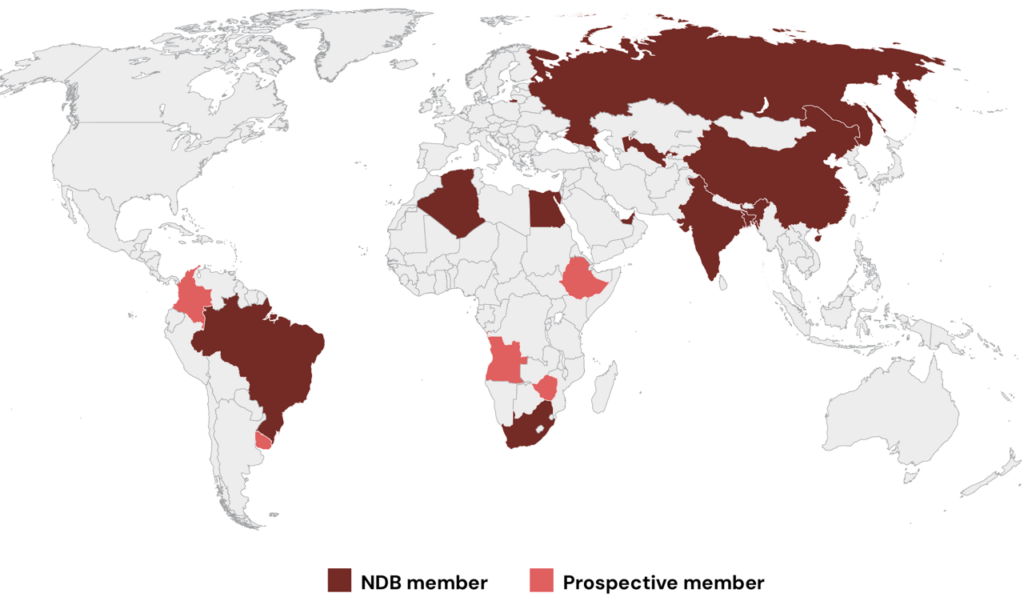
Starting in 2021, the NDB began to admit states that were not members of BRICS (some later became partner countries). These now include Algeria, Bangladesh, Egypt, Colombia, the UAE, Uzbekistan, and Zimbabwe, bringing total membership to eleven (See Figure 4).38The NDB now covers 46 percent of the world’s population and 37 percent of global GDP. With the entry of new members, the level of subscribed capital stands at $53.6 billion as of June 2026.39
Figure 4: Member states of the New Development Bank
Rather than cast its net wide, the NDB has zeroed in on two areas crucial to economic development in the Global South: infrastructure and sustainability. The bank pointedly stays away from spaces such as domestic “good governance” reforms, institution building, and anti-corruption, which Western–led lending institutions have long pushed. But the NDB has also stepped in to support disaster relief in the Global South. For example, it launched a $10 billion emergency assistance program for its vulnerable members during the pandemic, including an emergency loan to South Africa, and later allocated $1.1 billion for reconstruction in the wake of catastrophic 2024 flooding in Brazil.40
The NDB also takes a different approach to environmental and social concerns by asking recipient states to follow their own standards. Thus, the NDB governance model, with no single government holding a veto and flexible policy conditionality attached to loans, is a clearly novel departure from the more intrusive approaches of the US–dominated World Bank and the International Monetary Fund, or IMF. These Bretton Woods institutions were designed right after World War II, when most of the Global South was still colonized.
The NDB is clearly a success story in creating a new institution with standards much more aligned with Global South preferences. It is among the first post-unipolar experiments in multilateralism. However, the bank will need to be scaled up by close to an order of magnitude if it is to emerge as a shaper of the future global economic order.
Other issue areas
BRICS has also taken up the issue of financial instability, to which Global South countries are especially vulnerable. The 2008 global financial crisis began in the United States. Before that, the 1998 Asian financial crisis originated in the developing countries of Southeast Asia. In 2015, BRICS launched the Contingent Reserve Arrangement: a $100 billion financial stability initiative aimed at mitigating liquidity crises through establishing currency swap lines. China has committed $41 billion to the CRA; Russia, India, and Brazil have committed $18 billion each, and South Africa added $5 billion.41Though member states have never used the CRA, including during the pandemic, it remains a latent mechanism that could be called upon in future crises, especially those in which the IMF may be found wanting. The CRA has so far conducted seven technical test runs to ensure readiness.42BRICS’ detailed proposal on IMF quota reform issued in 2025 is also noteworthy. It aims to make the world’s dominant multilateral financial institution more equitable from a Global South perspective.43
BRICS has taken smaller steps toward institution-building in health and food security. The Partnership for the Elimination of Socially Determined Diseases was launched at the Rio summit in 2025, and its operational framework was endorsed in 2026.44BRICS has focused on pooling research capacities on tuberculosis, mental health, and vaccine research, and it also launched a medical regulatory convergence initiative.45Regulatory convergence could lower the cost of registering medicines across BRICS markets.
With a history of colonial-induced famines and the advent of climate change, food security is a vital area for the Global South.46At the 2024 Kazan summit, host Russia floated an innovative proposal for a BRICS grain exchange.47The grouping’s countries account for roughly 44 percent of the world’s grain production and consumption and nearly 25 percent of global grain exports.48Global commodity exchanges are predominantly based in the United States and Europe. If the proposal is implemented, the exchange will mark a significant move in decentering the role of the West in a commodity core to Global South interests.49
BRICS has taken noteworthy action in science and technology. The BRICS Science and Technology Initiative, or STI, has launched seven calls for collaborative proposals in science and technology across multiple themes such as sustainable agriculture, new and renewable energy, space, medicine, and others.50
Trade integration and combating terrorism are two areas where BRICS states’ convergence is very strong. China, India, and Russia have especially suffered from serious terrorist attacks in their recent history. Defending the multilateral trading order under the World Trade Organization framework is a longstanding theme in BRICS summit statements. Intra–BRICS trade is becoming much more significant relative to the G7’s internal trade footprint, as noted previously. Most BRICS countries have also individually accelerated trade integration efforts with non–BRICS countries since the Trump administration’s “Liberation Day” tariffs of April 2025.51Trade deepening within BRICS happens informally, during BRICS Business Council meetings. BRICS has a major opportunity to take formal steps toward deeper trade integration and greater cooperation on countering transnational terrorist groups.
Is BRICS a threat to US interests?
Washington’s posture toward BRICS has swung between two equally unhelpful poles: dismissal and hostility, with little space in between for a nuanced understanding and a proportionate response tailored to US interests.
The Biden administration was essentially dismissive of BRICS. At the announcement of the grouping’s major expansion, then–National Security Advisor Jake Sullivan spoke of “a very diverse collection of countries … with differences of view on critical issues” and added that Washington was “not looking at the BRICS as evolving into some kind of geopolitical rival to the United States.”52
The second Trump administration has swung to the other extreme of open hostility. Soon after being elected in 2024, but before assuming office, Donald Trump issued a threat of a 100 percent tariff on BRICS countries unless he got a “commitment from these countries that they will neither create a new BRICS currency, nor back any other currency to replace the mighty US dollar.”53Trump repeated his remarks as president at the Munich Security Conference in February 2025.54In July 2025, he attacked BRICS again, saying that “BRICS was set up to hurt us, BRICS was set up to degenerate our dollar and take our dollar, take it off as the standard,” while issuing another tariff threat.55The US commerce secretary issued an explicit threat to India in September 2025 when he told the founding BRICS member to “stop buying Russian oil, stop being a part of BRICS, and support the United States and the dollar or face a 50 percent tariff.56
Is BRICS truly emerging as a threat to the United States and its interests? To answer this question, two sub-questions must be addressed. First, what are the prospects of a BRICS–led de-dollarization of the global financial system? Second, does BRICS represent a radical challenge to the US–led order? If the answer to either or both questions is yes, then Washington has reason to be concerned about the rise of BRICS.
The upshot of the discussion below is that BRICS is a reformist, not radical, grouping, and it does not present an imminent threat to the dollar or core US interests. However, Washington is unwittingly strengthening the drivers for BRICS to emerge as a stronger grouping with a sharper challenge to the US–led order.
Is BRICS driving global de-dollarization?
De-dollarization is the topic allegedly on the BRICS agenda that gets major media attention and the one Washington most latches on to when it paints BRICS as a major threat.57Considerable literature exists on the broader question of whether the world order is moving away from dollar hegemony, which former French Minister of Finance Valéry Giscard d’Estaing famously called an “exorbitant privilege.”58
The de-dollarization conversation is not entirely fictional. The US dollar’s hegemony is starting to erode at the margins for many reasons and due to multiple actors. But the overall conclusion is that there is no imminent threat to America’s commanding role in global finance. And BRICS has played only a small role in the limited erosion that has taken place.
As of August 2026, according to the Atlantic Council’s Dollar Dominance Monitor, the US dollar makes up 57 percent of the global foreign exchange reserves, 54 percent of global export invoicing, and 89 percent of the share of foreign exchange transactions.59Moreover, no other currency, including the Chinese renminbi, even comes close to being a challenger.60The US Federal Reserve defines an index of international currency usage, in which the dollar has fallen only slightly since the year 2000.61
On the other hand, there is indeed a trend of “slow and bounded” de-dollarization underway.62States worry about Washington’s ability to impose sanctions and use other coercive means by leveraging the dollar’s dominance. A unipolar currency order also raises questions of global financial stability.63
The usage of local currencies in trade transactions has increased to an extent, mainly driven by Russia–China and Russia–India bilateral arrangements since 2022, and the Association of Southeast Asian Nations’ embrace of a similar approach.64Africa is beginning to follow in these footsteps with the Pan–African Payment and Settlement System.65All these efforts are happening piecemeal, with no global coordination. But unless Washington makes even more blunders that force countries to accelerate their efforts, the dollar’s dominance is likely to persist for at least a couple of more decades.66
To the extent the dollar’s role is eroding, how much is BRICS contributing to it? Very little, as it turns out.67Within the grouping, Russia is the keenest on de-dollarization, for reasons directly tied to the severe sanctions regime imposed on it by the United States and its allies since 2022.68But China’s enthusiasm for de-dollarization is lukewarm at best, reflecting Beijing’s own caution about ceding monetary control to any shared arrangement, and its desire to maintain the dialogue for strategic stability it is engaged in with the Trump administration. And virtually every Global South member (except Iran) is uncomfortable with any framework that could lead to greater dependence on the Chinese renminbi. Brazil and India have explicitly denied any intent to de-dollarize or create a rival BRICS currency.69
Nevertheless, two BRICS initiatives bear watching. The first is the NDB’s push for lending in local currencies, with the aim of a 30 percent share by the end of 2026.70But, considering the NDB’s modest footprint (its lending volume is many times smaller than the World Bank), and the fact that development finance is itself not the engine for a currency’s global fortunes, this can have only a marginal effect on the dollar’s global role.
A potentially more serious development is a BRICS–wide payment system for settling transactions in local currencies through a decentralized cross-border financial messaging system, acting as an effective rival to the currently dominant SWIFT.71Such a system does not need the creation of a common BRICS currency, or the yielding of sovereignty by central banks. Technological breakthroughs such as blockchains and central bank digital currencies have made such alternatives feasible. While SWIFT, headquartered in Belgium, is amenable to pressure from Washington, a BRICS payment system would sit outside the US–influenced financial networks. Even if the volume of payments routed through such an alternative system were limited, the United States would lose some of the geopolitical benefits of surveillance and coercion it now has over networks it can dominate.
The upcoming BRICS summit in New Delhi is expected to see further steps in building the infrastructure for the payment system, though technical and legal hurdles still need to be overcome to make it operational.72BRICS is developing the infrastructure, aided by technological advances, to move away from transacting in dollars between its members. But the club has not fully built the infrastructure, and progress is slow. Moreover, BRICS does not yet have the necessary level of geopolitical convergence (see below), inter-member trust, and, most importantly, the necessary political will to take a decisive turn away from the dollar.
Is BRICS radical or reformist?
The rise of BRICS is geopolitically significant. In less than two decades, BRICS has created the first truly transcontinental non–Western club, with significant achievements across a substantial geography and share of the global economy. It has maintained thick and thickening levels of interaction between its member states across a wide array of issues, including at the leader level. The grouping has doubled its size since its founding (or quadrupled it, if partner countries are considered). BRICS member states have also, until recently (see below), not let bilateral disputes get in the way of the club’s smooth functioning, including the most significant axis of such tension: China and India. All this is not easy in a world in which the United States remains the most powerful systemic actor with long reach and does not take kindly to any real or perceived challenges to its power.
The NDB and the CRA represent the best cases of BRICS going beyond rhetoric and building concrete institutions. The NDB is an especially successful case, despite its relatively modest size. Notable developments in other areas also have a good chance of flowering. The NDB’s design of no veto powers for any state and rejection of Western–crafted, World Bank– or IMF–style loan conditionalities is also a critical step in reifying the norm of state sovereignty; a norm which practically all Global South states, as well as China and Russia, strongly embrace.
These initiatives indicate a clear reformist push to plug gaps where US–led global institutions have been absent or have even damaged the interests of the Global South. But they do not amount to a radical challenge to the global order; rather, if anything, they entrench traditional Westphalian concepts of the state system.
It is true that Moscow and Beijing are locked in a serious security rivalry with Washington. But the Global South component of BRICS (except Iran) has a different orientation toward the United States than the Global East of Russia and China. Brazil, Indonesia, South Africa, and others are playing a hedging game and trying their best to maintain their historically good relations with all great powers. Moreover, India and the UAE are more than hedgers — being close US partners that have invested in strong security ties with Washington for decades.
In general, the Global South prefers BRICS to complement, rather than replace, Western–led institutions. But where the current order is failing, there are tendencies to undertake “soft balancing” on a limited set of issues.73These include, for example, UN reform, reifying a stronger idea of sovereignty, and pushing for a greater accounting of the economic interests of Global South states.
A world at war presents a challenge to BRICS.74As detailed previously, the grouping largely agrees on strengthening UN–centered multilateralism, fighting terrorism, and energizing economic development. BRICS declarations have expanded significantly since the 2011 summit in China in their coverage of geopolitical and security issues in non–BRICS countries. But serious differences over geopolitics have recently emerged within the expanded BRICS.
The Iran war is a good example. The Brazilian presidency of BRICS in 2025 generated a separate joint statement expressing “grave concern” at the US–Israeli attack on Iran (without naming the United States or Israel) and characterized it as a “violation of international law and the Charter of the United Nations.”75But under India’s presidency in 2026, BRICS foreign ministers failed to agree on such a statement, mainly because the war had by then pitted the UAE against Iran (both having joined BRICS recently).76
Even before the Iran war, BRICS faced a moment of deep division when new members Egypt and Ethiopia strongly opposed advocating for South Africa as a member of a reformed UN Security Council, or UNSC. Since the 2011 summit in Sanya, China, BRICS had routinely and uncontroversially mentioned Brazil, India, and South Africa by name in connection with reforming the UNSC.77However, the opposition by Egypt and Ethiopia led to a standoff and prevented the issuance of a joint statement during the BRICS foreign ministers’ meeting in April 2025.78
Clearly, BRICS’ big leap from five to 10 core members has not been without challenges, and consensus is becoming harder to achieve. This has made the grouping less able to build on its successes, and is slowing down its journey toward a more unified and assertive actor in world politics.
Policy recommendations for Washington
The rise of BRICS is a significant development. But the club also suffers from limitations and internal rifts. A policy response that fails to account for both these truths simultaneously is unlikely to serve American interests well.
Contrary to current perceptions in Washington, BRICS is a reformist, not a radical, grouping. It does not seek global revolutionary change, and is a far cry from the redistributionist demands of the newly decolonized Global South in the 1960s and 1970s. But its rise against all odds in a US–dominated world should be taken seriously. BRICS represents a strong demand signal and a reformist challenge from the Global South for repairing the broken international system.79Unwittingly as it may be, Washington’s own policies, including a history of sanctions against geopolitical rivals and a turn away from multilateralism, have been major drivers for the rise of BRICS. The recent issuance of crude and explicit threats against BRICS undoubtedly puts pressure on its Global South states in the short term.80But, in the longer run, it can only strengthen the incentives for its members to overcome their differences, move away from the US dollar, and challenge Washington in other ways.
It is certainly not in the US national interest for BRICS to create a parallel global order, even if it happens slowly. At this stage, the United States could slow BRICS down but cannot destroy it, and probably cannot stop its longer-term trend of greater collective assertion in economic, developmental, and normative arenas.
On the other hand, a stronger but still reformist BRICS could be an asset to the United States. It could help manage global crises when they strike and forge preventive solutions to common systemic challenges such as financial instability, climate shocks, new pandemics, and food insecurity. The United States is also threatened by these challenges, which urgently require coordinated action across the Global North and South to contain and manage them.
Thus, Washington would benefit from the following policies with respect to BRICS and its key Global South states:
- The 2025 US National Security Strategy demonstrated maturity by explicitly accepting that the world is becoming less unipolar.81Take the logical next step and accept that alternative multilateral or plurilateral institutions, such as BRICS, which do not include the United States or its closest allies, will emerge as a natural byproduct of the decline of unipolarity.
- Do not see BRICS as a vehicle for de-dollarization that threatens the United States. Such an occurrence is improbable due to anything BRICS does. The dollar possesses inherent strengths, BRICS suffers from significant structural limitations, and the Global South is currently reluctant to go too far down that road. But, ironically, the chances of BRICS gaining momentum on circumventing the dollar grow the more the United States acts coercively toward BRICS and continues its sanctions- and tariff-heavy foreign policy.
- Rather than treating BRICS as an adversarial or anti–American project, recognize that a BRICS focused on development finance, global health, and disaster relief in particular can help deliver a more stable world with expanding markets, which is in the US national interest. Such a world will give rise to fewer bad non-state actors and cause less involuntary migration to the United States and elsewhere.
- Consider engagement with BRICS’ New Development Bank. Some of the bank’s priorities, especially infrastructure, may align with US interests. Joint projects with the NDB may not be politically feasible, but complementarities that qualify as being in the US national interest can be actively pursued.
- Within BRICS, Brazil and India, both founding members, are outsized Global South powers and historically close to the United States. The United States needs to do what it can to ensure they maintain their traditional middle-ground positions within BRICS and elsewhere. Current US bilateral policies, including, among other things, interference in domestic politics (in the case of Brazil) and the mercurial imposition of tariffs (in both cases), have needlessly alienated key constituencies in these countries. The United States can fix these unforced errors, and should do so as soon as possible.
Acknowledgements
Dan Ford and Georgia Webb provided research support for this study.
Program
Countries/Territories
Entities
Authors

Sarang Shidore is director of the Global South Program at the Quincy Institute. His research focuses on the Global South in the global order, Asian security, and climate geopolitics.
Citations
Sarang Shidore, “The Return of the Global South,” Foreign Affairs, Aug. 31, 2023, https://www.foreignaffairs.com/world/return-global-south-critique-western-power. ↩
Christopher Layne, “This Time It’s Real: The End of Unipolarity and the Pax Americana,” International Studies Quarterly 56, no. 1 (March 2012): 203–13, https://academic.oup.com/isq/article-abstract/56/1/203/1939830. ↩
Sarang Shidore, “The Global South’s BRICS Play Should Not Be Dismissed,” The Nation, Aug. 17, 2023, https://www.thenation.com/article/world/the-global-souths-brics-play-should-not-be-dismissed. ↩
“BRICS Are Better Off Disbanding Than Expanding,” Reuters, July 31, 2023, https://www.reuters.com/breakingviews/brics-are-better-off-disbanding-than-expanding-2023-07-31; Sadanand Dhume, “The BRICS Bloc Is a House of Cards,” Wall Street Journal, March 11, 2026, https://www.aei.org/commentary/the-brics-bloc-is-a-house-of-cards. ↩
Joseph S. Nye Jr., “What Are the BRICS Good For?,” Project Syndicate, Jan. 2, 2025, https://www.project-syndicate.org/commentary/brics-china-russia-india-do-not-represent-global-south-and-have-own-rivalries-by-joseph-s-nye-2025-01. ↩
Jim O’Neill, “The BRICS Still Don’t Matter,” Project Syndicate, Oct. 17, 2024, https://www.project-syndicate.org/commentary/moscow-brics-summit-expanded-bloc-still-rudderless-and-ineffective-by-jim-o-neill-2024-1. However, O’Neill has more recently changed his tune on BRICS. See Karin Strohecker, “BRICS Alternatives to Dollar No Longer a ‘Fantasy,’ Economist O’Neill Says,” Reuters, July 6, 2026, https://www.cnbcafrica.com/2026/brics-alternatives-to-dollar-no-longer-a-fantasy-economist-oneill-says. ↩
Sarang Shidore, “How BRICS Can Survive ‘America First,’” Foreign Policy, July 2, 2025, https://foreignpolicy.com/2025/07/02/brics-america-first-trade. ↩
Cedric de Coning, Thomas Mandrup, and Liselotte Odgaard, eds., The BRICS and Coexistence: An Alternative Vision of World Order (London: Routledge, 2015), https://www.routledge.com/The-BRICS-and-Coexistence-An-Alternative-Vision-of-World-Order/deConing-Mandrup-Odgaard/p/book/9780415791113. ↩
See President Lula’s address at the 2025 BRICS summit in Rio de Janeiro: https://www.youtube.com/watch?v=PaV5bt5mnYw. The historic 1955 Bandung conference of newly decolonized Asian and African nations was a landmark event in what was then called the “Third World,” and the Non-Aligned Movement founded in 1961 took many of these ideas forward in an institutionalized framework. See archival footage of the Bandung Conference here: https://www.youtube.com/watch?v=zg4OGtlxu3Y. ↩
Sarang Shidore, “American Power Just Took a Big Hit,” New York Times, Sept. 1, 2023, https://www.nytimes.com/2023/09/01/opinion/brics-expansion-america.html. ↩
Jim O’Neill, “Building Better Global Economic BRICs,” Goldman Sachs, Nov. 30, 2001, https://www.goldmansachs.com/insights/goldman-sachs-research/building-better. ↩
BRIC foreign ministers, however, had been meeting at the sidelines of UN General Assembly sessions in New York since 2006. ↩
The Durban summit also marked the first structured outreach to non–BRICS states when South Africa invited its African partners for meetings on the day after the summit. See “BRICS Reach Deal over Development Bank,” Al Jazeera, March 27, 2013, https://www.aljazeera.com/economy/2013/3/27/brics-reach-deal-over-development-bank; “BRICS Summit Kicks Off in Durban,” China Daily, March 27, 2013, https://www.chinadaily.com.cn/world/2013-03/27/content_16347652.htm. ↩
“Sixth BRICS Summit – Fortaleza Declaration,” Ministry of External Affairs, Government of India, July 15, 2014, https://www.mea.gov.in/bilateral-documents?dtl/23635/Sixth_BRICS_Summit__Fortaleza_Declaration. ↩
“VII BRICS Summit: Ufa Declaration,” BRICS Information Centre, University of Toronto, July 9, 2015, http://www.brics.utoronto.ca/docs/150709-ufa-declaration_en.html. ↩
“IX BRICS Summit Xiamen Declaration,” Ministry of Foreign Affairs of the People’s Republic of China, 2017, https://brics2022.mfa.gov.cn/eng/gyjzgj/ljldrhwcgwj/202202/t20220222_10644353.html; and Wang Yi, “BRICS Plus’ Pattern to Fully Release Vitality of BRICS Cooperation,” Ministry of Foreign Affairs of the People’s Republic of China, Aug. 30, 2017, https://www.fmprc.gov.cn/eng./zy/jj/2017zt/XJPZCJZGJLDRDJCHWHXXSCGJYFZZGJDHH/202406/t20240606_11380699.html. ↩
“China’s ‘BRICS Plus’ Brings More Developing Economies to Trade Table,” CGTN America, Sept. 4, 2017, https://america.cgtn.com/2017/09/04/china-2017-summit-brics-plus. ↩
South Africa invited Global South states that were heading major regional and global institutions that year. Turkey participated as the chair of the Organization of Islamic Cooperation, Jamaica as the head of the Caribbean Community, and Argentina as the chair of the G20. ↩
“XIV BRICS Summit Beijing Declaration,” Ministry of Foreign Affairs of the People’s Republic of China, June 23, 2022, https://brics2022.mfa.gov.cn/eng/dtxw/202206/t20220624_10709295.html; “Concept Paper on Thematic Issues,” Ministry of Foreign Affairs of the People’s Republic of China, 2022, http://brics2022.mfa.gov.cn/eng/zg2022/CPTI. ↩
Pesha Magid, Maha El Dahan, and Manya Saini, “Saudi Arabia Sits on Fence over BRICS with Eye on Vital Ties with US,” Reuters, May 8, 2025, https://www.reuters.com/world/middle-east/saudi-arabia-sits-fence-over-brics-with-eye-vital-ties-with-us-2025-05-08/. ↩
“About Us,” BRICS 2026, accessed August 2026, https://www.brics2026.gov.in/about-us. ↩
“BRICS Expansion: September Summit to Decide New Members,” Rio Times, Aug. 4, 2026, https://www.riotimesonline.com/brics-expansion-september-2026-new-delhi-summit. ↩
Central Asia can be considered as an intermediate space between Russia and the Global South meta-region. ↩
“Population, Total,” World Bank Open Data, accessed August 2026, https://data.worldbank.org/indicator/SP.POP.TOTL; “GDP, PPP (Current International $) – World,” World Bank Open Data, accessed August 2026, https://data.worldbank.org/indicator/NY.GDP.MKTP.PP.CD?locations=1W. ↩
“Two Decades of Intra–BRICS Trade: Trends, Patterns and Policies,” UNCTAD, March 5, 2026, https://unctad.org/publication/two-decades-intra-brics-trade-trends-patterns-and-policies. ↩
Japan is not culturally Western but can be seen as a part of the “Global West” as defined by the United States and its core, wealthy allies. ↩
In terms of nominal GDP, by 2025, the 10 full BRICS members summed up to 60 percent of the GDP of the G7, higher than their relative position in 2010, when they were at 42 percent of the G7. Author’s calculations using data from the World Bank: https://data.worldbank.org. ↩
Richard Baldwin, “When Did G7–to–G7 Trade Stop Dominating World Exports?,” LinkedIn Pulse, Oct. 11, 2024, https://www.linkedin.com/pulse/when-did-g7-to-g7-trade-stop-dominating-world-exports-richard-baldwin-viz6e; “Two Decades of Intra–BRICS Trade: Trends, Patterns and Policies,” UNCTAD. ↩
Sarang Shidore, “The Return of the Global South,” Foreign Affairs, Aug. 31, 2023, https://www.foreignaffairs.com/world/return-global-south-critique-western-power. ↩
Sarang Shidore, “BRICS Southeast Asia Expansion: Malaysia and Thailand Joining Affirms the Global South’s Strategy,” Foreign Policy, July 4, 2024, https://foreignpolicy.com/2024/07/04/brics-southeast-asia-thailand-malaysia-russia-china. ↩
Generated by author from a textual analysis of annual summit declarations from 2009 to 2025. Words that are generic or not related to policy themes were filtered out to create the word cloud. ↩
An innovative “BRICS convergence index” shows an increasing trend of policy convergence until 2021. However, the expansion of BRICS since 2024 may have reversed this process. See Mihaela Papa, Zhen Han, and Frank O’Donnell, “The Dynamics of Informal Institutions and Counter-Hegemony: Introducing a BRICS Convergence Index,” European Journal of International Relations 29, no. 4 (2023): 960–89, https://doi.org/10.1177/13540661231183352. ↩
Financing for Sustainable Development Report 2026: Implementing the Sevilla Commitment (New York: United Nations, 2026), https://financing.desa.un.org/iatf/fsdr2026. ↩
“History,” New Development Bank, accessed August 2026, https://www.ndb.int/about-ndb/history; “VI BRICS Summit,” BRICS Policy Center, accessed August 2026, https://bricspolicycenter.org/en/vi-brics-summit. ↩
“Colombia, Uzbekistan Join BRICS Bank,” Xinhua, July 6, 2025, https://english.news.cn/20250706/d6d8f11ef3534f59a8f3010881a6a522/c.html; “New Development Bank Investor Presentation,” New Development Bank, June 2026, https://www.ndb.int/wp-content/uploads/2026/06/New-Development-Bank_Investor-Presentation_June_2026-2.pdf. ↩
World Bank Group, “Financial Summary,” in World Bank Annual Report 2025 (Washington DC: World Bank, 2025), https://www.worldbank.org/en/about/annual-report/financial-summary; “AIIB Sustainable Development Bonds Impact Report 2025,” Asian Infrastructure Investment Bank, 2025, https://www.aiib.org/en/treasury/_common/_download/AIIB-Sustainable-Development-Bonds-Impact-Report-2025-Web.pdf. ↩
PS Srinivas and Bert Hofman, “New Development Bank’s Role in the International Financial Architecture,” Global Policy Journal (blog), July 25, 2022, https://www.globalpolicyjournal.com/blog/25/07/2022/new-development-banks-role-international-financial-architecture; “Credit Ratings,” New Development Bank, accessed August 2026, https://www.ndb.int/investor-relations/credit-ratings. ↩
Additionally, Ethiopia and Uruguay are in advanced stages of the membership process. ↩
“New Development Bank Investor Presentation,” New Development Bank. ↩
“COVID–19: How Multilateral Development Banks Can Lead through a Crisis,” World Economic Forum, July 17, 2020, https://www.weforum.org/stories/health-and-healthcare-systems/brics-new-development-bank-leads-member-states-through-the-covid-19-crisis/; “More Development Banks Come to Brazil’s Aid after Floods,” LatinFinance, May 14, 2024, https://latinfinance.com/daily-brief/2024/05/14/more-development-banks-come-to-brazils-aid-after-floods. ↩
These amounts are not paid by the states into any centralized account. Rather, they are pledges made to draw upon in the event of a liquidity crisis in a member state. ↩
“XVI BRICS Summit – Kazan Declaration,” BRICS Information Centre, University of Toronto, Oct. 23, 2024, http://www.brics.utoronto.ca/docs/241023-declaration.html. ↩
“Rio de Janeiro Vision for IMF Quota and Governance Reform,” BRICS Finance Ministers and Central Bank Governors, July 5, 2025, https://brics.br/en/documents/economy-finance-trade-and-infrastructure/250705-1st-brics-fmcbg-rio-imf-vision.pdf/@@download/file. ↩
Draurio Barreira Cravo Neto et al., “The BRICS Partnership for the Elimination of Socially Determined Diseases: A Multilateral Agenda to Health Equity,” The BRICS Health Journal 2, no. 3 (2025): 60–71, https://doi.org/10.47093/3034-4700.2025.2.3.60-71. ↩
“16th BRICS Health Ministers’ Meeting Concludes Successfully under India’s BRICS Chairship 2026,” Press Information Bureau, Government of India, July 23, 2026, https://www.pib.gov.in/PressReleasePage.aspx?PRID=2288267®=3&lang=1&v=1; “Online Launching Ceremony of the BRICS Vaccine R&D Center and Workshop on Vaccine Cooperation Successfully Held,” Ministry of Foreign Affairs of the People’s Republic of China, May 2022, https://brics2022.mfa.gov.cn/eng/zdhzlyhjz/others/202205/t20220531_10696472.html. ↩
Mike Davis, Late Victorian Holocausts: El Niño Famines and the Making of the Third World (London: Verso, 2001). ↩
“XVI BRICS Summit,” BRICS Information Centre. ↩
Zongyuan Zoe Liu and Nadia Clark, “Why Expanded BRICS Is Backing a Russia–Initiated Grain Exchange,” Council on Foreign Relations, Oct. 31, 2024, https://www.cfr.org/articles/why-expanded-brics-backing-russia-initiated-grain-exchange. ↩
“BRICS Emerges as New Global Hub of Food Security,” The Tribune, Nov. 17, 2025, https://www.tribuneindia.com/news/world/brics-emerges-as-new-global-hub-of-food-security; “‘BRICS Leaders Expect a Genuine Transformation of Grain Trade Mechanisms,’” HSE University, Feb. 6, 2026, https://www.hse.ru/en/news/research/1125969906.html. ↩
“About,” BRICS Science, Technology, and Innovation Framework Programme, accessed Aug. 2026, http://brics-sti.org/index.php?p=about; “1st BRICS STI Framework Programme Innovation Call,” BRICS Science, Technology, and Innovation Framework Programme, Aug. 28, 2025, http://brics-sti.org/index.php?p=new/41. ↩
Sarang Shidore, “American Supremacy Is Over, and Something New Is Coming,” New York Times, Jan. 12, 2026, https://www.nytimes.com/2026/01/12/opinion/trump-venezuela-world-mercosur.html. ↩
“White House: US Doesn’t See BRICS Nations Turning into a Geopolitical Rival,” Reuters, August 29, 2023, https://www.reuters.com/article/markets/commodities/white-house-us-doesnt-see-brics-nations-turning-into-a-geopolitical-rival-idUSW1N37I01P/; “US Sees Wake-Up Call, if Not Threat, as BRICS Bloc Expands,” France24, Aug. 29, 2023, https://www.france24.com/en/live-news/20230829-us-sees-wake-up-call-if-not-threat-as-brics-bloc-expands. ↩
Donald J. Trump, “Statement by President–Elect Donald J. Trump on the Use of the US Dollar & BRICS Nations,” American Presidency Project, University of California, Santa Barbara, Nov. 30, 2024, https://www.presidency.ucsb.edu/documents/statement-president-elect-donald-j-trump-the-use-the-us-dollar-brics-nations. ↩
Nicholas Gordon, “Trump Threatens BRICS Tariffs over Challenge to US Dollar,” Fortune, Feb. 14, 2025, https://fortune.com/asia/2025/02/14/trump-threatens-brics-tariffs-challenge-us-dollar. ↩
“Trump Promises More Tariff Letters and Warns BRICS of What’s Coming,” CNN, July 9, 2025, https://www.cnn.com/2025/07/09/business/tariffs-trump-letters-threat-brics-intl-hnk. ↩
“US Commerce Secretary Warns India to Stop Buying Russian Oil, Leave BRICS or Face Tariff,” Times of India, Sept. 6, 2025, https://timesofindia.indiatimes.com/business/india-business/india-will-say-sorry-and-make-a-deal-us-commerce-secretary-howard-lutnick/articleshow/123722728.cms. ↩
Though, the Trump administration has internally conflicting views on the dollar’s strength. See Karthik Sankaran, “The Three-Dollars Problem,” Financial Times, Dec. 11, 2024, https://www.ft.com/content/6c9821f3-924f-4d07-a95e-765512b8c634. ↩
Desmond Lachman, “The End of America’s Exorbitant Privilege,” Project Syndicate, July 7, 2025, https://www.project-syndicate.org/commentary/trump-undermining-faith-in-us-economy-and-dollar-by-desmond-lachman-2025-07. ↩
“Dollar Dominance Monitor,” Atlantic Council, accessed August 2026, https://www.atlanticcouncil.org/programs/geoeconomics-center/dollar-dominance-monitor. ↩
China lacks deep and liquid domestic debt markets and maintains capital controls, which are major disadvantages. See Ruchir Sharma, “The Battle the US Is Winning against China,” Financial Times, May 18, 2026, https://www.ft.com/content/6228616c-0231-4926-ac1b-7125759c34a7. ↩
“The International Role of the US Dollar, 2025 Edition,” Board of Governors of the Federal Reserve System, July 18, 2025, https://www.federalreserve.gov/econres/notes/feds-notes/the-international-role-of-the-u-s-dollar-2025-edition-20250718.html. ↩
Otaviano Canuto, “De-Dollarization, Local Currencies, and External Financial Defense,” Policy Center for the New South, August 2025, https://www.policycenter.ma/sites/default/files/2025-08/RP_07-25%20(Otaviano%20Canuto).pdf ↩
Karthik Sankaran, “Letter: A Multi-Polar Monetary System or the Global Dollar,” Financial Times, May 27, 2025, https://www.ft.com/content/d25ce01c-6ff4-453b-8571-3ebee38e2e79. ↩
“ASEAN Countries Strengthen Commitment to Use Local Currency,” Bank Indonesia, Sept. 18, 2025, https://www.bi.go.id/en/publikasi/ruang-media/news-release/Pages/sp_2722025.aspx; “Putin Announces Major Shift: India–Russia Trade Almost Fully in National Currencies,” APT, YouTube, Dec. 5, 2025, https://www.youtube.com/watch?v=tlzq4rne9II; Hung Tran, “Understanding the Growing Use of Local Currencies in Cross-Border Payments,” Atlantic Council, Aug. 25, 2023, https://www.atlanticcouncil.org/blogs/econographics/understanding-the-growing-use-of-local-currencies-in-cross-border-payments. ↩
“African Countries Are Souring on the Dollar,” Economist, Aug. 6, 2026, https://www.economist.com/finance-and-economics/2026/08/06/african-countries-are-souring-on-the-dollar. ↩
“Dimon Warns Dollar Reserve Status at Risk within 25 Years as Triffin Paradox Lurks,” Tech Times, Aug. 10, 2026, https://www.techtimes.com/articles/323744/20260810/dimon-warns-dollar-reserve-status-risk-within-25-years-triffin-paradox-lurks.htm. ↩
Lauren A. Johnston, “The BRICS, the Dollar, and SWIFT: A Review of Evolving Interests and Monetary Reform Momentum,” South African Journal of International Affairs 32, no. 1–2 (July 10, 2025): 243–46, https://doi.org/10.1080/10220461.2025.2523509. ↩
“Russia’s Landmark BRICS Summit and the Specter of De-Dollarization,” Tufts University, October 2024, https://sites.tufts.edu/fletcherrussia/russias-landmark-brics-summit-and-the-specter-of-de-dollarization. ↩
“BRICS Nations Divide on US Dollar Replacement, India Declaring ‘No Interest,’” South China Morning Post, March 11, 2025, https://www.scmp.com/news/china/diplomacy/article/3301924/brics-nations-divide-us-dollar-replacement-india-declaring-no-interest; Marcela Ayres, Bernardo Caram, and Lisandra Paraguassu, “Brazil Nixes BRICS Currency, Eyes Less Reliance on ‘Mighty’ Dollar,” Reuters, Feb. 13, 2025, https://www.reuters.com/markets/currencies/brazil-nixes-brics-currency-eyes-less-reliance-mighty-dollar-2025-02-13; “When Will the Dollar Be Replaced by a BRICS Currency? ‘Ridiculous,’ China and India Say,” Fortune, Aug. 15, 2023, https://fortune.com/2023/08/15/when-will-dollar-be-replaced-brics-currency-ridiculous-china-india. ↩
“General Strategy,” New Development Bank, accessed August 2026, https://www.ndb.int/about-ndb/general-strategy. ↩
“SWIFT,” accessed August 2026, https://www.swift.com. ↩
“BRICS Laying First Tracks for New Global Payment System,” Asia Times, Jan. 29, 2026, https://asiatimes.com/2026/01/brics-laying-first-tracks-for-new-global-payment-system; “BRICS Nations Discuss Linking Payment Systems and CBDCs, RBI Chief Says,” Reuters, Aug. 11, 2026, https://www.reuters.com/world/india/brics-nations-discuss-linking-payment-systems-cbdcs-rbi-chief-says-2026-08-11. ↩
TV Paul, “Soft Balancing in the Age of US Primacy,” International Security 30, no. 1 (2005): 46–71, http://www.jstor.org/stable/4137458. ↩
Sarang Shidore, “Can BRICS Rise in a World Threatened by War?,” The Nation, Oct. 15, 2024, https://www.thenation.com/article/world/global-south-economic-development-brics. ↩
“BRICS Joint Statement on the Escalation of the Security Situation in the Middle East Following Military Strikes on the Territory of the Islamic Republic of Iran,” Department of International Relations and Cooperation, South Africa, June 2025, https://dirco.gov.za/brics-joint-statement-on-the-escalation-of-the-security-situation-in-the-middle-east-following-military-strikes-on-the-territory-of-the-islamic-republic-of-iran. Also see Sarang Shidore, “BRICS Takes Aim at Israel as It Wades into Geopolitical Conflicts,” Responsible Statecraft, July 6, 2025, https://responsiblestatecraft.org/brics-tariffs-rio. ↩
“BRICS Talks End without Joint Statement, Exposing Divisions over War in Iran,” Associated Press, May 15, 2026, https://apnews.com/article/india-brics-iran-war-c2239256c5f08ad15739fb528a53aedd. ↩
“III BRICS Summit: Sanya Declaration,” Ministry of Foreign Affairs of the People’s Republic of China, April 14, 2011, https://brics2022.mfa.gov.cn/eng/hywj/ODS/202203/t20220308_10649517.html; “15th BRICS Summit – South Africa 2023,” South African BRICS Think Tank, accessed August 2026, https://sabtt.org.za/wp-content/uploads/2025/07/15th-BRICS-Summit-South-Africa-2023.pdf. ↩
Lisandra Paraguassu, “BRICS Ministers Fail to Reach Joint Statement, Brazil Warns against Protectionism,” Reuters, April 29, 2025, https://www.reuters.com/world/brics-ministers-fail-reach-joint-statement-brazil-warns-against-protectionism-2025-04-29. ↩
Shidore, “American Power Just Took a Big Hit.” ↩
Sarang Shidore, “How BRICS Can Survive ‘America First,’” Foreign Policy, July 2, 2025, https://foreignpolicy.com/2025/07/02/brics-america-first-trade. ↩
“National Security Strategy of the United States of America,” The White House, December 2025, https://www.whitehouse.gov/wp-content/uploads/2025/12/2025-National-Security-Strategy.pdf. ↩