
Demilitarizing Counternarcotics: 25 Years of Evidence from Colombia
Executive Summary
For the past quarter-century, Colombia has been at the center of US counternarcotics policies in the Andean region and broader Western Hemisphere. With Colombia poised to select a new president next week, and the Trump administration taking an increasingly aggressive and militarized approach to drug policy in Latin America, this brief examines the implications of past US–Colombia cooperation for the future of Colombia and for US counternarcotics strategies more broadly.
This brief finds that a dual approach to curtailing the cocaine economy, which combines rural development with citizen security, has been most effective, whereas militarized approaches are effective only when embedded in broader efforts to establish state presence and the rule of law.
Mass aerial coca fumigation — the primary Colombian counternarcotic strategy from 2000 to 2007 — significantly reduced immediate-term coca crop coverage, but did not translate to significant reductions in cocaine production due to successful coca cultivation adaptations. The chemicals from fumigation have also caused irreparable damage to local water supplies, food production, and public health.
Beginning in 2007, Colombia transitioned to a more hands-on, manual coca eradication campaign, a strategy that has proven successful when sequenced with more comprehensive development plans and legal, carefully designed negotiations with some armed groups. These negotiations should be oriented toward the reintegration of armed groups into the legal economy, politics, and civilian life, as was pursued in the 2016 peace deal with the Revolutionary Armed Forces of Colombia, or FARC. Absent this, eradication campaigns tend to erode community trust in the state, strengthen the territorial hold of armed groups, and place civilians in harm’s way.
Broader US drug interdiction and inspection of larger vessels are essential for disrupting drug shipments originating from Colombia. The United States should boost cooperation with Colombia to expand interdiction efforts, strengthen intelligence gathering, and share capabilities. Joint efforts should also include enhanced regulatory integration and coordination against money laundering, terrorism financing, and other illicit financial flows.
If the goal is to halt the flow of drugs coming into the US, the Colombian experience demonstrates that a solely militarized approach is unlikely to succeed and could create significant negative spillovers. A comprehensive approach that combines security efforts with state presence, viable development alternatives, and the rule of law is far more productive and bears little if any resemblance to the Trump administration’s ongoing unilateral boat strikes.
Introduction
Ongoing US military strikes against alleged drug trafficking boats in Latin America and the Caribbean raise the question of the most effective and least lethal way to prevent deadly narcotics from entering the United States.1Colombia — where over two-thirds of the world’s cocaine, the second deadliest drug for US citizens, is produced — forms the nucleus of the Andean drug trade and is by far the United States’ biggest counternarcotics partner in the Western Hemisphere.2 The US has given Colombia nearly $15 billion since 2000 under Plan Colombia and successive assistance frameworks, in part to suppress coca cultivation and cocaine trafficking to the US.3As a result of this wide-ranging cooperation, ample data exist to determine how effective diverse supply-side counternarcotics strategies have been in achieving those goals over the past quarter-century, which this brief sets out to do.
As the Trump administration increasingly views the US relationship with Colombia — and the Western Hemisphere more broadly — through the lens of combatting “narco-terrorism,” outlining the contours of an effective counternarcotics strategy could not be more relevant. Over the past year, Colombia was decertified as a US counternarcotics ally for the first time in three decades; top Colombian officials were sanctioned over alleged drug links; and President Trump threatened unilateral strikes against drug targets in the country amid the backdrop of allegedly drug-related military operations, Absolute Resolve and Total Extermination, in neighboring Venezuela and Ecuador.4
Operationalizing an evidence-based, supply-side drug control policy in Latin America and the Caribbean is clearly of paramount importance not only to the Trump administration — as expressed in its National Security Strategy and National Drug Control Strategy — but also to those concerned about the effectiveness, legality, and externalities of the ongoing boat strike campaign and broader military operations against designated foreign terrorist organizations, or FTOs, in the region.
In Colombia — the source of around 90 percent of US cocaine imports — coca leaf is cultivated in regions with little to no state presence, limited job opportunities, weak institutions, and governance structures that are often complicit in illicit rackets.5Over the past quarter-century, US security, counternarcotics, and development assistance to Colombia have sought to prevent the country’s descent into a failed state, combat insurgent and criminal groups operating across vast swaths of the national territory, reduce coca cultivation and cocaine trafficking, and help end a six-decade-old internal armed conflict that has produced upward of 450,000 victims and over 9 million internally displaced persons.6
During the first stage of Plan Colombia, under President Andres Pastrana (1998–2002), 80 percent of this assistance consisted of military aid, mostly to combat the FARC and ELN guerrilla insurgencies, making Colombia among the world’s largest recipients of US security assistance, behind only Israel and Egypt.7Under President Álvaro Uribe (2002–2010), an emphasis on aerial fumigation temporarily reduced coca cultivation but, by some measures, cocaine production increased, while extrajudicial killings by security forces and paramilitary violence, under the framework of Plan Patriota, rose to unprecedented levels.8In part as a result of the ensuing “false positives” scandal, Uribe initiated a major demobilization process of the AUC narco-paramilitary organization through which tens of thousands of combatants disarmed in exchange for legal benefits, despite facing irregularities and widespread criticism.9
With scores of paramilitary leaders jailed and extradited to the US, the AUC splintered into regional criminal outfits known as BACRIM, giving rise to Colombia’s largest drug trafficking group today, the Gulf Clan.10Yet as targeted offensives weakened guerilla forces, security conditions improved in Colombia’s main cities, and transitional “consolidation zones” sprung up across the country, President Juan Manuel Santos (2010–18) negotiated and secured a landmark peace accord with the FARC — leading to its formal demobilization — and wound down fumigation in favor of manual eradication of coca amid a 2015 constitutional ban on the aerial application of glyphosate.11 The United States, in turn, surged support for governance and development programs under the framework of Plan Peace Colombia in 2016, contributing to modest declines in coca cultivation.12
Under President Iván Duque (2018–2022), however, limited implementation of the 2016 FARC peace accord contributed to rising cocaine production and the remobilization of dissident groups, particularly after the COVID–19 pandemic.13More recently, under President Gustavo Petro (2022–present), efforts to negotiate peace deals and demobilizations with armed groups under the aegis of “Total Peace” have yielded few durable agreements, while coca cultivation surges, drug interdictions and extraditions remain high, and tensions with the US escalate, prompting renewed enforcement measures alongside continued promotion of voluntary crop substitution programs.14
As Colombia’s upcoming June 21 elections pit diametrically opposed security and counternarcotics proposals against one another — potentially accelerating the broader regional shift toward a remilitarized “War on Drugs” — evaluating the efficacy and impacts of US counternarcotics strategies in Colombia over the past 25 years is indispensable.15
Based on quantitative data analysis from US, Colombian, and UN agency sources, nearly a dozen expert interviews, and an exhaustive review of relevant primary and secondary sources over two decades, this brief finds that:
- Supply-side drug policies that rely on economic and legal tools — including robust public, private and/or multilateral funding to strengthen state presence, invest in rural development, and bolster the rule of law in drug-producing areas — paired with a credible security posture, have proved most effective in reducing coca cultivation from Colombia over the past quarter-century, and thus should be the cornerstone of US counternarcotics strategy in Colombia.
- Rather than a return to ineffective and counterproductive aerial fumigation of coca crops, sequenced manual eradication campaigns, together with carefully designed and legally enforceable negotiations with certain armed actors, can help substitute the coca economy and weaken the criminal groups profiting from it.
- Instead of ramping up low-level arrests and raiding artisanal processing labs, boosting interdictions of existing supply at later stages of the value chain, combined with sustained bilateral judicial cooperation targeting transnational illicit financial flows — including, but not relying on, the extradition of kingpins — can help stem cocaine trafficking to the US and disrupt the global networks underpinning it.
State presence, rural development, rule of law: Military and non-military tools
It’s a well-established fact that there can be virtually no enduring success in supply-side counternarcotics without the rule of law and state presence in drug-producing areas, which has long been a key objective of US strategy in Colombia.16 Without a functioning justice system and credible government presence, repressive policies have to be very strong to suppress drug production, and, at best, will only achieve short-term successes, unless extreme repression is maintained indefinitely — a highly unlikely scenario.17)Even during the apex of Plan Colombia, across Republican and Democratic administrations, the US recognized this by allocating hundreds of millions of dollars in non-military assistance, which increased following the 2016 peace accords.18
This support has traditionally focused on a range of issues: from financing alternative rural development and strengthening judicial institutions and state presence in high-crime areas, to preventing environmental crime, facilitating migrant integration, countering impunity and corruption, providing disaster relief, and beyond.19Conceptually, this whole-of-government approach sought to offer viable economic alternatives to coca, on the one hand, by providing inputs, market access, and infrastructural development, as well as to reduce the power and influence of illicit armed actors, on the other, by strengthening local governance, legal institutions, police presence, and conflict resolution mechanisms.20
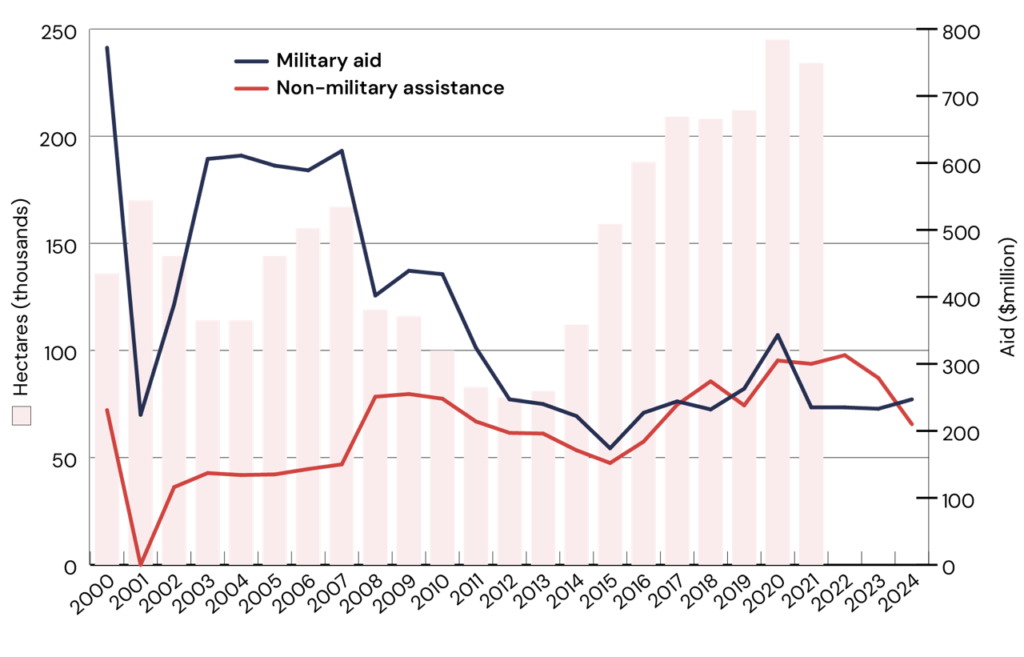
Until last year, Colombia had been the largest recipient of US non-military assistance in the Western Hemisphere, and while the Trump administration’s reduction and restructuring of foreign assistance has affected these programs in particular, some of this funding — which is the factor more directly associated with reduced coca cultivation, as measured by the White House’s Office of National Drug Control Policy, or ONDCP, than any other examined in this brief — has been spared.21
Figure 1: Coca Cultivation and US Military Aid/Non-Military Assistance, 2000–2024
In particular, specific initiatives like the Colombia Strategic Development Initiative and the Plan de Consolidación Integral de la Macarena, experienced measurable success in the historical FARC stronghold of Meta in the late 2000s, reducing coca cultivation by first establishing state authority and investing in roads and economic infrastructure before manually eradicating coca crops.22Later, the Familias Guardabosques program provided cash transfers and land titles to participants in exchange for eradication and reforestation efforts, contributing to considerable crop reductions and low replanting rates.23More recently, the Colombia Transforma initiative implemented priority areas of the 2016 peace accords by funding targeted interventions through municipal governments in coca-growing hotspots to catalyze productive economic alternatives, from high-value exports to ecotourism.24
But interagency coordination issues, insecurity in target areas, and zero-coca policies have contributed to limited results in many zones; other programs have had less success due to a lack of strategic vision, limited political will to extend funding, and politicization within implementing agencies.25Meanwhile, voluntary illicit crop substitution programs, such as the Programa Nacional Integral de Sustitución established under the 2016 peace accords, and more recently the RenHacemos program under Petro, have seen limited results in reducing coca cultivation, plagued by late arrival of inputs, more families signing up than hectares being substituted, ongoing violence and displacement preventing registrants from uprooting plants, payment delays, limited viability of alternative crops, and lack of infrastructure to get products to market.26
Despite these challenges, programs that have successfully bolstered state presence, rural development, and the rule of law in coca-growing regions — particularly in the late 2000s and following the 2016 peace accords — should be carefully studied, replicated, scaled, and safeguarded amid broader US foreign assistance cuts, even if implemented by private sector counterparts with support from the US Development Finance Corporation, multilateral lenders like the Inter-American Development Bank, allied governments in the European Union and Canada, and US federal agencies like the Department of Justice’s Office of Prosecutorial Development, Assistance and Training or the State Department’s Office of International Narcotics and Law Enforcement, or INL.
At the same time, of the nearly $15 billion the US has given Colombia since 2000, two-thirds — or $10 billion — has been for military or police aid. Major surges under both Pastrana and Uribe were later recalibrated through non-military assistance under Santos, ultimately weakening the FARC and bringing its commanders to the negotiating table. These funds are administered through different congressionally-appropriated channels, such as Foreign Military Financing, International Military Education and Training, and International Narcotics and Law Enforcement, or INCLE, yet even as direct security assistance to Colombia waned in the late 2000s, arms sales to the country gradually increased, underscoring the fungibility of these accounts.27
While the military component of Plan Colombia was overwhelmingly considered a counternarcotics failure, it was arguably a counterinsurgency success.28Primarily intended to strengthen Colombia’s aerial capabilities and military intelligence, US support for Colombia’s security institutions led to considerable force professionalization and the creation of vetted units that now train and advise their counterparts across the region. Several components of US military aid to Colombia, particularly that which is administered through INCLE, have proven indispensable in training and equipping Colombian air units, reducing externalities during eradication campaigns, and identifying and neutralizing top guerrilla and paramilitary leaders.29
Yet US military assistance to Colombia has also contributed to tension with the National Police, which operates under the Ministry of Defense’s control and largely sees the military’s anti-drug efforts not only as encroachment onto their turf, but a diversion from their main priority to fight insurrection and foreign enemies.30It also has done little to address the structural drivers behind illicit economies — such as local corruption, weak governance, barriers to licit markets and formal employment, and surging demand, among others — and thus, has had understandably little impact on coca cultivation.31And when measured by the incidence of violent paramilitary attacks in Colombia, this aid has actually fueled violence and instability — especially near Colombian bases where US forces are stationed — and has at times contributed to strains in regional diplomatic ties and the outsourcing of security operations to unaccountable para-state actors.32
Furthermore, the military tactics that may have worked under Uribe against the FARC — aerial bombardments, targeted killings, and high-level captures — will neither have the same effect nor yield the promised results as before, including the fact that local criminal outfits are more decentralized and diffuse, can more easily hide among citizens, and are now fighting more among themselves than against state forces, which suffer from aging equipment, low recruiting numbers, stagnant budgets, and an overstretched officer corps.33
Nevertheless, operationalizing a credible security posture focused on regaining territorial control, seizing illicit assets, and bolstering citizen security continues to be a crucial complement to the developmental, governance, and judicial tools needed to substitute the coca economy across rural Colombia.34
Sequenced manual eradication and negotiations with armed groups
In addition to striking a balance between military and non-military assistance, another major counternarcotics strategy the US has pursued in Colombia has been the forced eradication of coca, mostly under Uribe, through the aerial application of glyphosate (later banned in 2015). While aerial fumigation significantly reduced crop coverage by 50 percent from 2000 to 2008, potential cocaine production decreased by only 14 percent, according to the United Nations Office on Drugs and Crime, or UNDOC, and ONDCP figures show that production actually increased by 4 percent due to increased productivity per hectare stemming from better and denser planting techniques, the deforestation of protected areas, and other adaptive strategies.35
Aerial fumigation provided Uribe with immediate, quantifiable results that kept assistance flowing to Colombia, but these results were unsustainable over time and, in the end, proved counterproductive, leading farmers to resume cultivation after their fields were sprayed. Aerial fumigations also resulted in several adverse externalities, including environmental and health impacts resulting from the possibly carcinogenic nature of the chemicals applied and, consequently, irreparable harm to the water supply, food production, and local ecosystems.36Another major drawback of aerial fumigation is the so-called “balloon effect,” whereby stricter enforcement and more aggressive eradication in one region led to its geographic dislocation to another region, or even country, as occurred in the late 2000s when coca production surged in Peru.37 More recent experiments in the aerial application of glyphosate through low-flying drones in Cauca, supported by INL, have sought to subvert the constitutional ban on aerial application while protecting communities through more targeted interventions. Yet similar pilot programs in nearby Nariño were ineffective and eventually led to replanting, even if concerns about drift and inaccuracy are addressed.38
Beginning in 2007, Colombia pursued a shift away from aerial fumigation toward costly, time-consuming, and risky forced manual eradication campaigns.39This strategy produced important declines in cultivation but generated resistance and radicalization among coca-growing communities, and risks to security forces that had to navigate anti-personnel mines and ambushes from armed groups, generating considerable casualties.40Nevertheless, this strategy — which is statistically associated with decreased potential cocaine production, as measured by UNODC — can include ways to work with, rather than against, coca-growing communities, and sequencing is the key, as the Plan de Consolidación Integral de la Macarena at the end of Uribe’s second term showed.41The underlying idea was to establish police presence, provide viable economic alternatives, and invest in productive infrastructure and services before forcibly — or, ideally, collaboratively — pulling coca plants out of the ground. During this period, consumer cocaine prices rose, purity decreased, and state presence on the ground visibly increased.42
Figure 2: Potential Production and Forced Manual Eradication, 2000–2024
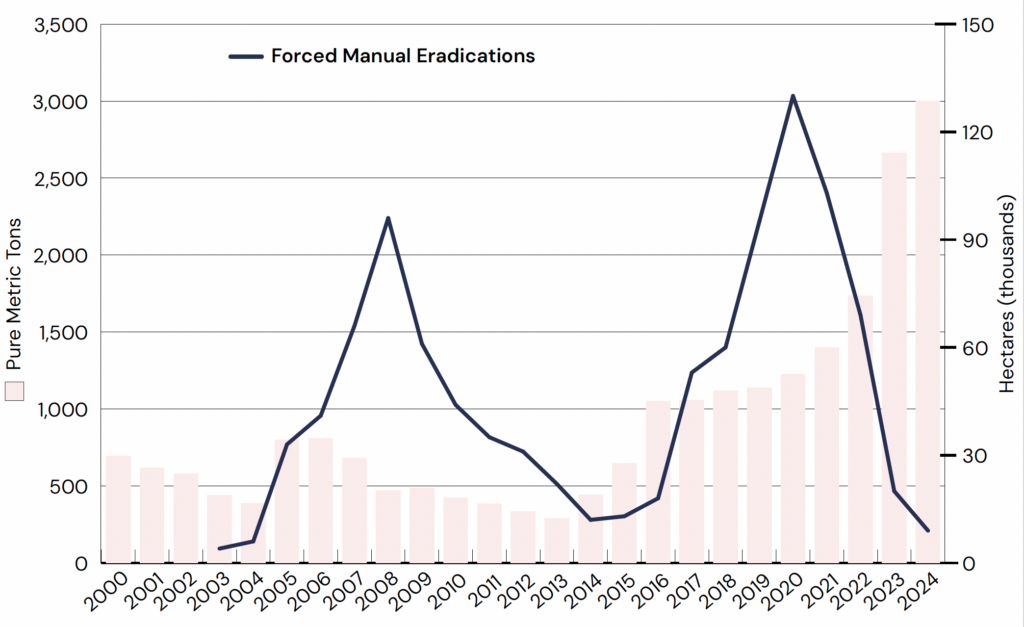
But Santos, focused on peace talks with the FARC, let this sequenced eradication strategy wither, and Duque would later revive manual forced eradication without sequencing mechanisms, achieving lackluster results.43Petro, for his part, oversaw plummeting manual eradication figures combined with limited efforts to boost state presence in drug-producing subregions, though more recently he sought to incentivize industrial-scale manual eradication by armed groups themselves by tying non-compliance to credible threats of targeted military offensives. Ultimately, if not sequenced with a more comprehensive development strategy, forced manual eradication can erode community trust in the state, strengthen armed groups’ territorial control, and place civilians in harm’s way, even if effective at reducing cocaine production in the short-term.44
Inherent to the eradication of coca fields under the protection and control of illicit armed actors are the complex peace negotiations and plea-bargain agreements under the framework of disarmament, demobilization, and reintegration, or DDR, which have led to the demobilization of at least 77,000 Colombian combatants, both paramilitary and guerrilla, since 2003. These individual and collective plea-bargain agreements and negotiation strategies have provided a range of legal incentives and benefits for armed actors to collaborate with authorities, provide crucial intelligence, forfeit illicit assets, and reintegrate into civilian life.
In particular, the US played a key role in the 2016 peace deal with the FARC, appointing a special envoy to the talks, co-sponsoring the UN Security Council resolution that established the accords’ verification mission, and providing over 40 percent of the funding for its implementation (nearly $1.5 billion through 2024).45Much of this aid provided support for the FARC’s demobilization, the reintegration of its members into civilian life, and the establishment of local economic development plans, called PDETs, intended to provide meaningful employment, services, and infrastructure in coca-producing subregions.46
While Colombia has had other, arguably more successful, experiences with insurgent demobilizations in the past — notably of the M-19 in 1990 and the EPL in 1991, with both transforming into political parties and some of its members becoming national political figures — the FARC demobilization and reintegration process, like the AUC process before it, has faced numerous challenges.47These include dissidence, or the fracturing and decentralization of new insurgent groups; the displacement of trafficking routes and violence to neighboring countries like Ecuador; assassinations and discrimination of peace accord signatories; and a lack of meaningful economic opportunities for ex-combatants, among others.48
Under both Duque and Petro, implementation of the 2016 accords has been weak; nearly two-thirds into the 15-year implementation timeline, only about 40 percent has been completed.49In particular, Duque’s ambiguous commitment to the accords accelerated dissidence, including among groups such as the Segunda Marquetalia, thereby enabling the ELN and the Gulf Clan to fill territorial vacuums. More recently, multiple FARC dissident factions, including the Estado Mayor de Bloques y Fuentes, the Estado Mayor Central, or EMC, and the Coordinadora Nacional Ejército Bolivariano, a splinter group of the Segunda Marquetalia, continue to grow in ranks, recruit minors, clash with security forces and other armed groups, tax drug production and trafficking activities, and, at the same time, engage in negotiating tables with the government, with varying levels of success.50
That said, DDR through peace negotiations — strategically designed, legally enforceable, accompanied by the international community, and paired with a credible security posture — remains a central strategy pursued across Colombian administrations to demobilize actors sustaining the drug trade.51Yet the lack of a legal framework for Petro’s Total Peace strategy has rendered many of these talks, particularly with criminal groups and urban gangs, non-binding and unenforceable, allowing outfits like the Gulf Clan and the EMC to exploit talks for strategic gain.
Moreover, fragile and unverified ceasefire agreements and the reluctance of certain armed group leaders to de-escalate violence amid talks have led to the fragmented negotiations and factional splintering, particularly among FARC dissidents and the ELN. Likewise, armed groups are now fighting among one another for control of trafficking routes more so than against state security forces, leaving communities stuck in the middle and fostering these groups’ territorial expansion through control of other criminal rackets. Many have, in turn, strengthened their negotiating positions by extracting illicit rents from gold mining, extortion, kidnapping, oil pipeline attacks, and illegal logging. Opportunistic alliances among armed groups have made it all the more difficult for the state to resolve localized conflicts through national-level negotiations.52
A key lesson from Total Peace and past negotiations with armed actors has been to distinguish between political insurgencies and criminal outfits, working to broker broader agreements with the former and submitting the latter to justice through plea-bargain agreements. Despite setbacks and suspensions, ongoing dialogue with both sets of actors remains important to provide humanitarian guarantees for civilians caught in the crossfire, safeguard election integrity, and protect vulnerable environmental assets that fund armed groups, such as minerals, wildlife, and timber.53
Overall, the pursuit of smaller, localized agreements, as have occurred in Nariño with the ELN splinter group Comuneros del Surand the Segunda Marquetalia splinter group Coordinadora Nacional Ejército Bolivariano, has proven more successful and would be a better approach for future Colombian administrations in achieving the durable demobilization of combatants in drug-producing subregions and the reestablishment of control over coveted trafficking routes.54
Late-stage drug interdiction and countering illicit financial flows
Decades of drug control policy have underscored the importance of tackling more profitable nodes of the drug supply chain through interdictions and inspections of larger vessels.55Historically, this has taken place under the purview of law enforcement agencies, such as the US Coast Guard and Customs and Border Protection, rather than the US military.56Scholars have shown that targeting coca production through crop eradication is 3.4 times less cost-efficient in reducing the quantity of cocaine reaching consumer countries than interdiction efforts aimed at disrupting drug shipments. This is because land is a relatively low factor of importance in the production function determining the retail price of cocaine in consumer markets, which is highly inelastic vis-à-vis demand.57
Under the Petro administration, cocaine interdictions are at an all-time high — Colombia, together with its international partners, seized around 900 tons of cocaine in 2025 and over 2,700 total so far since he took office.58Importantly, joint US–Colombia drug interdiction missions continue to occur even as the US strikes alleged drug boats, for which Petro assures he is not sharing intelligence.59These impressive figures — Colombia says it destroys an artisanal cocaine processing lab every 40 minutes, or 18,400 so far under Petro — have largely coincided with the record levels of coca cultivation and potential cocaine production; in fact, cocaine interdictions are the factor most directly correlated with increased coca cultivation, as measured by the UNODC.60Nonetheless, Colombian authorities say that metric tons seized as a percentage of overall potential cocaine production is higher than under any past Colombian administration.61
Figure 3: Coca Cultivation and Cocaine Interdictions, 2000–2024
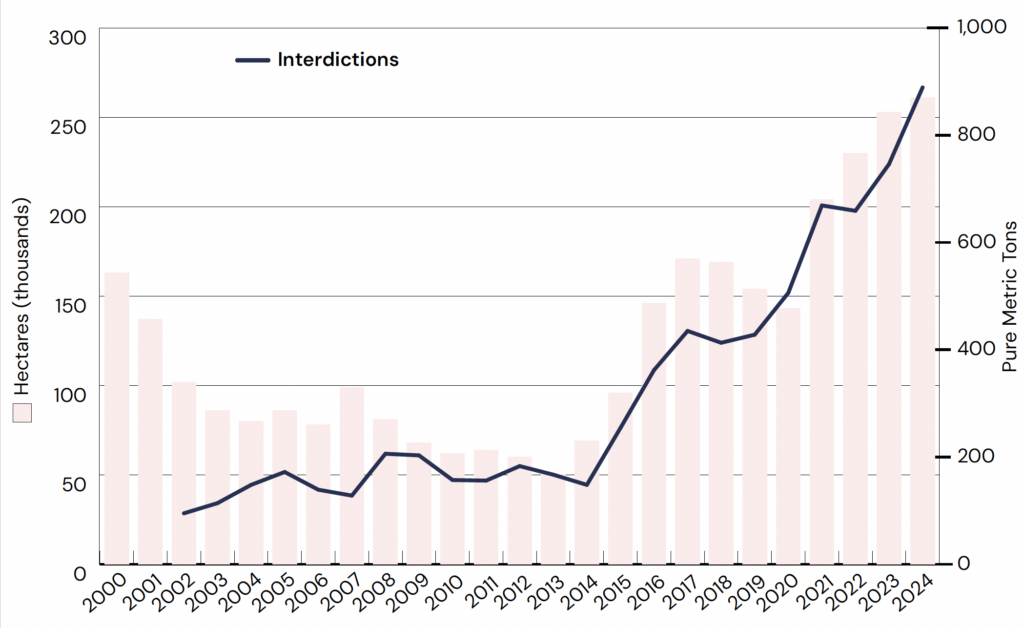
It’s important to note that while Colombian security forces used to seize more processed cocaine inside the country — through the destruction of artisanal drug labs, raids at interior checkpoints, seizures at ports and airports, and sophisticated criminal investigations — now, 66 percent of Colombian cocaine is seized by US and foreign counterparts using Colombian intelligence either at a transshipment point or upon reaching its final destination. By apprehending and boarding vessels, arresting crews, and collecting information, interdictions help fortify intelligence-gathering and sharing capabilities to better detect and disrupt illicit flows, underscoring the importance of bilateral cooperation in this regard.62
Yet while it may be more cost effective to seize cocaine supply at later stages of the value chain, critics warn that Colombia may be taking credit for interdictions it didn’t carry out, double-counting results reported by other countries, and not doing enough to prevent supply from leaving its borders.63But overall, this approach proves more effective and, importantly, less lethal than the Trump administration’s boat strike campaign, as it fosters intelligence sharing, respects international law and standards, elicits information necessary to dismantle broader networks, and is more fiscally prudent than the oftentimes excessive deployment of deadly force.64 While interdictions of existing supply are important in reducing flows, it’s important to remember that Colombian drug runners are not the driving forces behind the global drug trade — capos and financiers in the US, Europe, and the Arab Gulf are.65 Major banks, multinational corporations, and top security and political officials are often complicit, too, sometimes unknowingly.66As such, strengthening and coordinating anti-money laundering, illicit finance, and terrorism financing regulations across jurisdictions are key ways to cut off groups’ financial flows.67Stepping up enforcement actions, visa restrictions, and related penalties against executives credibly alleged to be involved in the drug trade, as well as enhancing judicial cooperation and the extraditions of kingpins, are strategies that governments have increasingly pursued to tackle the profit structures underpinning illicit narcotics markets.68
Colombia has comparatively strong anti-money laundering and counter-terrorism-financing statutes compared to the rest of Latin America and the Caribbean, yet the value of funds and assets seized or frozen is typically minor compared to the profits derived from the drug trade. In Colombia, where the laundering of illicit financial flows accounted for 5.4 percent of GDP, or $17 billion, in 2017 alone, judicial cooperation with the US has evolved since the 1980s, particularly after Colombia signed its extradition treaty with the US in 1982. Since 2001, the Department of Justice’s Office of Overseas Prosecutorial Development, Assistance, and Training has maintained an in-country office to help reform the country’s justice system, and of the 2,000 kingpins and accomplices sanctioned over the past 20 years by the Treasury Department’s Office of Foreign Assets Control, over half were Mexican and Colombian, underscoring the extent of bilateral cooperation in this area.69
While there are many ways to assess and evaluate joint efforts to attack money laundering in Colombia, extraditions of Colombian nationals to the US are a typically relied-upon tool to collect intelligence, build cases, and ultimately disrupt illicit financial flows at the most valuable rung of the international drug trade.70Extraditions from Colombia surged under Uribe and have remained at consistent levels ever since. While typically interpreted as a means by which the US has imposed its priorities onto Colombia, Colombian presidents have also relied on extraditions to advance their own domestic political interests.71The extraditions of paramilitary leaders on drug charges in the late 2000s, in particular, contributed to a perception of impunity for senior officials — including Uribe himself, who was alleged to have links to their criminal activities — over the light sentences and even carceral privileges granted to drug leaders implicated in mass atrocities.
The Petro administration currently boasts of its high extradition figures — which in fact surpass those pursued by both Santos and Uribe — but, in many cases, it has resisted US demands for the extradition of guerrilla and paramilitary leaders involved in active negotiations with the government to prevent the breakdown of talks.72Under Uribe, the high-level extradition of AUC kingpins produced the fracturing and expansion of paramilitaries like the Gulf Clan, Los Rastrojos, Águilas Negras, and regional self-defense forces that were able to localize territorial control and devise new trafficking routes, which may explain why extraditions to the US are positively associated with increased potential cocaine production, as measured by UNODC.73
As such, the kingpin strategy and emphasis on high-level targets may be misguided and even counterproductive to counternarcotics objectives, especially if they result in more groups operating than before and spawn more drug leaders to capture and extradite. For example, the high-profile extradition of Gulf Clan leader Otoniel under the Duque administration — among its crowning achievements — led to the rise of a new leader, Chiquito Malo, whose capture amid ongoing negotiations has become a major US demand of Petro. In the years following Otoniel’s extradition, the Gulf Clan expanded into the Chocó, Bolívar, and Córdoba departments, diversifying its revenue streams through extortion, migrant smuggling, and illegal mining.74
Thus, while bilateral judicial cooperation — particularly through joint anti-money laundering investigations led by the Treasury and Justice Departments — should remain central to US supply-side counternarcotics efforts, kingpin extraditions shouldn’t be the sole or primary means of advancing those efforts, as surges in extraditions are associated with periods of increased cocaine production. Executing high-level renditions may be good statistics to tout, but they do little to disrupt the underlying profit motive and intricate financial structures that sustain highly adaptive trafficking networks, and they contribute to the fracturing, expansion, and specialization of armed groups.75
Implications for US policy and Colombia’s next administration
It’s undeniable that drug trafficking to the US by non-state actors poses a serious problem to US national security; however, there are more productive and less lethal ways to tackle this scourge, including through cooperative approaches that can save lives, avoid costly military operations, adhere to domestic and international law, and attack the complex problem of drug production and smuggling at its root.76
Unfortunately, smart and effective drug control policy often runs up against the political incentives underlying the war on drugs, which seek fast results, flashy operations, and high-profile wins for policymakers operating amid the media cycle and electoral timelines. The boat strike campaign, in particular, and the overreliance on military-led drug operations more broadly, have faced widespread criticism over their highly performative, expensive, and ostentatious nature, with few quantifiable results, even as administration officials allege this visibility has deterred traffickers and resulted in reduced flows.77Nonetheless, it remains crucial to base drug policy interventions on empirical evidence and credible methodologies rather than untested claims and politically convenient talking points.
This point assumes even greater relevance as the Trump administration and leading Colombian presidential candidates push for a return to bombardments of alleged drug camps, aerial fumigation of coca crops, the extradition of kingpins, and breaking off talks with irregular armed groups as their preferred approach to supply-side counternarcotics in Colombia, the world’s leading cocaine producer.
Twenty-five years of evidence from Colombia shows that neither exclusively military-led strategies — whether increased military aid, aerial fumigation, or drug interdictions — nor exclusively non-military strategies — such as development assistance, peace negotiations, or judicial cooperation — have in and of themselves produced the outcomes that billions of dollars in US assistance were expected to yield. Ultimately, a dual supply-side counternarcotics strategy that combines and refines elements of both is the best approach for tackling the gargantuan task of reducing coca cultivation in Colombia and cocaine trafficking to the US.
In particular, supply-side policies that rely on economic and legal tools — using blended finance to strengthen state presence, invest in rural development, and bolster the rule of law in drug-producing areas — paired with a credible public security posture, should be the cornerstone of US counternarcotics strategy in Colombia.
Additionally, efforts to resume the ineffective and counterproductive aerial fumigation of coca plantations should be replaced by sequenced, cooperative manual eradication campaigns — together with carefully designed and legally enforceable negotiations with certain armed actors — that reduce industrial-level coca cultivation and weaken the groups profiting from it.
Lastly, rather than boosting low-level arrests and raids on jungle processing labs, enhancing interdictions of existing supply at later stages of the value chain, combined with sustained bilateral judicial investigations targeting transnational illicit financial flows — including, but not relying on, the extradition of kingpins — should be prioritized to stem cocaine trafficking to the US.
These lessons, based on decades of quantitative data and lessons learned in applied drug control policy, should serve as a broad conceptual roadmap for deploying effective supply-side counternarcotics strategies, particularly in Colombia and, more broadly, across the Andean region.
As the Trump administration expands its military footprint in Latin America through the recently inaugurated Americas Counter Cartel Coalition, arguing that only lethal force can deter drug trafficking by armed non-state actors, both the historical and empirical evidence show that a primarily or exclusively military solution is bound to fall short on its stated objectives.
Despite the administration’s insistence on applying “systemic friction” to designated FTOs in the hemisphere, its overly militarized strategy is already leading them to adapt to new illicit industries, divert trafficking routes, diversify economic portfolios, and expand operations to new subregions, resorting to more covert and asymmetrical forms of violence against states and competitors, as a recent surge in drone activity in Colombia has shown.78
Aside from proving woefully ineffective at reducing drug production and trafficking, mounting military pressure from the US in alliance with regional governments also risks increasing extrajudicial killings of unarmed civilians, fueling insurgent and anti–US sentiment, undermining the rule of law across the hemisphere, and reversing years of progress in Latin America’s fraught civil-military relations.
Yet even as the trend of overmilitarized drug enforcement seemingly accelerates — and demand-based solutions focused on substance use prevention, treatment, and recovery wane — the administration’s operational, if not political, support for joint drug interdictions, anti-money laundering initiatives, and criminal investigations in Colombia signals that at least some administration officials recognize, as General Francis Donovan of US Southern Command recently testified, that the boat strikes are “not the answer … [or] the most effective tool.”79
These lessons are particularly relevant for Colombia’s next administration, which can expect to face pressure from Washington to deliver concrete results on crop reduction, drug seizures, intelligence sharing, and destruction of processing laboratories, even if these indicators have long been deemed antiquated and inadequate at capturing more holistic metrics and trends in drug-producing regions.80
That Petro, who had vowed to break with failed drug war policies, has backtracked — under threat of sanctions, decertification, and unilateral US military action — into bombing ELN camps, seeking arrest of high-value targets, and resuming aerial fumigation via low-flying drone underscores the charged geopolitical environment in which scientifically-proven drug control policy gets deployed.81
For both left-wing candidate Iván Cepeda, who seeks to follow Petro’s negotiations with armed actors and voluntary substitution programs, and right-wing candidate Abelardo de la Espriella, who seeks to accelerate low-level arrests and increase the military’s role in targeting drug production and trafficking, a dual strategy is bound to yield more favorable outcomes. Neither the left’s hesitation to implement a credible supply-side counternarcotics agenda nor the right’s heavy-handed, militarized approach to curbing coca cultivation has yielded durable results to date. In fact, the lack of a viable, well-articulated strategy strengthens the hand of irregular armed actors, exacerbates a deteriorating security landscape across the country, and gives the Trump administration greater leverage to dictate its preferred approaches, regardless of their empirically poor outcomes.
A dual approach that combines public, private and multilateral financing for rural economic development, state presence and the rule of law; sequenced manual eradication campaigns tied to selective negotiations with armed groups; increased interdictions at more valuable stages of the supply chain; and robust judicial cooperation to dismantle illicit financial flows and networks provides a winning strategy for both candidates, which US officials should publicly support and privately encourage to whomever enters Colombia’s Casa de Nariño in August.
Conclusion
In evaluating the impacts of supply-side counternarcotics policies on drug production and trafficking from Colombia over 25 years, this brief finds that targeted public, private, and multilateral funding to boost state presence, finance rural development, and strengthen the rule of law has been the most enduring strategy, and thus should form the basis for US counternarcotics strategy in the Andes. This approach, however, must be pursued in concert with ramped-up interdictions of existing cocaine supply at later stages of the value chain and carefully sequenced manual eradication campaigns paired with credible offensive options in case of noncompliance by armed actors.
Likewise, it finds that the oft-cited recommendations for stemming drug production and trafficking in Colombia — raiding drug labs, fumigating farmers, or extraditing kingpins — have not proven particularly significant or impactful in advancing durable policy outcomes.
Ultimately, without viable economic opportunities, credible judicial institutions, and even rudimentary governance structures, illicit economies and armed non-state actors will thrive, as the past quarter-century of data makes clear. Assisting our Colombian counterparts in formulating a credible security posture against armed non-state actors is crucial to US counternarcotics goals. But this approach must operate in tandem with safeguarding development assistance for coca-growing communities, sequencing manual eradication campaigns with prior investment in infrastructure and market access, boosting interdictions of more valuable drug supply, and countering impunity and corruption by political and business elites.
In the wake of Colombia’s decertification, threats of unilateral strikes following Operations Absolute Resolve and Total Extermination, and the release of strategic US national security and drug policy documents, these recommendations serve to advance the debate on the effectiveness, legality, and externalities of both the boat strike campaign and broader regional military operations against designated foreign terrorist organizations.
With Colombia’s high-stakes presidential elections upcoming, potentially accelerating a re-militarization of the regional drug war, evaluating the impacts of diverse counternarcotics strategies in Colombia over the past quarter-century could not be more urgent — if reducing the flow of drugs to the US is truly the Trump administration’s objective.
Program
Countries/Territories
Authors

Lee Schlenker is a research associate with the Global South program at the Quincy Institute for Responsible Statecraft, where he focuses on Latin America. His research interests include US-Cuba relations, Colombian peace and security issues, counternarcotics, sanctions policy, and regional…
Citations
Simon Romero, “Trump’s Boat Strikes Have Failed to Curb Flow of Cocaine to US, Experts Say,” New York Times, May 29, 2026, https://www.nytimes.com/2026/05/29/world/americas/us-boat-strikes-cocaine-trump-south-america.html. ↩
Daniel Chang and Patrick Paterson, “The Colombia Coca Bloom, the Mexican Heroin Surge, and the Fentanyl Crisis,” Regional Insights, March 2022, https://wjpcenter.org/wp-content/uploads/2023/09/Colombia-Coca-Bloom.pdf. ↩
Geoff Ramsey and Isabel Chiriboga, “Advancing US–Colombia Cooperation on Drug Policy and Law Enforcement,” Atlantic Council, Nov. 30, 2023, https://www.atlanticcouncil.org/in-depth-research-reports/report/advancing-us-colombia-cooperation-on-drug-policy-and-law-enforcement/. ↩
Clare Ribando Seelke and Shelby Senger, “Colombia’s Antidrug Efforts and the ‘Failed Demonstrably’ Designation,” Congressional Research Service, 2025, https:/www.congress.gov/crs-product/IN12610. ↩
Andrés F. Aponte González et al., “Contestation, Governance, and the Production of Violence Against Civilians: Coercive Political Order in Rural Colombia,” Journal of Conflict Resolution 68, no. 4 (June 2023): 616–41, https://doi.org/10.1177/00220027231177591. ↩
Jonathan D. Rosen, The Losing War: Plan Colombia and Beyond (New York: SUNY Press, 2014). ↩
Alejandro Gaviria and Daniel Mejía, Anti-Drug Policies in Colombia: Successes, Failures, and Wrong Turns, (Nashville: Vanderbilt University Press, 2016); Winifred Tate, Drugs, Thugs, and Diplomats: US Policymaking in Colombia, (Palo Alto: Stanford University Press, 2015). ↩
Daniel Mejia, “Evaluating Plan Colombia,” in Innocent Bystanders: Developing Countries and the War on Drugs, eds. Phillip Keefer and Norman Loyaza (Washington DC: World Bank Publications, 2010); John Lindsay-Poland, Plan Colombia: US Ally Atrocities and Community Activism (Durham: Duke University Press Books, 2018). ↩
Deborah Sontag, “The Secret History of Colombia’s Paramilitaries and the US War on Drugs,” New York Times, Sept. 10, 2016, https://www.nytimes.com/2016/09/11/world/americas/colombia-cocaine-human-rights.html. ↩
Juan Carlos Garzón, “Mafia & Co.,” Woodrow Wilson International Center for Scholars, July 7, 2011, https://www.wilsoncenter.org/publication/mafia-co. ↩
Adam Isacson, “Confronting Colombia’s Coca Boom Requires Patience and a Commitment to the Peace Accords,” Washington Office on Latin America, March 14, 2017, https://www.wola.org/analysis/confronting-colombias-coca-boom-requires-patience-commitment-peace-accords/; Vanda Felbab-Brown,“Detoxifying Colombia’s Drug Policies: Colombia’s Counternarcotics Options and Their Impact on Peace and State Building,” Brookings Institution, January 2020, https://www.brookings.edu/wp-content/uploads/2020/01/FP_20200106_colombia_drug_policy_felbabbrown.pdf. ↩
“Fact Sheet: Peace Colombia: A New Era of Partnership Between the United States and Colombia,” Obama White House Archives, Office of the Press Secretary, Feb. 5, 2016, https://obamawhitehouse.archives.gov/the-press-office/2016/02/04/fact-sheet-peace-colombia-new-era-partnership-between-united-states-and/. ↩
Elizabeth Dickinson, “Colombia Braces for US Censure over Faltering Drug War,” International Crisis Group, June 24, 2025, https://www.crisisgroup.org/qna/latin-america-caribbean/andes/colombia-united-states/colombia-b races-us-censure-over-faltering-drug-war. ↩
Tiziano Breda, “‘Total Peace’ Paradox in Colombia: Petro’s Policy Reduced Violence, but Armed Groups Grew Stronger,” ACLED, Nov. 28, 2024, https://acleddata.com/report/total-peace-paradox-colombia-petros-policy-reduced-violence-armed-groups-grew-stronger; Valentina Parada Lugo, “La comisión secreta de Petro que negoció bombardeos y fumigaciones en Colombia para contentar a Trump,” El País América, Jan. 8, 2026, https://elpais.com/america-colombia/2026-01-08/la-comision-secreta-de-petro-que-negocio-bombardeos-y-fumigaciones-en-colombia-para-contentar-a-trump.html. ↩
Kyle Johnson et al., “Propuestas de seguridad candidatos presidenciales Colombia 2026,” Fundación Conflict Responses and Inter-American Dialogue, May 2026, https://www.conflictresponses.org/propuestas-de-seguridad-candidatos-presidenciales-colombia-2026/. ↩
Francisco Thoumi, “Illegal Drugs, Anti-Drug Policy Failure, and the Need for Institutional Reforms in Colombia,” Substance Use & Misuse 47, no. 8–9 (June 2012): 972–1004, https://doi.org/10.3109/10826084.2012.663287. ↩
Francisco Thoumi, “From Drug Lords to Warlords: Illegal Drugs and the ‘Unintended’ Consequences of Drug Policies in Colombia,” in Government of the Shadows: Parapolitics and Criminal Sovereignty, ed. Eric Wilson (Las Vegas: Pluto Press, 2009 ↩
Adam Isacson, “Testimony of Adam Isacson, Director for Defense Oversight of the Washington Office on Latin America, Before the US House of Representatives Committee on Foreign Affairs Subcommittee on the Western Hemisphere Hearing: ‘INL Should Fight Crime, Not Fight Conservatives,’” Washington Office on Latin America, March 27, 2025, https://docs.house.gov/meetings/FA/FA07/20250327/118054/HHRG-119-FA07-Wstate-IsacsonA-20250327.pdf. ↩
June Beitel and Liana Rosen, “Colombia’s Changing Approach to Drug Policy,” Congressional Research Service, Nov. 30, 2017, https://www.congress.gov/crs-product/R44779. ↩
Diana Machuca et al., “An Analysis of Colombia’s Drug Policy and Actors,” SOAS University of London, 2021, https://drugs-disorder.soas.ac.uk/wp-content/uploads/2021/05/05_21_Analysis-of-drug-policy-and-its-actors-in-Colombia_Final.pdf. ↩
Alfie Panell, “USAID Suspension Shutters Colombia Programs, Endangering FARC Peace Deal,” Reuters, March 18, 2025, https://www.reuters.com/world/americas/usaid-suspension-shutters-colombia-programs-endangering-farc-peace-deal-2025-03-18/; Lee Schlenker, “Demilitarizing Counternarcotics: 25 Years of Evidence from Colombia,” Capstone for the completion of the MA in Latin American Studies from Georgetown University School of Foreign Service, May 4, 2026, https://drive.google.com/file/d/1AsaO58DGJB7u1vrw8S8NSHWQkQBkLQOW/view?usp=sharing; Gimena Sánchez-Garzoli, “Trump–Petro Meeting: Crisis Averted, What Comes Next?” Washington Office on Latin America, Feb. 23, 2026, https://www.wola.org/analysis/trump-petro-meeting-crisis-averted-what-comes-next/. ↩
Adam Isacson, “Consolidating ‘Consolidation,’” Washington Office on Latin America, December 2012, https://ccai-colombia.org/files/primarydocs/consolidating_consolidation.pdf. ↩
Shannon O’Neill et al., “Report of the Western Hemisphere Drug Policy Commission,” Western Hemisphere Drug Policy Commission, December 2020, https://democrats-foreignaffairs.house.gov/_cache/files/a/5/a51ee680-e339-4a1b-933f-b15e535fa103/AA2A3440265DDE42367A79D4BCBC9AA1.whdpc-final-report-2020-11.30.pdf. ↩
“Continued Support for Sustainable Peace in Colombia,” MSI: A Tetra Tech Company, Oct. 17, 2023, https://www.msiworldwide.com/projects/continued-support-for-sustainable-peace-in-colombia/. ↩
Jess Ford, “Plan Colombia: Drug Reduction Goals Were Not Fully Met, but Security Has Improved; US Agencies Need More Detailed Plans for Reducing Assistance,” US Government Accountability Office, October 2008, https://www.gao.gov/assets/gao-09-71.pdf; O’Neill et al., “Report of the Western Hemisphere Drug Policy Commission.” ↩
Luis Jaime Acosta, “Colombia’s Petro Launches New Anti-Drug Plan with Focus on Opportunity,” Reuters, Oct. 3, 2023, https://www.reuters.com/world/americas/colombias-petro-launches-new-anti-drug-plan-with-focus-opportunity-2023-10-03/; Sebastián Forero, “El gobierno Petro infla la cifra de las hectáreas de coca sustituidas por otros cultivos,” El País América, Dec. 15, 2025, https://elpais.com/america-colombia/2025-12-16/el-gobierno-petro-infla-la-cifra-de-las-hectareas-de-coca-sustituidas-por-otros-cultivos.html. ↩
Lindsay-Poland, Plan Colombia. ↩
Paul J. Angelo, From Peril to Partnership: US Security Assistance and the Bid to Stabilize Colombia and Mexico (Oxford: Oxford University Press, 2024). ↩
Maureen Meyer and Adam Isacson, “Key Things to Know About the Proposed Foreign Aid Budget for FY2027,” Washington Office on Latin America, April 10, 2026, https://www.wola.org/analysis/key-things-to-know-about-the-proposed-foreign-aid-budget-for-fy2027/?emci=00286d17-5934-f111-8ef2-000d3a14b640&emdi=8466fc3d-e934-f111-8ef2-000d3a14b640&ceid=15737871. ↩
Lindsay-Poland, Plan Colombia. ↩
Rosen, The Losing War. ↩
Oeindrila Dube and Suresh Naidu, “Bases, Bullets, and Ballots: The Effect of US Military Aid on Political Conflict in Colombia,” National Bureau of Economic Research, 2013, https://doi.org/10.3386/w20213; Dana Priest, “Covert War in Colombia,” Washington Post, Dec. 21, 2013, https://www.washingtonpost.com/sf/investigative/2013/12/21/covert-action-in-colombia/; Tate, Drugs, Thugs, and Diplomats. ↩
Elizabeth Dickinson, “Colombia’s Polls Mark a Forking Path in Peace Talks,” International Crisis Group, March 25, 2026, https://www.crisisgroup.org/cmt/latin-america-caribbean/colombia/colombias-polls-mark-forking-path-peace-talks. ↩
Author interview with Glaeldys González Calanche, via Zoom, May 26, 2026. ↩
Mejia, “Evaluating Plan Colombia.” ↩
Michelle L. Dion and Catherine Russler, “Eradication Efforts, the State, Displacement and Poverty: Explaining Coca Cultivation in Colombia During Plan Colombia,” Journal of Latin American Studies 40, no. 3 (Aug. 2008): 399–421, http://www.jstor.org/stable/40056701; María Alejandra Vélez et al., “Environmental Impacts and Transitions Across Illicit, Informal and Licit Economies in Colombia: Coca-Cocaine, Gold, and Cattle,” Centro de Estudios Sobre Seguridad y Drogas, Universidad de los Andes, 2025, https://globalinitiative.net/wp-content/uploads/2025/07/Documento-tematico-CESED-54.pdf; Juan Forero, “Cultivation of Coca, the Leaf Used to Make Cocaine, Soars Anew in Colombia,” Wall Street Journal, March 12, 2017, https://www.wsj.com/articles/coca-growing-soars-anew-in-colombia-as-u-s-stops-fumigation-program-1489320025. ↩
Gino Costa Gino, “Security Challenges in Peru,” Americas Quarterly, Oct. 19, 2010, https://americasquarterly.org/fulltextarticle/security-challenges-in-peru/. ↩
Adam Isacson, “Robots Can’t Govern Rural Colombia,” Adam Isacson (blog), March 23, 2026, https://adamisacson.com/robots-cant-govern-rural-colombia/. ↩
Ricardo Vargas, “Erradicación Manual Forzosa: Otro revés para el estado y los derechos de las comunidades,” Transnational Institute, June 3, 2022, https://www.tni.org/es/art%C3%ADculo/erradicacion-manual-forzosa. ↩
Hernán Borrero and Jairo Parada,“The ‘Carrot’ and the ‘Stick’ to Reduce Coca Plantations in Colombia: An Empirical Investigation,” Desarrollo y Sociedad 92 (141-167),https://www.redalyc.org/journal/1691/169172962005/html/. ↩
Schlenker, “Demilitarizing Counternarcotics.” ↩
Socorro Ramírez and Coletta Youngers, “Drug Policy in the Andes: Seeking Humane and Effective Alternatives,” International Institute for Democracy and Electoral Assistance, 2011, https://www.idea.int/sites/default/files/publications/drug-policy-in-the-andes.pdf. ↩
Author interview with Dr. Paul Angelo, via Zoom, April 7, 2026. ↩
“Trapped in Conflict: Reforming Military Strategy to Save Lives in Colombia,” International Crisis Group, Sept. 27, 2022, https://www.crisisgroup.org/sites/default/files/2022-09/095%20Colombia%20-%20New%20Military%20Strategy.pdf. ↩
Roxanna Vigil, “Preventing Renewed Conflict in Colombia,” Council on Foreign Relations, February 2026, https://www.cfr.org/reports/preventing-renewed-conflict-in-colombia. ↩
Elizabeth Dickinson, “Colombia’s Polls Mark a Forking Path in Peace Talks,” International Crisis Group, March 25, 2026, https://www.crisisgroup.org/cmt/latin-america-caribbean/colombia/colombias-polls-mark-forking-path-peace-talks. ↩
Deborah Sontag, “The Secret History of Colombia’s Paramilitaries and the US War on Drugs,” New York Times, Sept. 10, 2016, https://www.nytimes.com/2016/09/11/world/americas/colombia-cocaine-human-rights.html. ↩
José Miguel Rodríguez-Castellón, “Evolution and Challenges of DDR: A Policy Review Through the Prism of Colombia’s DDR Experience,” Heliyon 10, no. 13 (July 15, 2024), https://www.sciencedirect.com/science/article/pii/S2405844024093927. ↩
“A Path Forward for Colombia’s 2016 Peace Accord and Lasting Security,” Atlantic Council, Nov. 25, 2024, https://www.atlanticcouncil.org/in-depth-research-reports/report/a-path-forward-for-colombias-2016-peace-accord-and-lasting-security/; “La implementación integral del acuerdo de paz debe garantizarse a fin de que se cumpla su promesa de paz, justicia y reconciliación,” United Nations Verification Mission in Colombia, Jan. 19, 2026, https://colombia.unmissions.org/es/comunicados-de-prensa/la-implementacion-integral-del-acuerdo-de-paz-debe-garantizarse-fin. ↩
“Informe: La Paz ¿Cómo Vamos? Radiografía de los procesos de diálogo de paz en Colombia entre 2022-2025,” Corporación Vivamos Humanos, June 2025, https://vivamoshumanos.org/wp-content/uploads/2025/06/INFORME-LA-PAZ-COMO-VAMOS.pdf. ↩
“10 Years After Caguán: Lessons for Peace in Colombia Today,” US Institute of Peace, Feb. 15, 2012, https://pdba.georgetown.edu/CLAS%20RESEARCH/Projects/Peace%20Processes/10YearsAfterCaguan.pdf; Bram Ebus and Tom Laffay, “Ending Colombia’s Cocaine Conflict Hinges on Negotiating with ‘21st Century’ Guerrillas,” Time Magazine, Aug. 20, 2025, https://time.com/7310606/colombia-cocaine-peace-negotiations-guerrillas/. ↩
Author interview with Clare Ribando-Seelke, via Zoom, April 7, 2026. ↩
Kyle Johnson et al., “Política de Paz Total: Entre luces y sombras: Marco para analizar la política integral de construcción de paz de Colombia,” Universidad de Birmingham, https://globalinitiative.net/wp-content/uploads/2025/03/SOCACE-RP34-TotalPeacePolicy-ESP-Mar25_final.pdf. ↩
Breda, “‘Total Peace’ Paradox in Colombia.” ↩
“Colombia: US Counternarcotics Assistance Achieved Some Positive Results, but State Needs to Review the Overall US Approach,” US Government Accountability Office, Dec. 12, 2018, https://www.gao.gov/products/gao-19-106. ↩
Ryan C. Berg et al., “Pentagon Announces a New Counternarcotics Task Force in the Caribbean,” Center for Strategic and International Studies, Oct. 23, 2025, https://www.csis.org/analysis/pentagon-announces-new-counternarcotics-task-force-caribbean. ↩
Daniel Mejía, “Plan Colombia: An Analysis of Effectiveness and Cost,” Brookings Institution, July 2016, https://www.brookings.edu/wp-content/uploads/2016/07/Mejia-Colombia-final-2.pdf. ↩
Diego Stacey and Valentina Parada Lugo, “Los datos sobre narcotráfico en Colombia queserán clave en la reunión entre Petro y Trump,” El País América, Feb. 2, 2026, https://elpais.com/america-colombia/2026-02-02/los-datos-sobre-narcotrafico-en-colombia-que-seran-clave-en-la-reunion-entre-petro-y-trump.html. ↩
“In Focus: Colombia and the US Dialogue on Drug Policy, Security, and Human Rights,” Embassy of Colombia in the United States, March 5, 2025, https://www.colombiaemb.org/post/in-focus-colombia-and-the-u-s-dialogue-on-drug-policy-security-and-human-rights. ↩
Eve Hartley, “How Cocaine Corridors Are Fueling Colombia’s Worst Violence in Decades,” Wall Street Journal, April 13, 2026, https://www.youtube.com/watch?v=gInkiQtA1_M; Schlenker, “Demilitarizing Counternarcotics.” ↩
Interview with Gloria Miranda, Director of National Illicit Crop Substitution, Caracol TV Colombia, May 4, 2026, https://x.com/petrogustavo/status/2051400320014848204?s=20. ↩
Celina B. Realuyo, “Collaborating to Combat Illicit Networks Through Interagency and International Efforts,” William J. Perry Center for Hemispheric Defense Studies, August 2013, https://www.govinfo.gov/content/pkg/GOVPUB-D5-PURL-gpo119569/pdf/GOVPUB-D5-PURL-gpo119569.pdf. ↩
Mejia, “Evaluating Plan Colombia,” in Innocent Bystanders; Laura Gamba Fadul, “Petro sobredimensiona los logros de Colombia en la incautación de cocaína,” El País America, Jan. 24, 2026, https://elpais.com/america-colombia/2026-01-24/petro-sobredimensiona-los-logros-de-colombia-en-la-incautacion-de-cocaina.html. ↩
Author interview with Dr. Paul Angelo, via Zoom, April 7, 2026. ↩
“Estimating Illicit Financial Flows Resulting From Drug Trafficking and Other Transnational Organized Crimes,” United Nations Office on Drugs and Crime, 2011, https://www.unodc.org/documents/data-and-analysis/Studies/Illicit_financial_flows_2011_web.pdf. ↩
Aileen Teague, Policing on Drugs: The United States, Mexico, and the Origins of the Modern Drug War, 1969–2000 (Oxford: Oxford University Press, 2025). ↩
“International Narcotics Control Strategy Report Volume II Money Laundering,” US Department of State, March 2021, https://www.state.gov/wp-content/uploads/2021/02/21-00620-INLSR-Vol2_Report-FINAL.pdf. ↩
“Curbing Violence in Latin America’s Drug Trafficking Hotspots,” International Crisis Group, March 11, 2025, https://www.crisisgroup.org/rpt/latin-america-caribbean/colombia-ecuador-guatemala-honduras-mexico/108-curbing-violence-latin-america-drug-trafficking-hotspots. ↩
O’Neill et al., “Report of the Western Hemisphere Drug Policy Commission.” ↩
Author interview with Paul Valy, via Zoom, Feb. 11, 2026. ↩
Emily Edmonds-Poli and David A. Shirk, “Extradition and International Cooperation: Lessons From the US–Colombia Relationship,” UCLA Journal of International Law and Foreign Affairs 29, no. 1 (2025): 229, https://escholarship.org/content/qt6b0010z7/qt6b0010z7.pdf. ↩
Carolina Barrios Martinez et al., “La extradición desplazó la Paz Total en la política de seguridad de Petro,” La Silla Vacía, Feb. 7, 2026,
https://www.lasillavacia.com/red-de-expertos/red-de-la-paz/la-extradición-desplazo-la-paz-total-en-la-política-de-seguridad-de-petro/. ↩
Schlenker, “Demilitarizing Counternarcotics.” ↩
“Gaitanistas – Gulf Clan,” InSight Crime, March 18, 2025, https://insightcrime.org/colombia-organized-crime-news/urabenos-profile/. ↩
Author interview with Dr. Paul Angelo, via Zoom, April 7, 2026. ↩
Jaya Rose and Geoff Ramsey, “Trump’s War on Cartels is Missing the Target,” El País América, Oct. 29, 2025, https://english.elpais.com/opinion/2025-10-29/trumps-war-on-cartels-is-missing-the-target.html. ↩
Leo Shane III, “Pentagon Says Lethal Boats Strikes are ‘Just the Beginning” in Central, South America,” Politico, March 17, 2026, https://www.politico.com/news/2026/03/17/pentagon-boat-strikes-south-central-america-00832855. ↩
Sandra Pellegrini and Tiziando Breda, “The US’ Donroe Doctrine is Reshaping Conflicts in Latin America and the Caribbean,” ACLED, May 27, 2026, https://acleddata.com/report/us-donroe-doctrine-reshaping-conflicts-latin-america-and-caribbean. ↩
Filip Timotija, “Boat Strikes ‘Aren’t the Answer’ to US Drug Problems, General Says,” The Hill, March 19, 2026, https://thehill.com/policy/defense/5792837-donovan-boat-strikes-not-answer/. ↩
Santiago Torrado and Zedryk Raziel, “The US Ramps up Pressure on Mexico and Colombia in its New Drug Control Strategy,” El Pais América, May 6, 2026, https://english.elpais.com/usa/2026-05-06/the-us-ramps-up-pressure-on-mexico-and-colombia-in-its-new-drug-control-strategy.html?outputType=amp; “Joint Statement on Colombia–US Holistic Strategy Updated Metrics,” Embassy of Colombia in the United States, July 30, 2024, https://www.colombiaemb.org/post/joint-statement-on-colombia-us-holistic-strategy-updated-metrics. ↩
“The Wrong Tool for the Job: Why Decertifying Colombia Would Be a Big Mistake,” Washington Office on Latin America, Sept. 17, 2025, https://www.wola.org/analysis/the-wrong-tool-for-the-job-why-decertifying-colombia-would-be-a-big-mistake/; Valentina Parada Lugo, “La comisión secreta de Petro que negoció bombardeos y fumigaciones en Colombia para contentar a Trump,” El País América, Jan. 8, 2026, https://elpais.com/america-colombia/2026-01-08/la-comision-secreta-de-petro-que-negocio-bombardeos-y-fumigaciones-en-colombia-para-contentar-a-trump.html. ↩