
European Strategic Autonomy: The European Union and Vital American Interests
Executive Summary
European security stands at a perilous crossroads, driven by a dramatic loss of confidence in American leadership during the second Trump administration. European leaders have declined to support the US approach to ending the Ukraine war, while the US maintains territorial designs on Greenland, and — in a crushing blow to already weak European economies — launched a war against Iran without consulting its partners in NATO. After years of calls to realize greater European independence on security matters, these recent ruptures have fueled a substantive drive toward strategic autonomy.
Europe’s two dominant multilateral institutions — the EU and NATO — have embraced the urgency of promoting greater European independence on security matters. Progress toward strategic autonomy will ultimately depend on deeper coordination between the two organizations. While the EU possesses significant financial resources and a degree of independence from the United States, it is not primarily a security organization; institutionally, therefore, it is ill-suited to a major reorientation of its purposes. A Europeanized NATO, meanwhile, would require the US to cede some of its decision-making power in the alliance to its European allies in return for their acceptance of greater responsibility for the Continent’s conventional military defense.
The rearmament drive in Europe has been led thus far by Germany, which, given its size and relatively strong public finances, can increase defense spending more quickly than debt-constrained France or the United Kingdom. It is vital, however, that Germany’s rearmament be closely coordinated with its EU partners in order to maintain a balance of power in Europe. Given its not-too-distant history, post–World War II Germany has always sought to embed its defense policy within a collaborative European framework.
To drive and coordinate parallel changes in both NATO and the EU, Europe requires a steering group of leading European countries that are members of both organizations and represent the majority of Europe’s defense industrial capacity. The recently formed E6 — comprising Germany, France, Italy, the Netherlands, Spain, and Poland — fits this description and could serve as the basis for institutionalizing European strategic autonomy and for placing transatlantic security relations on a new footing. This group, led by each country’s finance minister, should work to develop a robust, capable, and integrated European defense industrial base, which is entirely consistent with US interests.
The United States should avoid any temptation to exploit divisions within Europe, and will need to ensure that a “strategic Europe” will not neglect the necessity of both dialogue and deterrence in its relations with Russia. European defense industries will need the scope to expand, which will likely require some reduction in Europe’s reliance on US weapons suppliers. Finally, the US will need to ensure that its prerogatives on NATO expansion are protected under the rules of a Europeanized alliance.
Introduction: Europe’s strategic challenge
Europe’s political leaders are attempting to respond to a strategic challenge posed to intermediate powers in an emerging order dominated by the great powers: China, Russia, and the US. Europe, in this context, encompasses European Union members and Switzerland, and the non–EU members of NATO — the United Kingdom, Norway, Türkiye, and Iceland — but excludes the EU aspirants in southeastern Europe as well as Russia and Belarus.
The countries of “Europe” thus defined share, to varying extents, a loss of confidence in US security commitments and claims to global leadership, exacerbated by the unilateral US–Israel war with Iran, US designs on the Danish territory of Greenland, and US pressure on Ukraine to cede territory as part of a settlement with Russia.
Many ruling European elites and thought leaders perceive an imperative to overcome their differences in order to make Europe an independent strategic actor capable of balancing among the major powers. Canadian Prime Minister Mark Carney set Davos aflame in 2026 by advocating for a form of active non-alignment for countries still committed to the liberal values of the “ruptured” rules-based international order:
“We know the old order is not coming back … but we believe that from the fracture, we can build something bigger, better, stronger, more just. This is the task of the middle powers, the countries that have the most to lose from a world of fortresses and most to gain from genuine cooperation.”1
These elites claim to seek to wield European power in defense of liberal values, contrasted with authoritarian Russia and China, and increasingly with the United States under the Trump administration. As they see it, in a world of contending great powers, Europe needs to develop greater cohesion and capacity for concerted action. Of course, Europe’s own failures to apply international law impartially in many instances have been neglected, a reality that has tarnished Europe’s credibility among many in the Global South.
Two multilateral institutions contend for the role of coordinating the defense-security adaptation: NATO and the European Union. NATO has obvious natural advantages to take on this role, but a Europeanized NATO would require negotiating a revamped role for the United States within it. Creating a more self-reliant European NATO would involve Europeans driving a process of transformation that neither discourages a continued role for the US in European security nor relies on an American backstop in every contingency.2
For its part, the United States will need to refashion its policy toward Europe to restore trust and to convey a sincere readiness to make room for greater defense and foreign policy autonomy for Europe. This will mean jettisoning the impulse to “lead” in the sense that has been customary since the end of World War II, even if the US cannot be indifferent to the outcome of Europe’s quest for greater independence. The core American interest should be to preserve unity of purpose among EU members and the European members of NATO, and to resist the temptation to exploit differences among European states.
The European Union’s supranational executive powers and ability to mobilize resources from member states’ budget contributions and raise funds on financial markets give it certain advantages over NATO. These advantages include greater independence from the United States.
Since taking office in 2020, European Commission President Ursula von der Leyen has aimed to create a “strategic Europe” and, in doing so, has moved well beyond the customary (and arguably legal) boundaries governing the commission’s work. These initiatives involve financing rearmament and urging coordination among member states on defense industrial matters, such as weapons procurement. The Security Action for Europe, or SAFE, program, launched in 2025, offers member countries access to a €150 billion lending facility for defense sector investments.3There is also an effort to operationalize the mutual defense clause — Article 42.7 of the Treaty of the European Union (also known as the Lisbon Treaty). 4
This brief will argue that, despite its impressive command over financial resources, the European Union is unlikely to play the leading role in enabling strategic autonomy for Europe. This is due to the absence of hard-power resources under EU control. Moreover, the EU can act in security matters only by consensus, which is absent on fundamental matters. Member countries are very unlikely to cede meaningful authority over war and peace to the commission.5This could be accomplished in principle only by a unanimous vote in the European Council, composed of the elected leaders of all member states. Nonetheless, the EU — and in particular the intergovernmental council — will necessarily be engaged in pursuing greater strategic autonomy.
The best available approach for advancing Europe’s strategic autonomy would be for a core group of national leaders to spearhead efforts within the EU and NATO to generate and sustain public support across Europe for reviving the defense industry, without disturbing the balance of power within Europe itself. The European Commission can foster competition, transparency, and coordination among member countries and their defense-industrial firms for the effective use of resources and to expand the financial options available to debt-constrained countries.
Such a group should also define a renewed diplomatic agenda for relations with the US, China, and, most problematically, Russia. The pursuit of rearmament and deterrence, as now being trumpeted, tends to overlook aspects of security outside of hard power and risks contributing to an intensified crisis rather than to a stable balance of power within Europe and with the great powers.
The United States should support an approach to achieve European strategic autonomy that preserves Europe’s internal cohesion and does not pit EU or NATO members against each other. Such an approach should be fully representative of the main disparate tendencies within the European Union — north, south, west, and east. The maintenance of intra–European peaceful cooperation satisfies a vital American interest.
It is possible that achieving greater cohesion on foreign and security policy could be accompanied by a relaxation of centralized EU authority in other policy areas. Without flexibility, a renewed push from the European Union for deeper political integration could founder on the advanced counter-trend across European polities for reaffirmation of national sovereignty.
Timothy Garton Ash has cautioned about the potential emergence of a “scramble for Europe,” an ironic reference to the 19th-century imperial scramble for Africa.6In this scenario, each of the great powers will try to pull European countries into its orbit.It is imperative that the US avoid the temptation to exploit divisions in Europe, as both Russia and China are likely to do. A great power scramble would not benefit the United States and is indeed a looming danger if Europe fails to manage its centrifugal tendencies.
Is America divorcing Europe?
The American threat to take over Greenland forced Europeans into open defiance, away from their habit of offering (superficial and partial) accommodation of the United States for the sake of preserving American security undertakings within NATO and hoping for a resumption of American financial support for Ukraine. The “Greenland moment” passed at the Davos conference in January, but shows signs of being revived after NATO partners’ refusal to support the US–Israel attack on Iran.
The Iran war, launched without consultations with European allies, despite the war’s wholly predictable economic and security impact in Europe and globally, has convinced many Europeans that there is no way back to the reassuring protections of the US under NATO’s Article 5. Trump told the Telegraph on April 1 that he would seriously consider withdrawing from the alliance, having pilloried the “cowards” of NATO, reserving special spite for UK Prime Minister Keir Starmer.7
Trump has announced he will redeploy 5,000 (of the roughly 36,000) US troops stationed in Germany in response to critical remarks from German Chancellor Friedrich Merz about the US conduct of negotiations with Iran. Trump also canceled a deployment of US long-range Tomahawk missiles to Germany set to take place next year.8This was taken in Germany as signaling a weakening of Europe’s capacity to deter a Russian attack and as a shock to Germany’s defense planning. Subsequent changes to US deployments in Poland have exacerbated confusion and anxiety about US troop commitments.
Since beginning his second term in office, Trump has defected from the pro–Ukraine mainstream consensus in Europe, led by the E3 (the UK, France, and Germany) and shared by Nordic and Baltic countries as well as Poland. Committing to supporting Ukraine through an indefinitely prolonged war with Russia has been the major accomplishment of a strategic Europe striving to pursue an independent foreign and security policy.
Instead of welcoming European determination to pull its own weight on security matters, the American administration demanded European military backing for its unilateral attack on Iran. This has seemingly stretched the alliance to its breaking point.
Might this historically resonant breach between the US and its NATO allies mobilize a new burst of European integration led by the EU? This has definitely put strategic autonomy higher on the agenda. The Economist has wryly acknowledged the irritating feeling across Europe that France may have been right all along.9
Obstacles remain daunting. European integration was generated and fostered under a bipolar international system in which US hegemony over the industrialized and liberal West was generally unchallenged. The EU formally requires equivalent treatment for all member countries, with most decisions requiring unanimity. This tends to produce messy, time-consuming compromises at best and deadlock at worst. The EU’s incremental institutional evolution proceeded in a stable bipolar order and aimed to foster permanent peace among its members under benign US leadership of a Western bloc. Constrained by its legalistic, gradual evolution, the European Union is ill-equipped to adapt quickly enough to an abrupt decline in US hegemony.
Moreover, there is diminishing political support among national polities for a great leap toward a centralized political union. An ambitious integration initiative would now confront a rising neo–Gaullist “sovereigntist” tendency to reconceive Europe as a group of mutually congenial but independent countries with differing assessments of risks and opportunities in relation to powers outside Europe. An EU more permissive of national differences would seem to be at odds with the ambition to conduct rearmament and defense industrial policy from Brussels.
French Prime Minister Emmanuel Macron, long the main proponent of strategic autonomy, says Europe is dealing with an “openly hostile” American administration, which wants its “dismemberment.” He urged Europe to steel itself against a “cowardly sense of relief” if the crisis seems to pass, because it is now clear that the “profound geopolitical rupture” is irreversible.10
The dismemberment agenda
The Iran war dramatically contradicts the Middle East strategy laid out in the Trump administration’s National Security Strategy, or NSS, of last November.11With regard to relations with Europe, however, the NSS still seems pertinent.
The idea of reversing European integration is clearly outlined in the NSS, which deplores “international institutions” and “transnationalism” and celebrates “individual state sovereignty.” Unnamed “sovereignty-sapping” transnational organizations threaten states’ prerogatives. A principal purpose of US strategy is to “prevent the emergence of dominant adversaries,” which could conceivably include a strategic Europe.
In the section entitled “Promoting European Greatness” — a priority ranked third after the Western Hemisphere and Asia — the report excoriates EU activities that “undermine liberty” and “suppress political opposition” while failing to curb the immigration threatening “civilizational erasure.”
“Managing European relations with Russia” is a major objective, which “will require significant US diplomatic engagement” to restore strategic stability and “mitigate the risk of conflict between Russia and European states.” The report asserts a core interest of the United States is to negotiate a cessation of hostilities in Ukraine in order to “stabilize European economies” and allow for the reconstruction of Ukraine as a “viable state.”
These statements do not necessarily indicate that the Trump administration will be satisfied to offload the Ukrainian conflict onto Europe, since doing so could increase the risk of escalation to an overt war between Europe and Russia. Such an outcome would certainly not promote or restore strategic stability, nor stabilize European economies.
Finally, the NSS celebrates the rise of “patriotic” parties in Europe able to avert “civilizational erasure” and foster a peaceful resolution of the war in Ukraine.
The war in Iran put European economies’ growth prospects under greater strain due to their defense spending commitments and funding of the Ukraine war. Europe’s drive to modernize and enlarge its defense industries satisfies US demands for burden-shifting, but confronts American reservations about the potential loss of lucrative arms sales to Europe.12
Congress has not appropriated new funds for Ukraine since 2024.13Since the summer of 2025, a NATO–led procurement process called the Prioritized Ukrainian Requirements List, or PURL, has allowed Europeans to purchase US weapons and equipment.
In a speech on April 15, Under Secretary of Defense for Policy Elbridge Colby warned European NATO countries that they should not continue to rely on the availability of US supplies for Ukraine.14
“Developing a robust, capable, and integrated European defense industrial base cannot simply be an aspiration, but an absolute prerequisite for credible deterrence and defense. This is a historic opportunity for European defense cohesion and, again, we are prepared to support in this area. This will be critical to achieving an end to the war in Ukraine, on terms that support an enduring peace.”
Colby’s remarks, however, suggest no trade-off exists between undiminished US defense industrial sales in Europe and the expansion of the European munitions industry. Both objectives, he said, can be achieved in a renewed “NATO 3.0” with US cooperation.
“The need to quickly rebuild European munitions stocks is paramount, as is the need to remove protectionist trade barriers that stifle the Continent’s industrial potential. We are prepared to support and work with you on this … We will all benefit from a stronger and more coherent European defense industrial base alongside a growing and more vital American one.”
The Russian threat: Deterrence without dialogue?
The determination of most European leaders to support Ukraine emerged during the Biden administration, when the American role as prime mover was virtually uncontested among elites and the broader public in Europe. When the Trump administration departed from the consensus its predecessor had fostered, the European leadership’s determination persisted. Apparently, retreating from the ethical imperative that the Europeans had asserted in 2022 to provide indefinite support for Ukraine would imply an unacceptable loss of face for leaders whose public approval is low and falling.
The ostensible consensus among EU governments on support for Ukraine signals European unity of purpose and bolsters public support for rearmament as a means to deter an anticipated further Russian attack against the Baltics or Poland. However, there is considerable variation in public opinion across nine EU member countries polled about the probability of war with Russia. This variation is borne out in many other national and cross-national polls.15
A poll published in December 2025 shows that Italians, Portuguese, and Croatians find war with Russia fairly improbable, while opinion is almost evenly split in Spain and Germany. More than three-quarters of Poles consider war with Russia likely. These wide disparities in threat assessment reveal the difficulty of reaching a politically sustainable consensus on security policy across the EU.
Figure 1: The Russian Threat to Europe
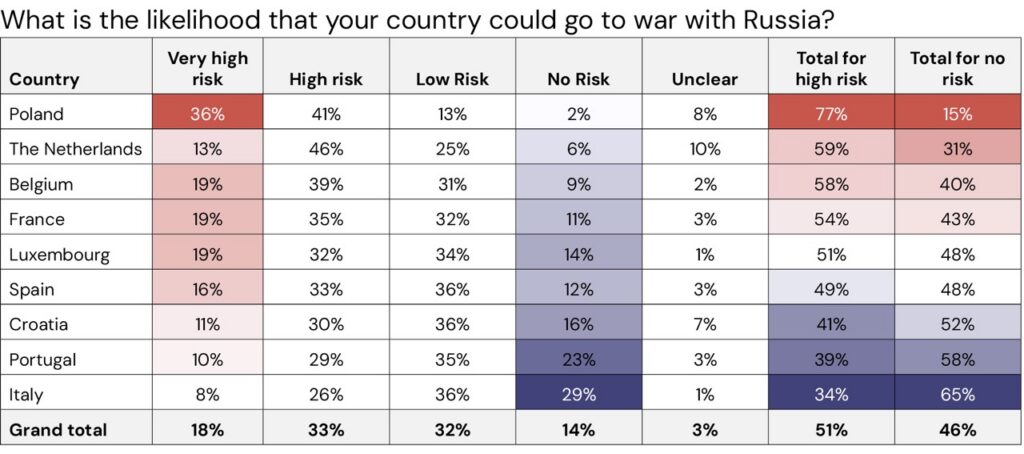
Observing the same trends in public opinion in Europe, the Economist accuses European societies of being naïve or ignorant about the allegedly looming and urgent danger posed by Russia.16A December 2025 poll indicates that majorities in Germany and France want to dial back assistance to Ukraine and do not see Russia as an imminent threat to their countries.17
Rightsizing Russian military capability
An International Institute for Strategic Studies report released on February 16 says that, despite the increased defense spending in Europe, Russian defense spending — calculated using purchasing power parity — is slightly greater than that of Europe as a whole.18The report nevertheless suggests that Russia’s ability to sustain this level of engagement could begin to be exhausted within the coming year. The report documents the continued dominance of the big five US defense companies (Lockheed Martin, RTX, Northrop Grumman, Boeing, and General Dynamics) and the rapid growth of several European and other non–American companies, notably Germany’s Rheinmetall. Poland, the Baltics, and the Nordic countries are among the opponents of adopting “European preference” in defense procurement.
Dialogue and deterrence
European proponents of rearmament, including von der Leyen and Merz, tend to neglect any role for diplomatic engagement with Russia. Such engagement could help stabilize any outcome that emerges from the end of the war in Ukraine. As was the case in the mature phase of the Cold War, it will be necessary to build institutions and habits of mutual confidence, transparency, arms control, and accommodation.
Thomas Graham argues that European leaders should “resist the tendency to rely on alarmist rhetoric” to shock complacent citizens into squarely facing the Russian challenge, and “eschew rhetoric that demonizes Russia or Russians.”19Dialogue is an essential safeguard to “reduce the risk that the Kremlin will misread Europe’s intent and overreact.” There have been fitful attempts by some Europeans to open dialogue with Russia, but no concerted, purposeful diplomatic agenda has emerged.
Cracks in consensus
Despite the semblance of consensus on unwavering support for Ukraine, American efforts to find a diplomatic settlement by engaging with Russia have exposed varying degrees of enthusiasm within the EU and NATO for doubling down on support for Ukraine.
The failure last December of the European Commission’s attempt to use Russian official reserves held by Belgium’s Euroclear exposed divisions within the core group of Ukraine supporters in Europe. Belgium, France, and Italy blocked the commission’s proposal. Hungary, Czechia, and Slovakia were allowed to opt out of the compromise solution of a €90 billion loan to be backed by the EU budget. Although billed as a success for Europe, the failure to tap the Russian reserves was an affront to Merz and von der Leyen. France has sought to ensure the loan’s proceeds finance the acquisition of European, rather than American or even British, arms.
Money talks
Data from the Kiel Institute show that Europe as a whole was able to sustain both humanitarian and military aid to Ukraine in 2025 at levels not dramatically lower than in 2024.20The PURL program helped significantly to make up for the withdrawal of direct American arms supplies for Ukraine, allowing Europeans to purchase American weapons and equipment. European weapons and procurement from Ukraine’s own defense industries have also helped sustain Ukraine’s military capabilities.
EU institutions have become the primary providers of financial aid to Ukraine. The bulk of military aid to Ukraine, however, has come from several Western European countries — notably Germany and the UK — in addition to Northern Europe. Military aid to Ukraine from the Nordic countries exceeds that of all other countries as a share of GDP, but remains small in absolute terms. The share from Eastern Europe has declined, and the share from Southern Europe (including Italy and Spain) is quite low. This pattern exposes the fragility of consensus in Europe over the war in Ukraine.
EU structural limitations and collective action
The European Union seeks to redesign its institutions and rules while in an unprecedented period of turbulence and uncertainty. Achieving strategic autonomy for Europe as a whole would involve resolving the collective action problem within the EU. The Franco–German tandem that drove European integration and enlargement for decades is now neither inclusive nor coherent enough to serve its former purpose. This poses a dilemma not easily resolved within the institutional framework of the European Union.
This process might be simplified if there were a prime mover or regional hegemon among European countries. This role could, in principle, be played by Germany — the largest European economy — but, given its 20th-century history, it is ill-suited to play such a role. Germany’s role within postwar Europe has been purposefully embedded in the self-imposed constraint of building consensus and not openly seeking to dominate.
Partner disquiet over German rearmament
The German defense budget for 2026 shows a large increase over the two previous years and forecasts a continued steep trajectory for “kriegstuchtigkeit” (i.e, war readiness) and the realization of the goal of making the German armed forces the largest and best-equipped conventional force in Europe.21Total defense spending in 2026 will reach €108 billion.
Figure 2: The German Defense Budget, 2024-26
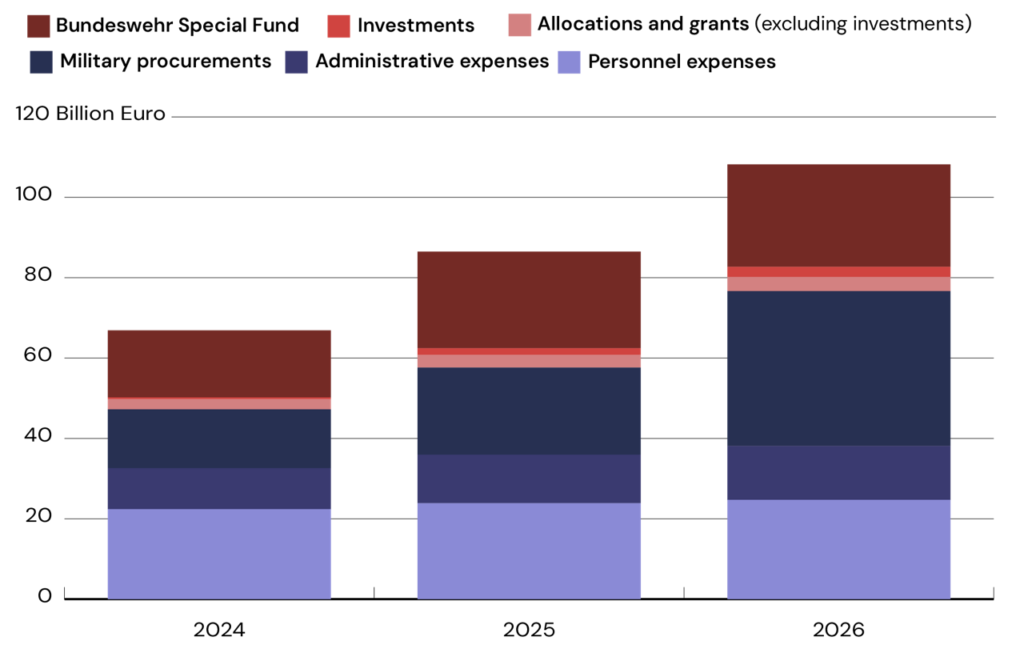
Germany’s program of rearmament has been slow to gain momentum and has been criticized for emphasizing legacy items, including tanks and artillery, while slighting advances in drone warfare and technical battlefield intelligence capabilities.22
Viewed from the standpoint of preserving or reinforcing stability in Europe, the difficulty posed by Germany’s rearmament drive is not so much what Germany is producing or procuring, but that it is being undertaken outside of an inclusive European framework. This approach rattles France and Poland because it violates one of the maxims that has governed Germany’s post–WWII foreign policy. This principle, summarized by the maxim “never alone,” means that Germany will always embed its national aims in the broader interests of Europe and, where possible, the transatlantic West as a whole.
Germany’s neighbors’ worries persist despite the efforts of Merz and Defense Minister Boris Pistorius to dispel them. Merz continues to insist that Germany aims to contribute to the defense of Europe as a whole.
A sure indication that Germany risks disrupting European unity and continental security is the objections and warnings from scholars known to have a strong affinity for a European–focused Germany. In the Guardian, Garton Ash cautions Merz to heed the concerns raised by France, Poland, and the UK.23In Foreign Affairs, German scholar Liana Fix raised similar concerns.24Both urge Germany to coordinate its defense and security buildup more closely with partners and to take the interests of other Europeans more fully into account. They also evoke the danger of disturbing the balance of power that has been submerged in Europe under the pacifying leadership of the United States. Fix’s article and her meeting with Merz during his last visit to Washington inspired the Financial Times to ask what Germany’s rearmament means for Europe.25
Debt constraint on defense buildup
According to the most recent Eurostat data, Greece, Italy, France, Belgium, and Spain have debt-to-GDP ratios of 100 percent or more, while Germany’s debt amounts to just over 60 percent of GDP.26
Germany’s comparatively low public debt-to-GDP ratio offers an opportunity to finance the defense buildup through borrowing, while many other European countries, including the UK, are constrained in their public expenditures by debt service and politically sensitive social spending obligations.
This fiscal constraint explains why France and Italy favor the idea of EU–issued Eurobonds to promote a more concerted Europe–wide defense modernization. Germany remains in firm opposition to this idea. Von der Leyen would not oppose EU borrowing to fund defense spending, nor the revision of the next EU budget to favor it.
France also worries that Germany’s new defense spending could perpetuate dependence on US systems, including the F-35 and Patriot air defense. France wants Europe to have its own advanced fighter and air defense systems.
Since much of the European public remains unpersuaded that a Russian attack on Europe is imminent, increases in defense spending are politically controversial and only feasible if other programs are not cut. The social safety net will be particularly vital given the economic slump that will deepen if the war in Iran renews.
Restoring public confidence and dynamism to the EU
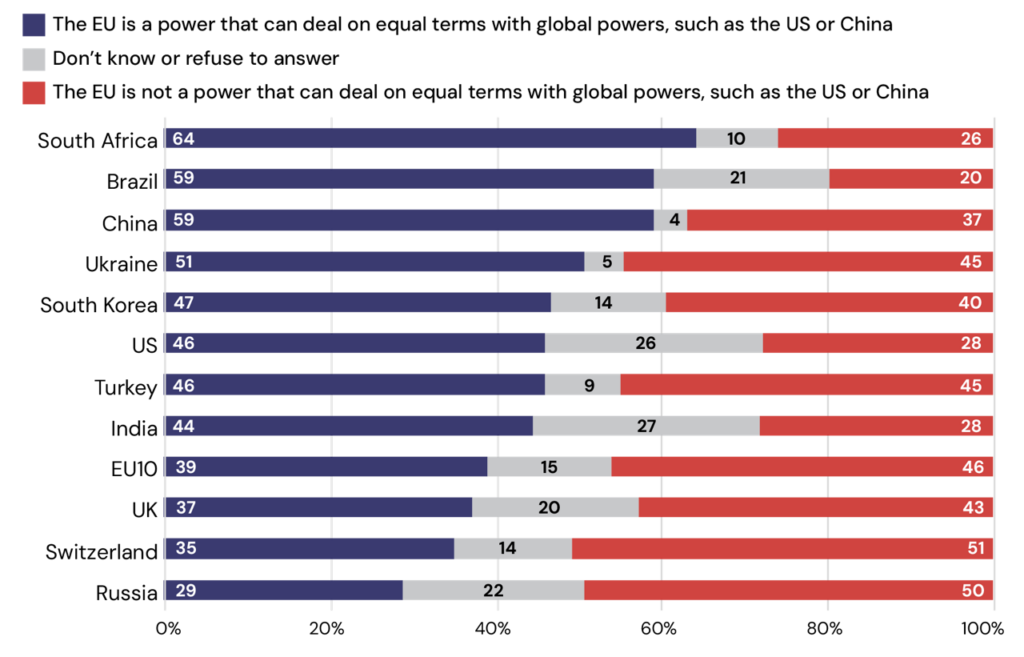
A European Council on Foreign Affairs poll published in January shows limited public confidence within EU member countries about the EU’s capacity to deal on equal terms with global powers such as the US or China.27
Figure 3: The Power of the EU
The most promising approach to overcoming the collective action problem in a way that might rally public support and bolster confidence would be to form a steering group of member states that unites a critical mass of leading EU and NATO countries that includes — but is not dominated by — Germany. Such a group should bridge the North–South and East–West divides in Europe, which correspond to differing assessments of the Russian threat and different degrees of resolution to assert independence from the United States.
The Franco–German tandem remains necessary because they are the major military powers of the EU, but it is no longer sufficient given the shift of Europe’s center of gravity eastward. The Weimar group adds Poland to the Franco–German format, but it remains inadequate for finding common ground on European security.
At the initiative of the German and French finance ministers, a new grouping — the E6 — unites Germany, France, Italy, the Netherlands, Spain, and Poland to coordinate defense procurement decisions and find resources in the coming EU Multiannual Financial Framework for urgent defense priorities.28The group has also ruffled feathers among the EU countries not involved as it surges ahead to address major objectives such as a single capital market across the EU.29
The six countries involved have the European Union’s most significant defense industries, which could promote joint industrial projects. However, it is worth noting that the Franco–German joint effort to develop a fighter aircraft has been abandoned after years of disputes between the French and German companies involved.
The E6 countries together represent more than two-thirds of the EU’s population and GDP. If this coalition produced an agreement, it would have strong prospects for pressing through decisions at the European Council.
Populist-nationalist prospects and the Trump precedent
While attention has been focused on how Europe’s leaders could collectively assert greater strategic autonomy, it is always worth remembering the strong countercurrent toward the reassertion of national sovereignty led by populist parties of the right and, in some cases (notably France), on the left as well. Developments affecting Europe’s future as a coherent strategic actor are thus evolving along two opposing tracks. The electoral success of populist nationalists has geopolitical content: it arguably frustrates European ambitions to coalesce around the aim of strategic autonomy.
The protagonists of greater integration on foreign and defense policy — Starmer, Macron, and Merz — are themselves not popular (Starmer especially so, given the announcement of his impending resignation).30Europe’s leaders depict nationalist Eurosceptics as Russia–aligned because they tend to favor a negotiated settlement of the war in Ukraine, though it would be more accurate to say that they see mass immigration and social disintegration as much greater threats to European security than the Russian military. The strategy adopted toward the populist challenge has been marginalization and demonization, which does not seem to have curbed these parties’ momentum.31
The push to unite Europeans so that Europe can matter globally has little or no resonance with that portion of the public seeking instead to reassert national sovereignty and identity.
A major unifying theme of the populist right is Euroscepticism, or the drive to curtail the commission’s scope of authority. Viktor Orbán, who epitomized and led Europe’s national-populist camp, sought not to abandon the European Union but to force a rollback of integration by promoting the election of “sovereigntist” leaders across European states and in the European Parliament. Orbán suffered a crushing defeat in the April elections, but populist-nationalist parties, notably Reform in the UK, Rassemblement National, or RN, in France, and Alternative for Germany, or AfD, in Germany, continue to rise in opinion polls.
Populist parties of the right have drawn inspiration from the Trump administration’s “America First” slogan and applied this to their own countries.32This emulation came to a shuddering halt with the American–Israeli war with Iran, which was, and remains, almost universally deplored across Europe, including in the UK and even dependably pro–American Poland.33Germany’s AfD, which had courted American Republican support, tactfully pulled back, while France’s RN was harshly critical.
The revulsion among Europeans appeared not primarily to be about the violation of the UN Charter’s prohibition on aggressive war, but rather the lack of coherent, achievable aims for the war and the prospect of a prolonged disruption of global economic activity.
As commission president, von der Leyen has sought to revive enthusiasm for deeper integration. She tries to move fast and break things.34The absence of meaningful checks on her power has fostered backlash. She has disempowered commissioners and grabbed the foreign policy agenda, formally reserved for the council and for High Representative Kaja Kallas, who advises the council.
Newly elected Hungarian Prime Minister Petr Magyar may represent a synthesis of the mainstream center-right and the nationalist-populist trend, much as Italy’s Georgia Meloni has done. The RN’s Jordan Bardella, who leads opinion polls for next year’s presidential election in France, seems to be creeping toward the center-right mainstream on defense and security matters. His likely opponent in a second round is center-right former Prime Minister Edouard Phillipe, implying that the contest could be fought mainly between tendencies in the right wing of national politics.
It is possible that Europe’s populist right will, out of nationalist principles or political calculation, rally to the cause of European strategic autonomy. But this would probably require the commission to cede leadership to some coalition of member countries. It would also likely happen only in the context of a European diplomatic effort to achieve a compromise peace in Ukraine.
There is serious doubt that either the UK or France could deliver on the pledge to deploy troops in post-conflict Ukraine. UK Reform leader Nigel Farage and France’s RN leaders Marie Le Pen and Bardella oppose the commitment of the so-called Coalition of the Willing.35In both France and the UK, such a deployment would require parliamentary approval.
How should American aims and purposes change?
American diplomacy faces an urgent imperative for renewal to meet the epochal change affecting the global system. The reflexive assertion of primacy and the profligate use of military force risks accelerating the diminution of America’s global influence.
The US needs to cultivate a deeper, more comprehensive analytical understanding of Europe and its institutions, and to work with Europeans to fashion a genuinely cooperative relationship that accommodates a greater degree of European independence in foreign and defense policy.
The United States should not follow a dismemberment strategy vis-à-vis the European Union. The EU has fostered peace among its members — a remarkable and historic achievement given the wars of the 20th century. Maintaining this core of peace on the Continent satisfies a vital American interest.
For all its challenges, Europe has been indispensable to the broader Western political community in partnership with the United States. A Europe dissolved into fully sovereign nation-states pursuing disparate agendas would invite divide-and-conquer tactics and would certainly not advance prospects for peace and security. The US should not inadvertently promote, let alone join, a great power scramble to pull Europe apart.
American support for Europe’s strategic autonomy will necessarily stop short of a complete renunciation of efforts to promote US security interests in Europe. To date, the main accomplishment of European foreign and security policy has been mobilizing and maintaining support for Ukraine and condemnation of Russia since the full-scale invasion of 2022, even after US aims and intentions diverged.
The US National Security Strategy observes that a negotiated settlement of the war in Ukraine is a necessary condition for restoring strategic stability. While supporting Europe’s strategic autonomy, the US must try harder to persuade Europeans that a settlement is in their interest. The US should encourage European diplomatic contacts with Russia, coordinated with American efforts, while the war proceeds to ensure greater stability in the post-conflict period.
Given the economic disruption caused by the Iran war and the already weak growth across the Eurozone, continued European financing of the Ukraine war risks deepening domestic political polarization and damaging social peace. The populist right has attracted much of the support of working-class and financially precarious voters, long the traditional base of social democratic support. At a European level, fissures among EU members about the case for continued arming and funding of Ukraine exacerbate the collective action problem.
A restoration of trust, albeit within a new balance that respects European strategic agency, will be the necessary foundation for new relations with Europe, as with other regions of the world. The US cultivation of unpredictability and extreme unilateralism is corrosive of the strategic stability that is a core American interest. If the US were completely estranged from Europe, the credibility of American security commitments to any country or region would be permanently damaged.
A European NATO, one in which American power recedes somewhat, could reopen the divisive question of NATO’s eastern expansion to include Ukraine, Georgia, Moldova, and others. The US should ensure that a new distribution of power within NATO does not affect American prerogatives regarding NATO’s eastward expansion. Such expansion would intensify the war in Ukraine and generate greater regional tensions. It would impair the establishment of a measure of restored strategic security with nuclear-armed Russia and complicate the progress of the European NATO and EU in strengthening their conventional territorial defense. A Europeanized NATO could not, by virtue of its eastward expansion, be allowed to impose new security obligations on the United States.
US mercantilism should not be allowed to obstruct Europe’s path to greater strategic autonomy. Europe needs to be substantially more self-sufficient in defense industrial capacity. The harsh reality is that the expansion of Europe’s defense capabilities implies some loss of market share in Europe for US exports of armaments and equipment.
The US and Europe should realize that strategic autonomy implies that decision-making on matters of war and peace on the Continent would no longer be monopolized by the United States. A strategic Europe could and probably would not always adopt American approaches to crises, which could call for the use of force within Europe or elsewhere. The reservations of Europeans about the US–Israeli war against Iran are likely to be repeated in other contexts.
Program
Entities
Authors

Dr. Molly O’Neal is a non-resident fellow at the Quincy Institute and former U.S. Foreign Service Officer whose career, from 1989 onward, was devoted to U.S. relations with Central and Eastern Europe, Russia, and Eurasia.
Citations
“Davos 2026: Special Address by Mark Carney, Prime Minister of Canada,” World Economic Forum, Jan. 20, 2026, https://www.weforum.org/stories/2026/01/davos-2026-special-address-by-mark-carney-prime-minister-of-canada. ↩
Bojan Pancevski and Daniel Michaels, “Europe is Accelerating a NATO Fallback Plan in Case Trump Pulls Out,” Wall Street Journal, April 14, 2026, https://www.wsj.com/world/europe/europe-nato-trump-plans-3a423233. ↩
“Security Action for Europe (SAFE),” European Commission, accessed May 9, 2026, https://defence-industry-space.ec.europa.eu/eu-defence-industry/safe-security-action-europe_en. ↩
“Article 42.7: An Explainer,” European Council on Foreign Relations, Nov. 19, 2025, https://ecfr.eu/article/commentary_article_427_an_explainer5019/. ↩
Hugo Bromley, “Europe Cannot Be a Military Power,” Foreign Affairs, March 17, 2026, https://www.foreignaffairs.com/europe/europe-cannot-be-military-power. ↩
Gideon Rachman, “Europe’s Triple Shock: Putin, Trump, and Xi,” podcast interview by Gideon Rachman, The Rachman Review, Dec. 25, 2025, https://www.ft.com/content/684291e2-f2b4-4b27-8de4-d712c09cb114?syn-25a6b1a6=1. ↩
Connor Stringer, “Trump Interview: I am Strongly Considering Pulling Out of NATO,” Telegraph, April 1, 2026, https://www.telegraph.co.uk/world-news/2026/04/01/donald-trump-strongly-considering-pulling-us-out-of-nato/. ↩
Liana Fix, “Trump Is Pulling Troops From Germany. The Missiles Are a Bigger Problem,” Council on Foreign Relations, May 4, 2026, https://www.cfr.org/articles/trump-is-pulling-troops-from-germany-the-missiles-are-a-bigger-problem. ↩
“That Irritating Feeling That France Was Right,” Economist, Feb. 18, 2026, https://www.economist.com/europe/2026/02/18/that-irritating-feeling-that-france-was-right. ↩
“Emmanuel Macron Declares a European State of Emergency,” Economist, Feb. 10, 2026, https://www.economist.com/europe/2026/02/10/emmanuel-macron-declares-a-european-state-of-emergency. ↩
“National Security Strategy of the United States of America,” The White House, November 2025, https://www.whitehouse.gov/wp-content/uploads/2025/12/2025-National-Security-Strategy.pdf. ↩
Laura Kayali, “Pentagon Aggressively Lobbies EU Against Buy European Weapons Push,” Politico, Feb. 19, 2026, https://www.politico.eu/article/washington-lobbies-eu-against-buy-european-push-for-weapons-donald-trump/. ↩
Jonathan Masters and Will Merrow, “Here’s How Much Aid the United States Has Sent Ukraine,” Council on Foreign Relations, Feb. 23, 2026, https://www.cfr.org/articles/how-much-us-aid-going-ukraine. ↩
“Remarks by Under Secretary of War for Policy Elbridge Colby at the Ukraine Defense Contact Group (As Delivered),” US Department of Defense, April 15, 2026, https://www.war.gov/News/Speeches. ↩
“European Public Opinion Barometer – Wave 4,” The Great Continent, Dec. 2025, https://legrandcontinent.eu/fr/eurobazooka-decembre-2025. ↩
“Europe’s Generals are Warning People to Prepare for War,” Economist, Dec. 30, 2025, https://www.economist.com/europe/2025/12/30/europes-generals-are-warning-people-to-prepare-for-war. ↩
Stephan Faris, Hanne CokeLaere, Tim Ross, and Gregory Svirnovskiy, “French and German Adults Lean Toward Dialing Back Ukraine Support, New Politico Poll Shows,” Politico, Dec. 15, 2025, french-and-germans-lean-toward-dialing-back-ukraine-support-new-international-politico-poll-shows. ↩
Lucia Mackenzie, “Russian Defense Spending Overtakes Europe, Study Finds,” Politico, Feb. 12, 2025, https://www.politico.eu/article/russian-defense-spending-overtakes-europe-study-finds/. ↩
Thomas Graham, “Right-Sizing the Russian Threat,” Council on Foreign Relations, Feb. 17, 2026, https://www.cfr.org/articles/right-sizing-the-russian-threat. ↩
Christoph Trebesch and Taro Nishikawa, “Europe Steps Up: Ukraine Support After Four Years of War,” Kiel Institute, February 2026, https://www.kielinstitut.de/fileadmin/Dateiverwaltung/IfW-Publications/fis-import/dd24a73f-4270-46c5-9c40-bcc9df4f1672-KPB2023_EN.pdf. ↩
Levente Bartha, “Germany’s Path to Kriegstüchtigkeit: The 2026 Defence Budget,” Atlas Institute for International Affairs, Dec. 19, 2025, https://atlasinstitute.org/germanys-path-to-kriegstuchtigkeit-the-2026-defence-budget/. ↩
Laura Pitel and Sylvia Pfeifer, “Germany Vows More Defence Tech Funding After Backlash Over Tanks,” Financial Times, Feb. 15, 2026, https://www.ft.com/content/62f4a0f7-ffc9-49c8-b1e5-649703018dd1?syn-25a6b1a6=1 ↩
Timothy Garton Ash, “Germany’s Military Power is on the Rise. This Time it Must Be Firmly Embedded in Europe,” Guardian, May 4, 2026, https://www.theguardian.com/commentisfree/2026/may/04/germany-military-power-rise-embedded-europe-us-trump. ↩
Liana Fix, “Europe’s Next Hegemon: The Perils of German Power,” Foreign Affairs, Feb. 6, 2026, https://www.foreignaffairs.com/germany/europes-next-hegemon-liana-fix. ↩
Anne-Sylvaine Chassany and Leila Abboud, “Germany Re-Arms: What Does It Mean for Europe,” Financial Times, April 28, 2026, https://www.ft.com/content/4b7c00f6-7b32-416b-a06d-485473068058?syn-25a6b1a6=1. ↩
“Government Debt at 87.8% of GDP in Euro Area,” Eurostat, April 22, 2026, https://ec.europa.eu/eurostat/web/products-euro-indicators/w/2-22042026-bp#:~:text=The%20highest%20ratios%20of%20government,%25)%20and%20Bulgaria%20(29.9%25. ↩
Timothy Garton Ash, Ivan Krastev, and Mark Leonard, “How Trump Is Making China Great Again — And What It Means for Europe,” European Council on Foreign Relations, January 2026, https://ecfr.eu/wp-content/uploads/2026/01/How-Trump-is-making-China-great-again%E2%80%94and-what-it-means-for-Europe.pdf. ↩
Peter Becker et al., “The New E6 Format: The EU Between Unity and Fragmentation,” German Institute for International and Security Affairs, April 26, 2026, https://www.swp-berlin.org/en/publication/the-new-e6-format-the-eu-between-unity-and-fragmentation. ↩
Gregorio Sorgi and Giovanna Faggionato, “‘No Red Lines’: Spain Reveals EU Supergroup’s Plan to Challenge US and China,” Politico, Feb. 19, 2026, https://www.politico.eu/article/spain-reveals-eu-supergroup-e6-plan-challenge-us-and-china/. ↩
S. Galan, “Approval Ratings of Selected World Leaders as of April 2026,” Statista, May 7, 2026, https://www.statista.com/statistics/1456852/world-leader-approval-ratings/?srsltid=AfmBOoo4fg1BeCGMBrsi_7S7iIOwmjpjY9lxTE42XCXMoicYD3VuIk9S. ↩
“Can Anyone Stop Europe’s Populist Right?” Economist, Dec. 11, 2025, https://www.economist.com/leaders/2025/12/11/can-anyone-stop-europes-populist-right. ↩
Mark Leonard, “The Biggest Threat Facing Europe is Not a Trump Invasion. It’s His Global Political Revolution,” Guardian, Feb. 7, 2026, https://www.theguardian.com/commentisfree/2026/feb/07/europe-trump-invasion-global-political-revolution-new-right. ↩
Vincenzo Genovese, “Europe’s Far Right Is Lost in Trump’s War Against Iran,” EuroNews, Mar. 7, 2026, europes-far-right-is-lost-in-trumps-war-against-iran. ↩
Eddy Wax and Thomas Moller-Nielsen, “Move Fast and Break Things: Von Der Leyen’s Method Under Scrutiny,” Euractiv, Mar. 19, 2026, https://www.euractiv.com/news/move-fast-and-break-things-von-der-leyens-method-under-scrutiny/?utm_source=euractiv&utm_medium=newsletter&utm_content=Zone+name&utm_term=0-0&utm_campaign=EN_BREAKING_ALERT. ↩
Marion Solletty, Laura Kayali, and Esther Webber, “Bardella and Farage Cast Doubt on French and British Pledges to Ukraine,” Politico, Jan. 15, 2026, https://www.politico.eu/article/jordan-bardella-nigel-farage-surge-casts-doubts-over-france-uk-commitments-to-ukraine/. ↩