
Strategic Prudence and Extending New START
Executive Summary
The last standing bilateral nuclear arms control agreement between the United States and Russia — the New Strategic Arms Reduction Treaty, or New START — is set to expire on Feb. 5. In an era of nuclear escalation, the end of New START and effective lapsing of nuclear guardrails would pave the way for an unrestrained nuclear arms race. This brief outlines diplomatic options for the Trump administration to preserve strategic stability between the United States and Russia in the form of a renewed New START or a successor agreement.
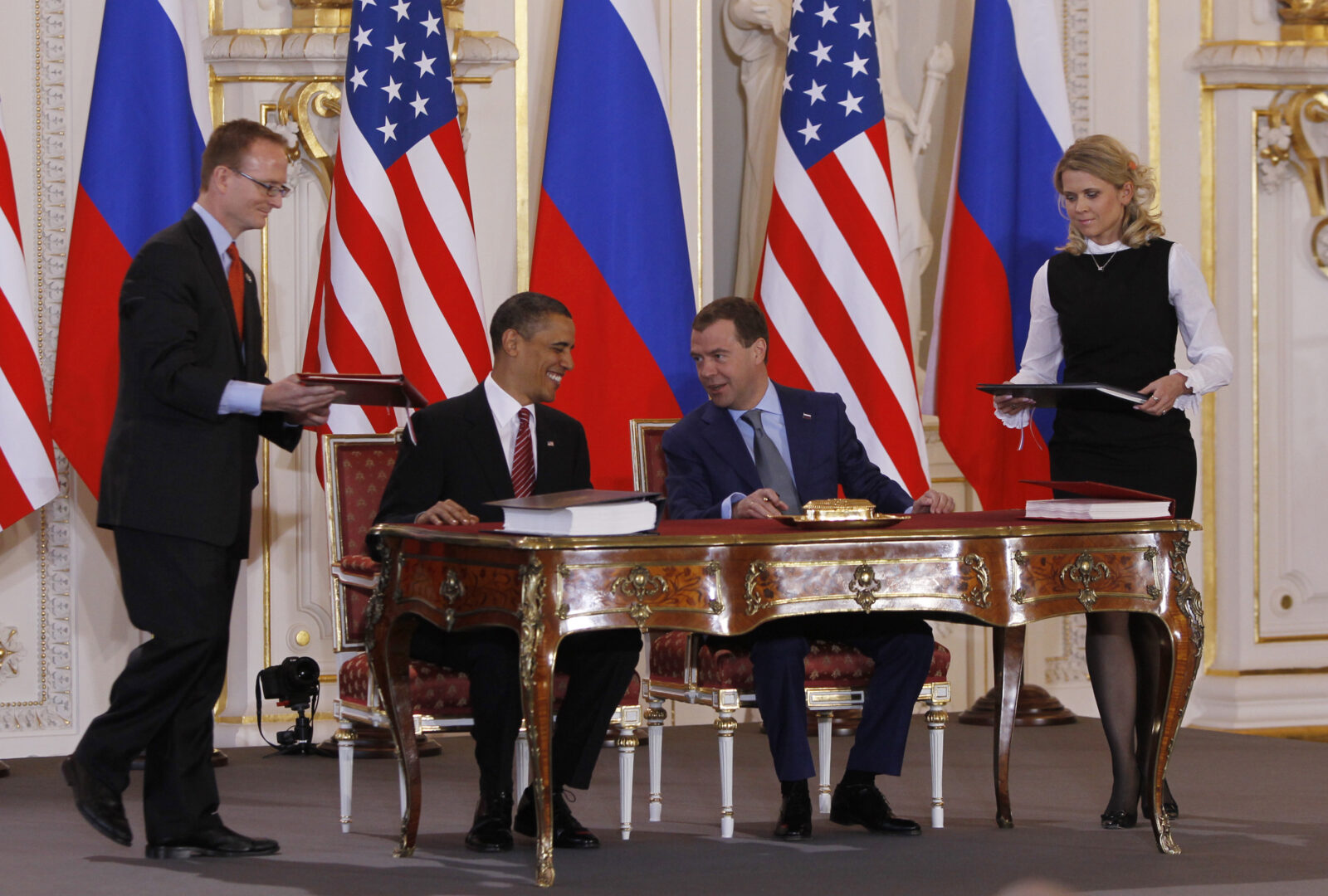
New START was originally signed by Presidents Obama and Medvedev on April 8, 2010. The agreement capped the nuclear arsenals of Russia and the United States and also established several overlapping mechanisms to ensure compliance and implementation.
Since New START’s signing, the United States and Russia have abided by its numerical limits, even as verification mechanisms have been suspended. Amid the war in Ukraine, there remains overwhelming U.S. public support for sustaining arms control with Russia.
Russia has been accused of violating nine separate arms agreements or commitments. However, sustained U.S. nuclear cooperation with Russia remains a far better alternative than a landscape in which no agreements exist. An uncontrolled nuclear arms race environment would be highly destabilizing, extremely costly financially, and possibly lead to intensified Russia–China nuclear coordination. All of these developments would be antithetical to U.S. interests.
A diplomatic approach with Russia is more cost-effective, realistic, and conducive to further trilateral nuclear discussions with China. Toward that outcome, this brief lays out several immediate-term options for the Trump administration:
- Amend New START’s expiration toward a short-term extension, achieved through formal U.S.–Russian diplomatic negotiations.
- Successor Agreement: In addition to replicating New START’s arsenal caps, an updated agreement could also incorporate limits on novel U.S. and Russian systems such as Burevestnik, Poseidon, and Dark Eagle, and establish updated verification mechanisms.
- An informal Trump–Putin deal: a stopgap agreement between the two leaders to maintain existing nuclear caps, halting an arms race in the short term to support a broader, formalized framework down the road.
- Reestablish U.S.–Russian notification procedures for nuclear force movements and exercises, and create new transparency measures for novel systems.
Introduction
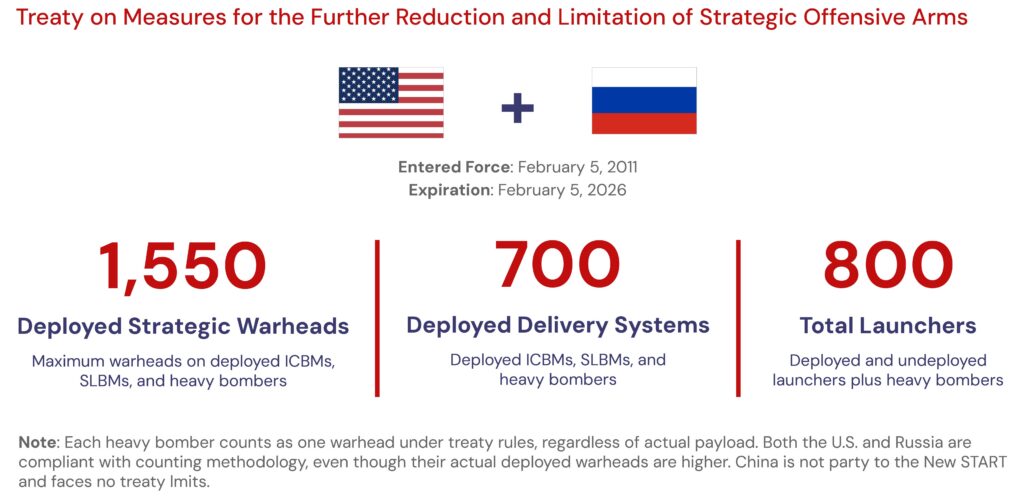
The international security landscape stands at a critical juncture as the New Strategic Arms Reduction Treaty, or New START, approaches its expiration on Feb. 5, 2026. This treaty, the last remaining bilateral nuclear arms control agreement between the world’s two largest nuclear powers, limits U.S. and Russian nuclear forces to 1,550 strategic warheads and 700 strategic launchers deployed on each side.1If it lapses without arrangements to continue the application of its core provisions while buying time for negotiating a successor, the door opens to an unconstrained nuclear arms race at precisely the moment when global nuclear risks are already dangerously elevated.
The urgency is hard to overstate. Nuclear saber-rattling during the war in Ukraine, Russian tests of novel nuclear delivery systems that push the boundaries of existing arms control frameworks, President Trump’s call to resume nuclear testing, and China’s military modernization have all complicated the strategic picture.
Trump has signaled interest in “denuclearization” with Russia and China, while acknowledging the staggering costs of nuclear modernization. “Tremendous amounts of money are being spent on nuclear, and the destructive capability is something that we don’t even want to talk about today,” he remarked at the 2025 World Economic Forum.2This recognition of both the financial burden and the existential danger of nuclear weapons opens a potential window for pragmatic arms control. That window widened in September 2025, when Russian President Vladimir Putin proposed that Russia and the U.S. agree to continue observing New START’s “central quantitative limits” for one additional year.3
More recently, in a January 2026 interview with The New York Times, Trump said of the treaty: “If it expires, it expires. … We’ll just do a better agreement,” adding that he’d want to “get a couple of other players involved also.”4 Five days later, Kremlin spokesman Dmitry Peskov emphasized the precariousness of the moment, stating that “Russia is awaiting a response to Putin’s initiative.”5Since then, Deputy Foreign Minister Sergey Ryabkov has asserted that if the treaty expires on Feb. 5 without replacement, “nothing” will happen in terms of Russian security, which is “100% guaranteed” by its own capabilities. He interprets U.S. silence on Putin’s one-year extension proposal as “military-political egoism” and “complete indifference.”6Russia has not withdrawn its proposal for a mutual, parallel commitment to central quantitative limits for one year post-expiration, but insists this must be reciprocal.
This brief explores pathways to extend those central numerical limitations, focusing primarily on bilateral U.S.–Russia dynamics while acknowledging the growing significance of China. The brief deliberately sets aside tactical nuclear weapons — shorter-range systems that would require their own diplomatic track with different verification challenges. The focus is on preserving constraints over strategic nuclear forces — the intercontinental-range systems that form the backbone of nuclear deterrence — while laying the groundwork for more comprehensive future agreements.
Origins of New START
New START emerged from a moment of renewed U.S.–Russian engagement after the elections of Barack Obama and Dmitry Medvedev in 2008. The Russian–Georgian War that year nearly derailed the relationship altogether, prompting both leaders to try a different approach. Negotiations began in earnest in 2009, building on the foundation established by the original START treaty and its successors. Signed in Prague on April 8, 2010, and entering into force on Feb. 5, 2011, New START reduced U.S. and Russian strategic offensive nuclear arms to levels not seen since the 1960s.7
The treaty established three central quantitative limits that have governed strategic nuclear forces for over a decade. Each nation agreed to cap its arsenal at no more than 1,550 deployed strategic warheads; 700 deployed intercontinental ballistic missiles, or ICBMs, submarine-launched ballistic missiles, or SLBMs, and nuclear-capable bombers; and 800 deployed and nondeployed launchers and bombers combined. Crucially, the treaty’s verification provisions require data exchanges, notifications, and on-site inspections to confirm compliance with these numerical limits.
Figure 1. New START Treaty Limits
Implementation went smoothly through the 2010s. Both nations met the treaty’s limits by the February 2018 deadline. The verification regime worked effectively, involving hundreds of annual notifications and 18 on-site inspections per year. This transparency built confidence and predictability during a period when bilateral relations were otherwise deteriorating.8
The verification architecture was itself a significant achievement. Multiple overlapping mechanisms combined to ensure compliance. Regular data exchanges tracked the numbers and locations of treaty-relevant systems. Notifications covered movements and changes in strategic forces. On-site inspections at declared facilities provided transparency. The treaty also established a Bilateral Consultative Commission requiring American and Russian experts to meet twice yearly to discuss compliance and implementation. It is this structure that allows for discussions and debates on any novel issues.
In 2021, the U.S. and Russia exercised a treaty clause permitting a one-time, five-year extension. Agreed to in the early days of the Biden administration, this extension demonstrated that even amid severe political tensions, both nations recognized the value of maintaining strategic constraints. It was meant to buy time for negotiations on a follow-on agreement, though subsequent events would severely complicate those prospects.9
Current state of New START
Despite political tensions, both the U.S. and Russia have generally remained within New START’s numerical limits, even as the treaty’s verification mechanisms have been suspended.
But in February 2023, Putin announced that Russia would suspend its observance of the treaty. Russian officials clarified that Moscow would continue observing the treaty’s limits on nuclear delivery vehicles but would halt data exchanges and inspections.10In June 2023, Washington suspended its own implementation of verification provisions, while stating it would also continue abiding by the numerical limits.11
This mutual suspension of verification, while both sides maintain adherence to numerical caps, creates an unstable equilibrium. The U.S. and Russia can still monitor each other’s strategic launchers and bombers using independent means like imagery satellites. However, monitoring deployed warheads without notifications and on-site inspections is considerably harder.
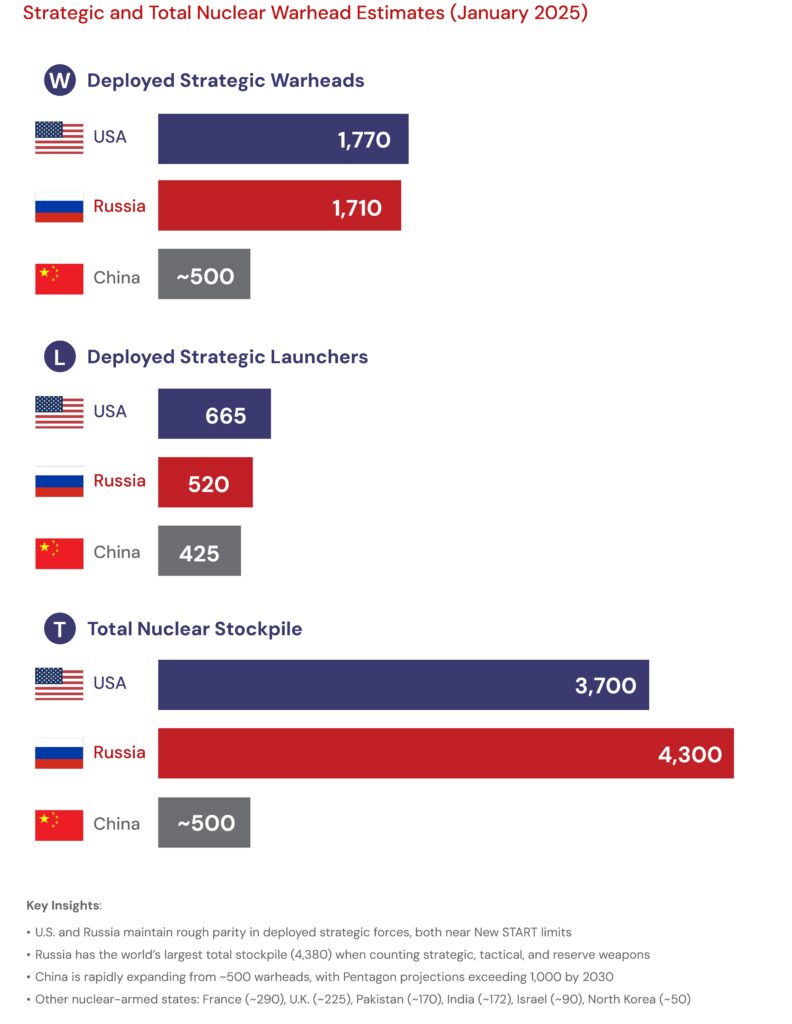
Figure 2. Current Nuclear Force Balance
Congressional support for arms control constraints remains notably bipartisan despite the polarized political environment. In February 2025, the House introduced H.Res.100, expressing support for the continued value of arms control agreements and negotiated constraints on Russian and Chinese strategic nuclear forces. “The Trump administration has a historic opportunity to initiate high-level talks for a new pact and prevent a dangerous and costly nuclear arms race,” said Senator Edward Markey, Democrat of Massachusetts, who introduced an identical resolution in the Senate.12
Efforts to maintain dialogue persist through multiple channels. U.S. and Russian parliamentarians continue to seek neutral venues to discuss New START and broader bilateral issues, despite the difficult diplomatic environment. Representative Anna Paulina Luna, Republican of Florida, has joined bipartisan calls for maintaining strategic dialogue. On the Russian side, Alexey Chepa, first deputy chairman of the State Duma Committee on International Affairs, has signaled openness to parliamentary exchanges. Putin envoy Kirill Dmitriev has reportedly explored back-channel communications regarding potential frameworks for strategic stability discussions in his meetings with Trump envoy Steve Witkoff and other U.S. representatives.13The 28-point Ukraine peace plan included the extension of “START I” — likely a reference to New START and not the treaty that expired in 2009.14
The American public has spoken in favor of maintaining limits on nuclear weapons. A January 2026 poll found that an overwhelming majority of Americans (91 percent) say the U.S. should negotiate a new agreement with Russia to either maintain current limits on nuclear weapons or further reduce both countries’ arsenals.15Crucially, this sentiment cuts across party lines: 85 percent of those who voted for President Trump believe he should accept Russia’s proposal to continue abiding by New START limits for at least another year. Furthermore, 72 percent of voters, including 61 percent of Republicans, believe that removing all nuclear limits would make the U.S. less secure. This data suggests that eschewing arms control would not only be strategically risky but also politically unpopular with the president’s own base.
A 2024 State Department report to Congress indicated that, though Russia “may have exceeded the deployed warhead limit by a small number during portions of 2024,” both nations broadly maintain the treaty’s central constraints.16This general adherence, even without active verification, speaks to the stabilizing influence of agreed limits.
Importantly, extending New START without settling the war in Ukraine faces significant political obstacles and may not be advisable from a strategic perspective. Russian leaders echo this sentiment: Former President Dmitry Medvedev, who negotiated and signed New START during his presidency, recently stated that “the prospects for resuming fruitful cooperation with the United States on arms control are directly related to the availability of favorable conditions for this. First of all, we need a basic normalization of Russian–American relations. After all, under Biden, they degraded to a level significantly worse than the period of the [Cuban Missile Crisis].”17
Russian rhetoric on extension
Putin’s proposal to extend New START for one additional year represents a significant diplomatic opening, though one that requires careful evaluation. Putin stated that “a complete renunciation of New START’s legacy would, from many points, be a grave and short-sighted mistake.”18
However, Russia’s proposal comes with important caveats. The measure would not be viable if the U.S. takes “steps that would undermine or disrupt the existing balance of deterrence,” Putin said. He specifically named U.S. “preparations for the deployment of [missile defense] interceptors in outer space” as a potentially destabilizing step.
Russian officials have provided mixed signals about prospects for formal negotiations. Ryabkov noted that, despite ongoing dialogue with Washington, this is insufficient to relaunch stability dialogue. “If there are no cardinal changes for the better in U.S. policy toward Russia, then there will be no prospects for preserving this treaty,” said Ryabkov.19Ryabkov has also stated that Russia is prepared to sign agreements pledging not to attack NATO.20
Russia’s position on verification remains elusive. Moscow claims it is adhering to New START’s central limits, arguing that continuing the unverifiable status quo is sufficient. “The U.S. has not yet provided a substantive response to our initiative,” Ryabkov said in December 2025. “In this regard, the task of preparing for all scenarios of strategic situation development after New START expires remains relevant.”21
Other senior Russian officials have stressed Moscow’s conditional approach to arms control. Medvedev, who is now the deputy chairman of Russia’s Security Council, noted that the treaty “played quite a positive role” and “provided the necessary predictability in the field of strategic offensive weapons.” However, Medvedev suggested that Russia would prefer no agreement to a flawed one: “No New START is better than a treaty that only masks mutual distrust and provokes an arms race in other countries.”22This hardline position, from a key architect of New START, underscores how difficult negotiations for a successor agreement may prove to be.
After the publication of Trump’s National Security Strategy, which includes the priority to “reestablish strategic stability with Russia,” the Russian MFA expressed dismay over the lack of “an American vision of a ‘post–New START’ world.”23Alexey Arbatov, one of Russia’s foremost experts on arms control, argues that “the complete abandonment of limitations would lead to an uncontrolled arms race that would be extremely dangerous and costly for all parties.” He emphasizes that preserving the treaty framework while acknowledging the need to address novel systems remains crucial for strategic stability.24Evidently, support for arms control extends beyond Putin’s immediate circle.
Trump’s openness to arms control
President Trump’s approach to nuclear arms control reflects both continuity with his first-term priorities and evolution in response to changing strategic realities. “There’s no reason for us to be building brand-new nuclear weapons. We already have so many,” Trump said. “You could destroy the world 50 times over, 100 times over. And here we are building new nuclear weapons, and they’re building nuclear weapons.”25
Throughout 2025, President Trump discussed potential talks with Russia and China concerning nuclear weapons reductions. In his first term, Trump tried and failed to bring China into nuclear arms reduction talks when the U.S. and Russia were negotiating an extension of New START. This insistence on trilateral negotiations complicated efforts to extend the treaty, ultimately leaving the extension to the Biden administration in 2021.
Trump said he would look to engage in nuclear talks with the two countries once “we straighten it all out” in the Middle East and Ukraine. “One of the first meetings I want to have is with President Xi of China, President Putin of Russia. And I want to say, ‘Let’s cut our military budget in half.’ And we can do that.”26This ambitious vision, while appealing in principle, faces significant practical obstacles.
The 2025 Trump–Putin summit in Anchorage provided a venue for preliminary discussions on strategic stability. The administration continues to express interest in comprehensive negotiations addressing not just deployed strategic warheads but all nuclear weapons.
China and trilateralism
China’s response to trilateral proposals remains categorically negative. Beijing’s Ministry of Foreign Affairs spokesman said it was “neither reasonable nor realistic” to expect China to participate in trilateral nuclear disarmament negotiations with the U.S. and Russia. “China and the United States are not at the same level at all in terms of nuclear capabilities.” Beijing says it favors disarmament in principle but has regularly rejected Washington’s invitations to join U.S.–Russian talks on reducing their nuclear arsenals.27Chinese officials argue that the nuclear superpowers should first reduce their arsenals to levels comparable to China’s and implement New START before Beijing joins multilateral negotiations.28Russia has long respected China’s position on this matter, but has expressed interest in accounting for France and the U.K.’s nuclear arsenals as well.29
According to 2024 estimates, the U.S. has 3,708 nuclear warheads and Russia has 4,380, excluding retired warheads. China had 500 in 2024, 90 more than in 2023. This vast disparity in arsenal sizes complicates any trilateral proposals.
However, China’s nuclear modernization trajectory adds urgency to engagement efforts. According to a 2024 U.S. Department of Defense assessment, China could have over 1,000 “operational nuclear warheads” by 2030.30This expansion, combined with China’s development of new delivery systems, including hypersonic glide vehicles and expanded ICBM fields, alters the strategic calculus.
Understanding China’s motivations for expansion is essential for crafting effective diplomatic approaches and eventually including Beijing in nuclear arms control frameworks. Beijing’s nuclear buildup is driven at least in part by China’s desire to preserve an assured retaliatory strike capability in the face of what it views as increasingly capable U.S. conventional and nuclear strike and missile defense capabilities. From Beijing’s perspective, American advances threaten to undermine China’s relatively small deterrent force.31This defensive logic suggests that addressing Chinese concerns about survivability could help moderate the pace of expansion. To its credit, the 2026 National Defense Strategy outlines a shift toward “respectful relations” with China and broadening military-to-military communications with the People’s Liberation Army to ensure deescalation and strategic stability.32Simultaneously, the National Defense Strategy emphasizes nuclear force modernization, a goal that remains compatible with maintaining New START’s numerical constraints.33
Tech competition and novel systems
The strategic landscape is being reshaped by novel weapons systems that complicate traditional arms control frameworks. Russia has developed systems like the Burevestnik nuclear-powered cruise missile and the Poseidon autonomous underwater vehicle.34Indeed, Putin announced these weapons in 2018, explicitly justifying them as efforts to overcome American missile defense capabilities. These weapons are designed to bypass traditional radar and early warning systems. Poseidon is designed to travel underwater to detonate radioactive tsunamis against coastal cities, while Burevestnik theoretically possesses unlimited range and loitering capability.
Foreign Minister Sergey Lavrov has stated that Russia is ready to account for systems like Avangard and Sarmat in New START, as they fit the definitions of existing delivery vehicles. However, Poseidon, Burevestnik, and others do not fall under this framework.35Vladimir Leontiev, deputy director of the Department for Nonproliferation and Arms Control of the Russian Ministry of Foreign Affairs, has suggested these new “exotic” systems should form the basis for separate agreements rather than being folded into existing frameworks.36
After a State Department official proposed including these weapons into the New START framework, Lieutenant–General Evgeny Buzhinsky, former head of the Ministry of Defense’s international treaty department, argued that “it has never been possible to include something under restrictions unilaterally. If the Americans want to include Poseidon, I would raise the issue of including their orbital drone.”37
The U.S. has its own advanced systems pushing technological boundaries. President Trump introduced the Golden Dome initiative in 2025 — a multilayer missile defense system for the U.S. designed to detect and destroy ballistic, hypersonic, and cruise missiles before they launch or during flight.38
Trump stated that Golden Dome would cost $175 billion, though Bloomberg’s estimate runs closer to $1.1 trillion.39This ambitious missile defense initiative has prompted significant international concern. Russian Ministry of Foreign Affairs spokeswoman Maria Zakharova said, “The United States’ Golden Dome project undermines the foundations of strategic stability as it involves the creation of a global missile defense system.”40In May 2025, China and Russia issued a joint statement criticizing the proposal’s rejection of the “inseparable interrelationship between strategic offensive arms and strategic defensive arms.”41
The U.S. has also developed Dark Eagle, America’s entry into the hypersonic arms race. Francisco Lozano, director of Hypersonic, Directed Energy, Space and Rapid Acquisition, told Secretary of Defense Pete Hegseth that Dark Eagle has a 3,500-kilometer range. Lozano noted that Dark Eagle could hit Moscow from London, Tehran from Qatar, or mainland China from Guam.42These technological developments on both sides illustrate precisely the action-reaction dynamics that arms control seeks to prevent.
Addressing the counterarguments
Critics of New START extension raise several substantive concerns that deserve examination. Critics argue that extending the treaty constrains U.S. forces while Russia violates agreements and China expands unchecked.43Since Putin’s rise to the Russian presidency, the U.S. has formally accused Russia of violating nine separate arms control agreements or commitments. This track record of noncompliance, critics argue, makes any new agreement futile.
Furthermore, opponents note that extending New START would ignore Russia’s treaty violations, constrain needed U.S. strategic nuclear force modifications, and indicate to China that it can proceed with its large-scale nuclear buildup and its rejection of serious arms control discussions without consequence.44They argue that restraint signals weakness, inviting further aggression.
These arguments carry weight and reflect legitimate security concerns. However, they overlook several critical factors. While Russia’s compliance record may be troubling, the alternative to imperfect constraints is no constraints at all. Even with violations at the margins, the central limits of New START have largely held, preventing a far more dangerous unconstrained competition.45
Some in the U.S. nuclear security community object that constraining the U.S. while China’s nuclear expansion continues unbounded would be strategically misguided.46They argue for expanding the U.S. arsenal to cope with the combined arsenals of Russia and China. Yet normalization of U.S.–Russia relations makes the prospect of a Russia–China nuclear coordination, through shared early warning systems or coordinated targeting, less likely and renders the dubious goal of numerical parity with their combined arsenals unnecessary. A diplomatic approach offers a more cost-effective and realistic solution.47By maintaining dialogue and constraints with Russia, even imperfectly, the U.S. reduces incentives for Moscow and Beijing to coordinate their nuclear strategies. An unconstrained three-way arms race could push these two powers into unprecedented strategic cooperation.48
The argument that extending New START locks the U.S. into outdated force structures while new technologies and threats emerge conflates the need for force modernization with the value of numerical constraints.49The U.S. can modernize its forces within treaty limits while maintaining strategic stability. This includes building next-generation capabilities such as the Sentinel ICBM, the B–21 Raider, and Columbia–class submarines. Modernization creates a more survivable and effective force, while numerical expansion creates a larger target list.
The argument that numerical constraints disadvantage the U.S. assumes that matching Russia’s arsenal is financially feasible. The Congressional Budget Office estimated in 2025 that the operation and modernization of U.S. nuclear forces would cost more than $800 billion over the next decade.50The National Nuclear Security Administration is already managing seven nuclear weapons modernization programs at the same time, with the cost of the Sentinel ICBM program 81 percent over budget.51Attempting to match two peer competitors simultaneously would multiply these already staggering costs and divert resources from conventional military priorities like shipbuilding and drone warfare.
Engaging in a nuclear arms race with Russia would not only be dangerously destabilizing but also economically ruinous, given the structural advantages of Russia’s defense industrial base. Russia is currently outproducing the U.S. and NATO in ammunition, rockets, and tanks. The structure of Russia’s military-industrial complex, which emphasizes autarky and state control, allows Russia to rapidly scale up production with less regard for profit motives.52Meanwhile, the U.S. defense industry remains captured by contractors who prioritize shareholder returns over strategic capacity. Lobbyists and donors push Congress to throw more taxpayer dollars at the Pentagon year after year while diverting profits to stock buybacks rather than investing in the industrial base America needs.53
Policy recommendations
The impending expiration of New START demands diplomatic solutions that preserve strategic stability while adapting to new realities. The treaty cannot be extended again under Article XIV, which permitted only a single five-year extension. However, viable pathways exist to maintain constraints on strategic nuclear forces.
Amending protocol
A narrow amendment could alter Article XIV before expiration to potentially allow for additional short-term extensions. This approach would require formal diplomatic negotiations and likely Senate advice and consent, making it politically challenging but legally sound. The protocol could be drafted narrowly to address only the extension provision while leaving other treaty elements intact.
Successor agreement
A new treaty that replicates New START’s essential caps while updating provisions for contemporary challenges would provide a comprehensive solution. Such an agreement could incorporate emerging technologies like hypersonic delivery systems; address novel systems like Burevestnik, Poseidon, and Dark Eagle; and establish updated verification mechanisms.
Reciprocal political commitments
Putin and Trump could strike a simple, informal deal to maintain the existing caps set by New START after the treaty expires, if the other side agrees to do so. While such an arrangement could not enable inspections (which require formal legal protections for both inspectors and host nations), both sides could monitor compliance through national technical means of intelligence and potentially exchange data. This approach would reduce tensions, prevent a costly arms race, and buy time for talks on a broader framework that includes the legal arrangements necessary for verification measures. However, this informal approach depends entirely on political will and lacks the binding force and verification mechanisms of a treaty.
Verification and transparency measures
Regardless of the framework chosen, reestablishing verification is a critical priority. Both countries have a legal obligation under the treaty to fulfill verification measures that are clearly laid out in treaty protocols. The administration should prioritize resuming data exchanges on strategic force deployments, reestablishing notification procedures for force movements and exercises, and creating new transparency measures for novel systems. Virtual verification technologies developed during the COVID pandemic could supplement on-site inspections if political obstacles prevent their immediate resumption.
Conclusion
The approaching expiration of New START represents both a danger and an opportunity. The danger lies in the prospect of unconstrained nuclear competition among great powers at a time of heightened geopolitical tensions. Yet opportunity exists in the expressed willingness of Presidents Trump and Putin to maintain strategic constraints.
Their shared recognition that nuclear weapons impose tremendous costs while providing diminishing security returns creates space for pragmatic agreements. The challenge lies in translating this shared interest into concrete arrangements that enhance stability while addressing each nation’s security concerns.
The path forward requires American leadership grounded in diplomatic realism rather than ideological posturing. Restraint-oriented engagement with Russia on strategic stability serves U.S. interests by preventing costly arms races, maintaining predictability in the strategic relationship, and creating space for addressing other security challenges.
Ultimately, extending or replacing New START’s constraints serves the fundamental U.S. interest in preventing nuclear war. Through pragmatic diplomacy that prioritizes national security, the U.S. can lead the world back from the nuclear brink. The choice between strategic stability and unconstrained competition will shape international security for decades to come. American policymakers must choose wisely, for the stakes could not be higher.
Related
Extending New START and Revitalizing Great Power Nuclear Cooperation
A discussion of the urgent need for the renewal of New START and broader nuclear cooperation amongst great powers.
Ukraine Peace Talks and the Pitfalls of Maximalism in a Multipolar World
How to bring the Ukraine War to a close in a multipolar world.
Program
Topics
Entities
Authors

Pavel Devyatkin is a non-resident fellow at the Quincy Institute and senior associate at The Arctic Institute. His research on Arctic security and cooperation, nuclear arms control, and U.S.-Russia-China relations has been published by the U.S. Department of Defense, Responsible…
Citations
“New START Treaty,” U.S. Department of State, https://www.state.gov/new-start-treaty/. ↩
“Remarks by President Trump at the World Economic Forum,” U.S. Mission to the European Union, Jan. 24, 2025, https://useu.usmission.gov/remarks-by-president-trump-at-the-world-economic-forum/. ↩
Xiaodon Liang, “Russia Proposes One-Year New START Extension,” Arms Control Association, October 2025, https://www.armscontrol.org/act/2025-10/news/russia-proposes-one-year-new-start-extension. ↩
David E. Sanger, Tyler Pager, Katie Rogers, and Zolan Kanno-Youngs, “Trump Lays Out a Vision of Power Restrained Only by ‘My Own Morality,’” The New York Times, Jan. 10, 2026, https://www.nytimes.com/2026/01/08/us/politics/trump-interview-power-morality.html. ↩
Dmitry Antonov, “Russia Says It Awaits U.S. Response on ‘Important’ Issue of Expiring Nuclear Treaty,” Reuters, Jan. 15, 2026, https://www.reuters.com/world/europe/russia-says-it-awaits-us-response-important-issue-expiring-nuclear-treaty-2026-01-15/. ↩
Andrey Shitov, “Sergey Ryabkov: The Russian Federation and the United States Conduct Non-Public Contacts on ‘Irritants’” [“Сергей Рябков: РФ и США ведут непубличные контакты по ‘раздражителям’”], TASS, Jan. 26, 2026, https://tass.ru/interviews/26244565. ↩
“U.S.–Russia Relations: ‘Reset’ Fact Sheet,” The White House, June 24, 2010, https://obamawhitehouse.archives.gov/the-press-office/us-russia-relations-reset-fact-sheet. ↩
Rose Gottemoeller, “New START: Security Through 21st-Century Verification,” Arms Control Association, September 2010, https://www.armscontrol.org/act/2010-09/new-start-security-through-21st-century-verification. ↩
Hans Kristensen, “First New START Data After Extension Shows Compliance,” Federation of American Scientists, April 6, 2021, https://fas.tghp.co.uk/publication/new-start-data-2021/. ↩
Shannon Bugos, “Russia Suspends New START,” Arms Control Association, March 2023, https://www.armscontrol.org/act/2023-03/news/russia-suspends-new-start. ↩
“U.S. Countermeasures in Response to Russia’s Violations of the New START Treaty,” U.S. Department of State, Bureau of Arms Control and Nonproliferation, June 1, 2023, https://www.state.gov/u-s-countermeasures-in-response-to-russias-violations-of-the-new-start-treaty/. ↩
“One Year from Expiration of New START Nuclear Treaty, Sen. Markey Introduces Resolution to Avoid New Arms Race with Russia and China,” U.S. Senator Ed Markey of Massachusetts, Feb. 5, 2025, https://www.markey.senate.gov/news/press-releases/one-year-from-expiration-of-new-start-nuclear-treaty-sen-markey-introduces-resolution-to-avoid-new-arms-race-with-russia-and-china. ↩
“Dot and Maps: Russia and the USA Choose a Place for a Meeting of Parliamentarians,” Izvestia, Nov. 13, 2025, https://iz.ru/en/node/1989161. ↩
Barak Ravid and Dave Lawler, “Trump’s Full 28-Point Ukraine-Russia Peace Plan,” Axios, Nov. 20, 2025, https://www.axios.com/2025/11/20/trump-ukraine-peace-plan-28-points-russia. ↩
“Americans Across Party Lines Want the U.S. to Keep Nuclear Limits with Russia, New Poll Finds,” Nuclear Threat Initiative, Jan. 21, 2026, https://www.nti.org/news/americans-across-party-lines-want-the-u-s-to-keep-nuclear-limits-with-russia-new-poll-finds/. ↩
“2024 Report to Congress on Implementation of the New START Treaty,” U.S. Department of State, Bureau of Arms Control, Deterrence, and Stability, Jan. 17, 2025, https://2021-2025.state.gov/2024-report-to-congress-on-implementation-of-the-new-start-treaty/. ↩
Elena Chernenko, “Problems in the Strategic Sphere Only Continue to Grow” [“Проблемы в стратегической сфере лишь продолжают нарастать”], Kommersant, Jan. 26, 2026, https://www.kommersant.ru/doc/8377464. ↩
Liang, “Russia Proposes One-Year New START Extension.” ↩
Vedomosti, “Ryabkov Explained What the U.S. Must Do to Preserve the New START Treaty” [“Рябков рассказал, что должны сделать США для сохранения СНВ-3”], Vedomosti, May 9, 2025, https://www.vedomosti.ru/politics/news/2025/05/09/1109136-chto-dolzhni-ssha-snv-3. ↩
“Russia Is Ready to Legally Confirm That It Has No Intention of Attacking NATO, Deputy Minister Says,” Reuters, Dec. 22, 2025, https://www.reuters.com/world/china/russia-is-ready-legally-confirm-that-it-has-no-intention-attacking-nato-deputy-2025-12-22/. ↩
“Ryabkov: There Is Still No U.S. Response to Putin’s New START Initiative” [“Рябков: ответа США на инициативу Путина по ДСНВ до сих пор нет”], Interfax, Dec. 22, 2025, https://www.interfax-russia.ru/index.php/main/ryabkov-otveta-ssha-na-iniciativu-putina-po-dsnv-do-sih-por-net. ↩
Elena Chernenko, “Problems in the Strategic Sphere Only Continue to Grow,” [“Проблемы в стратегической сфере лишь продолжают нарастать”], Kommersant, Jan. 26, 2026, https://www.kommersant.ru/doc/8377464. ↩
“National Security Strategy of the United States of America,” The White House, November 2025, https://www.whitehouse.gov/wp-content/uploads/2025/12/2025-National-Security-Strategy.pdf; “Responses from the Official Representative of the Russian Ministry of Foreign Affairs, M.V. Zakharova, to Media Questions Regarding the New ‘U.S. National Security Strategy,’” Ministry of Foreign Affairs of the Russian Federation, Dec. 8, 2025, https://mid.ru/ru/press_service/spokesman/answers/2064143/. ↩
“Russia Is Not Making Such Proposals to Please Anyone,” [“Россия выдвигает такие предложения не для того, чтобы кому-то угодить”], Kommersant, Oct. 7, 2025, https://www.kommersant.ru/doc/8098707. ↩
Xiaodon Liang, “Trump Says U.S. Is Open to Nuclear Talks,” Arms Control Association, March 2025, https://www.armscontrol.org/act/2025-03/news/trump-says-us-open-nuclear-talks. ↩
Zeke Miller and Michelle L. Price, “Trump Wants Denuclearization Talks with Russia and China, Hopes for Defense Spending Cuts,” AP News, Feb. 13, 2025, https://apnews.com/article/trump-china-russia-nuclear-bbc1c75920297f1e5ba5556d084da4de. ↩
“China Rules Out Participating in Denuclearization Talks with U.S. and Russia, as Suggested by Trump,” CBS News, Aug. 27, 2025, https://www.cbsnews.com/news/china-rejects-trump-invite-nuclear-weapons-denuclearization-talks-us-russia/. ↩
“Statement at the General Debate by Mr. SUN Xiaobo, Director General of the Department of Arms Control of MFA of China and Head of the Chinese Delegation to the First Committee of the 80th Session of the United Nations General Assembly,” Ministry of Foreign Affairs of the People’s Republic of China, Oct. 11, 2025, https://www.fmprc.gov.cn/eng/wjb/zzjg_663340/jks_665232/kjfywj_665252/202510/t20251011_11730663.html. ↩
“Russia Respects China’s Stance on Arms Control — Senior Diplomat,” TASS, Nov. 19, 2025, https://tass.com/politics/2045529; Dmitry Antonov, “Russia Says It Awaits U.S. Response on ‘Important’ Issue of Expiring Nuclear Treaty,” Reuters, Jan. 15, 2026, https://www.reuters.com/world/europe/russia-says-it-awaits-us-response-important-issue-expiring-nuclear-treaty-2026-01-15/. ↩
“Military and Security Developments Involving the People’s Republic of China,” U.S. Department of Defense, 2024, https://media.defense.gov/2024/Dec/18/2003615520/-1/-1/0/MILITARY-AND-SECURITY-DEVELOPMENTS-INVOLVING-THE-PEOPLES-REPUBLIC-OF-CHINA-2024.PDF. ↩
Li Bin, “Chinese Perspectives on Strategic Stability Engagement with the United States,” Brookings Institution, July 21, 2025, https://www.brookings.edu/articles/chinese-perspectives-on-strategic-stability-engagement-with-the-united-states/. ↩
“National Defense Strategy,” U.S. Department of Defense, Jan. 23, 2026, https://media.defense.gov/2026/Jan/23/2003864773/-1/-1/0/2026-NATIONAL-DEFENSE-STRATEGY.PDF. ↩
“National Defense Strategy,” U.S. Department of Defense. ↩
Dmitry Stefanovich, “What We Know About the ‘Burevestnik’ Missile and the ‘Poseidon’ Mega-Torpedo,” Russian International Affairs Council, Nov. 13, 2025, https://russiancouncil.ru/en/analytics-and-comments/analytics/what-we-know-about-the-burevestnik-missile-and-the-poseidon-mega-torpedo/. ↩
“Interview of the Minister of Foreign Affairs of the Russian Federation Sergey Lavrov with Russian and Foreign Media on Current Issues on the International Agenda,” Ministry of Foreign Affairs of the Russian Federation, Nov. 12, 2020, https://www.mid.ru/ru/foreign_policy/international_safety/1446544/. ↩
“Russian Foreign Ministry: ‘Burevestnik’, ‘Kinzhal’ and ‘Poseidon’ Do Not Fall Under the START Treaty” [“МИД РФ: ‘Буревестник’, ‘Кинжал’ и ‘Посейдон’ не попадают под Договор о СНВ”], Kommersant, Nov. 1, 2019, https://www.kommersant.ru/doc/4147589. ↩
“The Expert Called the Introduction of New Russian Weapons in the Start Treaty Impossible” [“Эксперт назвал внесение нового российского оружия в ДСНВ невозможным”], RIA Novosti, March 10, 2020, https://ria.ru/20200310/1568376824.html. ↩
Mike Stone and Jeff Mason, “Trump Selects $175 Billion Golden Dome Defense Shield Design, Appoints Leader,” Reuters, May 21, 2025, https://www.reuters.com/world/us/trump-make-golden-dome-announcement-tuesday-us-official-says-2025-05-20/. ↩
Sana Pashanker, Becca Wasser, Kyle Kim, and Stephanie Davidson, “Trump’s ‘Golden Dome’ Missile Defense Plan Would Cost a Fortune,” Bloomberg, Dec. 11, 2025, https://www.bloomberg.com/graphics/2025-golden-dome/. ↩
“Russia Says U.S. Golden Dome Project Undermines Strategic Stability,” Reuters, May 27, 2025, https://www.reuters.com/world/europe/russia-says-us-golden-dome-project-undermines-strategic-stability-2025-05-27/. ↩
Xiaodon Liang, “China, Russia Sharpen ‘Golden Dome’ Missile Defense Critique,” Arms Control Association, June 2025, https://www.armscontrol.org/act/2025-06/news/china-russia-sharpen-golden-dome-missile-defense-critique. ↩
Stavros Atlamazoglou, “The Dark Eagle Hypersonic Missile Will Pierce China’s A2/AD Bubble,” The National Interest, Dec. 20, 2025, https://nationalinterest.org/blog/buzz/the-dark-eagle-hypersonic-missile-will-pierce-chinas-a2-ad-bubble-sa-122025. ↩
Robert Peters, “Don’t Renew New START. It Only Helps Our Adversaries,” The Heritage Foundation, Dec. 22, 2025, https://www.heritage.org/global-politics/commentary/dont-renew-new-start-it-only-helps-our-adversaries. ↩
Chairman Mast, Rep. Self Pledge to Work Closely with Trump Admin on Modernizing Arms Control Approach Ahead of New START Treaty Expiration,” U.S. House Committee on Foreign Affairs, Jan. 14, 2026, https://foreignaffairs.house.gov/news/press-releases/chairman-mast-rep-self-pledge-to-work-closely-with-trump-admin-on-modernizing-arms-control-approach-ahead-of-new-start-treaty-expiration; Greg Weaver, “Is Extending the New START Limits in the U.S. National Security Interest?,” Atlantic Council, Dec. 22, 2025, https://www.atlanticcouncil.org/in-depth-research-reports/issue-brief/is-extending-the-new-start-limits-in-the-us-national-security-interest/. ↩
“2024 Report to Congress on Implementation of the New START Treaty,” U.S. Department of State. ↩
Eric S. Edelman and Franklin C. Miller, “No New START,” Foreign Affairs, June 3, 2025, https://www.foreignaffairs.com/united-states/no-new-start. ↩
Rose Gottemoeller, “Arms Control Is Not Dead Yet,” Foreign Affairs, April 15, 2025, https://www.foreignaffairs.com/united-states/arms-control-not-dead-yet. ↩
Dave Lawler, “A U.S. Arms Race with Russia and China Could Spin Out of Control,” Axios, April 20, 2023, https://www.axios.com/2023/04/20/russia-china-us-nuclear-arms-race. ↩
Edelman and Miller, “No New START.” ↩
“Projected Costs of U.S. Nuclear Forces, 2025 to 2034,” Congressional Budget Office, April 24, 2025, https://www.cbo.gov/publication/61362. ↩
Anya L. Fink, “The U.S. Nuclear Security Enterprise: Background and Possible Issues for Congress,” Congressional Research Service, Aug. 15, 2025, https://www.congress.gov/crs-product/R48194#; “Department of Defense Announces Results of Sentinel Nunn-McCurdy Review,” U.S. Department of Defense, July 8, 2024, https://www.war.gov/News/Releases/Release/Article/3829985/department-of-defense-announces-results-of-sentinel-nunn-mccurdy-review/. ↩
Mike Fredenburg, “Why Russia Is Far Outpacing U.S./Nato in Weapons Production,” Responsible Statecraft, Aug. 14, 2024, https://responsiblestatecraft.org/russia-ammunition-ukraine/. ↩
William D. Hartung, “Inside the ICBM Lobby: Special Interests or the Public Interest?,” Quincy Institute for Responsible Statecraft, Aug. 7, 2024, https://quincyinst.org/research/inside-the-icbm-lobby-special-interests-or-the-public-interest/. ↩