
The Cost of the Iran War to American Farmers
Overview
Less than 48 hours after US–Iran diplomatic talks in Geneva in February 2026, the United States and Israel launched a massive military strike against Iran. Iran retaliated by attacking US military bases in the Persian Gulf and Israel and closing the Strait of Hormuz. Before the war started, the Strait of Hormuz carried about 20 million barrels of crude oil and petroleum products daily, roughly 20 percent of global oil consumption and global liquefied natural gas, or LNG, trade, and 25 percent of seaborne oil trade. The International Energy Agency called the closure the largest supply disruption in global oil market history.
The costs of the war in Iran are numerous. In September, the Congressional Budget Office estimated the Department of Defense’s cost at $38 billion. However, Quincy Institute non-resident fellow, Linda Bilmes, a senior lecturer at the Harvard Kennedy School, estimates the actual military costs could reach $370 billion. Beyond direct government costs, the war has pushed costs onto American families through grocery prices and inflation. A Brown University study shows the war has added nearly $130 billion in gasoline and diesel costs — nearly $1,000 per household — since it began. Some sectors of the American public have been hit particularly hard. Farmers face an especially heavy burden, as higher fuel, fertilizer, transportation, and borrowing costs reduce their incomes.
Estimating the agricultural sector’s direct war costs is difficult; factors such as drought, ongoing trade and tariff disputes with China, biofuel rules, labor costs, and disease are hard to isolate. But the closure of the Strait of Hormuz quickly affected the cost of fuel, fertilizer, and credit, compounding the financial problems already facing the industry.
Discussion
Fuel
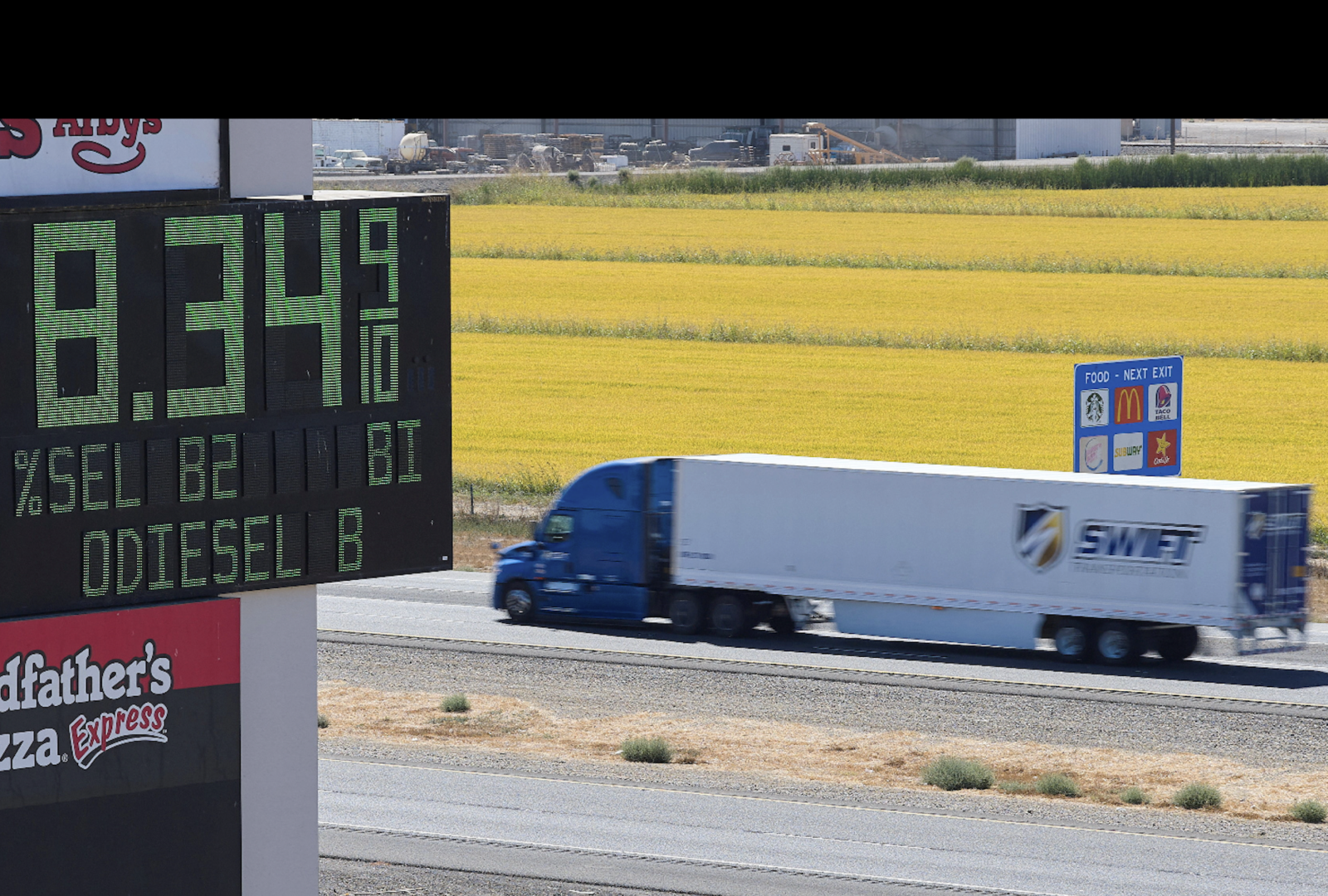
The war and the closure of the Strait of Hormuz disrupted exports of oil, natural gas, liquefied natural gas, petrochemicals, and nitrogen fertilizer. A few weeks before the war, the US Energy Information Administration projected that Brent crude oil prices would average $58 per barrel in 2026 and $53 in 2027. In its latest October forecast, the average Brent price for 2026 rose to $96 per barrel, 65 percent higher. On Feb. 27, 2026, average gasoline was $2.99 per gallon, and diesel was $3.67. By Oct. 7, gasoline rose to $4.40 per gallon, and diesel reached $6.30 per gallon.
Fuel accounts for approximately 3 to 4 percent of the agricultural sector’s expenses, so these increased prices have made their mark. Diesel powers most American tractors, combines, irrigation pumps, and other heavy agricultural machinery, as well as trucks, trains, barges, and ships that transport agricultural inputs and products. Higher fuel and freight costs make farming more expensive by increasing the costs of transporting seeds, fertilizer, feed, machinery, livestock, and harvested crops.
Before the war, the United States Department of Agriculture, or USDA, projected that fuel and oil expenses would decline in 2026. Instead, farmers are now expected to pay $21.6 billion in 2026, up from $16.8 billion in 2025. The real, imposed cost therefore exceeds $4.9 billion in year-over-year increase, as farmers face higher expenses and the loss of anticipated savings. Transportation costs for corn and soybeans rose 13 to 14 percent, as ocean freight and barge rates rose 49 percent and 28 percent, respectively. As a result, the cost of exporting grain from Minneapolis to Japan via the Gulf increased by 33.5 percent in 2026. Transport accounted for 45.8 percent of the delivered corn cost and 25.2 percent of the delivered soybean cost on that route.
Fertilizer
Fertilizer prices are another impact of the war in Iran. This is partly due to energy prices, as natural gas is the primary feedstock for ammonia and other nitrogen fertilizers. Beyond energy prices, the war also directly disrupted fertilizer supply. Before the war, 20–30 percent of global fertilizer exports passed through the Strait of Hormuz. This included 20 percent of phosphates, 23 percent of ammonia, 34 percent of urea, and 45 percent of sulfur. As a result, the war raised global prices for most nitrogen- and phosphate-based fertilizers. According to an April report from the American Farm Bureau Federation, nitrogen and urea fertilizer prices have risen more than 30 percent and 47 percent, respectively.
A survey of more than 5,700 farmers conducted in April indicates that 70 percent of respondents said they can no longer afford all the fertilizer they need. Regional responses show that 80 percent of farmers in the southern US said they cannot afford all necessary fertilizer supplies this year, followed by the Northeast and West at 69 and 66 percent, respectively.
Credit
The war has added inflationary pressure and pushed interest rates higher. The war is expected to increase inflation by 0.6 percentage points in 2026. By October 2026, the 10–year Treasury yield had risen to 5.35 percent, and the average 30–year mortgage rate had reached 7.28 percent, raising farm borrowing costs and squeezing liquidity in agriculture. For farmers who rely heavily on short-term operating credit to buy fuel, fertilizer, seed, and feed before receiving income from the harvest, higher borrowing costs can reduce their income. In particular, more vulnerable farmers have to borrow more to cover increasingly expensive inputs while also paying more for that credit.
The Iran war’s agricultural costs, along with weak commodity prices, trade uncertainty, and elevated labor and other production costs, have adversely impacted farmers’ income. The American Farm Bureau Federation projected a $31 billion shortfall between market returns and total production costs across nine principal crops, and $12 billion in uncovered losses across American agriculture in 2026. The war’s adverse impact alone has been strong enough to change how US farmers view their economic outlook. A Purdue University survey conducted in May 2026 found that 65 percent of the respondents expected their net income to decline because of the war. In a separate question, 45.5 percent highlighted high input costs as the main obstacle to improving their farm’s financial position. Although these responses reflect farmers’ expectations rather than causal estimates of war-related losses, they indicate that most surveyed producers expected the conflict to deepen the financial pressures already confronting US agriculture.
A new and improved ‘Iran Deal’ would benefit US farmers
The Iran War has cost American farmers. The alternative, a stronger US–Iran deal, could have benefited them. A 2025 Quincy Institute research brief argued that, with smart diplomacy, the United States could turn an adversary into a market by incorporating economic components into a deal. By opening Iranian markets to US businesses, the deal would create natural constituencies in the US rooting for its success, making it harder for the United States to exit the deal on a political whim, as with the original Iran deal, known as the Joint Comprehensive Plan of Action, or JCPOA.
Iran is the largest untapped market in the Middle East for US exporters, and peace with Iran presents a unique opportunity for the aviation, agriculture, and automobile industries. The Quincy Institute study estimated that US firms and farmers with access to Iranian markets could export up to roughly $25 billion per year, including up to $6 billion in agricultural goods and production. The market opportunities are significant for US agriculture. Iran cannot meet all of its food and feed needs domestically. Iran imports wheat, corn, soybeans, animal feed, meat, and selected food products. The USDA Foreign Agricultural Service report affirmed our 2026 estimate that Iran needs 10 million tons of corn. The report also showed that Iran was Brazil’s largest corn buyer in 2025, importing about 9 million metric tons. With smart diplomacy focused on American interests, the Trump administration could have wrangled an agreement that was both more stable than the JCPOA and a better deal for American agricultural interests.
Program
Countries/Territories
Entities
Authors

Hadi Kahalzadeh is a non-resident fellow at the Quincy Institute and a research fellow at the Center for Global Development and Sustainability at Brandeis University.