
U.S.–China Scientific Collaboration at a Crossroads: Navigating Strategic Engagement in the Era of Scientific Nationalism
Executive Summary
An era of scientific globalism has given way to greater scientific nationalism in both the United States and China. Cooperation in scientific research has become increasingly overshadowed by the belief that scientific exchange constitutes an actual or potential national security threat. It is becoming increasingly difficult for U.S. and Chinese universities and scientific or research institutions to maintain productive contacts without falling under suspicion.
Underlying U.S. policy is the implicit belief that the United States sets the pace in global innovation, that China has succeeded only by imitating or even stealing U.S. technology, and that the United States needs to close off scientific and technological collaboration to protect its competitive edge. As this paper documents, this assumption is gravely outdated. China is now a global leader in scientific innovation. This paper also documents that even as China has risen to global scientific leadership, U.S.–Chinese scientific collaboration has significantly declined, with co-authorships dropping by some 20 percent in recent years, especially in the most sensitive engineering areas. Current trends suggest that interaction will likely decline further.
We argue that China’s rise to global science and technology leadership means that blanket efforts to eliminate U.S.–China scientific interaction do not benefit long-term U.S. national security. Instead, they threaten America’s innovative edge by cutting off access and visibility into global scientific frontiers. It is increasingly urgent to develop new frameworks to manage security risks while continuing to permit U.S.–Chinese cooperation in an atmosphere free of hostility and political suspicion.
The renewal of the U.S.–China Science and Technology Agreement, or STA, in December 2024 offers a potential path to establishing such a framework. The agreement contains several innovative elements, including a requirement for U.S.–China reciprocity in scientific research, enhanced oversight of project data tracking and data security, and the establishment of a binding mechanism to resolve disputes.
We propose to build on the revised 2024 STA to establish a framework for research collaboration that we call “smart openness.” This framework lays out a practical mechanism to facilitate continued scientific cooperation while incorporating clear and systematic security safeguards. Implementing the smart openness framework into practice across universities, labs, and government agencies could dispel the cloud of suspicion currently hanging over U.S.–China scientific cooperation and allow the U.S. to gain the benefits of continued contact with the other global scientific leader — China — while minimizing security risks.
Introduction: The Transformation of Global Scientific Cooperation
From the late 20th century until the mid–2010s, the global scientific system operated under an ethos of what might best be described as scientific globalism.1The fundamental assumption was that science was a transnational enterprise: knowledge moved across borders, researchers collaborated irrespective of political differences, and scientific journals and conferences served as platforms for open exchange. For the United States, this framework was not merely compatible with national interests — it was a strategic advantage. By positioning itself as the central hub of global research, the United States attracted the world’s most talented students and scientists, maintained intellectual leadership across critical domains, and set the norms of knowledge production.2
China emerged as perhaps the most significant partner in this system. Beginning with the normalization of U.S.–China relations in 1979 and the signing of the bilateral Science and Technology Agreement that same year, scientific exchanges became one of the most stable and mutually beneficial aspects of the relationship.3Over four decades, the partnership yielded advances in fields as diverse as genomics, earthquake monitoring, energy efficiency, and agricultural productivity.4For much of this period, U.S. policymakers and scientists framed collaboration not as a concession to China’s rise, but as a source of U.S. competitive renewal, particularly by exposing American researchers to the latest problems, datasets, and approaches.5
Yet by the mid–2010s, the logic of scientific globalism began to unravel.6The shift coincided with what can be described as a new era of scientific nationalism. This era has been defined by the securitization of research, the framing of technological development as a zero-sum competition, and the recalibration of partnerships through a lens of strategic vulnerability.7Nowhere has this shift been more visible than in U.S.–China relations. As further documented in this study, the past decade has witnessed a progressive, though not yet comprehensive, decoupling of scientific collaboration.8The decline has been driven by escalating geopolitical tensions, U.S. concerns about intellectual property theft and industrial espionage, and China’s own strategic determination to reduce reliance on foreign partners for key technologies.9
This transformation poses a central paradox for U.S. policymakers. On the one hand, legitimate national security concerns must be addressed, particularly in domains such as artificial intelligence, quantum computing, semiconductors, and biotechnology, where military and civilian applications may overlap. On the other hand, the erosion of U.S.–China scientific ties carries costs that extend far beyond research itself: it undermines innovation ecosystems, weakens U.S. higher education, and erodes the very openness that has historically constituted America’s greatest competitive advantage.10
Treating security and openness as mutually exclusive impoverishes both. A purely defensive posture — defined by blanket prohibitions, ambiguous red lines, and episodic political signaling — can temporarily reduce certain exposures, but it also degrades the very ecosystem that has powered U.S. leadership: world-class universities that attract global talent, public–private research partnerships that translate ideas into industries, and scientific communities that set the norms others follow.11
Security matters, as does vigilance about intellectual property, export controls, talent recruitment programs, and dual-use spillovers. But securitization without calibration invites a variety of pathologies. History suggests a better path. At moments of intense rivalry — such as the early Cold War or the space race — the United States combined targeted protection with rule-setting and coalition-building. It competed ferociously, yet it kept channels open where the public good was evident and where visibility into the rival’s capabilities was strategically valuable.
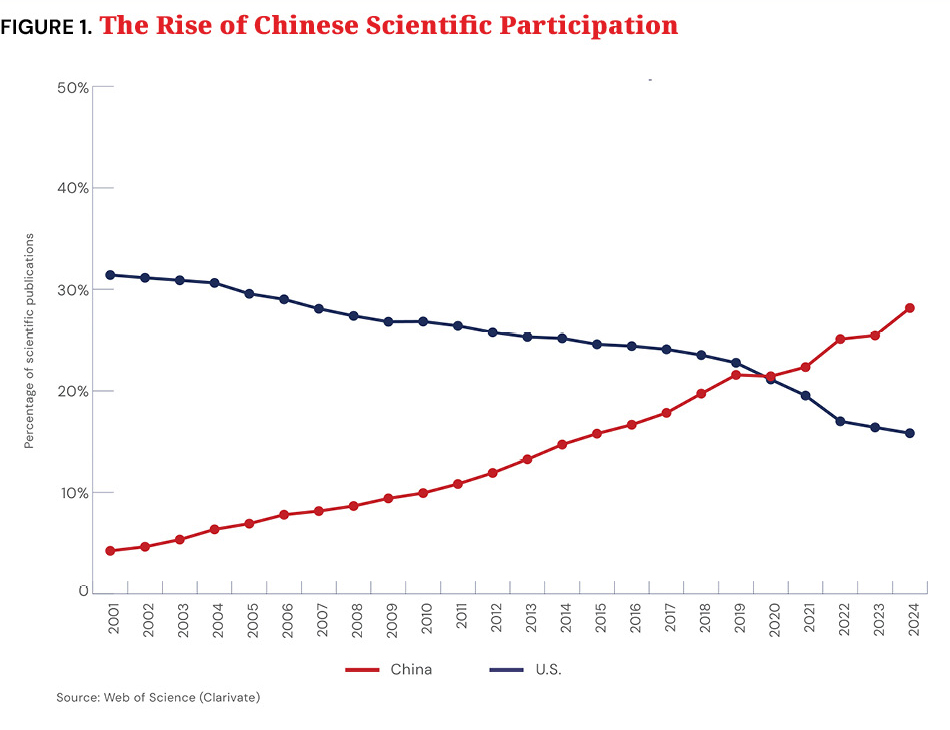
Today, the stakes could not be higher. Around 2020, China surpassed the United States as the world’s largest producer of scientific articles, and now accounts for almost twice the American percentage of global output (see Figure 1). In high-impact journals, Chinese co-authorship with American scholars remain among the most cited globally, even as overall collaboration numbers began to decline.
Cutting off scientific connections risks depriving the United States of access to frontier research and the ability to benchmark against the world’s second-largest economy and second-most populous country. Moreover, unilateral disengagement could concede influence over global scientific norms to China, the European Union, and other emerging players, and thus diminish America’s capacity to shape the governance of transformative technologies.
This paper argues that U.S.–China scientific collaboration is at a crossroads. What we are witnessing is neither wholesale disengagement nor business-as-usual cooperation, but a process of selective, albeit growing, decoupling that reflects a recalibration of once-clear strategic priorities. The challenge for U.S. policymakers is to balance security protections with the imperative to maintain “smart openness” — a framework for structured, reciprocal, and safeguarded engagement.
The following sections will explore this dynamic in detail.
- Section II provides empirical evidence of China’s growth in influence and the evolving decoupling, examining bibliometric trends and shifts in collaboration domains.
- Section III analyzes the political and security drivers of this transformation, including the securitization of academic partnerships.
- Section IV discusses the past benefits to the United States of scientific cooperation and potential future losses from a blunt decoupling with China, including the potential costs of decoupling in the particularly strategic area of advanced manufacturing.
- Section V introduces the 2024 renewal of the U.S.–China STA as a model for structured engagement, which we call smart openness. We outline the benefits of the smart openness approach and describe ways to operationalize this framework that maintain both protections for the most sensitive areas of research and guarantees of reciprocity in collaboration.
- Section VI explores a path forward to maintain America’s cutting edge innovation while competing with China and other countries.
- Finally, the conclusion reflects on the false binary between openness and security, arguing instead for leadership through selective engagement and strategic resilience.
The current era is not one of inevitable rupture but one of contested redefinition. The way the United States chooses to navigate this crossroads — balancing protection against overreach, and engagement against naïveté — will shape not only bilateral relations with China but the very architecture of global science in the decades ahead.
The Current Situation: Empirical Evidence of Strategic Decoupling
Chinese research growth and patterns of decline in U.S.–China cooperation
Bibliometric data shows the astounding growth of Chinese participation in the world scientific community over the past two decades. As Figure 1 shows, scientific publications with at least one Chinese author grew from less than 5 percent of global scientific output at the turn of the century, far behind the United States, to a dominant role today. Chinese–linked scientific output now represents almost 30 percent of global scientific output, almost twice the U.S. level.12Other sources indicate that China has also pulled ahead of the U.S. in the critical category of elite scientific publications in the world’s top journals.13
The steady growth of Chinese–linked publications conceals a significant change in recent years — the beginning of a U.S.–China scientific decoupling. For more than a decade, from 2005 until around 2017, U.S.–China scientific partnerships represented the fastest-growing and most extensive binational collaboration in the world. The growth was both remarkable in scale and symbolically important: it signaled the integration of China into the fabric of the global scientific system and highlighted the centrality of the United States as a hub of international knowledge networks.
Between 2005 and 2017, U.S.–China co-authored publications expanded at double-digit annual growth rates. By 2017, more than 20 percent of all U.S. internationally co-authored papers included at least one Chinese collaborator, while over 16 percent of all Chinese international publications involved a U.S. partner. No other bilateral scientific partnership matched this scale, not even U.S.–European Union collaboration, which had long been the benchmark of global co-authorship activity. The collaboration covered a wide spectrum — from physics and chemistry to biomedical sciences and materials engineering — reflecting both countries’ complementary strengths. The United States contributed deep reservoirs of frontier knowledge and access to world-class research universities, while China supplied large datasets, unique research problems, and an expanding cadre of scientists trained in both domestic and overseas institutions.
Yet the trajectory of exponential growth reached an inflection point around 2017–18. According to the National Science Foundation’s 2024 Science and Engineering Indicators, the absolute number of U.S.–China co-authored papers peaked at approximately 55,000 in 2017.14By 2022, that number had fallen to about 45,000 — a contraction of nearly 20 percent. In Figure 2 below, we show Clarivate data on research collaboration that demonstrate a similar decline of nearly 20 percent between 2017 and 2024.
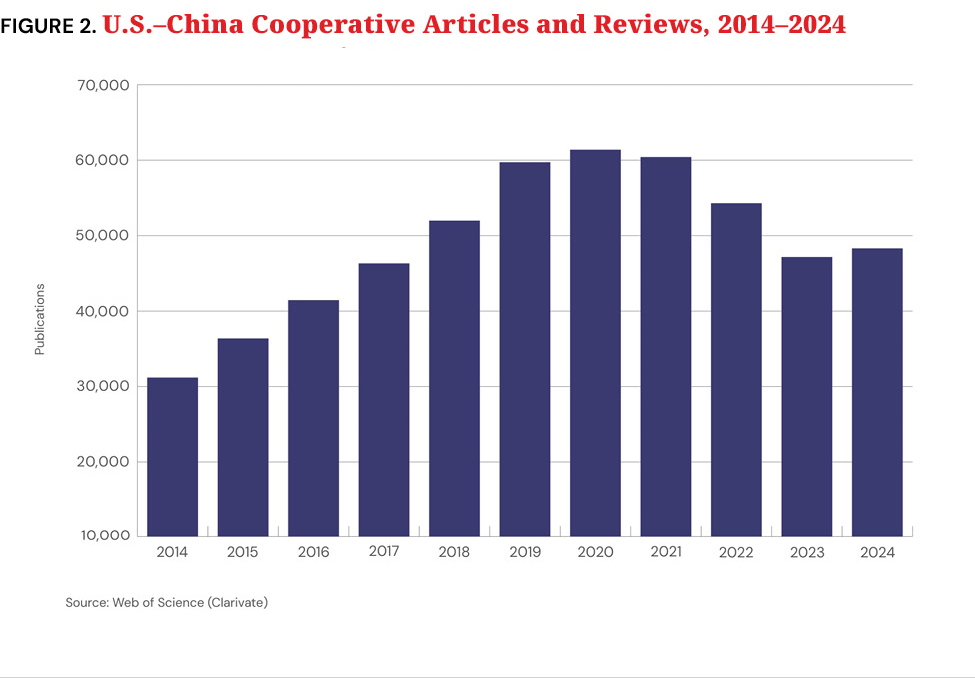
The dates of this reversal roughly align with the Justice Department’s 2018 launch of the “China Initiative.”15However, they also predate the recent wave of securitization that began during the later years of the Biden administration and is continuing under the second Trump administration. To take one example, as discussed further below, beginning in 2024, the Select Committee on the Chinese Communist Party, CCP, in the U.S. House of Representatives began to specifically target U.S.–China scientific co-authorship and collaboration as a security threat.16
Since securitization pressures are continuing and scientific publications often take years to develop, the bibliometric data should be seen as a “lagging indicator” of scientific cooperation. Unless current trends are interrupted, we can expect U.S.–China scientific cooperation to decline much further.
The decline is even more striking when placed in comparative perspective. Between 2017 and 2024, while U.S.–China co-authorships contracted, U.S.–EU co-authorships grew by 21 percent, U.S.–Japan collaborations remained essentially stable, and U.S.–India collaborations nearly doubled. The selective nature of the contraction underscores that this was not simply a retrenchment of U.S. international science across the board; rather, it was a targeted decoupling specifically vis-à-vis China. The phenomenon reflects the overlay of political and security concerns upon the scientific domain, producing a divergence between patterns of U.S. collaboration with like-minded democracies and its engagement with its most important strategic competitor.
Moreover, the contraction has not been evenly distributed across scientific fields. Examining the subjects of co-authored publications between Chinese and American researchers over a 10–year period, based on data derived from Scopus, we identified specific research areas experiencing dramatic growth or decline.17Areas with significant increases over the decade studied include genetic associations and epidemiology (up 77.78 percent), liver disease diagnosis and treatment (up 55.56 percent), geophysics and gravity measurements (up 42.71 percent), seismic imaging and inversion techniques (up 41.89 percent), and single-cell and spatial transcriptomics (up 38.95 percent). These topics of growth are either biological or earth sciences, which are generally not closely associated with national security concerns. In contrast, topics which dramatically decreased as subjects of U.S.–China collaboration over the decade include advanced neural network applications (down 53.64 percent), advanced wireless communication technologies (down 53.54 percent), topic modeling (down 50.76 percent), advanced oxidation water treatment (down 45.83 percent), and urban transport and accessibility (down 45.74 percent). These declining collaboration areas include many topics identified in China’s Made in China 2025 government initiative — such as electronics, maritime, and transport — suggesting the impact of policy guidance on the choices made by Chinese researchers.
Taken together, the data points to a process of strategic, domain-specific decoupling. The decline is not random, nor is it uniform. Instead, it reflects the deliberate narrowing of collaborative space in areas deemed strategically sensitive, while lower-risk, globally oriented fields continue to support limited co-authorship and data sharing. This distinction underscores the importance of understanding not only aggregate bibliometrics but also the sectoral composition of scientific engagement.
Qualitative shifts in collaborative focus
Beyond the raw numbers, the story of U.S.–China collaboration in the past decade is one of shifting emphasis across fields — some retaining vitality, others contracting sharply. These shifts mirror the interplay between scientific priorities and national security concerns.
Growth areas: Biomedical and earth sciences
Biomedical sciences have proven generally resilient as a domain of cooperation. Despite political tensions, the urgency of global health challenges has ensured that biomedical research continues to attract potential collaborative engagement. The COVID–19 pandemic starkly illustrated this interdependence. In January 2020, Chinese scientists rapidly sequenced the SARS-CoV-2 genome and made it publicly available.18This action triggered a wave of co-authored studies with U.S. researchers that accelerated global vaccine development and therapeutic trials.19
The persistence of collaboration in health sciences is instructive: it demonstrates that in areas where challenges are inherently transnational — such as pandemics, cancer research, or antimicrobial resistance — political obstacles have not easily extinguished the opportunities for joint work. Chinese hospitals provide large patient populations and clinical datasets, while U.S. labs bring cutting-edge molecular and computational expertise.20Together, these complementarities create outcomes unattainable in isolation.
Similarly, earth and environmental sciences have remained persistent fields of cooperation.21U.S.–China collaboration in seismology, climate modeling, and hydrology grew modestly between 2017 and 2024.22A prime example is the U.S. Geological Survey–China Earthquake Administration partnership, which has enabled both countries to improve early-warning systems and risk assessments.23These projects, perceived as lower risk and with primarily civilian applications, continue to thrive even as other domains contract. At the same time, they also allow U.S. researchers to gain insight into China’s data collection capabilities — an important, if underappreciated, benefit.
Decline areas: Advanced technologies
In stark contrast, areas closely aligned with China’s Made in China 2025 priorities — such as advanced information and communications technologies, aerospace, and new materials — have experienced severe contractions.24U.S. policymakers increasingly interpret joint research in these domains as contributing to China’s military-civil fusion, or MCF, strategy, with direct implications for the People’s Liberation Army, or PLA.25The most dramatic declines include:
- High-speed rail engineering: Once a domain of active exchange, collaboration virtually disappeared as China consolidated its dominance in the sector and U.S. policymakers grew wary of potential dual-use applications.26
- Artificial intelligence: Perhaps the most politically charged domain, China’s stated ambition to lead artificial intelligence globally by 2030 has made AI collaboration a lightning rod for suspicion.27While Chinese researchers continue to cite and build upon U.S. scholarship, direct co-authorship has sharply declined, particularly in military-relevant subfields such as advanced neural network applications.
The contraction of these collaborations highlights the selective securitization of science. The very areas where frontier innovation most directly underpins national power and strategic competition are the ones most subject to decoupling pressures.28
The broader context of China’s scientific evolution
Understanding these patterns requires situating them within China’s broader scientific trajectory. The rise of China’s domestic research ecosystem has transformed the terms of engagement with foreign partners, reducing dependence while enhancing strategic autonomy. China now sees science diplomacy as a key linchpin in its foreign relations, especially with the Global South.29
Rising domestic research capacity
China’s ascent is striking. In 1991, China accounted for less than 1 percent of global scientific articles. As shown in Figure 1 above, by 2024 it had become the world’s largest producer, accounting for 27 percent of output and far surpassing the United States. Parallel to this, China’s research and development, or R&D, expenditure reached 2.68 percent of GDP in 2024, compared with approximately 3.45 percent in the United States. China is now the second biggest spender in the world on R&D.30Given China’s larger GDP in purchasing power parity terms, the absolute scale of Chinese R&D spending now rivals or surpasses that of the United States in certain sectors.31
This maturation has gradually reduced China’s reliance on international collaboration. In 2000, more than 35 percent of Chinese publications were internationally co-authored. By 2023, that figure had dropped below 18 percent, even as total output soared. International collaboration remains beneficial for prestige, visibility, and access to frontier methods but, more often than not, it is no longer essential for sustaining growth. China has reached the point where it can generate world-class science on its own terms, if needed.
Nationalism and xenophobia in Chinese research
A further qualitative shift is the rise of scientific nationalism within China. A series of U.S. actions — such as visa restrictions, FBI investigations into Chinese scientists, and political rhetoric about espionage — have contributed to a climate of growing suspicion.32In response, many Chinese researchers now view reliance on U.S. partnerships as not only strategically risky but potentially damaging to their careers.33This emerging situation conjures up images of the Cultural Revolution where Chinese scientists who followed Western science were ostracized as “slaves to Western ideas.”34The growing pressures today have also fueled a reverse brain drain. Since 2018, the number of Chinese students and scholars returning from the United States has exceeded those leaving, reversing a four-decade-long pattern.35
These returnees are helping to bolster China’s capabilities in key “choke point” technologies such as semiconductors, quantum computing, life sciences, and AI. At the same time, some Chinese research groups increasingly choose to limit or avoid U.S. partnerships voluntarily, compounding the effects of official restrictions.36This bottom-up decoupling reinforces broader political shifts, accelerating China’s drive toward greater self-reliance across many science and technology fields.
Continuity in growth despite decoupling
Perhaps most strikingly, the contraction of international co-authorship has not slowed China’s overall rise. On the contrary, some indicators suggest that Chinese science is becoming more impactful. A 2023 Nature analysis found that China overtook the United States in contributions to the top 1 percent of highly cited papers, particularly in physics, chemistry, and materials science.37In other words, even as collaboration with the United States declines, China continues to climb in global rankings of quality and influence.
This resilience complicates U.S. strategy. Decoupling may deprive Washington of access to frontier Chinese research, but it does not appear to slow Beijing’s momentum. The outcome is a widening gap in situational awareness: While China continues to learn from open-source U.S. publications, American scientists lose access to privileged collaborations that once offered early visibility into Chinese advances. The situation is not helped by the fact that there has been an increased tendency among Chinese scientists to publish more of their work in China–based journals — the bulk of which are in Chinese language — as part of an effort to strengthen the status and quality of domestic journals.38
Interim assessment
The evidence thus presents a nuanced but sobering picture. U.S.–China scientific collaboration is shrinking, but selectively and strategically rather than uniformly. Currently, areas of mutual benefit and lower sensitivity — such as biomedicine and earth sciences — remain moderately robust. By contrast, advanced and dual-use technologies — such as AI, aerospace, ICT, and new materials — are subject to sharp curtailment.
The broader implication is that the era of rapid expansion in bilateral co-authorship appears largely over. China’s growing self-sufficiency ensures that it no longer needs international collaboration to fuel its rise, while U.S. security concerns and political pressures create disincentives to sustain partnerships. Yet this selective decoupling carries serious risks for the United States:
- It reduces access to frontier research at the very moment when China is producing an unprecedented share of high-impact science.
- It narrows situational awareness of China’s technological trajectory, heightening the risk of strategic surprise.
- It fuels mistrust, contributing to a broader spiral of geopolitical rivalry that makes cooperative engagement harder in other domains.39
- It reduces the size and caliber of the talent pipeline coming from China to the United States for study and careers in research.
For U.S. policymakers, the challenge is therefore not merely to recognize the decline but to craft a sustainable strategy for managing it. Understanding the political and security drivers behind these trends — explored in the following section — is essential if the United States is to preserve both its innovation capacity and its leadership role in the global scientific system — and not because it has isolated itself from China’s progress.
The Political and Security Drivers Behind Decoupling
The contraction of U.S.–China scientific collaboration cannot be explained by bibliometrics alone. Numbers tell us what is happening, but not why. To understand the causes of decoupling, one must examine the political and security context that increasingly frames bilateral science and technology, or S&T, relations. Over the past decade, science has been progressively securitized, recast in the language of strategic rivalry, and entangled with ideological disputes within both countries.40 These drivers — emanating from Washington, Beijing, and broader domestic politics — have transformed once routine academic exchange into an arena of suspicion, mistrust, and strategic maneuvering.
The zero-sum national security paradigm
The first and most consequential driver of decoupling is the adoption of a zero-sum security paradigm in Washington. Until the mid-2010s, U.S. officials often justified S&T collaboration with China as a means of exposure to frontier knowledge, talent pipelines, and problem-driven science. It also was part of a perspective that perceived close alignment between China’s reform and modernization and U.S. national interest.41While risks of intellectual property diversion were increasingly acknowledged, they were framed more as troublesome rather than as existential.42That started to change decisively during President Obama’s second term and gained a new momentum with the 2017 U.S. National Security Strategy, or NSS, which designated China a “strategic competitor.”43
From engagement to competition
The NSS, followed by Pentagon reports, intelligence assessments, and congressional hearings, codified a new growing U.S. perception: China’s technological rise was not merely a natural byproduct of modernization, but a deliberate strategy to erode U.S. dominance.44Technology became the central battlefield in this contest. The Department of Defense characterized China’s civil research ecosystem as integral to the MCF strategy, blurring the line between academic research and military application.45Under this framing, every joint paper, lab exchange, or shared dataset risked strengthening the PLA.
The effect was a wholesale revaluation of risk. Sectors once viewed as apolitical — such as materials science, robotics, or computational algorithms — were reclassified as sensitive. Even basic science was deemed dual use if it could, in principle, accelerate Chinese capabilities in aerospace, AI, or cybersecurity.46The language of “existential competition” left little room for nuanced assessments of costs and benefits.
Visa restrictions and student flows
This securitization quickly translated into policy. The 2020 Presidential Proclamation 10043 barred entry to Chinese graduate students and researchers affiliated with institutions linked to MCF.47Seven defense-affiliated universities were identified as “off limits” in terms of exchanges and cooperation. The impact was immediate: The number of new Chinese graduate students admitted annually in sensitive STEM fields declined from over 30,000 in the early 2010s to fewer than 20,000 by 2023.48Fields such as electrical engineering and computer science, which had once depended heavily on Chinese talent, saw enrollment drops that alarmed U.S. faculty and industry leaders alike.49
These restrictions were not limited to new entrants. Visa delays, denials, and revocations disrupted ongoing projects.50Chinese PhD candidates and postdocs at U.S. universities started reporting difficulties renewing visas, leading some to abandon degrees midstream.51U.S. labs lost promising postdocs who had to return to China abruptly. The uncertainty created a deterrent effect: Many prospective students and scholars chose to apply to Canada, Australia, or European universities instead.52
Institutional restrictions and investigations
At the institutional level, federal agencies imposed new restrictive regulations. The Department of Energy prohibited DOE–funded researchers from collaborating with colleagues at a growing list of Chinese universities and institutes.53The Department of Defense similarly restricted collaborations in areas like advanced materials and aerospace engineering.54
The National Institutes of Health launched investigations into researchers suspected of failing to disclose ties to Chinese institutions.55These inquiries led to dozens of forced resignations or early retirements, often of prominent Chinese–American scientists.56Critics argued that the NIH and FBI applied standards inconsistently and disproportionately targeted ethnic Chinese researchers, creating a perception of racial profiling.57The Asian American Scholar Forum and other advocacy groups documented widespread fear within the community, with many researchers curtailing legitimate collaborations to avoid scrutiny.58
The China Initiative
The most visible expression of this paradigm was the China Initiative, launched by the Department of Justice in late 2018.59Ostensibly designed to counter economic espionage, the initiative focused heavily on academia. Researchers were investigated for apparent grant disclosure violations, often involving minor paperwork errors rather than proven theft of technology. Although the initiative was formally terminated in 2022 after widespread criticism, its effects persist.60Many Chinese and Chinese–American scientists describe a chilling environment: surveillance by the FBI, questioning without cause, and reputational damage even when exonerated. Unfortunately, the initiative institutionalized the narrative that collaboration with Chinese scientists constituted a national security risk.61
Ideological campaigns against public and private institutions
The end of the China Initiative did not, however, signal the end of the suspicion and hostility directed at U.S.–China research collaboration. If national security concerns largely have provided the strategic rationale for decoupling, domestic politics amplified and broadened it. In recent years, universities, companies, and even local governments have become frequent targets of ideological campaigns.
Universities under scrutiny
American universities — long celebrated as engines of international openness and innovation — have faced growing scrutiny. Congressional hearings between 2020 and 2024 accused them of failing to disclose foreign funding, with China singled out as the primary culprit. The University of Michigan’s Joint Institute with Shanghai Jiao Tong University, once hailed as a model of Sino–American partnership, came under intense criticism and was forced to curtail operations.62More generally, University of Michigan faculty were pressured to reduce reliance on most Chinese funding streams.63
Similarly, Georgia Tech terminated several cooperative agreements with Chinese universities under federal pressure.64Other institutions — such as MIT, Stanford, and Berkeley — were asked to account for millions in research contracts or philanthropic donations from Chinese sources.65In many cases, the funds supported non-sensitive areas like biomedical science, yet the optics of accepting Chinese money became politically toxic.
The Select Committee on the CCP of the U.S. House of Representatives
The Select Committee on the CCP of the U.S. House of Representatives has led an ongoing campaign targeting both U.S. businesses and especially U.S. colleges and universities for their contacts with China. In their 2024 “CCP on the Quad” report, the committee portrayed U.S.–China research collaboration as a scheme “to acquire U.S. technology and expertise,” saying that efforts occur “under the guise of academic cooperation, but in practice, they conceal a sophisticated system for transferring critical U.S. technologies and expertise to the PRC, including to blacklisted entities linked to China’s defense and security apparatus.”66The committee followed up the six university case studies in the 2024 report with ongoing efforts to target other collaborative university relationships with China and pressure to cancel them.67
The populist framing
Right-leaning commentators and politicians framed universities as “bastions of globalization” that allegedly prioritized cosmopolitan “global” values over national loyalty.68In this narrative, partnerships with China symbolized complicity in outsourcing jobs, hollowing out industry, and empowering an adversary. The rhetoric tapped into broader populist grievances about inequality, trade imbalances, and declining U.S. manufacturing. As a result, decisions about scientific collaboration — once largely technocratic matters — were politicized and subjected to broad political attacks by both major U.S. parties.
Private sector and industry
The private sector has also faced ideological targeting. U.S. companies pursuing joint ventures with Chinese firms in renewable energy, pharmaceuticals, or biotechnology were accused of “selling out” American interests.69Even when collaborations offered clear mutual benefits — such as joint vaccine development or shared clinical trials — political narratives tried to paint them as betrayals.70
Semiconductor firms faced especially harsh scrutiny.71Companies like Intel, Qualcomm, and NVIDIA, which maintained research partnerships or sales relationships in China, were portrayed as jeopardizing national security.72Congressional committees launched investigations into supply chain dependencies, while activist groups demanded “reshoring” of manufacturing.73The bipartisan consensus hardened: Corporate engagement with China in high-tech fields was seen as risky at best, unpatriotic at worst.
Historical echoes
The securitization of science has parallels with earlier periods. During the Cold War, East–West collaboration was tightly circumscribed, with physics and computing research subject to export controls. There are also echoes of McCarthyite blacklisting of communists in some current congressional activity.
Yet even during the Cold War, the United States maintained selective exchanges to avoid duplication and stagnation. Today’s approach is arguably much more sweeping: Rather than compartmentalizing sensitive domains, suspicion bleeds across nearly all fields where Chinese participation is significant. This broad-brush treatment reflects the depth of political mistrust that now defines the bilateral relationship.
Devaluation of expertise
Underlying these campaigns is a broader devaluation of expertise in U.S. politics. Trust in academic elites and technocratic decision-making clearly has eroded, replaced by suspicion that globalist scientists and corporate leaders are disconnected from national interests. In such an environment, even neutral or beneficial collaborations with Chinese partners have become suspect. The politicization of science funding and university governance has further narrowed the space for meaningful, nuanced discussion of viable engagement strategies.
China’s strategic response and domestic priorities
The drivers of decoupling are not unilateral. Many of China’s policies and strategic choices have also accelerated the unraveling of collaboration, especially as U.S. restrictions have exacerbated traditional Chinese xenophobia about engagement with the West stemming from the 19th century — the era of Western imperialism in China.
Made in China 2025 and indigenous innovation
China’s Made in China 2025 program, launched in 2015, explicitly targeted 10 priority sectors: AI, robotics, aerospace, advanced materials, and more.74Although the program was rhetorically de-emphasized after foreign backlash, its logic permeates the 14th Five-Year Plan and subsequent strategies.75At their core, these initiatives aim to reduce dependence on foreign technology and achieve indigenous leadership in critical sectors.
“Indigenous innovation,” which first started to appear as a slogan in 2005–06 with the launch of the “15 Year Medium-to-Long Term Science and Technology Plan,” has guided policy for two decades, but intensified in recent years.76The government has invested heavily in domestic talent training, research infrastructure, and state-led innovation clusters. While foreign collaboration remains welcome in most areas, the overall trajectory emphasizes greater self-reliance as a hedge against further external shocks. Chinese actions, when viewed in the context of the growing plethora of U.S. controls and restrictions, are not entirely unreasonable. Chinese leaders have remained committed to reducing technological dependency that could provide political leverage to other countries such as the United States.77
Bottom-up decoupling by scientists
Chinese researchers themselves have had to adapt to this new difficult environment. By 2019, surveys indicated growing reluctance to submit grant proposals involving U.S. partners.78Many feared bureaucratic delays, reputational risks, or accusations of disloyalty.79Journals and conferences in China increasingly highlight domestic achievements rather than joint outputs. There is now a new emphasis on growing the stature and quality of Chinese domestic scientific journals. In some cases, universities have quietly discouraged faculty from co-authoring with U.S. colleagues in sensitive areas. It has been the observation of one of the authors that even elite members of the Chinese scientific community who traditionally favored collaboration with the United States now see risks in advocating for ongoing U.S. contacts.
This bottom-up decoupling complements top-down directives. The result is a cultural shift: Collaboration with U.S. partners, once prestigious, is now viewed with enhanced caution because of growing uncertainty and the strained political relationship.
Reverse brain drain
Another striking trend is the reverse brain drain. Since 2018, the number of Chinese students and scholars returning from the United States has outpaced those leaving for the first time since the 1980s.80Multiple factors contribute: visa difficulties, rising nationalism, attractive opportunities at home, and programs like the Thousand Talents Plan. Returnees bring with them advanced expertise in semiconductors, quantum computing, and AI, enhancing China’s capacity in choke point technologies. The South China Morning Post, an English–language newspaper published in Hong Kong, has instituted regular weekly reporting about the growing number of prominent Chinese–American scientists who have decided to return to China because of the political situation in the United States.81
The security dilemma dynamic
At the geopolitical level, for both countries, these dynamics have produced a classic security dilemma.82U.S. restrictions confirm Chinese suspicions that Washington seeks to suppress its rise; Chinese moves toward self-reliance are interpreted in Washington as evidence of adversarial intent. Each side’s defensive measures appear offensive to the other, creating a self-fulfilling prophecy of decoupling. Over time, mistrust deepens, channels of exchange close, and collaboration becomes politically untenable.
Interim assessment
The political and security drivers behind U.S.–China scientific decoupling form a complex feedback loop. In the United States, securitization reframes science as a zero-sum contest, domestic politics amplifies suspicion of institutions, and ideological narratives stigmatize engagement. In China, strategic priorities push for self-reliance, researchers undertake bottom-up disengagement, and nationalism fuels reverse brain drain. Together, these forces lock the two countries into a spiral of mistrust and further decoupling.
The paradox is clear. The very tools that Washington deploys to protect its innovation base — like visa restrictions, investigations, and funding bans — risk weakening the openness, diversity, and global connectedness that have historically underpinned American scientific leadership. Meanwhile, Beijing’s pursuit of indigenous innovation reduces opportunities for U.S. visibility and influence, even as China continues to benefit from global scientific networks outside the United States. Interestingly, Xi Jinping, China’s president, has continued to highlight the importance of cross-border scientific engagement even as the world has shifted in the direction of greater scientific nationalism.83
The result is neither full rupture nor business as usual, but a progressive narrowing of collaborative space. Understanding these drivers is essential for U.S. policymakers: Without addressing the security paradigm, domestic ideological pressures, and China’s strategic response, any attempt at rebuilding structured cooperative engagement in S&T will falter.
The next section therefore turns to the benefits of cooperation and costs of decoupling, asking what the United States stands to lose if current trajectories continue unchallenged.
Benefits of Collaboration: Past and Future
The narrative of securitization focuses exclusively on hypothesized benefits to China of U.S.–China scientific collaboration. It is likely that these benefits are exaggerated. For example, the fact that rapid Chinese scientific and technical advance has continued and even accelerated over the past decade despite significant U.S.–China research decoupling indicates that a great deal of Chinese scientific development is internally generated and not dependent on the United States.
But beyond this, ignoring the benefits to the United States of scientific collaboration is obviously a highly skewed approach. A balanced appraisal of scientific collaboration demands equal attention to U.S. benefits from joint efforts.
Below, we outline examples of demonstrated past benefits to the United States in four clusters of scientific achievement:
1) Biomedical breakthroughs and accelerated drug development
From the 1990s forward, joint U.S.–China research has helped shorten clinical timelines, expand cohort diversity, and lower trial costs. The folic-acid program in the 1990s — an oft-cited success — led to widespread prenatal supplementation that reduced neural tube defects worldwide.84In the 2000s and 2010s, oncology collaborations leveraged available Chinese patient registries and tumor banks, while U.S. groups contributed genomic analytics and clinical trial design.85In virology and epidemiology, complementary capacities accelerated meta-analyses and cross-cohort replication.86
2) Materials innovation supporting the defense industrial base
Materials science is a typical dual-use field: breakthroughs in nanostructured alloys, high-entropy materials, and metamaterials drive civilian productivity and defense performance. Historically, U.S.–China engagements in materials helped U.S. groups benchmark technique, validate models, and derisk scale-up.87Even when joint outputs did not commercialize in the United States, they improved American situational awareness of China’s materials capabilities.
3) Disaster response and Earth monitoring
Joint seismology, hydrology, and meteorology programs produced earlier warnings, more accurate risk maps, and more robust cross-border data. The U.S. Geological Survey–China Earthquake Administration collaboration improved models that benefit East and Southeast Asia and the U.S.88In climate observation, satellite-based monitoring and ground-station sharing tightened calibration, feeding global systems for typhoon tracking and flood prediction.89
4) STEM workforce development and patent generation
For decades, the U.S. innovation engine has relied on international graduate talent, including Chinese students who trained in American labs and co-invented patents that seeded startups and corporate R&D pipelines. A 2020 U.S. Patent and Trademark Office analysis found that nearly one in five U.S. patents in AI and biomedicine included a Chinese–born co-author.90 Downstream, many remained in the United States, founding companies, staffing national labs, and teaching the next generation.
Future benefits: Advanced manufacturing at the crossroads of engagement and decoupling
Many examples of the benefits of past collaboration can be found, but given China’s rapid advance it is likely that future benefits to the United States will be even greater. Few areas illustrate the future stakes of U.S.–China scientific engagement more clearly than the critical area of advanced manufacturing.
Defined by the integration of digital design, automation, additive manufacturing, robotics, and data-driven quality control, advanced manufacturing represents both a backbone of economic competitiveness and a locus of strategic vulnerability. It is the field in which basic science most directly translates into industrial productivity and global market share. The nexus between scientific advancement and practical application means that the security issues here go beyond those involved in purely academic research, and are in some cases beyond the scope of this paper. But as discussed below, the costs of decoupling in engineering-related basic science and in business cooperation could severely impact U.S. progress in advanced manufacturing.
The United States has historically excelled in the upstream research and development that underpins advanced manufacturing, from computer-aided design and high-performance computing to breakthrough materials.91China, in turn, has leveraged massive state investments, rapid scale-up capacity, and increasingly sophisticated engineering talent to dominate the downstream production ecosystem.92Together, the two countries account for more than half of the world’s industrial R&D spending.93
Continued engagement with China provides the United States with several tangible advantages:
1) Access to scale and experimentation
Many technologies critical to advanced manufacturing — such as additive manufacturing (3D printing of metals), advanced robotics, and flexible electronics — require large-scale pilot projects and production runs to refine. China’s capacity for rapid prototyping and scaling complements U.S. strengths in design and early-stage innovation. Without engagement, U.S. researchers risk working in isolated test environments, unable to validate innovations at industrial scale.
2) Shared standards and interoperability
Global manufacturing relies on shared technical standards for machine-to-machine communication, digital twins, and industrial Internet of Things, or IoT. By engaging China in cooperative forums, U.S. scientists and engineers can shape emerging standards in ways that align with Western values of transparency and quality control. If the United States withdraws, Chinese standards may dominate by default, leaving American firms forced to adapt.
3) Talent and knowledge pipeline
U.S. graduate programs and national labs remain magnets for Chinese engineering students specializing in manufacturing systems.94These students often contribute directly to patent generation and startup ventures in the United States. Delinking from China would weaken these pipelines, exacerbating the U.S. skills gap in precision manufacturing and automation.95
How cooperation sustains U.S. leadership
Scientific and technological cooperation with China in advanced manufacturing also enhances America’s ability to maintain leadership in a globally competitive domain. Historically, the U.S. edge has come not from monopolizing production but from remaining at the frontier of process innovation.96Cooperation allows U.S. researchers to benchmark against Chinese advances, test interoperability, and identify complementary strengths.
Examples include:
- Additive manufacturing for aerospace: U.S. and Chinese labs have exchanged methods for 3D printing lightweight alloys. Such collaboration ensures that U.S. aerospace firms can anticipate and compete with Chinese innovations.
- Robotics and human-machine interfaces: Cooperative studies in ergonomics and industrial robotics have informed safer and more efficient shop-floor designs.
- Materials science in manufacturing: Joint research on composites and nanomaterials has shortened product development cycles in both economies.
In each case, engagement provides situational awareness and accelerates the diffusion of process innovation into American firms. In other words, smart openness allows the United States to reap the rewards from sustained cooperation.
The consequences of decoupling
A policy of full decoupling from China would carry profound costs for the United States:
1) Loss of visibility
Without collaborative projects or exchanges, U.S. firms and policymakers would be less able to track Chinese advances. This creates the danger of “technological surprise,” where breakthroughs in process efficiency, automation, or materials suddenly emerge from China, disrupting global supply chains while U.S. firms are caught unaware.97
2) Fragmentation of standards
If China sets industrial IoT or digital twin standards unilaterally, U.S. firms risk exclusion from major segments of the global market. This fragmentation would increase costs for U.S. exporters and diminish their competitiveness.
3) Talent pipeline disruptions
Restricting the flow of Chinese graduate students, postdocs, and engineers into U.S. programs would shrink the workforce available for advanced manufacturing R&D, particularly in semiconductor equipment, robotics, and materials engineering.98
4) Innovation bottlenecks
The absence of opportunities for U.S. innovators to test prototypes at scale in Chinese industrial environments could slow America’s ability to commercialize breakthroughs.
5) Strategic vulnerabilities
A weakened advanced manufacturing base would undercut U.S. defense readiness, which increasingly depends on rapid prototyping, additive manufacturing for spare parts, and secure supply chains.
Strategic implications
The long-term consequence of decoupling is that the U.S. risks eroding its once clear comparative advantage in process innovation — precisely the domain where it has historically excelled.99While China would lose access to U.S. frontier science, its vast industrial ecosystem and government support might allow it to compensate. By contrast, the United States, deprived of complementary capabilities and scale, could see its lead narrow more quickly than anticipated.
In this sense, advanced manufacturing underscores the broader thesis of this article: that structured, safeguarded engagement is not a liability but a strategic necessity. By remaining engaged, the United States can shape global standards, preserve situational awareness, and ensure that its innovation ecosystem retains both speed and scale.
The Smart Openness Model and the 2024 Science and Technology Agreement
The renewal of the U.S.–China STA, signed in December 2024, offers a potential blueprint for reconciling two imperatives that, in recent years, have been framed as mutually exclusive: safeguarding national security and sustaining the innovative dynamism that thrives on international exchange.
A U.S.–China STA was the first agreement signed after diplomatic relations were established between the United States and Communist China in 1979, and has been renewed continuously ever since. The agreements formally govern only government-to-government scientific cooperation between the U.S. federal government and China, but they are also umbrella agreements that set the tone for scientific cooperation among the entire “broader S&T ecosystem of universities, firms, professional bodies, and nongovernmental organizations.”100
Pre–2024, U.S.–China STA iterations leaned aspirational, evoking cooperation in broad, hortatory language. However, the 2024 text is more procedural and more detailed.101It is designed not to roll back competition but to channel it, with the goal of creating structured lanes where collaboration is clearly permissible, risks are specified and managed, and reciprocity is operationalized rather than assumed.
Below, we discuss and propose in detail a conceptual and operational framework for implementing the ideas in the 2024 STA. This smart openness framework accepts the reality of geostrategic rivalry, while refusing the false binary that treats scientific engagement as synonymous with naïveté. We first unpack the 2024 STA and delineate some of its key innovations and why they matter. We then lay out a strategic rationale for smart openness, showing how it can preserve U.S. leadership, build situational awareness, diversify supply chains, and shape global norms. Finally, we detail implementation scaffolding — metrics, audit trails, domain-specific pilots, compliance architectures, and multilateral linkages — that can translate principles into practice.
The modernized 2024 Science and Technology Agreement
While its text is relatively brief and conceptual, the 2024 STA signals a number of institutional innovations and guardrails that respond directly to the frictions of the past decade. Several design features mark a step-change from previous practice:
- Reciprocity: Earlier STAs presumed reciprocity as a norm; the 2024 STA specifies it as a requirement. U.S. researchers must receive guaranteed, documented access to Chinese facilities, datasets, samples, fieldwork sites, archives, and instruments proportionate to what Chinese researchers receive in the United States.
- Enhanced oversight: The 2024 STA commits the parties to share “complete and timely data necessary for or resulting from cooperative activities under this agreement,” specifies formats and types of data to be shared, and the procedures for establishing formal data management and access plans. The special focus on project data tracking and guaranteeing data security is notable as these issues were not part of the landscape for previous agreements.
- Binding dispute resolution: The agreement commits the parties to establish a binding mechanism “to resolve implementation concerns when disputes or differences cannot be resolved through direct consultations between implementing agencies,” including disputes in the critical area of intellectual property.
- Top-down reviews of research projects: As part of enhanced oversight, the 2024 STA mandates that the scope and nature of research collaborations and any data resulting therefrom should be reviewed by implementing agencies. Presumably such a review will include security oversight for sensitive technologies.
Building on the STA: A smart openness framework for cooperation
The STA offers a new direction that can be built upon in organizations not directly bound by the new agreement, such as universities. The goal is not to pretend the security environment has improved; it is to institutionalize risk management upfront so that cooperation can occur in areas where it is in the U.S. interest, while ruling out domains where collaboration would be imprudent. Longer term, however, the framework also provides a potential window to reverse the move toward exclusion by providing clarity and reassurance to U.S. participants that the risks and benefits of cooperation have been properly balanced. Openness is essential to scientific progress and to long-term U.S. competitive standing in the global innovation system.
Five broad elements form the core of the system:
1) Reciprocity obligations
Reciprocity should not be a rhetorical flourish. It must be a compliance obligation embedded in project-level agreements. Access should be defined in operational terms (e.g., number of on-site days, scope of instrument time, size of dataset, and level of administrative support), making reciprocity measurable.
Reciprocity transforms asymmetry management from an ad-hoc negotiation into the equivalent of a contractual requirement. For decades, American scientists reported uneven experiences securing visas, field permissions, or instrument time in China. The STA’s reciprocity clause addresses that grievance head-on: no reciprocity, no project. In doing so, it shields U.S. principal investigators, or PIs, and university offices from being the sole enforcers. Reciprocity is now a requirement backed by a formal agreement, not a favor.
2) Enhanced transparency and oversight
The United States should establish a secure, shared database where research collaborations are logged before work begins. Required fields, at a minimum, will include: the full list of investigators and their institutional affiliations; funding sources and amounts; scientific domain and risk tier; anticipated outputs (e.g., datasets, software, publications, or prototypes); data governance and IP arrangements; and any subcontractors or third-party service providers.
Such a registry would curb undisclosed parallel arrangements and make oversight proactive rather than forensic. It also reduces the compliance burden on individual researchers, who often struggle to interpret evolving disclosure rules. Agencies can cross-reference registry entries with grant databases and export-control lists. Suspicious patterns can trigger pre-emptive review rather than post-hoc investigation.
3) Intellectual property protections
The STA agreement requires binding dispute resolution for IP conflicts, convened through a joint arbitration panel composed of U.S., Chinese, and neutral international experts. To facilitate and further formalize this, projects could select one of several pre-approved IP templates at the outset (e.g., Background IP retained, Project IP shared, Field-of-use carve-outs, Background IP licensed, or Project IP several and separate) and must register resulting patents, software, and data assets to the STA’s registry with contribution statements detailing who did what.
Two pain points have plagued past collaborations: ambiguous ownership of project IP and slow, politicized dispute resolution. Standardized IP templates and an agreed arbitration pathway shorten timelines, lower legal ambiguity, and reduce incentives to escalate to political channels. Requiring contribution statements deters opportunistic appropriation and anchors authorship and inventorship in documented worklogs.
4) Exclusion zones around sensitive technologies
U.S. agencies, universities, and researchers should collaborate in delineating red-list domains where collaboration is prohibited (potentially areas like hypersonics, advanced cryptography, cutting-edge semiconductor design and lithography, or certain quantum sensing applications), an amber list of domains requiring heightened safeguards (e.g., AI and machine learning methods of potential dual use, certain autonomous systems, or advanced composites), and a green list of areas generally suitable for collaboration (e.g., many biomedical subfields not involving controlled pathogens or select agents, seismology, hydrology, climate observation, or aspects of materials characterization).
Clear delineation is particularly important because ambiguity constrains legitimate work, especially in the current political environment. Clear exclusion zones, combined with amber and green tiers, de-risk compliance decisions for universities and firms. The tiering system also allows for granularity: AI ethics research might be green, generic optimization algorithms amber, and specific targeting applications red. This differentiation replaces the blunt “everything is risky” atmosphere with navigable rules.
5) Annual security reviews and adaptive governance
Security reviews could audit project compliance, evaluate the sufficiency of safeguards given the year’s threat landscape, and recommend adjustments to lists, templates, or procedures. Crucially, the reviews could include security agencies (e.g., DOD, Commerce and its Bureau of Industry and Security, the State Department, Department of Homeland Security, and FBI) alongside science agencies (e.g., the National Science Foundation, NIH, and the Energy Department’s Office of Science) and university representatives.
Regular reviews permit governance to be adaptive rather than static. Institutionalized reviews also signal to the public that collaboration is monitored and continuously risk-assessed.
How these provisions work together: A compliance architecture
Individually, each provision reduces risk or friction; collectively, they constitute a compliance architecture that can facilitate and sustain on-going cooperation within the current environment.
- Front-end clarity (e.g., green, amber, and red lists; reciprocity metrics; and IP templates) reduces ambiguity.
- Mid-stream visibility (e.g., registry and contribution logs) enables real-time oversight and course correction.
- Back-end accountability (e.g., arbitration and annual reviews) resolves disputes and iterates the framework.
The underlying theory is simple: Rather than a non-specific atmosphere of universal assumed risk, specific risks are identified and managed. The 2024 STA replaces informal trust with formalized transparency and replaces moral suasion with operational levers — reciprocity thresholds, registry gates, and standardized IP scaffolding.
Even more important, these recommendations offer the opportunity to not just stabilize the prevailing situation in its current form — that is, highly securitized and tending toward decoupling and exclusion — but to improve it. The clear and tangible safeguards outlined in the STA could allow the restoration of confidence that U.S.–China scientific cooperation is beneficial to national security broadly understood. The practical framework of the STA, which allows detailed differentiation in research cooperation mechanisms based on reasonable and clearly specified security concerns, could allow the return to a research landscape that is not dominated by an atmosphere of mutual suspicion.
For example, the annual review process here could introduce flexibility not just to increase restrictions, but also to reduce restrictions and limitations in areas where risks are found to be limited compared to potential benefits.
Strategic rationale for smart openness
The case for smart openness is not nostalgia for pre–2015 globalism. It is a forward-looking strategy grounded in four propositions.
1) Preserve U.S. leadership through competitive engagement
Leadership in science is not secured by withdrawal; it is earned by being central to global networks, setting standards, and defining problems. If the United States isolates itself from the world’s largest producer of scientific articles, others — such as Europe, Japan, India, Southeast Asian nations, and consortia of the Global South — will become the norm-entrepreneurs. The STA and smart openness ensures that the United States stays in the room — not as a supplicant, but as an agenda-setter with leverage derived from access to U.S. talent markets, instruments, funding, and publication venues.
2) Maintain situational awareness at lower cost
Selective collaboration is a visibility mechanism. It yields non-classified, ground-level insights into China’s technical capabilities (and vice versa) that complements — and many times outperforms — intelligence collection. Project registries, contribution logs, and routine contact among PIs create early-warning channels for methodological advances and talent flows that would otherwise be detected late and at higher cost.
3) Diversify supply chains and reduce strategic dependencies
In pharmaceuticals, agriculture, and clean energy, collaboration can reduce single-point vulnerabilities. Not all diversification requires reshoring; some requires plural sourcing combined with transparent standards. Joint research that standardizes testing protocols and quality benchmarks helps U.S. firms qualify multiple suppliers and de-risk bottlenecks.
4) Shape global norms and ethical frameworks
Norms will be established and codified by somebody. The question is whether U.S. values will influence the drafting table for AI safety, gene editing, dual-use biotech, quantum communications, and research ethics. The STA becomes a staging area for pilot norms that can be exported to multilateral arenas — such as the Organization for Economic Co-operation and Development, International Organization for Standardization, the World Health Organization, or the United Nations Educational, Scientific and Cultural Organization. As China proposes new bodies (e.g., a World AI Cooperation Organization), the United States can counter-propose or co-shape, rather than boycott and cede the field.102
From text to practice: Implementing smart openness
What follows is a practical operating model — including governance, workflows, and tools — that translate the STA–based smart openness framework into executable policy on campuses, in labs, and across agencies.
1) Risk-tiered domain maps
Each participating agency should publish domain maps updated and revised annually:
- Green list (permit by default): Low-risk domains where collaboration is presumptively permissible: many biomed subfields, seismology, hydrology, climate observation, biodiversity, certain materials characterization, and portions of computational social science. China’s large investments in the physical infrastructure for basic science mean that fields such as particle physics and astronomy may also benefit from being in this category.
- Amber list (permit with safeguards): Domains requiring enhanced due diligence, such as specific AI subfields (e.g., reinforcement learning for autonomous platforms), advanced composites with defense uses, or dual-use robotics. Safeguards include export-control screenings, pre-publication technical review, and access controls for code repositories.
- Red list (prohibited): This would include clearly enumerated topics (e.g., hypersonics, advanced cryptography, cutting-edge extreme ultraviolet lithography design kits, and certain quantum sensing with direct weapons utility). Projects proposed in these areas are non-registrable.
Crosswalk tables should connect domain maps to cost and freight export categories, Bureau of Industry and Security Entity lists, and International Traffic in Arms regulations. This anchors academic compliance to the same lattice used by firms, preventing policy drift between campuses and industry.
2) The collaboration registry: Minimum viable fields and workflows
A centralized, secure registry must be usable by PIs and compliance officers:
- Minimum fields: PI/Co-PI data, institutional affiliations, funding amounts and sources, domain tier, project abstract, data governance plan, IP template chosen, anticipated outputs, third-party service providers, expected foreign travel, and virtual access provisions.
- Workflow: PI drafts entry, institutional compliance pre-screens, agency gatekeeping (green auto-approval, amber routed to expert panel, red rejected), and issuance of Registry ID required for grant fund drawdown.
3) Standardized IP and data governance templates
Projects choose from vetted IP templates and Data Use Agreements, or DUAs:
- IP menus: Shared project IP with field-of-use splits, several and separate IP with cross-licenses, and background retention and project-specific licensing. Each template maps to dispute-resolution clauses (e.g., venue, panel composition, and timelines).
- Data menus: Open data with attribution, controlled access via data enclave, federated learning with no raw data transfer, and synthetic data generation with published fidelity metrics. Templates specify privacy, re-identification risk thresholds, security controls, and audit logs.
4) Reciprocity metrics and dashboards
Reciprocity must be measured both quantitatively and qualitatively:
- Inputs: Instrument-time hours, dataset sizes, cohort counts, fieldwork days, staff support hours, visa and permit turnaround times.
- Outputs: Shared algorithms and tools, co-authored publications, joint patents (with contribution statements), and code commits.
- Dashboards: Agencies publish aggregate reciprocity indices by domain and by institution, enabling transparent assessment and targeted remediation when imbalances appear.
5) Amber-tier safeguards: How to collaborate safely
Ambiguous, dual-use domains need guardrails rather than bans:
- Secure research environments: Vetted cloud enclaves with role-based access, tamper-evident logs, reproducibility notebooks, and watermarking for code and models.
- Pre-publication technical review: Independent, time-bounded review (e.g., 14 days) to flag sensitive details and suggest redactions without stifling academic freedom.
6) University-level research security offices, or RSOs
The STA works best when universities have professional RSOs:
- Functions: Registry submissions, export-control screening, domain-tiering, IRB/IBC coordination, pre-publication checks, training for PIs, and incident response.
- Staffing: Compliance specialists with cross-training in export controls, data privacy, and research ethics and liaison roles to FBI, DOE, NIH, and NSF points of contact.
- Tools: Automated entity-list checks, grant-registry reconciliations, template wizards, and reciprocity trackers.
7) Funding mechanisms that reward compliance
Incentivize disciplined participation:
- Pilot grants: (e.g., $250,000–$1 million) Restricted to green and amber domains with model compliance and perhaps even identifying new “safe” pathways for broadened collaboration.
- Matching funds: Federal matches for university or state funds when reciprocity metrics exceed thresholds.
- Fast lanes: Expedited grant reviews for bilateral projects and teams with exemplary compliance histories and reproducibility records.
8) Enforcement with proportionality
A credible system punishes egregious abuse while avoiding criminalization of honest mistakes on both sides:
- Administrative penalties: Suspension of registry privileges or specific project IDs, temporary ineligibility for fast lanes, and corrective action plans.
- Graduated responses: Repeat or willful violations escalate to funding claw-backs or debarment; only the most serious, intentional diversions warrant referral for criminal enforcement.
9) Track–1.5 dialogue and scientific mediation
In high-tension periods, Track–1.5 (officials and experts) working groups can troubleshoot:
- Rapid response panels for time-sensitive disputes: This could include data embargoes, visa snarls, or allegation triage. The Experts Group formed during the U.S.–China Innovation Dialogue (2008–2017) provides a good example.103
- Good-offices mechanism: A concise list of mutually trusted scientific societies (e.g., academies, professional associations) empowered to mediate technical misunderstandings before they escalate.
Anticipating critiques and meeting them head-on
A credible framework must address some potential well-founded objections.
- Critique 1: “The registry becomes a roadmap for adversaries.”
Response: The registry is classified by design. Abstracts are high-level; technical annexes stay compartmentalized; and access is role-based. Auditors see enough to evaluate risk; foreign intelligence services do not. Moreover, registries exist on both sides; symmetry deters misuse.
- Critique 2: “Reciprocity will be gamed with performative access.”
Response: Reciprocity metrics are quantitative (e.g., instrument hours and dataset sizes) and qualitative (for operational usefulness). Annual reviews analyze utilization and value, not mere access. Persistent imbalance triggers automatic pause and renegotiation.
- Critique 3: “Amber-tier reviews will slow science to a crawl.”
Response: Reviews are time-bounded (e.g., 10–14 days) with clear criteria, fast lanes reward compliant teams, and template reuse reduces friction. The status quo of arbitrary delays and unclear rules creates more drag than calibrated review.
- Critique 4: “Arbitration will be politicized.”
Response: Default international arbitration rules (e.g., World Intellectual Property Organization variants) are embedded, panelists pre-cleared for independence, timelines enforced with consequences, and awards recognized by both sides’ courts as a condition of participation.
- Critique 5: “University RSOs will become mini-security agencies and chill inquiry.”
Response: RSOs professionalize what is already happening haphazardly. With tiered domain maps, templated agreements, and training, RSOs can enable lawful collaboration by removing fear and guesswork, and thus enable them to move ahead with their respective university research agendas. Creating a clear and transparent security framework is intended to facilitate mutually beneficial cooperation and would be a dramatic improvement over the current environment of generalized suspicion.
Interim assessment
By replacing ambiguity with tiered rules, atomized decisions with registry visibility, and ad-hoc negotiation with codified reciprocity and arbitration, this framework makes collaboration legible, auditable, and adaptive. It channels engagement toward domains where the public good and national interest align — such as biomedicine, environmental monitoring, agricultural resilience, and responsible AI — while erecting firm walls around areas that demand insulation.
The benefits at stake are concrete: faster biomedical discovery, better disaster preparedness, stronger supply-chain resilience, and continued access to global talent. Strategically, smart openness preserves U.S. leadership by keeping the United States central to networked science, maintaining situational awareness at lower cost, and shaping the global rulebook for emergent technologies.
The task ahead (taken up in Section VI) is to operationalize this framework across agencies and campuses: to build the compliance capacities, training pipelines, risk-tier maps, and pilot programs that turn the STA’s principles into daily practice. That work is not glamorous. But in an era defined by simultaneous rivalry and interdependence, such institutional craftsmanship is precisely what will allow the United States to compete fiercely, cooperate prudently, and lead confidently.
A Path Forward: Managing Competition While Preserving Innovation
The evidence from the past decade demonstrates that complete disengagement from China is neither feasible nor desirable. At the same time, a return to the permissive globalism of the early 2000s is politically impossible. What remains is the challenge of crafting a sustainable middle ground, one that balances legitimate security concerns with the imperative to preserve America’s openness, innovation, and influence.
This section outlines a roadmap for smart openness, emphasizing institutional reforms, building blocks for selective engagement, and the reframing of public narratives.
Institutional reforms and safeguards
The first priority is strengthening institutional capacity to manage the tension between security and openness. At present, U.S. research institutions often face conflicting pressures: security agencies demand restrictions, while faculty emphasize the need for academic freedom. Without clear rules and consistent oversight, universities adopt risk-averse policies that stifle legitimate cross-border collaboration.
1) Balancing research security with academic freedom
The federal government must provide clear, domain-specific guidance distinguishing legitimate collaboration from undue foreign influence. Currently, most guidance comes in the form of blanket advisories, such as discouraging partnerships with institutions linked to the People’s Liberation Army.104But these advisories often lack granularity, leaving universities uncertain about whether fields such as biomedicine or agriculture are considered safe. A tiered system — green zones (permit by default), amber zones (permit with safeguards), and red zones (prohibited) — would enable universities to manage partnerships without stifling innovation and collaboration.
2) Strengthening oversight mechanisms
Oversight mechanisms should be robust but not punitive. The creation of independent research security offices at major universities, supported by federal funding, would allow institutions to vet collaborations while maintaining faculty autonomy. These offices could liaise with agencies such as the FBI and DOE, ensuring compliance without instilling fear of prosecution for minor disclosure lapses. The termination of the China Initiative in 2022 was a step forward, but its chilling legacy requires pro-active rebuilding of trust between all Chinese–American researchers and U.S. institutions.
3) Investing in domestic research capacity
Safeguards must be paired with renewed domestic investment. The United States cannot hope to sustain leadership by restricting China alone; it must also ensure that its own research ecosystem is vibrant, dynamic, and adequately funded. The CHIPS and Science Act of 2022 authorized historic investments in semiconductors and STEM R&D, but implementation has been slow.105Fully funding and accelerating these commitments is essential for ensuring that engagement with China is a choice made from a position of strength, not necessity.
Building blocks for smart openness
To operationalize selective engagement, the United States should prioritize low-risk, high-impact domains, structure collaboration agreements transparently, and ensure accountability through regular review.
1) Focus on high-impact, non-sensitive domains
Collaboration should be concentrated in domains where the benefits are clear, the risks manageable, and the public good global. Examples include:
- Neuroscience and public health, where shared datasets accelerate drug discovery and improve pandemic preparedness.
- Agricultural science, particularly food security research, where U.S.–China joint work on drought-resistant crops has global implications.
- Computing architecture, excluding sensitive chip design but encompassing sustainable computing systems, energy efficiency, and green IT solutions.
These areas provide mutual benefit while avoiding core strategic vulnerabilities.
2) Structured transparency in agreements
Every collaboration should include formal agreements registered with a federal oversight body, outlining funding, data-sharing, and IP arrangements. Transparency reduces opportunities for exploitation while providing assurance to policymakers that collaborations are not covert channels for technology transfer.
3) Leveraging cooperation for shared global challenges
Selective engagement also can be a diplomatic tool. Joint research on climate change mitigation, renewable energy, and pandemic response demonstrates to allies and partners as well as to Chinese counterparts, that the United States can cooperate with China where the stakes are global, while at the same time competing in strategically important fields. This not only strengthens America’s image as a responsible leader but also builds multilateral coalitions that prevent China from monopolizing scientific partnerships in the Global South.
4) Accountability without a joint commission
One of the weaknesses of the old STA was reliance on a formalized “joint commission on S&T cooperation,” which lacked meaningful enforcement power.106Under the 2024 STA, accountability should instead be ensured through substantive annual independent audits of collaborative projects by an expert group with adequate experience. Universities and labs should submit compliance reports, which are reviewed by both governments and an international panel of neutral experts. This approach institutionalizes oversight without creating another bureaucratic bottleneck.
Reframing the narrative
Finally, effective management of U.S.–China scientific engagement requires reframing the public narrative. Too often, the debate is presented as a binary choice between openness and security. Policymakers must demonstrate that both can coexist.
1) Moving beyond zero-sum thinking
Collaboration should be framed not as a concession to China but as a strategic instrument of competition. By engaging selectively, the U.S. maintains visibility into Chinese research, shapes norms, and ensures that American researchers remain central to global networks. This is not weakness but smart competition. The United States also benefits from the sustained flow of Chinese students and scholars to American universities and research labs.
2) Recognizing collaboration as a tool of influence
Engagement is a form of soft power. For decades, Chinese scientists trained in the United States brought back not only technical skills but also appreciation for U.S. academic norms of openness and peer review. Restricting these flows risks reinforcing Chinese narratives of Western hostility. By contrast, continued engagement — even in more limited domains — can sustain channels of influence that advance U.S. interests over the long term.
3) Investing in domestic research while maintaining international engagement
Public communication should emphasize that smart openness is not about dependence on China but about strengthening U.S. leadership. By combining domestic investment with selective collaboration, the United States preserves its innovation edge while managing risks. Policymakers must reclaim the narrative: Cross-border scientific engagement is not a vulnerability but a strategic asset.
Conclusion: Leading from Strength in a New Era
The debate over U.S.–China scientific collaboration is too often cast in stark terms: either clamp down to protect national security or keep doors open and accept the potential risks. That framing is misleading and, if allowed to dominate policy, self-defeating. The record shows the United States has been strongest when it couples prudent safeguards with confident engagement. In a world where discovery is distributed, data flows are global, and frontier problems — from pandemics to climate risk to AI safety — do not respect borders, a strategy of smart openness is not a concession; it is an assertion of leadership. The question, then, is not whether to engage but how to do so in ways that protect core interests, reinforce comparative advantages, and keep the United States at the center of global knowledge networks.
The false choice between security and openness
Treating security and openness as mutually exclusive impoverishes both. A purely defensive posture — defined by blanket prohibitions, ambiguous red lines, and episodic political signaling — can temporarily reduce certain exposures, but it also degrades the very ecosystem that has powered U.S. leadership: world-class universities that attract global talent, public-private research partnerships that translate ideas into industries, and scientific communities that set the norms others follow. The United States rose to preeminence not by sealing laboratories from foreign influence but by positioning itself as a global magnet: researchers, students, and companies wanted to work here because the rules were clear, the science was excellent, and the opportunities were unmatched.
Security matters, as does vigilance about intellectual property, export controls, talent recruitment programs, and dual-use spillovers. But securitization without calibration invites two pathologies. First, it shifts institutional behavior toward risk aversion and away from innovation — university legal offices default to “no,” companies disengage from helpful collaborations, and promising projects die in compliance limbo. Second, it obscures the gradations of risk across domains, treating low-risk, high-benefit activities as though they were indistinguishable from sensitive work at the technological frontier. The result is a chilling effect that neither deters adversaries nor serves the national interest.
History suggests a better path. At moments of intense rivalry — the early Cold War or the space race — the United States combined targeted protection with rule-setting and coalition-building. It competed ferociously, yet it kept channels open where the public good was evident and where visibility into the rival’s capabilities was strategically valuable. The lesson is not that yesterday’s tools map neatly onto today’s challenges, but that confidence, not closure, has been the hallmark of durable American advantage.
Preserving America’s competitive edge
Competitiveness is a system property. It emerges from dense networks of talent, capital, infrastructure, and know-how; from the velocity with which ideas move from preprint to prototype to product; and from the United States’ continued capacity to define how science is done through standards, best practices, and ethical frameworks. Openness — carefully structured — is catalytic to each of these:
- Talent: The United States cannot meet its scientific and industrial ambitions by domestic supply alone, especially in AI, advanced manufacturing, semiconductors, and biomedicine. Smart openness sustains the inflow of high-skill students and postdocs into programs and labs that demonstrably advance U.S. interests, while screening out placements that create unacceptable vulnerabilities. The goal is not indiscriminate expansion but a curated pipeline with clear guardrails.
- Innovation velocity: We live in a world of accelerated technological change and scientific advance. Collaboration in low-risk, high-benefit domains — such as public health surveillance, climate modeling, basic materials characterization, and agricultural resilience — does more than produce papers. It enriches datasets, improves reproducibility, and tightens the feedback loop between observation, hypothesis, and application. These gains compound faster iteration cycles in “safe” domains and free resources, attention, and infrastructure that spill over into adjacent areas of the research enterprise.
- Situational awareness: Selective engagement provides early visibility into methodological advances, talent flows, and capability trajectories abroad. Replacing collaborative windows with solely clandestine windows makes awareness more brittle, more expensive, and often slower. A measured presence inside global research conversations is a strategic asset, not naiveté.
- Rule-setting power: Many of the thorniest questions of the next decade — such as AI safety and provenance, data governance, gene-editing ethics, and quantum communications protocols — will be resolved by communities of practice long before they are codified by governments. If the United States vacates from those communities where China is present, it cedes agenda-setting to others. Smart openness preserves a seat at the table from which to align standards with democratic values, scientific integrity, and responsible innovation.
None of this argues for complacency. The same framework that enables engagement must harden defenses where necessary: exclusion zones for clearly sensitive technologies; time-bounded pre-publication review in amber-risk domains; contribution logs and model cards for code and AI systems; standardized IP templates and binding arbitration; robust research security offices on campus; and auditable collaboration registries. These are the tools of advantage, not constraints on it, because they convert vague fear into operational control and allow the United States to direct collaboration toward areas where the returns are highest and the risks containable. And it allows the United States to potentially expand collaboration if and when the political relationship improves or new scientific opportunities present themselves.
Call to action
To replace the false binary with a durable strategy, policymakers should commit to a practical program built on three pillars.
1) Differentiate risk with precision
Replace broad-brush prohibitions with tiered domain maps that clearly identify green (permit by default), amber (permit with safeguards), and red (prohibited) areas. Publish these maps, update them annually, and crosswalk them to export-control categories and entity lists so universities and firms can align compliance without guesswork. Ambiguity is the enemy of both security and innovation.
2) Pair safeguards with investment
Smart openness requires domestic strength: fully funding authorized science programs, accelerating CHIPS–related R&D and workforce pipelines, upgrading research cyberinfrastructure, and supporting university research security offices so compliance is professional, predictable, and facilitative rather than ad-hoc and punitive. The message should be explicit: we secure to engage, and we invest to lead.
3) Reframe collaboration as leverage, not liability
Engagement in low-risk, high-benefit domains is a way to shape norms, set standards, and benchmark capabilities — advantages that isolation forfeits. Bilateral projects can be used to seed multilateral standards, export proven templates for IP and data governance, and build pilot programs in areas where the public good is unambiguous: pandemic-ready data fabrics, seismic risk and hydrology, agricultural resilience, and responsible AI benchmarks.
Two further principles should guide implementation. First, measure what matters: reciprocity indices (access in equals access out), time-to-approval metrics for green and amber projects, audit rates, diversion incidents (ideally none), and innovation outputs (reproducible datasets, co-authored work in safe domains, joint patents with clear inventorship). Public, aggregate reporting builds trust and enables mid-course correction. Second, institutionalize adaptive review: annual interagency assessments that include security and science voices, with the authority to tighten or relax controls as technologies and threats evolve.
Ultimately, the success of U.S. science and technology policy in an era of strategic rivalry will hinge on rejecting performative choices — overstating manageable risks while understating strategic opportunities — and embracing institutional craftsmanship. The United States leads when it sets rules others adopt; when it magnetizes talent with excellence and fairness; when it couples world-class science with clear values; and when it competes fiercely without abandoning the cooperative infrastructures that make discovery faster, safer, and more beneficial.
Scientific discovery in the 21st century is inherently cross-border and irreversibly networked. Trying to wall it off wholesale would dim our own horizons without blinding our competitors. By embracing smart openness the United States can lead from strength, protect what must be protected, and keep scientific collaboration a cornerstone of global progress. This is not a middle road of convenience; it is an enlightened path of strategic purpose.
Related
Smart Openness in U.S.–China Scientific Collaboration
A discussion of new frameworks that manage security risks while continuing to permit U.S.-Chinese scientific cooperation in an atmosphere that is not poisoned by political suspicion.

Program
Countries/Territories
Entities
Authors

Denis Simon is a senior research fellow in the Quincy Institute’s East Asia program, focusing on global science and technology (S&T) issues and U.S.-China S&T relations. He also holds a senior faculty appointment at Schwarzman College at Tsinghua University in…

Caroline S. Wagner is academy professor at The Ohio State University John Glenn College of Public Affairs. Her research focuses on global research networks, international scientific collaboration, and science policy.
Citations
Qinchang Gui et al., “Globalization of Science and International Scientific Collaboration: A Network Perspective,” Geoforum 105 (Oct. 2019): 1-12, https://www.sciencedirect.com/science/article/abs/pii/S0016718519302040; Caroline Wagner, Knowledge, Networks, and Nations: Global Scientific Collaboration in the 21st Century (London: The Royal Society, 2011), https://www.academia.edu/29770342/Knowledge_networks_and_nations_Global_scientific_collaboration_in_the_21st_century?email_work_card=title. ↩
Steve Blank, “How the United States Became a Science Superpower — and How Quickly it Could Crumble,” Nature, April 14, 2025, https://www.nature.com/articles/d41586-025-01146-4. ↩
See “Agreement between the Government of the United States of America and the Government of the People’s Republic of China on Cooperation in Science and Technology,” signed January 31, 1979, Treaties and and Other International Acts Series no. 9179, https://www.state.gov/china-24-227. The signatories were U.S. President Jimmy Carter and Chinese Vice Premier Deng Xiaoping ↩
Richard P. Suttmeier, “Trends in U.S.–China Science and Technology Cooperation: Collaborative Knowledge Production for the Twenty-First Century?”, U.S.–China Economic and Security Review Commission, Sept. 11, 2014, https://www.uscc.gov/sites/default/files/Research/Trends%20in%20US-China%20Science%20and%20Technology%20Cooperation.pdf. ↩
Amanda DeMarco, “From Collaboration to Controversy: The Origins of the 1979 U.S.–PRC Science and Technology Cooperation Agreement,” 21st Century China Center, UC San Diego, Sept. 30, 2024, https://china.ucsd.edu/_files/21china-report_from-collaboration-to-controversy-sta.pdf. ↩
Rickard Danell, “Global Shifts in Scientific Production: The Decline of Academic Freedom and the Impact on International Collaboration,” European Review 33 (2025): 1-15, https://www.researchgate.net/publication/392948234_Global_Shifts_in_Scientific_Production_The_Decline_of_Academic_Freedom_and_the_Impact_on_International_Collaboration. See also Ansgar Baums and Nicholas Butts, Tech Cold War: The Geopolitics of Technology (Boulder: Lynne Reinner Publishers, 2025). ↩
Tommy Shih and Caroline Wagner, “The Trap of Securitizing Science,” Issues in Science and Technology, 2024, https://issues.org/wp-content/uploads/2024/12/100-103-Shih-Wagner-The-Trap-of-Securitizing-Science-Fall-2024.pdf. ↩
Gemma Conroy, “China–U.S. Research Collaborations are in Decline — This is Bad News for Everyone,” Nature, July 19, 2024, https://www.nature.com/articles/d41586-024-02046-9. ↩
For example, see Mike Gallagher and Elise Stefanik, “Letter to Secretary Blinken on Science and Technology Agreement,” Select Committee on the CCP, U.S. House of Representatives, June 27, 2023, https://selectcommitteeontheccp.house.gov/media/letters/letter-secretary-blinken-science-and-technology-agreement. ↩
Niccolo Pisani, “U.S.–China Tensions: What That Means for Science,” World Economic Forum, March 11, 2025, https://www.weforum.org/stories/2025/03/us-china-tensions-risk-setting-science-back-decades/. ↩
Dmytro Filchenko, “Briefing: Research in the United States as a Driver for Economic Growth and Global Impact,” Clarivate, May 29, 2025, https://clarivate.com/academia-government/blog/briefing-research-in-the-united-states-as-a-driver-for-economic-growth-and-global-impact/. ↩
This data from Web of Science is confirmed in other data sources as well. For example, Scopus data from the National Science Foundation on peer-reviewed publications in science and engineering journals finds that, in 2022, 27 percent of publications were Chinese–linked while only 14 percent were American. “Publications Output: U.S. Trends and International Comparisons,” National Science Foundation, Dec. 11, 2023, https://ncses.nsf.gov/pubs/nsb202333. ↩
Caroline S. Wagner, “China’s Rise to the Top of the Scientific Ladder,” Quincy Institute for Responsible Statecraft, Oct. 24, 2025, https://quincyinst.org/research/chinas-historic-rise-to-the-top-of-the-scientific-ladder/#. ↩
“The State of U.S. Science and Engineering,” National Science Foundation, March 13, 2024, https://ncses.nsf.gov/pubs/nsb20243. ↩
Eileen Guo, Jess Aloe, and Karen Hao, “The U.S. Crackdown on Chinese Economic Espionage is a Mess. We Have the Data to Show It,” MIT Technology Review, Dec. 2, 2021, https://www.technologyreview.com/2021/12/02/1040656/china-initative-us-justice-department/. ↩
CCP on the QUAD: How American Taxpayers and Universities Fund CCP’s Advanced Military and Technological Research (Washington, D.C.: Select Committee on the CCP, 2024), https://selectcommitteeontheccp.house.gov/media/reports/ccp-quad-how-american-taxpayers-and-universities-fund-ccps-advanced-military-and. ↩
“Publications Output: U.S. Trends and International Comparisons,” National Science Foundation, Dec. 11, 2023, https://ncses.nsf.gov/pubs/nsb202333/. ↩
Jon Cohen, “Chinese Researchers Reveal Draft Genome of Virus Implicated in Wuhan Pneumonia Outbreak,” Science, Jan. 11, 2020, https://www.science.org/content/article/chinese-researchers-reveal-draft-genome-virus-implicated-wuhan-pneumonia-outbreak. ↩
Chiranjib Chakraborty et al., “SARS-CoV-2 Vaccines, Vaccine Development Technologies, and Significant Efforts in Vaccine Development during the Pandemic: The Lessons Learned Might Help to Fight against the Next Pandemic,” Vaccines 11 (Mar. 17, 2023), https://pmc.ncbi.nlm.nih.gov/articles/PMC10054865/. ↩
On Chinese advantages, see S. Jin, L. Chen, K. Chin et al., “Establishment of a Chinese Critical Care Database from Electronic Healthcare Records in a Tertiary Care Medical Center,” Scientific Data 10, no. 49 (2023), https://doi.org/10.1038/s41597-023-01952-3. For U.S. advantages, see Katharine Gammon, “How Artificial Intelligence and Computational Biology are Reshaping the Quest for Better Medicines,” USC Dornsife, July 11, 2024, https://dornsife.usc.edu/magazine/crunching-codes-crafting-cures/. ↩
Ming Xu et al., “U.S.–China Collaboration is Vital to Global Plans for a Healthy Environment and Sustainable Development,” Environmental Science & Technology 55, no. 14 (2021), https://pubmed.ncbi.nlm.nih.gov/34170667/. ↩
As an example, see Ping Chang et al., “An Unprecedented Set of High Resolution Earther System Simulations for Understanding Multiscale Interactions in Climate Variability and Change,” Journal of Advances in Modelling Earth Systems 12, no. 12 (2020), https://doi.org/10.1029/2020MS002298. ↩
“NIST Signs U.S.–China Cooperative Agreement on Earthquake and Volcano Sciences,” NIST, Oct. 20, 2009, https://www.nist.gov/news-events/news/2009/10/nist-signs-us-china-cooperative-agreement-earthquake-and-volcano-science. ↩
For information on China’s “Made in China 2025” initiative, see “Made in China 2025: Backgrounder,” Institute for Security and Development Policy, June 2018, https://www.isdp.eu/wp-content/uploads/2018/06/Made-in-China-Backgrounder.pdf. On contractions, see Natasha Gilbert and Smriti Mallapatay, “U.S. and China Sign New Science Pact — But with Severe Restrictions,” Nature, Dec. 13, 2024, https://www.nature.com/articles/d41586-024-04175-7. ↩
“Military and Security Developments Involving the People’s Republic of China: 2020,” Office of the Secretary of Defense, U.S. Department of Defense, 2020, https://media.defense.gov/2020/Sep/01/2002488689/-1/-1/1/2020-DOD-CHINA-MILITARY-POWER-REPORT-FINAL.PDF. ↩
“The U.S. Just Partnered with China to Build a Bullet Train Between LA and Vegas,” Science Alert, Sept. 18, 2015, https://www.sciencealert.com/the-us-just-made-a-deal-with-china-to-build-a-high-speed-rail-between-la-and-vegas; Te-Ping Chen, “U.S. Throws China Off High Speed Rail Project,” Wall Street Journal, June 9, 2016, https://www.wsj.com/articles/u-s-throws-china-off-high-speed-rail-project-1465465356. ↩
Klon Kitchen and Bill Drexel, “Pull U.S. AI Research out of China,” Defense One, Aug. 10, 2021, https://www.defenseone.com/ideas/2021/08/pull-us-ai-research-out-china/184359/. ↩
Graham Allison et al., The Great Tech Rivalry: China and the U.S. (Cambridge: Belfer Center, 2021), https://www.belfercenter.org/sites/default/files/pantheon_files/GreatTechRivalry_ChinavsUS_211207.pdf. ↩
https://www.sciencediplomacy.org/perspective/2024/science-diplomacy-and-chinas-new-self-prioritizing-development-mindset.Joy Zhang, “Science Diplomacy and China’s New ‘Self-Prioritizing’ Development Mindset,” Science & Diplomacy, Oct. 17, 2024, https://www.sciencediplomacy.org/perspective/2024/science-diplomacy-and-chinas-new-self-prioritizing-development-mindset. ↩
“Research and Development Expenditure (% of GDP) – China,” World Bank, https://data.worldbank.org/indicator/GB.XPD.RSDV.GD.ZS?locations=CN. ↩
“China Is Outpacing U.S. R&D Spending; New Report Urges Congress to Fully Fund NSF TIP Directorate to Make America More Competitive,” Information Technology and Innovation Foundation, June 30, 2025, https://itif.org/publications/2025/06/30/china-outpacing-us-rd-spending-new-report-urges-nsf-tip-funding/. ↩
Ilaria Mazzocco and Qin Mei, “How U.S.–China Tensions Have Hurt American Science,” Big Data China, Dec. 9, 2022, https://bigdatachina.csis.org/how-u-s-china-tensions-have-hurt-american-science/. ↩
Yasheng Huang, “Scientists are Mired in China–U.S. Tensions,” John Hopkins University, https://acf.sais.jhu.edu/scientists-mired-china-us-tensions.html. ↩
Zuoyue Wang, “The Chinese Developmental State During the Cold War: The Making of the 1956 Twelve-year Science and Technology Plan,” History and Technology 31, no. 3, (2015): 180-205, https://www.tandfonline.com/doi/full/10.1080/07341512.2015.1126024. ↩
“Reverse Brain Drain? Exploring Trends Among Chinese Scientists in the U.S.,” Stanford Center on China’s Economy and Institutions, July 15, 2024, https://fsi9-prod.s3.us-west-1.amazonaws.com/s3fs-public/2024-07/reverse_brain_drain_7.15.24_0.pdf. ↩
Conroy, “China–U.S. Research Collaborations are in Decline.” ↩
Simon Baker, “China Overtakes United States on Contribution to Research in Nature Index,” Nature, May 19, 2023, https://www.nature.com/articles/d41586-023-01705-7. ↩
Brian Owens, “China’s Research Clout Leads to Growth in Homegrown Science Publishing,” Nature, June 5, 2024, https://www.nature.com/articles/d41586-024-01596-2. ↩
International Talent Programs in the Changing Global Environment (Washington D.C.: National Academies Press, 2024), https://nap.nationalacademies.org/catalog/27787/international-talent-programs-in-the-changing-global-environment. ↩
Shih and Wagner, “The Trap of Securitizing Science.” ↩
U.S. Department of State, Bureau of Oceans and International Environmental and Scientific Affairs, Office of Science & Technology Cooperation, U.S.–China: Thirty Years of Science and Technology Cooperation (Washington D.C.: Government Printing Office, 2009), https://2009-2017.state.gov/e/oes/rls/fs/2009/130625.htm; U.S. Government Accountability Office, U.S.–China Cooperation: Bilateral Clean Energy Programs Show Some Results but Should Enhance Their Performance Monitoring, GAO-16-669, (July 5, 2016), https://www.gao.gov/products/gao-16-669. ↩
Lan Xue and Denis Simon, “U.S.–China Science and Technology Cooperation,” in International Talent Programs in the Changing Global Environment. ↩
“National Security Strategy of the United States of America,” The White House, Dec. 2017, https://trumpwhitehouse.archives.gov/wp-content/uploads/2017/12/NSS-Final-12-18-2017-0905.pdf. ↩
See, for example, “The China Threat,” FBI, https://www.fbi.gov/investigate/counterintelligence/the-china-threat; Idriss Ali and Jun Yuan Yong, “Pentagon Chief Warns of Imminent China Threat, Asks Asian Allies to Spend More On Defense,” Reuters, May 31, 2025, https://www.reuters.com/world/china/pentagon-chief-warns-imminent-china-threat-pushes-asian-allies-hike-defence-2025-05-31/; Dave Lawler, “U.S.–China Tech Race is Top Intel Priority, Deputy CIA Director Says,” Axios, May 21, 2025, https://www.axios.com/2025/05/21/deputy-cia-director-ellis-china-spying; “Five China Threats the U.S. Can’t Afford to Ignore – Chairman Moolenaar,” Select Committee on the CCP, April 29, 2024, https://selectcommitteeontheccp.house.gov/media/press-releases/five-china-threats-us-cant-afford-ignore-chairman-moolenaar. ↩
“Military and Security Developments Involving the People’s Republic of China,” Department of Defense. ↩
Elsa Kania, “Minds at War: China’s Pursuit of Military Advantage Through Cognitive Science and Biotechnology,” PRISM 3, no. 8 (2020), https://ndupress.ndu.edu/Portals/68/Documents/prism/prism_8-3/prism_8-3_Kania_82-101.pdf. ↩
“Suspension of Entry as Nonimmigrants of Certain Students and Researchers From the People’s Republic of China,” The White House, May 29, 2020, available at https://www.federalregister.gov/documents/2020/06/04/2020-12217/suspension-of-entry-as-nonimmigrants-of-certain-students-and-researchers-from-the-peoples-republic. ↩
Chris Carr and Dave Christy, “U.S. Universities are Losing their STEM Doctoral Pipeline,” Harvard Business Impact, March 27, 2025, https://hbsp.harvard.edu/inspiring-minds/strategies-us-academic-leaders-stem-doctorial-pipeline. ↩
Carr and Christy, “U.S. Universities are Losing.” ↩
Frank Laczko and Neli Esipova, “Amid Declining U.S. Enrollment, Many Chinese Students Cite Negative Experiences,” Migration Policy Institute, Sept. 10, 2025, https://www.migrationpolicy.org/article/discrimination-chinese-students-us#:~:text=Yet%20the%20future%20of%20Chinese,6%2C000%20students%20of%20varied%20nationalities. ↩
Laczko and Esipova, “Amid Declining U.S. Enrollment.” ↩
Didi Tang, “After the Pandemic, Young Chinese Again Want to Study Abroad, Just Not So Much in the U.S.,” Associated Press, March 16, 2024, https://apnews.com/article/china-education-students-universities-a0193f84fd7b6879867aee147ae73a48. ↩
“DOE Announces Measures to Prevent China’s Illegal Diversion of U.S. Civil Nuclear Technology for Military or Other Unauthorized Purposes,” Department of Energy, Oct. 11, 2018, https://www.energy.gov/articles/doe-announces-measures-prevent-chinas-illegal-diversion-us-civil-nuclear-technology#:~:text=%E2%80%9CThe%20United%20States%20cannot%20ignore,Click%20here%20for%20more%20information. ↩
Jeffrey Mervis, “House Defense Bill Would Block U.S. Research Collaborations with China,” Science, June 17, 2024, https://www.science.org/content/article/house-defense-bill-would-block-u-s-research-collaborations-china. ↩
Ruixue Jia et al., “The Impact of U.S.—China Tensions on U.S. Science: Evidence from the NIH Investigations,” Proceedings of the National Academy of Sciences of the United States of America 121, no. 19 (2024), https://pmc.ncbi.nlm.nih.gov/articles/PMC11087765/. ↩
Jia et al., “The Impact of U.S.—China Tensions.” ↩
Jia et al., “The Impact of U.S.—China Tensions.” ↩
“BREAKING: NIH Director Releases Statement in Support of Asian American Scholars & Publishes Decision Matrix for Assessing Potential Foreign Interference,” Asian American Scholar Forum, Aug. 16, 2024, https://www.aasforum.org/2024/08/16/breaking-nih-director-releases-statement-in-support-of-asian-american-scholars-publishes-decision-matrix-for-assessing-potential-foreign-interference/. ↩
“Information About the Department of Justice’s China Initiative and a Compilation of China–Related Prosecutions Since 2018,” Department of Justice, Nov. 19, 2021, https://www.justice.gov/archives/nsd/information-about-department-justice-s-china-initiative-and-compilation-china-related. ↩
Mike German, “The ‘China Initiative’ Failed U.S. Research and National Security. Don’t Bring It Back,” Brennan Center for Justice, Sept. 23, 2024, https://www.brennancenter.org/our-work/analysis-opinion/china-initiative-failed-us-research-and-national-security-dont-bring-it. ↩
German, “The ‘China Initiative’ Failed U.S. Research and National Security.” ↩
“University of Michigan to End Joint Institute with Chinese University,” Select Committee on the CCP, Jan. 10, 2025, https://selectcommitteeontheccp.house.gov/media/press-releases/university-michigan-end-joint-institute-chinese-university. ↩
Richard Stone, “In Sign of Rising Tensions, University of Michigan Ends Partnership with Chinese Campus,” Science, January 13, 2025, https://www.science.org/content/article/sign-rising-tensions-university-michigan-ends-partnership-chinese-campus. ↩
Stone, “In Sign of Rising Tensions.” ↩
Stone, “In Sign of Rising Tensions.” ↩
CCP on the Quad, Select Committee on the CCP. ↩
“Moolenaar Touts Closure of Joint Programs Tied to CCP Tech Transfer,” Select Committee on the CCP, Sept. 24, 2025, https://selectcommitteeontheccp.house.gov/media/press-releases/moolenaar-touts-closure-of-joint-programs-tied-to-ccp-tech-transfer. ↩
David Bell, “Citadels of Neoliberalism or Bastions of Wokeism,” The Chronicle of Higher Education, Dec. 9, 2022, https://www.chronicle.com/article/citadels-of-neoliberalism-or-bastions-of-wokism. ↩
“U.S. Companies Cut Investments in China to Record Lows. Here’s Why,” World Economic Forum, July 30, 2025, https://www.weforum.org/stories/2025/07/tariff-impacts-us-companies-cut-investments-china-record-lows/#:~:text=Tariffs%20and%20trade%20tensions%20have,to%20overhaul%20US%20trade%20policy. ↩
Brian Yang, “U.S. Regulatory Chill Threatens to Dampen New Investment in Chinese Biotech,” Stat10, July 7, 2025, https://www.statnews.com/2025/07/07/china-biotech-drugmakers-fda-regulation/#:~:text=Last%20month%2C%20the%20FDA%20announced,direct%20threat%20to%20public%20health’. ↩
Sujai Shivakumar, Charles Wessner, and Thomas Howell, “The Limits of Chip Export Controls in Meeting the China Challenge,” CSIS, April 14, 2025, https://www.csis.org/analysis/limits-chip-export-controls-meeting-china-challenge. ↩
David Cowan, “Nvidia is a National Security Risk,” Compact Magazine, Sept. 11, 2025, https://www.compactmag.com/article/nvidia-is-a-national-security-risk/. ↩
“Strengthening Our Supply Chain,” Committee on Transportation and Infrastructure, https://transportation.house.gov/strengthening-our-supply-chain/; “Our Mission,” Reshoring Initiative, https://reshorenow.org/. ↩
“Made in China 2025,” Institute for Security and Development Policy. ↩
“CSET Original Translation: China’s 14th Five-Year Plan,” CSET, May 13, 2021, https://cset.georgetown.edu/publication/china-14th-five-year-plan/. ↩
Cong Cao, Richard Suttmeier, and Denis Simon, “China’s 15-Year Science and Technology Plan,” American Institute of Physics, Dec. 2006, https://china-us.uoregon.edu/pdf/final%20print%20version.pdf. ↩
“Understanding the Next Phase of U.S.–China Relations,” Harvard Kennedy School, https://rajawali.hks.harvard.edu/articles/understanding-the-next-phase-of-us-china-relations/. ↩
Jia et al., “The Impact of U.S.—China Tensions on U.S. Science.” ↩
Jia et al., “The Impact of U.S.—China Tensions on U.S. Science.” ↩
“Reverse Brain Drain?” Stanford Center on China’s Economy and Institutions. ↩
“Abandoning the U.S.: Top Chinese Scientists Return Home,” SCMP, China Series, updated Sept. 15, 2025, https://www.scmp.com/news/china/series/3325286/abandoning-us-top-chinese-scientists-return-home. ↩
Peter Burds, “The Security Paradox in China–U.S. Relations,” Arms Control Association, Sept. 2024, https://www.armscontrol.org/act/2024-09/features/security-paradox-china-us-relations. ↩
Ben Jiang, “Xi Jinping Calls for Global Cooperation on Technology at Zhongguancun as Beijing Courts Top Scientists,” SCMP, May 26, 2023, https://www.scmp.com/tech/policy/article/3221971/xi-jinping-calls-global-cooperation-technology-zhongguancun-beijing-courts-top-scientists. ↩
“We Were There: Highlighting 40 Years of U.S. and China Public Health,” webinar, Food Fortification Initiative, March 29, 2023, https://www.ffinetwork.org/ffimedia/wewerethere-2023. ↩
“U.S.–China Program for Biomedical Research Cooperation,” National Cancer Institute, https://www.cancer.gov/about-nci/organization/cgh/global-research-programs/international-bilateral-programs-china. ↩
“CDC in China,” Centers for Disease Control and Prevention, Sept. 4, 2024, https://www.cdc.gov/global-health/countries/china.html. ↩
“Quantum Materials for Future Technology,” lecture as part of 2024 Chinese–American Kavli Frontiers of Science symposium, Nov. 19-21, 2024, Beijing, China, https://www.nasonline.org/symposia/2024-chinese-american-kavli-frontiers-of-science/#quantum. ↩
“Protocol between the U.S. Geological Survey of Department of the Interior, the National Science Foundation, and the National Institute of Standards and Technology of the United States of America, Jointly, and the China Earthquake Administration and National Natural Science Foundation of the People’s Republic of China, Jointly, Concerning Scientific and Technical Cooperation in the Earthquake and Volcano Sciences,” U.S. Department of State, Oct. 15, 2009, https://2009-2017.state.gov/documents/organization/135086.pdf. ↩
As an example, see “China–U.S. Scientific Engagement: Key Issues and Possible Solutions for Sustainability and Planetary Health,” proceedings of a NAS-CAS Workshop, Beckman Center, June 20-21, 2023, Irvine, California, https://nap.nationalacademies.org/catalog/27334/china-us-scientific-engagement-key-issues-and-possible-solutions-for-sustainability-and-planetary-health. ↩
“Inventing AI: Tracing the Diffusion of Artificial Intelligence with U.S. Patents,” Office of the Chief Economist, United States Patent and Trademark Office, Oct. 2020, https://www.uspto.gov/sites/default/files/documents/OCE-DH-AI.pdf?utm_campaign=subscriptioncenter&utm_content=&utm_medium=email&utm_name=&utm_source=govdelivery&utm_term=. ↩
“Advanced Manufacturing,” U.S. National Science Foundation, https://www.nsf.gov/focus-areas/manufacturing. ↩
Robert Atkinson, “China is Rapidly Becoming a Leading Innovator in Advanced Industries,” Information Technology and Innovation Foundation, Sept. 16, 2024, https://itif.org/publications/2024/09/16/china-is-rapidly-becoming-a-leading-innovator-in-advanced-industries/. ↩
Davide Bonaglia, Lorena Leon, Sacha Wunsch-Vincent, “End of Year Edition — Against All Odds, Global R&D has Grown Close to USD 3 Trillion in 2023,” World Intellectual Property Organisation, Dec. 18, 2024, https://www.wipo.int/web/global-innovation-index/w/blogs/2024/end-of-year-edition. ↩
Stephanie Yang and Grace Xue, “Why Chinese Students Still Want to Attend U.S. Universities,” Los Angeles Times, Feb. 21, 2025, https://www.latimes.com/world-nation/story/2025-02-21/why-chinese-students-still-want-to-attend-u-s-universities. ↩
Ann Scott Tyson, “Feeling Unwelcome in the U.S., Will Chinese Scholars Turn to Home?” Christian Science Monitor, Sept. 11, 2025, https://www.csmonitor.com/World/Asia-Pacific/2025/0910/China-U.S.-research-science. ↩
Ufuk Akcigit, John Grigsby, and Tom Nicholas, “When America was Most innovative, and Why,” Harvard Business Review, March 6, 2017, https://hbr.org/2017/03/when-america-was-most-innovative-and-why. ↩
Moriba Jah, “The Best Technological Surprise is None at All,” Aerospace America, July 1, 2022, https://aerospaceamerica.aiaa.org/departments/the-best-technological-surprise-is-none-at-all/. ↩
Zack Cooper and Samm Sacks, “Bad Idea: Banning Chinese Students from Studying in the United States,” American Enterprise Institute, Dec. 6, 2018, https://www.aei.org/articles/bad-idea-banning-chinese-students-from-studying-in-the-united-states/. ↩
“Joe Mariani, Duncan Stewart, and Diana Kearns-Manolatos, “Sustaining America’s Technology Preeminence,” Deloitte, March 25, 2025, https://www.deloitte.com/us/en/insights/industry/government-public-sector-services/america-pole-position-future-technology-predictions.html. ↩
“U.S.–China Science and Technology Cooperation Agreement,” Congressional Research Service, Dec. 13, 2024, https://www.congress.gov/crs-product/IF12510. ↩
The discussion here and below is based on the text of the 2024 STA treaty in “China (24-1213) – Protocol Amending and Extending the Agreement on Cooperation in Science and Technology, as Amended and Extended,” U.S. Department of State, Dec. 13, 2024, https://www.state.gov/china-24-1213, and also on one author’s understanding of the concerns of the principal negotiators. ↩
Brenda Goh, “China Proposes New Global AI Cooperation Organisation,” Reuters, July 26, 2025, https://www.reuters.com/world/china/china-proposes-new-global-ai-cooperation-organisation-2025-07-26/. ↩
“Outcomes of the Fifth U.S.–China Innovation Dialogue,” The White House, August 13, 2014, https://obamawhitehouse.archives.gov/blog/2014/08/13/outcomes-fifth-us-china-innovation-dialogue. ↩
“Chinese Military Companies Sanctions,” Office of Foreign Assets Control, U.S. Department of the Treasury, https://ofac.treasury.gov/sanctions-programs-and-country-information/chinese-military-companies-sanctions#:~:text=Legal%20Framework%20for%20Chinese%20Military,U.S.C.%20%C2%A7%C2%A7%201601%2D1651. ↩
Sujai Shivakumar, Charles Wessner, and Thomas Howell, “A World of Chips Acts: The Future of U.S.–E.U. Semiconductor Collaboration,” CSIS, August 20, 2024, https://www.csis.org/analysis/world-chips-acts-future-us-eu-semiconductor-collaboration. ↩
Blevins and Sutter, “U.S.–China Science and Technology Cooperation Agreement.” ↩