
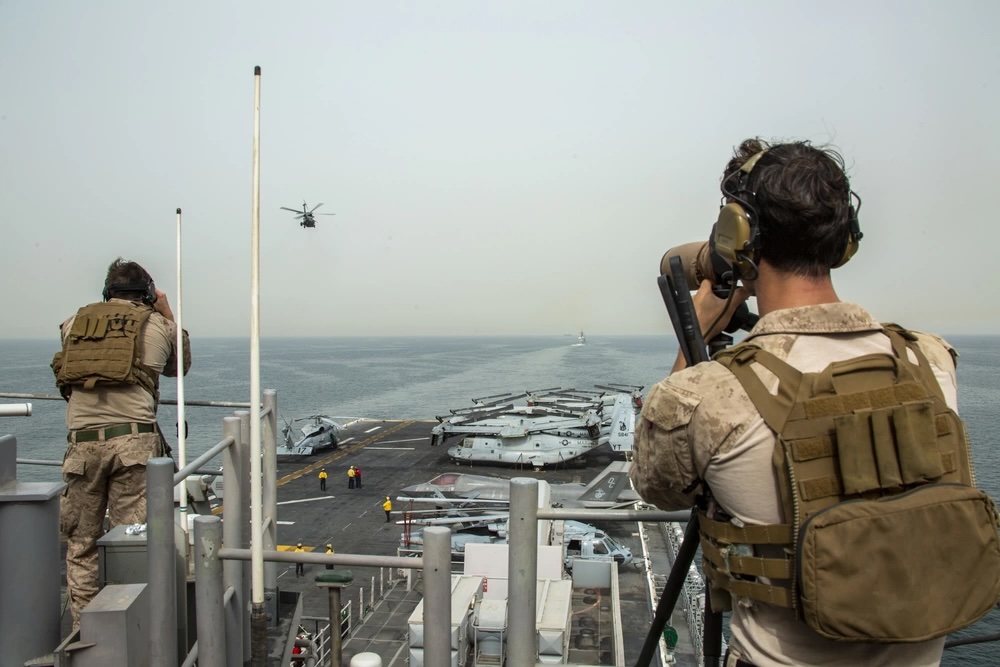
Limited US Ground Operations in Iran Will Not Shift the War’s Balance
Overview
The United States is reportedly considering conducting limited ground operations in the Iran war. Among the potential operations reportedly under consideration are efforts to seize the Persian Gulf islands of Abu Musa and the Greater and Lesser Tunbs, Larak, and Kharg.
There are serious questions surrounding the feasibility of these potential US ground actions. But even if these uses of force are successful tactically, like the air war, it is highly unlikely that they will bring about the desired strategic effects that the Trump administration seeks. Limited ground operations are unlikely to compel Tehran to agree to an immediate ceasefire or an initial political agreement to end the war. They are even more unlikely to succeed in compelling the Iranian government to fully reopen the Strait of Hormuz to international shipping prior to the cessation of hostilities, as Iran’s control over the waterway is its most important source of leverage in forcing an end to the war on favorable terms.
Rather than serving as a means to rapidly conclude the war, limited ground operations risk prolonging and widening it. These operations will substantially increase the resources required to prosecute the war, severely degrading US military readiness in other critical areas of national interest, particularly the Indo–Pacific. Impacts on readiness, moreover, will not be short-term.
Discussion
Despite the sustained degradation of Iranian military capabilities and its industrial base in the four weeks since the US initiated Operation Epic Fury, the combined US–Israeli offensive has not succeeded in bringing about the desired strategic results. The Iranian government has not collapsed, continues to maintain the capacity to attack targets throughout the Middle East, and maintains de facto control over the flow of shipping through the Strait of Hormuz.
The US is now seeking solutions to break the strategic impasse that air power alone cannot solve. The US is currently considering conducting three operations requiring the use of ground forces to seize Iranian islands — Abu Musa, Larak, and Kharg — in the Persian Gulf. It is not clear whether one of these islands is a higher priority objective than the others, as their military and strategic values differ. Abu Musa (as well as the Greater and Lesser Tunbs) and Larak are useful — though not critical — to the control of the strait and possess a clear operational value. The control of Kharg Island, in contrast, is intended to serve as a potential form of economic counter-leverage to Iran. The island is Iran’s primary oil export hub, processing 90 percent of the country’s oil exports.
Three separate deployments of US ground forces to the Middle East are now under way, including the Tripoli Ambiphious Ready Group and the 31st Marine Expeditionary Unit (2,500 Marines), which arrived in theater on March 27; the Boxer ARG and the 11th MEU (2,500 Marines); and 2,000 paratroopers of the 1st Brigade Combat Team of the 82nd Airborne Division. This deployment of 7,000 soldiers and Marines is in addition to the 50,000 US service members already deployed to the Middle East. The US is also reportedly considering the further deployment of another 10,000 US troops.
All three elements’ primary combat mission is to serve as rapid reaction assault forces. The US Army’s 82nd Airborne specializes in parachute assault. But airborne units typically do not serve as a forcible entry operation’s primary assault force, as they possess less firepower than traditional infantry due to limits on equipment that can be carried in a parachute assault. Moreover, the islands are small, making it difficult to drop paratroopers on target in an environment as contested as the Persian Gulf currently remains.
MEUs, normally consisting of approximately 2,200–2,400 Marines, are the smallest form of a Marine Air–Ground Task Force. MAGTFs are a combined arms task force designed to conduct forcible entry operations — traditionally, amphibious assault — independently and without the need for land basing. They are also capable of conducting air assault from amphibious assault ships, utilizing MV–22 Ospreys or CH–53K King Stallions. MAGTFs are uniquely suited to conduct operations requiring the projection of power from sea to land.
Seizing Abu Musa and Larak Islands
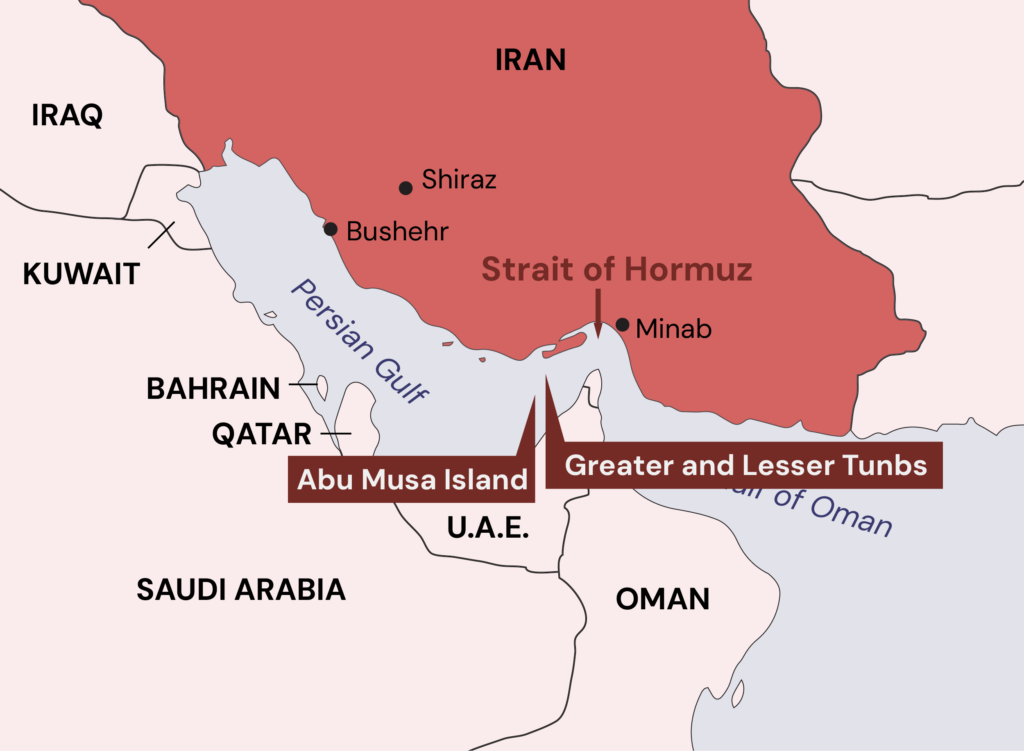
Abu Musa is located in the Persian Gulf at the western entrance of the Strait of Hormuz. Iran currently administers the island, but the United Arab Emirates contests its sovereignty. Approximately 4.9 square miles in area, the island is 37 miles north-northwest of the UAE and 43 miles south of Iran. The Greater and Lesser Tunbs, which would also be part of an operation to seize Abu Musa, sit northeast of that island, directly in the sea lanes necessary to transit the strait.
Figure 1: Map of Abu Musa and the Greater and Lesser Tunbs
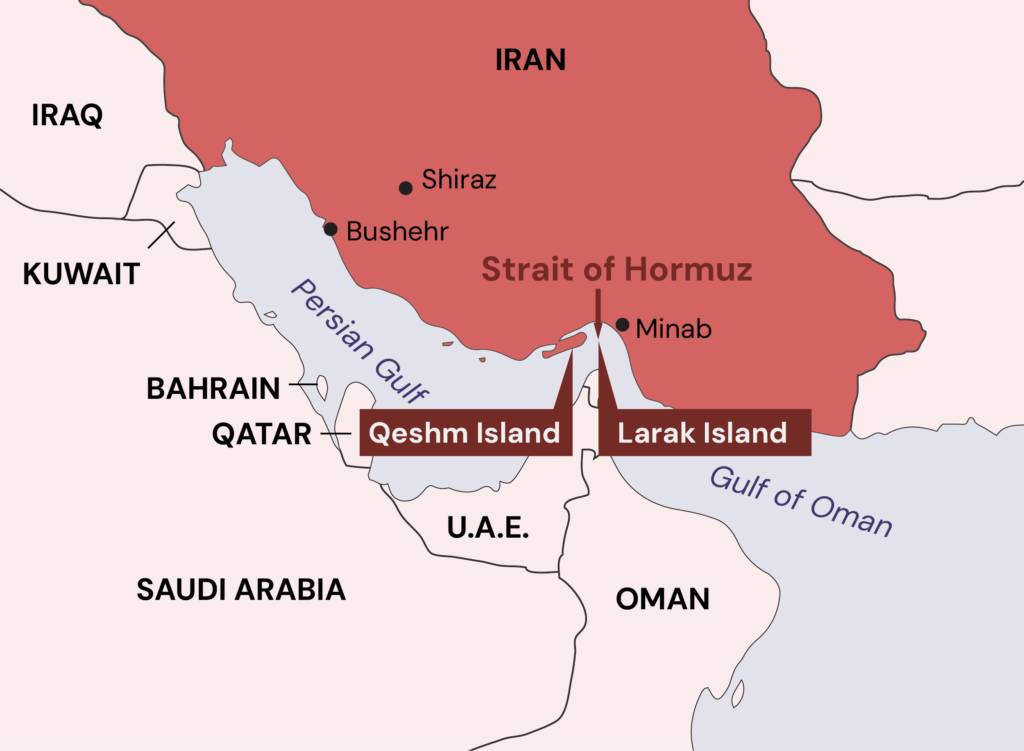
Larak Island is located directly in the Strait of Hormuz itself. Larger than Abu Musa, with an area of 19 square miles, Larak is considerably closer to Iran, only a few miles offshore, and sitting in the narrowest part of the strait. Though Abu Musa and Larak have been reported as separate operations and objectives, they have both historically been considered critical to controlling the strait, though that usefulness has declined given the lethality of Tehran’s missiles and drones. Reporting has indicated that the Islamic Revolutionary Guard Corps, or IRGC, began operating a de facto “toll booth” using Larak around March 13, requiring ships to pay a fee in order to secure safe passage. The US is likely considering seizing the islands in an effort to reopen the strait by force.
Figure 2: Map of Larak Island
Tactically, it is highly unlikely that the US will attempt a traditional amphibious assault against either of the islands; the associated risks make it prohibitive. Iranian anti-ship cruise missiles, ballistic missiles, and underwater drones could easily target the amphibious assault ships and landing craft necessary to move Marines from ship to shore. That threat would increase significantly if Iran successfully mined a portion of the strait. The threat that Iran poses to the US Navy’s surface ships has required the Abraham Lincoln Carrier Strike Group to operate in the Arabian Sea; it is improbable that the Navy could position its ships close enough for the Marines’ amphibious assault vehicles to launch at a maximum distance of only 3,000–4,000 yards from shore to conduct the assault itself.
Air assault is therefore the likeliest method of insertion. Given Abu Musa’s closer proximity to the UAE, it would be considerably easier to land Marines on that island than Larak, which not only sits significantly closer to Iran’s southern coastline but is only six miles east of the 579-square-mile Iranian island of Qeshm.
The major difficulty is not, ultimately, landing Marines on and seizing either Abu Musa or Larak, though the assault forces would likely face fire from surface-to-air missiles and air-defense drones. Rather, the issue is holding the islands once US forces are there. Without prepared, hardened fortifications to provide cover, even with air support from nearby naval assets, force protection would be an enormous challenge. The Marines would likely incur high casualties from Iranian ballistic missiles and drones relentlessly targeting either island, whether from nearby islands including Qeshm or Iran’s coastline itself, severely limiting their ability to project power into the strait. Providing logistical support would be extremely demanding. MEUs are typically capable of self-sustainment for 15 days but require resupply thereafter. Any effort at resupply, depending on the remaining threat that Iran poses in the strait at that time, would come under intense fire.
It is not clear, therefore, how seizing Abu Musa and Larak by themselves would substantively aid in reopening the Strait of Hormuz unless they formed part of a broader campaign. Without also seizing Qeshm, where satellite imagery suggests that Iran has deployed a significant number of anti-ship cruise missiles, US forces will have failed to eliminate the challenge that Iran’s capabilities pose in the strait itself. More fundamentally, however, the primary threat to international shipping does not emanate from an Iranian military capability deployed on the strait’s islands but from the entire stretch of Iran’s southern coastline, from which it can launch ballistic missiles, cruise missiles, and drones. Though Iran has historically deployed radar and anti-ship cruise missiles on the islands, there are numerous areas elsewhere to deploy those assets. Indeed, while the strait is the waterway’s narrowest point, ships must transit the Persian Gulf as well — only a tiny sliver of which lies outside the reach of Iran’s shortest-range ballistic missiles but well within range of its other capabilities, including the 1,000-mile-capable Shahed–136 drone.
As the war has demonstrated thus far, Iran’s missile and drone threat cannot be eliminated from the air alone. The Shahed drone, for example, only requires a pickup truck for a launch platform and is highly mobile and easy to conceal. The terrain of Iran’s southern coast, dominated by the Zagros Mountains, makes the job of locating and destroying Iranian fires from the air substantially more difficult. Iran has the added advantage of having spent decades preparing defensive countermeasures to evade targeting. Iran’s southern coastline spans 1,520 miles, approximately the distance from Washington, DC to the eastern border of Colorado; the US would require a substantially larger ground force, including assault forces and logistical support, to meaningfully suppress Iranian missile and drone fire in that amount of territory.
The scale of this threat is partially why the US Navy has refrained from attempting to conduct escort operations in the Persian Gulf: the risk remains too high. If traveling at supersonic speeds, it takes only 47 seconds for an anti-ship cruise missile to reach a ship 30 nautical miles offshore. Moreover, US escort operations, which the Navy has told shippers that it does not have the available resources to conduct, would only enable the transit of 10 percent of normal traffic in a best-case scenario.
Kharg Island
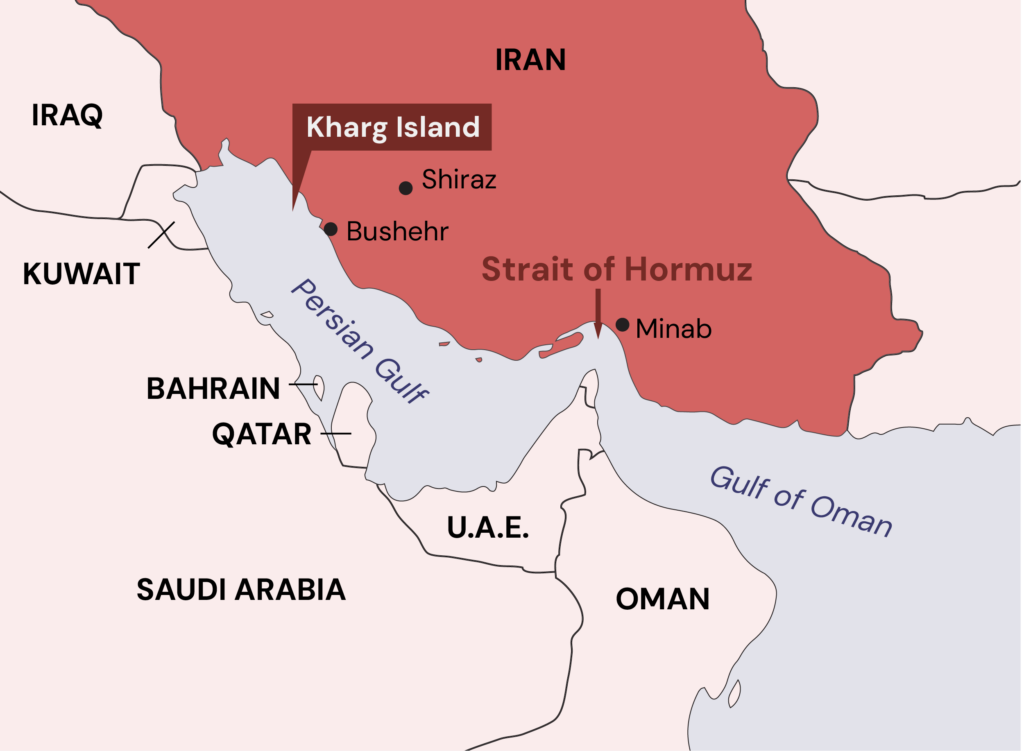
Seizing Kharg Island would be considerably more difficult than Abu Musa or Larak. Not only is Kharg just 16 miles off the coast of Iran, the Persian Gulf island is farther from the Strait of Hormuz, 410 miles to the northwest and parallel with Kuwait. Kharg’s location gives Iran a significant advantage in supporting the island’s defense and complicating US efforts at resupply. As with Abu Musa and Larak, Kharg’s position precludes an amphibious assault. Rather, air assault forces would launch either from amphibious assault ships operating in the Arabian Sea or US bases elsewhere in the Middle East.
Figure 3: Map of Kharg Island
It is highly unlikely that the US could launch an operation against Kharg with any advantage of surprise. Tehran is aware of the island’s value just as much as Washington is. The IRGC maintains a presence there, and recent reporting has indicated that Iran has taken steps to strengthen its defenses: increasing deployed personnel; supplying additional shoulder-fired, surface-to-air guided missiles; and laying antipersonnel and anti-armor mines around the island, including the beaches that Iran suspects the US would attempt to land on in an amphibious assault.
The island is small, only 7.7 square miles, and relatively flat, save for a small section of 230-foot-high hills at its southern extreme. The island’s capital, Kharg City, has a population of more than 8,000 civilians as well as its only airfield. The presence of a substantial civilian population would make US forces’ task of clearing the city significantly more difficult. However, it is unclear whether Iran would attempt to directly contest US forces on the island itself or withdraw and pummel US troops with ballistic missiles, drones, and any other available fire. Given the island’s lack of cover and proximity to Iran’s shoreline, US forces on Kharg would be extremely exposed.
Assuming, however, that the US made a successful assault against the island and maintained control for some time, it is unlikely that seizure of Kharg would provide the strategic leverage that the administration seeks. Though Kharg is Iran’s primary oil export terminal, the country does possess others, including the port city of Jask, Lavan Island, Sirri Island, and Qeshm. None have anywhere near the capacity of Kharg, but they would allow Iran to maintain an emergency economic lifeline. Analysts suspect that they could meet approximately 25 percent of Kharg’s volume. Given Tehran’s exceedingly high pain tolerance, that lifeline would likely be sufficient to prevent it from succumbing to US pressure, especially as Iranian oil is selling for twice as much as prior to the war. Iran has weathered significant disruptions to its oil exports previously and refused possible accommodations. In 2020/21, for instance, Iranian crude exports stood at fewer than 250,000 barrels per day for several months (compared to a typical output of more than 3 million BPD), yet the Iranian government refused to accede to the increased pressure. It is not clear why Tehran would buckle now, when the stakes are far greater.
Seizing Kharg Island could backfire strategically. Iran would likely increase its targeting of energy infrastructure in the Gulf, and the loss of Iranian oil production would exacerbate an already severe squeeze on global oil supply and prices — a variable that the US and its partners appear far more sensitive to than Iran does. The Trump administration has already confirmed the degree to which it recognizes the severity of its predicament, having unilaterally lifted sanctions on some Iranian oil. Iran could also prioritize targeting civilian infrastructure, including water desalination plants. The US should be under no illusions, therefore, that the seizure of Kharg Island would serve as a panacea to shift the war in its favor.
Conclusion
The operations that the US is currently considering utilizing ground forces for are unlikely to aid it in recapturing the war’s initiative. They suffer from significant tactical and operational risks and major strategic flaws. The US should avoid the temptation to commit further military resources to a conflict that is unlikely to result in the realization of its strategic aims at an acceptable cost to other national priorities. Distasteful as it may be, the US must stem any additional losses and pursue a negotiated settlement to the war that best preserves American power and the ability to maintain its commitments.
Program
Countries/Territories
Entities
Authors

Brandon Carr is a studies associate at the Quincy Institute. He studied politics and international relations at The George Washington University and the University of Oxford.

Trita Parsi is co-founder and executive vice president of the Quincy Institute. He is an award-winning author and the 2010 recipient of the Grawemeyer Award for Ideas Improving World Order.