
Trump’s $1.5 Trillion Defense Budget Request: Unhinged, Unaffordable, and Unnecessary
Overview
The Trump administration’s 2027 budget request, submitted on April 3, calls for funding defense at $1.5 trillion. It is difficult to overstate just how massive an increase in defense spending this would represent — or how unhinged it seems to be from reality and sober policymaking.
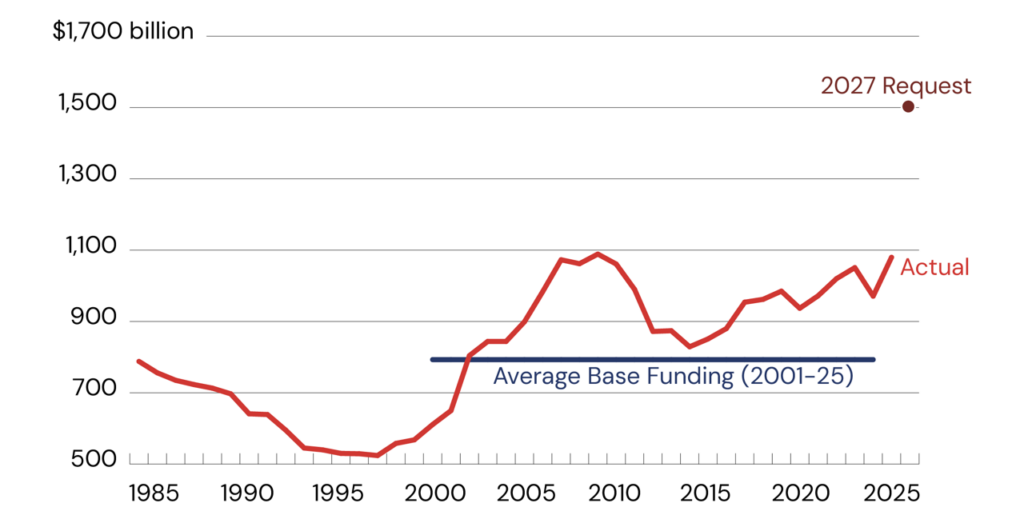
The 2026 defense budget already included a $150 billion increase from 2025. The latest request would involve a further increase of some $450 billion, marking an increase in “real” terms (i.e., inflation-adjusted) of 40 percent from 2026, and a 58 percent increase from 2025. Moreover, it would establish a defense budget that is some 90 percent higher — again, in real terms — than both the peak of the Cold War and the average base defense budget of the past 25 years (see Figure 1). It is also important to understand that the administration’s request — like all base budget requests — is intended only to cover the Pentagon’s peacetime manning, operating, and modernization costs. It is in addition that the administration plans to request a further $200 billion to cover Iran war costs.
This note explores the administration’s proposal by focusing on four specific questions:
- What exactly is the administration proposing?
- How would this budget compare to the military spending of both partners and potential adversaries?
- How would this budget compare to the estimated cost of sustaining recent US defense plans?
- How would maintaining such a high level of spending impact the federal debt?
Key findings from this brief analysis are:
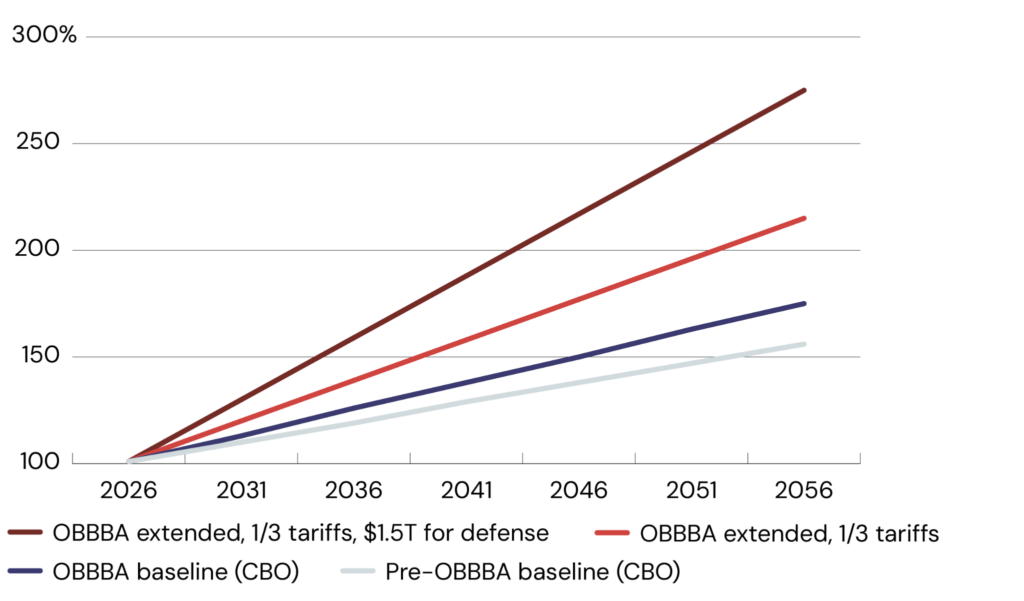
- Implementing the proposed increase in defense spending, and sustaining it over the long term, would result in a major increase in the federal debt, pushing it up to as much as 275 percent of gross domestic product, or GDP, by 2056.
- The United States already spends far more on its military than does China or Russia, and the US also benefits from substantial spending by its allies.
- Nothing remotely as high as the proposed $1.5 trillion defense budget is needed to cover the cost of recent defense plans, including that from the last year of President Donald Trump’s first term.
Discussion
Question 1: What exactly is the administration proposing?
The Trump administration’s $1.5 trillion request for defense is composed of two parts. The first consists of $1.15 trillion in discretionary funding to be provided as part of the regular annual appropriations process (the manner in which defense budgets have traditionally been funded). The second part includes $350 billion in mandatory spending to be provided through another reconciliation bill. Traditionally used as a mechanism to expedite the enactment of revenue or entitlement changes, Republicans used reconciliation legislation — last year’s One Big Beautiful Bill Act, or OBBBA — to provide $155 billion in additional defense spending. This year’s request would essentially double down on that approach.
The longer-term plan released by the administration with the 2027 budget request projects Pentagon funding falling back to $1.3 trillion in 2028, with no additional mandatory spending projected. But history strongly suggests that, once spending levels for defense (or most other areas, for that matter) are increased and plans expanded, administrations do not suddenly propose reductions. And certainly the pattern that the Trump administration, in particular, has shown for these past two fiscal years — including a $150 billion defense increase for 2026, a proposed $450 billion defense increase in 2027, and a $200 billion supplemental wartime request — may be taken to suggest that this administration is, if anything, more likely to further increase defense spending beyond $1.5 trillion rather than to preside over some future reduction in spending.
Figure 1: Actual and Proposed Funding for Defense, 1985-2027 (in billions of 2026 dollars)
Question 2: How would such a budget compare to military spending by both partners and potential adversaries?
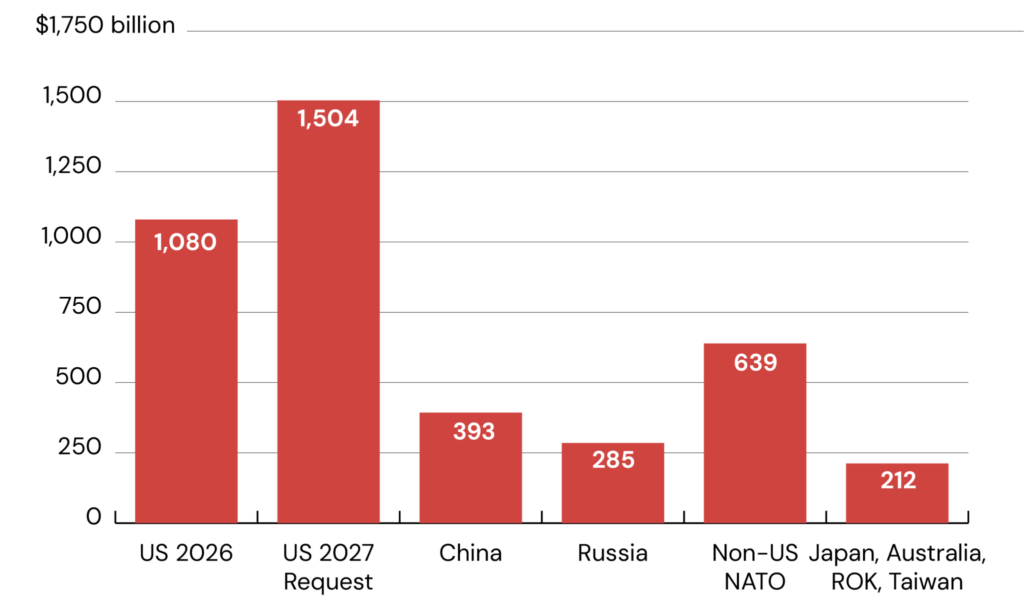
In absolute terms, the US already spends far more on its military than any potential adversary, including China and Russia. At present, Washington spends two to three times more than Beijing and three to four times more than Moscow on their respective militaries (Figure 2).1The US also has a range of relatively wealthy allies in both Europe and the Pacific that themselves spend substantial resources on defense. In particular, non–US NATO countries spend more than twice as much on their militaries as does Russia. It is also worth noting that these spending ratios are far more favorable to the US and its allies than was the ratio faced by NATO during the Cold War, when most comparisons showed it with only a relatively modest lead (sometimes barely over one to one) in military spending over the Soviet Union and its Warsaw Pact allies. Relatively, as a share of its economy, the US also already allocates far more of its resources to defense than either any of our major friends and allies or as potential rivals like China.
Figure 2: International Comparisons of Military Spending (in billions of 2026 dollars)
Question 3: How would such a budget compare to the estimated cost of recent US defense plans?
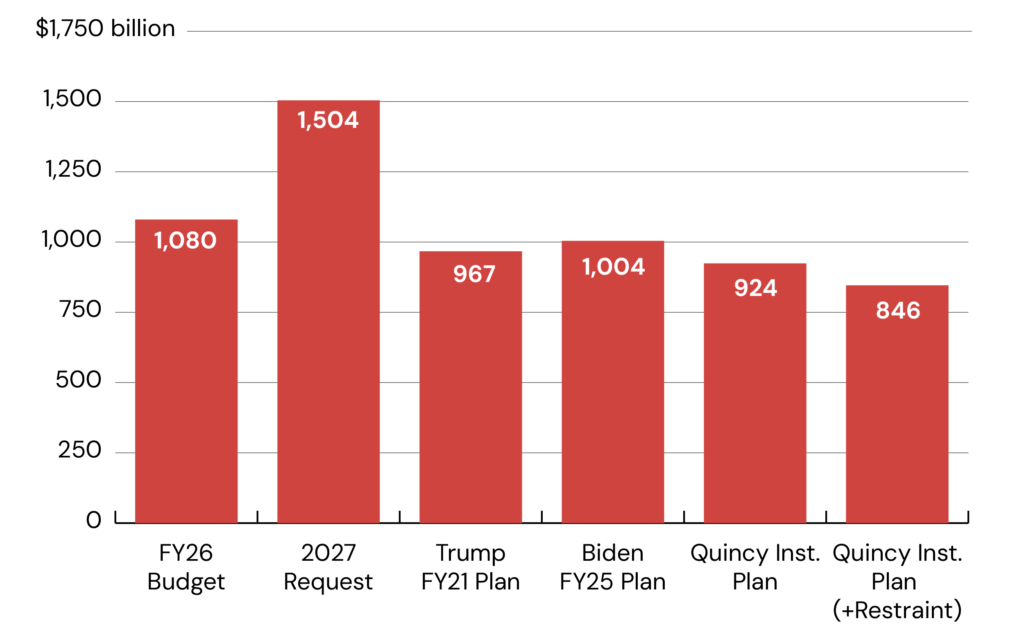
The case for a massive increase in defense spending looks no more persuasive when examined from a detailed military-focused planning perspective. Figure 3 compares the administration’s proposed 2027 defense budget with estimates of the long-term average annual costs associated with US defense plans of the recent past, including the last defense plan proposed by President Trump during his first term and the last Biden administration defense plan. In both cases, the estimated level of spending required to execute the plans is well below the level of funding already being provided for defense this year.2
Moreover, in 2022, a Quincy Institute paper written by a panel of military and policy experts found that, if the US were to adopt a more restrained — but still very robust — “active denial” strategy toward countering China and make other appropriate adjustments among other missions, it could cut annual spending on defense some $150 billion below the level approved for this year.3And if the US were to take an even more restraint-oriented approach — that, in particular, included deeper cuts in ground forces — the study estimated that Washington might be able to reduce annual defense spending by more than $230 billion compared to today’s level.4It is also worth noting that, in many ways, these far less costly alternative defense plans — which, for example, assume a less active US role in Europe’s defense and eschew involvement in large-scale stability-type operations — are, arguably, far more consistent with much of the rhetoric expressed by Trump, as both a candidate and as president, than his latest defense plan and its $1.5 trillion price tag.
Figure 3: Budget Levels Compared to Estimated Long-Term Annual Costs of Various Defense Plans (in billions of 2026 dollars)
Question 4: How would this level of spending, if sustained, impact the federal debt?
Increasing the US defense budget to $1.5 trillion and sustaining it over the long run would make an already very difficult fiscal situation for the country far worse (see Figure 4). This January, the Congressional Budget Office issued its baseline estimate of how the debt was likely to grow, under current law, in the aftermath of the OBBBA. The estimate projected that, as a share of gross domestic product, the size of the US publicly held debt would increase from about 101 percent of GDP in 2025 to 175 percent over the next three decades.5This “current law” baseline, however, incorporates a number of assumptions that likely cause it to substantially understate the growth in the debt: most importantly, it assumes that the temporary tax cuts included in the OBBBA will not be made permanent and that the high tariffs unilaterally imposed by President Trump (and largely struck down by the Supreme Court) will remain in place over the long term. Based on CBO and other data, I would more realistically estimate that, by 2056, the federal debt would instead grow to some 215 percent of GDP.6The Trump administration’s current proposal to increase defense spending to $1.5 trillion, if sustained, would thus further accelerate the projected growth of the debt to perhaps 275 percent of GDP over the next 30 years.
Figure 4: US Debt–to–GDP Ratio, 2026–56
The US is a wealthy country, and it can carry a substantial level of debt without posing a significant risk to its financial stability or long-term economic growth. However, the growth of the federal debt along the lines described here would be far above current or historical levels and on anything but a stable and, thus, sustainable path. Concerns about a rising debt–to–GDP ratio include its effect on both long-term economic growth and the country’s ability to respond to significant economic downturns, inefficiencies associated with excessive borrowing, and the potential for such borrowing to trigger a financial crisis.7
An acceleration of the debt driven by the proposed massive increase in defense spending, combined with already-enacted large tax cuts, would greatly exacerbate each of these dangers. Indeed, it is difficult to imagine a weaker and more fragile economic, financial, and budgetary foundation upon which to rest the country’s long-term security — including, ultimately, its military capabilities — than the one that would be constructed under such a set of policies.
Program
Entities
Authors

Steven Kosiak is a non-resident fellow at the Quincy Institute and a partner at ISM Strategies in Washington, D.C. He is also a senior adjunct faculty member at American University’s School of International Service (SIS) and an adjunct senior fellow…
Citations
Estimates are expressed in terms of purchasing power parity except for the US and non–US NATO estimates, which are at market exchange rates. ↩
Estimates for the 2021 Trump administration and 2025 Biden administration defense plans are from the Congressional Budget Office: Long-Term Implications of the 2021 Future Years Defense Program (Washington, DC: CBO, 2020), 1, https://www.cbo.gov/publication/56526; Long-Term Implications of the 2025 Future Years Defense Program (Washington, DC: CBO, 2024), 1, https://www.cbo.gov/publication/60665. ↩
Rachel Esplin Odell et al., “Active Denial: A Roadmap to a More Effective, Stabilizing, and Sustainable US Defense Strategy in Asia,” Quincy Institute, 2022, 289, https://quincyinst.org/research/active-denial-a-roadmap-to-a-more-effective-stabilizing-and-sustainable-u-s-defense-strategy-in-asia. ↩
Esplin Odell et al., “Active Denial,” 290. ↩
The Budget and Economic Outlook: 2026 to 2036 (Washington, DC: CBO, 2026), 4, https://www.cbo.gov/publication/61882. ↩
For example, see “The 30–Year Cost of OBBBA,” Committee for a Responsible Federal Budget, July 15, 2025, https://www.crfb.org/blogs/30-year-cost-obbba; Jared Bernstein and Bobby Kogan, “President Trump’s ‘Big Beautiful Bill’ Raises Fiscal Gap to 2.4 Percent,” Center for American Progress, Feb. 5, 2026, https://www.americanprogress.org/article/president-trumps-big-beautiful-bill-raises-the-fiscal-gap-to-2-4-percent. ↩
Steven Kosiak, “The Fiscal Implications of a Major Increase in US Military Spending,” Quincy Institute, 2025, 41–44, https://quincyinst.org/research/the-fiscal-implications-of-a-major-increase-in-u-s-military-spending. ↩