
Containment, Resistance, and the MOU: The US–Iran Negotiations in Historical Context
Executive Summary
The Memorandum of Understanding between the United States and Iran could be a watershed moment in resolving the deadlock between the two countries dating back to the 1979 Iranian Revolution. Alternatively, it could break down under the same pressures that have sustained conflict between the two countries for so long.
This brief outlines the recent history and consequences of the interaction between Iranian resistance strategies and the American strategy of coercion and containment. The US–Iran War laid bare the failures of both strategies, failures that should galvanize each country to pursue a new arrangement based around reciprocity, restraint, and reconstruction.
Containment and coercion have been the consistent throughline of US policy toward Iran, a strategy seen by Iranian leadership as a perpetual American effort to isolate their country. In this sense, the launching of a full-scale war on Iran was the culmination of an over 40-year American effort to defeat the Islamic Republic.
The war’s outcome is a complete indictment of this US approach. The United States and Israel killed hundreds of Iranian senior leaders and caused $270 billion in direct economic damage through its targeting of Iranian military, economic, and institutional infrastructure central to the regime’s hold on power. Despite this, the United States did not force Iranian submission and created risks to the world economy through Iran’s control of the Strait of Hormuz.
At the same time, the war reflects the disconnect between the Iranian resistance strategy and the well-being of the Iranian people. The resistance model has stymied economic growth, prevented development, and intensified poverty, even as the Islamic Republic has adapted to economic coercion. As this brief documents, Iran’s economy today is likely approximately half as large as it could have been had Iran not been under sanctions and periodically at war for the past decade, implying that the total costs Iran has paid for its resistance strategy run into the trillions of dollars. While successful in preventing an American victory, Iran remains highly vulnerable in a post-war landscape, as it is governed by a corrupt, unpopular regime and in dire economic straits.
In this 60-day MOU window, both sides should work toward a realistic, mutually beneficial outcome which permits an exit from the coercion-resistance spiral, one in which Iran agrees to verifiable restraints on its nuclear program in exchange for US sanctions relief.
Absent good-faith diplomacy from both sides toward this objective, the United States and Iran will once again succumb to a push and pull that has led to destructive war and instability. There has never been a better opportunity to transcend this pernicious dynamic toward a transformative deal. Both the United States and Iran should seize it.
Introduction
In a rare high-level move since the 1979 revolution, the US and Iranian presidents signed on June 17 a Memorandum of Understanding to end the US–Iran war and explore a potential settlement. The announcement immediately fueled unsettling debates in both Washington and Tehran over who won, who lost, which side gained leverage, which conceded too much, or whether the agreement was just a fragile pause that would collapse into another round of confrontation. Those questions are politically powerful, but they miss the larger point. The MOU is not a verdict on victory or defeat. It is evidence of a deeper strategic deadlock and a narrow chance to break it.
This brief views the MOU in the context of the five-decade US–Iran conflict, a coercion-adaptation spiral that needs to be broken. US containment has pushed Iran toward resistance; resistance, in turn, produces adaptation. Iran’s adaptation helped it survive, but it also created new vulnerabilities and new security concerns in Washington. Those vulnerabilities and threat perceptions then justify more pressure. The result is a recurring cycle of coercion, adaptation, escalation, and deadlock. Through this lens, the MOU reveals the limits of both strategies. US pressure has weakened Iran without forcing capitulation or collapse. Iranian resistance has preserved the Islamic Republic’s bargaining power without delivering security, prosperity, or legitimacy.
To explain how this spiral emerged, this brief first reviews the evolution of US–Iran relations since the 1979 Islamic Revolution. It shows how Washington’s policy centered on containment and, in turn, how Iran’s response gradually took shape as three interconnected pillars: defense, deterrence, and resilience. These pillars were designed to withstand pressure, raise the costs of coercion, and exhaust Washington until it changed course or accepted the Islamic Republic as a normal, independent state.
The resistance strategy helped the Islamic Republic survive pressure rather than escape it. It has triggered a domino effect, exacerbating four interlocking crises. This is the resilience trap at the center of Iran’s strategy. Sanctions have increased international isolation and exacerbated economic hardship; the economic distress has paralyzed state functioning; and the growing mismanagement, corruption, and economic hardship have fueled public dissatisfaction and undermined the state’s legitimacy. Washington misreads these domino effects as signs that the Islamic Republic is approaching a breaking point. This misperception, along with new security concerns, is leading to further pressure, pushing Tehran back toward resistance. It creates a self-reinforcing cycle of coercion, adaptation, escalation, and deadlock.
The MOU offers a fragile opportunity to break the deadlock. It can serve as an off-ramp if both sides recognize the limits of their own strategies and view it as a transition to change the logic of the conflict. The MOU can help turn the ceasefire into a political process and resistance into compromise, but only if pressure is tied to relief and Iranian restraint is tied to a credible path toward reconstruction and regional deescalation. Otherwise, if Washington uses it as a pause before extracting more concessions through renewed pressure, or if Tehran uses it as proof that resistance alone won, the MOU will reproduce the same spiral.
The US grand strategy of containment
The 1979 Islamic Revolution transformed US–Iran relations and Washington’s strategic view of Tehran. The revolution overthrew the Pahlavi monarchy, a key pillar of US regional policy, and replaced it with a government that openly challenged American influence and the US–led order in the Middle East. The seizure of the US Embassy in Tehran deepened the rupture, turning mistrust into lasting hostility.1In Washington, the Islamic Republic came to be viewed as an ideological, anti–American, and revisionist state seeking to export revolution, undermine US interests, threaten Israel, and destabilize the regional order. As Israel’s security became a priority in US Middle East policy, the view that the Islamic Republic needed to be constrained was reinforced.
US strategy toward post-revolution Iran centered mostly on containment to address three challenges: nuclear, military, and regional influence.2Across different US administrations, Iran policy language and instruments might have changed, but its center of gravity has remained containment.3At different times, Washington pursued sanctions, diplomatic isolation, military pressure, and limited diplomacy and engagement to address its three challenges. Iran’s nuclear capability and potential acquisition of nuclear weapons; its missile, drone, and asymmetric military capabilities; and its regional presence and support for armed non-state actors that Washington defines as terrorist groups or Iranian proxies. These concerns shifted in priority over time, but together they sustained a broad bipartisan consensus that Iran must be contained.4
US containment of Iran drew on older Cold War logic: Washington used sustained pressure rather than direct, full-scale war to contain Soviet power until the Soviet system collapsed due to its internal contradictions.5Applied to Iran, containment meant restricting Iran’s economic, military, diplomatic, and regional power without necessarily pursuing a direct regime-change war. The ultimate objective has been to prevent Iran from becoming strong enough to challenge US regional interests, threaten Israel and Washington’s Arab partners, or reshape the regional balance of power in ways hostile to Washington’s interests.6
The form of containment changed from one administration to another.7President Carter initially sought to preserve some relationship with the new Islamic Republic before the hostage crisis pushed Washington toward sanctions and isolation. President Reagan adopted a more militarized policy during the Iran–Iraq War, including a stronger US presence in the Persian Gulf and a tilt toward Iraq, even as the Iran–Contra affair briefly opened a tactical channel to Tehran. President George H. W. Bush showed some interest in improving relations if Iran helped release American hostages in Lebanon, but when Iran helped, Washington did not meaningfully reciprocate and instead settled into a more passive form of containment.8President Clinton formalized “dual containment,” using sanctions and pressure to limit both Iran and Iraq. President George W. Bush initially allowed limited cooperation with Iran after 9/11, especially over Afghanistan, but the “axis of evil” speech, the Iraq War, and revelations about Iran’s nuclear facilities pushed US policy back toward confrontation.
President Obama blended containment with diplomacy and limited engagement. His administration constrained Iran’s nuclear program through diplomacy while maintaining pressure on Iran’s regional policy, missile program, and support for armed groups. The 2015 nuclear deal restricted Iran’s nuclear capabilities. At the same time, Obama encouraged US regional partners to “share the neighborhood” with Iran rather than relying on the United States to settle every regional contest by force.9In contrast, President Trump withdrew from the nuclear deal, brokered the Abraham Accords that further isolated Iran, and publicly advocated for regime change while avoiding a full-scale war.10President Biden tried to revive nuclear diplomacy while maintaining much of the sanctions architecture, but the deal was not restored, and the conflict continued to escalate.11Trump’s second term marked a more destructive phase in this long pattern. In less than a year, the US integrated its negotiations with military confrontations, holding two confrontations to address all concerns at once.
US containment strategy, however, did not operate in a vacuum. It shaped how Iranian leaders understood US intentions and built their own strategy in response.
How Tehran read containment
In Iran’s post-revolution state, the United States has been viewed as an imperial power that lost its privileged position in Iran and has since sought to restore its influence, weaken the Islamic Republic, or ultimately change the regime.
From Tehran’s perspective, US containment has not been a limited response to specific Iranian policies. It has been understood as a broader strategy aimed at isolating Iran, restricting its sovereignty, and forcing it into either submission or collapse.12Iranian leaders point to the freezing of Iranian assets, US support for Iraq during the Iran–Iraq War, the expansion of the US military presence in the region, economic sanctions, support for opposition groups and pressure campaigns, and repeated references to regime change as evidence that Washington’s objective goes beyond behavioral change. In this reading, the United States has used nearly every instrument short of full-scale invasion to contain and eventually change the Islamic Republic.13
This reading of the US containment has been shaped by Iran’s perception of its security vulnerabilities and its history of foreign intervention, war, isolation, and confrontation with the United States. As Vali Nasr explains, Iran sees itself as strategically vulnerable: “a Persian Shia country in the midst of Arab and Sunni rivals, without any reliable alliances and facing containment imposed by the world’s principal superpower.” This sense of strategic loneliness has been reinforced by memories of colonial intrusion, territorial loss, national humiliation, the 1953 coup, the Iran–Iraq War, regional isolation, US containment, and even Washington’s treatment of regional allies. In Nasr’s account, these perceptions and experiences shaped a security worldview in which Iran’s leaders came to see survival, independence, and strategic autonomy as inseparable. They came to believe that “Iran must stand on its own two feet to win security and grandeur by resisting and defying the Western–led international order.”14
Iran’s response, as former Foreign Minister Mohammad Javad Zarif summarized it, has been resistance: “We are used to resisting; the Americans are used to imposing.” Zarif called resistance less of Iran’s preferred strategy than a fallback under pressure, then described the 2015 nuclear deal as a shift from resistance to compromise, an exception that ended when the Trump administration withdrew from the agreement. As he put it: “We are back to the resistance strategy. We can resist; as we have resisted,” even if it is “not the best strategy” he would prescribe.15
Zarif represents the pragmatic approach within Iran’s political elite, advocating engagement, diplomacy, and deescalation as a path toward normalization. In contrast, a more pessimistic approach within the ruling bloc has viewed American policy as structurally hostile and as impossible to resolve through engagement and diplomacy alone, advocating resistance. Iran’s dual power structure reinforced this tension: elected administrations often sought engagement to ease sanctions and reduce diplomatic isolation, while the supreme leader, who held ultimate authority over strategic foreign policy, favored resistance. Over time, the repeated failure of diplomatic openings strengthened the resistance camp’s argument that Washington was not seeking compromise but submission.
Nasr explicitly demonstrates that Iran’s foreign policy is predominantly guided by a pragmatic, rational understanding of its national security interests, rather than by revolutionary ideology or a random anti–Western stance. However, this rationalism and pragmatism do not necessarily mean completely neglecting the influence of leadership perceptions and values. In Ayatollah Khamenei’s worldview, the global order has been constructed around concepts of domination and subordination, and US hostility is insoluble because Washington seeks subordination rather than accommodation, while Iran rejects it.16
Khamenei’s worldview aligns with broader critical traditions such as dependency theory, post-development thought, and world-systems theory, which view the international system through a core-periphery framework. In the domination-subordination order, the United States imposes its political, cultural, and economic influence, while less powerful states are expected to submit.17From his perspective, Western–led development functions as an instrument of neo-colonization, enforcing the standards, institutions, and cultural assumptions of dominant powers as being universally applicable to exploitation.18“When a nation stands up to defend its independence, conflict is inevitable,” Khamenei said. According to his view, the US–Iran conflict, beyond issues of nuclear enrichment, missile development, or regional influence, is fundamentally centered on Iran’s capacity to sustain political independence within a framework of domination and subjugation.19“The Islamic system is standing; it opposes oppression, it opposes domination,” according to Khamenei. As such, US hostility toward Iran is a structural and insoluble issue that cannot be resolved through negotiation as long as it denies Iran’s independence. In this context, resistance constitutes not only a security strategy but an aspirational ideal for development, sovereignty, and national identity.
The US invasion of Iraq and the escalation over Iran’s nuclear program deepened this suspicion that containment and pressure could eventually lead to direct confrontation. The 2015 nuclear deal briefly interrupted that logic and offered a rare moment of compromise. But the US withdrawal from the agreement restored his deeper suspicion: Washington was not prepared to accept Iran through compromise, but only through pressure.
These perceptions turned resistance from a political slogan into a strategic framework built around defense, deterrence, and resilience.
Iran’s theory of resistance and practice
Iran’s theory of resistance has gradually been built on three pillars: defense, deterrence, and resilience. Each served a broader strategic objective: to raise the costs of US containment, exhaust Washington’s willingness to sustain pressure, and eventually compel a shift in US policy toward Iran.20
The first pillar was asymmetric defense. Tehran understood that if it could not match the United States conventionally, it could raise the costs of confrontation through missiles, drones, and armed regional partners. This regional deterrence and defense power also gave Iran a way to threaten US forces, Israel, Persian Gulf infrastructure, energy markets, and regional allies without fighting the United States on conventional terms.
The nuclear program added another layer of leverage. Iran viewed its enrichment capacity and nuclear threshold status as a deterrent that raised the cost of military confrontation and strengthened Tehran’s bargaining position. As such, Iran leveraged nuclear escalation to mitigate further US pressure and to seek relief.
The third pillar was economic and social resilience: the capacity to absorb, withstand, and adapt to external pressure. Iran, through social protection programs, softened the economic pain and prevented it from turning into domestic political pressure. At the same time, economic diversification, selective indigenization, and sanctions evasion helped keep trade, production, and core state functions operational under pressure.
Iran’s unconditional cash transfer program, introduced in 2010–2011, helped mitigate some of the welfare losses caused by the 2012–14 sanctions.21However, its protective effect weakened after 2012 as inflation eroded the transfer’s real value. Since then, Iran has relied on a broader mix of cash transfers, universal health insurance, food subsidies, and other social protection measures to ease economic hardship. As sanctions limited the state’s fiscal capacity to adjust public programs for inflation, the government increasingly prioritized its exclusive welfare protection for groups essential to the state’s functioning. These groups include public employees, military personnel, security-linked institutions, and parts of the formal and pseudo-private sectors. For instance, on average, a public employee receives roughly three times the per-capita welfare resources available to others. This has intensified Iran’s privilege-based welfare system: a system that does not eliminate hardship but distributes it unevenly. Informal workers, independent private firms, and vulnerable households remain far more exposed. In this sense, social policy became part of Iran’s resistance strategy.22It did not prevent broad social pain; it helped manage its political consequences and limited the transformation of economic hardship into organized domestic pressure for submission.
Figure 1: US Sanctions Cases Against Iran
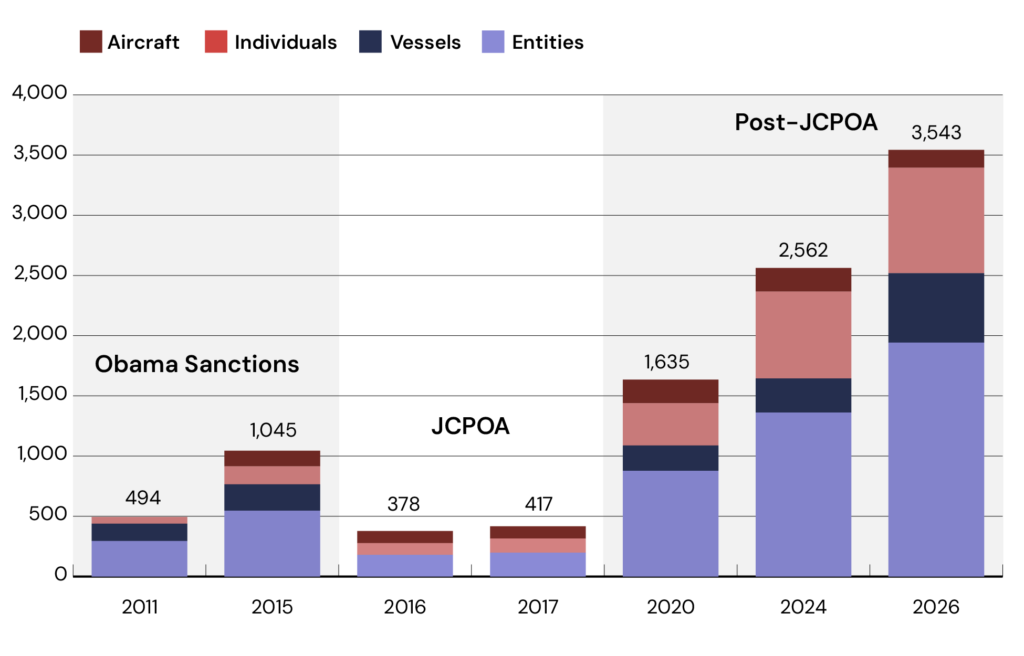
As the sanctions tightened, Tehran was forced to reduce its vulnerability to external pressure. Unlike the pre–2010 sanctions, the post–2010 economic sanctions exerted significant pressure on Iran’s economy by targeting oil exports, banks, shipping, insurance, and access to global finance.23In response, Iranian leaders proposed an economic resistance master policy as an endogenous, outward-looking economic model that relies on domestic capacities, engages with the global economy, and confronts external pressure from a position of strength.24
The resistance economy sought to make the economy survivable rather than necessarily efficient. This survival model has gradually been built around three broad pillars: diversification, indigenization, and evasion.25Together, these pillars gave Iran a costly but functional model of economic resistance that prioritized survival over efficiency, control over competition, and adaptation over development.
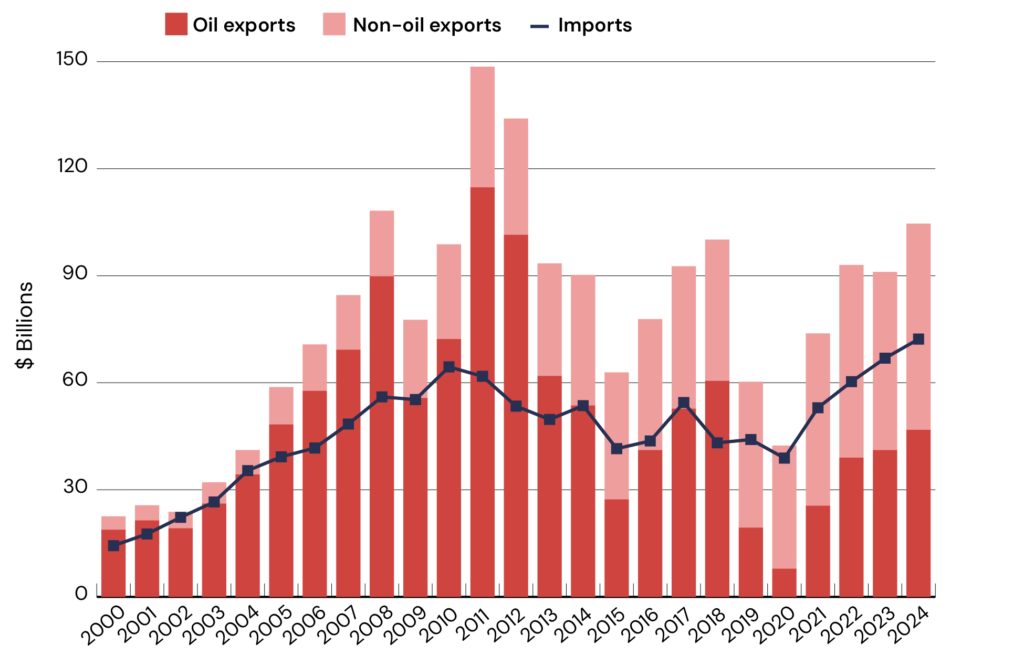
The first pillar was diversification to reduce reliance on crude oil revenue. Iran’s oil revenue fell from $115 billion in 2011 to $8 billion in 2020. While oil remained a key part of the national budget, sanctions pushed Iran to expand non-oil exports.26Average annual oil income dropped by about 40 percent, from roughly $66 billion during 2002–2012 to about $39 billion after 2012. At the same time, non-oil exports, which averaged about $17 billion annually from 2002 to 2011, have tripled, averaging $42 billion since 2012.27Much of its non-oil export base remained tied to energy-intensive sectors such as petrochemicals, steel, minerals, and basic industrial inputs. The devaluation of currency rendered Iranian products more competitively priced on the global stage, thereby enhancing the profitability of non-oil manufacturing sectors and promoting domestic production as an alternative to imports. As such, non-oil exports to neighboring countries expanded, and the composition of Iran’s exports shifted.
Figure 2: Iran’s Oil and Non-Oil Trade, 2000–2024
The second pillar was indigenization or selective self-reliance, aimed at expanding domestic production in strategic sectors and, where possible, reducing dependence on imports. Iran could not produce everything domestically, but in sectors essential to national security and social stability, Tehran expanded local capacity. In the pharmaceutical sector, domestic producers already met about 95 percent of demand, but production remained heavily dependent on imported raw materials. Tehran, therefore, sought to localize more of the supply chain, reducing reliance on imported pharmaceutical inputs from 80 percent in 2011 to 30 percent by 2024.28A similar pattern emerged in medical equipment: whereas around 90 percent of Iran’s needs were imported in 2010, the expansion of domestic alternatives reportedly reduced that dependence to about 10 percent by 2024. Gasoline production increased from about 54 million liters per day in early 2011 to roughly 120 million liters per day in early 2025.29In petrochemicals, Iran doubled its capacity and sites from 42 units with 54.5 million tons in 2010 to 80 units with 105 million tons in 2025.30
The third pillar was evasion, aimed at keeping trade, finance, and oil exports moving through informal or alternative channels beyond the reach of US sanctions. Tehran developed networks of intermediaries, exchange houses, front companies, shadow banking channels, reflagged vessels, informal payment systems, barter arrangements, and trade settlement in non-dollar currencies or local-currency mechanisms. These networks allowed Iran to continue selling oil, importing essential goods, and moving money outside formal Western–controlled financial channels, but at a much higher cost, with greater risk and less transparency.31
Together, these pillars produced a sanctions-driven geoeconomic reorientation. Iran’s trade became more concentrated among fewer partners. Its trade partners, which numbered 157 in 2010, declined to 142 in 2023. China overtook the European Union as its main trading partner.32The United Arab Emirates remained a crucial commercial, logistical, and financial gateway. Iraq, Türkiye, Afghanistan, Russia, and Central Asian routes also became more important. Iran did not become isolated in a simple sense; it became differently connected.
Over time, the same adaptation tools that helped Iran survive also created new vulnerabilities, distortions, and threat perceptions. This is the resilience trap.
The resilience trap
Iran’s resistance strategy helped the Islamic Republic survive sustained pressure while creating a resilience trap. The same instruments that allowed Tehran to absorb sanctions, preserve core state functions, and maintain bargaining power also intensified Iran’s structural vulnerabilities and new security concerns, giving the United States new reasons to expand its pressure. This dynamic created a self-reinforcing cycle in which pressure forced Iran to invest more in its resilience, defense, and deterrence. However, these measures exacerbated some of Iran’s structural crises. At the same time, they raised new security concerns in Washington. Those vulnerabilities in Tehran and threat perceptions in Washington invited further pressure.
The resilience trap worked through triggering four interconnected structural crises: international relations, the economy, legitimacy, and governability. International isolation worsens economic stagnation. Economic stagnation deepens public dissatisfaction. Public dissatisfaction reduces legitimacy. Weak legitimacy pushes the state toward securitization and coercion. In this way, resistance has not only responded to vulnerability, it has reproduced vulnerability.
Over time, sanctions reshaped Iran’s postwar growth-oriented economy into a survival-oriented political economy. Tehran learned how to reroute trade, expand domestic production in strategic sectors, develop sanctions-evasion networks, and preserve core state functions, but at a very high cost: 3,500 US sanctions narrowed Iran’s trade partnerships, raised transaction costs, and reduced the economy’s capacity to create jobs and wealth.33They made the economy less efficient, more distorted, more inflationary, more dependent on opaque networks, and more reliant on a small number of partners. The rial lost value, firms struggled to access inputs, and households faced rising prices and declining purchasing power.
From the end of the Iran–Iraq War until 2010, Iran’s GDP grew by about 4.5 percent annually, while the inflation rate averaged 20 percent. Sanctions altered this postwar growth trajectory. After 2011, annual growth fell to about 1.8 percent, while inflation averaged roughly 35 percent. In particular, since the US withdrawal from the Iran nuclear deal in May 2018, consumer prices have risen by 1,900, and the exchange rate has deteriorated from roughly 60,000 to about 1,700,000 rials per dollar, meaning the dollar has become more than 28-fold more expensive in rial terms.34
Figure 3: Iranian GDP: Actual vs. Annual Growth from 2011
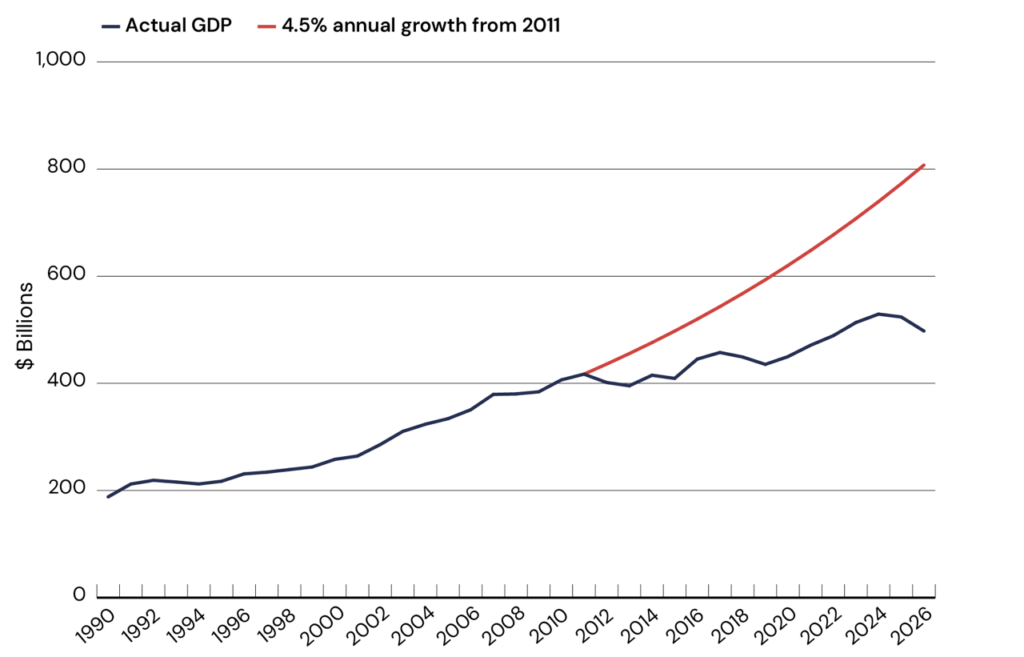
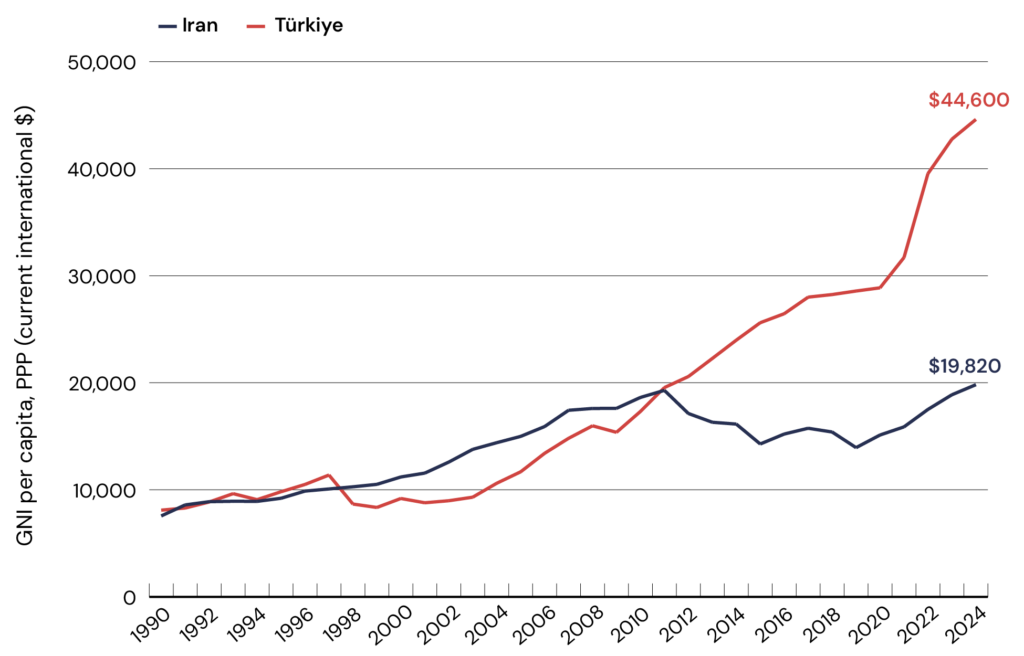
The economic cost of the containment-resistance spiral is not limited to recession, inflation, and currency collapse, but also to the development Iran lost after 2010. By 2026, Iran’s actual GDP was only 62 percent of the level implied by its modest pre-sanctions growth path, and only 38 percent of the level implied by the official 8 percent development plan target. In dollar terms, the economy was roughly $310 billion smaller than it would have been under a 4.5 percent postwar growth path, and about $826 billion smaller than it would have been had Iran achieved its official development target. Adding the estimated $270 billion cost of the war to the $310 billion GDP loss under the modest scenario yields a total economic loss of roughly $580 billion.35The same pattern of lost progress is evident in Iran’s labor market. If, after the Iraq War, Iran maintained a 3 percent employment growth trajectory after 2010, more than 10 percent of Iran’s population — equivalent to an additional 9 million employed individuals — would be employed by 2026. Therefore, this was not simply a period of recession; it was a long-term derailment of development. Before 2011, Iran’s gross national income per capita in purchasing power parity terms continued to rise to $19,290, and remained broadly comparable to Türkiye’s at $19,550. The decisive break came after 2011. By 2024, Iran’s national income per capita had reached only $19,820, almost unchanged from its 2011 level, while Türkiye’s GNI per capita had risen to $44,600, more than twice Iran’s level.
Figure 4: Iran vs. Türkiye: A Widening Prosperity Gap
The social consequences have been severe. Within a decade, Iran’s social pyramid not only flipped but collapsed. Poverty and vulnerability became the majority and deepened, while the middle-class majority became a minority of the population. The share of Iranians who are poor or economically vulnerable rose from about 35 percent to 70 percent, and the number of Iranians living in extreme poverty — those unable to meet their basic subsistence needs — increased about five times. At the same time, the share of the lower and upper-middle classes shrank from 64 percent in 2011 to 30 percent in 2026.
Economic hardship also translated into deeper social and political grievances. The erosion of state-society trust is evident in both public opinion data and declining electoral participation. Iran’s government-administered National Survey on Values and Attitudes shows a sharp fall in public confidence: In 2014, 82 percent of respondents expressed confidence in the government, but by 2023 that figure had dropped to 43 percent.36Pessimism about the country’s future rose at the same time. Whereas roughly 20 percent of Iranians in 2014 expected conditions to worsen over the next five years, by 2023 that share had increased to 55 percent. This widening distance between state and society was also reflected at the ballot box. Presidential election turnout declined from 73 percent in 2016 to 40 percent in 2024, the lowest level recorded in a presidential election since the revolution.37
Sanctions and the economic crisis also deepened Iran’s governability crisis: the state’s ability to manage shocks, solve problems, and meet needs. The sanctions shrank the government’s revenues, while the growing weight of pension, subsidy, and public-sector obligations absorbed an increasing share of limited resources. Although Iran’s dual political structure further weakened coherent decisionmaking, 15 to 25 percent public-budget deficits undermined its governability. As a result, the state became more adept at emergency control than at long-term problem-solving. It could ration resources, manage markets, repress dissent, and protect strategic sectors, but it became less capable of pursuing institutional reform, maintaining fiscal discipline, planning investment, and implementing effective public policy. This growing ungovernability, when intertwined with corruption, reinforced public dissatisfaction and economic crisis.
Iran’s growing vulnerabilities, including economic hardship, public anger, and governance failure, have convinced Washington that the Islamic Republic has been approaching its breaking point. At the same time, defense and deterrence raised new security concerns in Washington, presenting pressure and containment as the most effective policy toward Iran. But when the pressure failed, it was concluded that it had not been applied forcefully enough as opposed to evidence that the pressure-resistance cycle was making Iran more damaged but not necessarily more coercible. This cycle has weakened Iran, but it has failed to bring about the desired change that Washington has been seeking. It fueled escalation without surrender and survival without development.
War and the limits of containment and resistance
The 2026 war was a militarized reproduction of a longstanding strategy, not an exception. Its stated objective suggests that the US compressed all objectives into a single instrument: Iran’s military capabilities, nuclear program, and regional influence. Containment weakened Iran without resolving Washington’s core concerns, creating both frustration and temptation. From Washington’s perspective, sanctions had exposed Iran’s vulnerabilities but failed to break its resistance; war would exert enough pressure to compel Iran to submit or collapse. In particular, the war targeted Iran’s core pillars of resistance.
The pattern of 23,000 air strikes indicates that the US and Israel moved beyond degrading Iran’s military and nuclear capabilities and instead sought to strike the broader foundations of Iran’s resistance strategy and state functionality.38The United States’ 30,000 bombs targeted not only command structures and senior security officials but also the economic and institutional infrastructure that had enabled Tehran to adapt to sanctions and sustain core state functions under pressure. In this sense, the war’s economic significance lay less in the $270 billion in destruction than in its attempt to weaken Iran’s resilience architecture itself. The war disrupted industrial production, supply chains, energy and transportation infrastructure, trade routes, and financial channels, and targeted the production networks, logistics systems, labor mobility, and the flow of essential goods through which Iran had learned to survive.
Among the hardest-hit sectors, steel accounts for 42 percent of Iran’s industrial supply chain, spanning construction, automobiles, appliances, pipe manufacturing, and parts of the oil, gas, and petrochemical sectors, putting 1.8 million industrial jobs and 3.8 million construction jobs at risk. Petrochemicals provide major non-oil export revenue and inputs for plastics, packaging, textiles, agriculture, pharmaceuticals, construction materials, auto parts, refining, and energy production. Iran’s petrochemical sector accounts for 30 percent of Iran’s industrial output, and its disruption puts another 1.2 million jobs at risk.39Attacks on South Pars cut natural gas by 20 percent and gas condensate by 35 percent, disrupting inputs for petrochemical complexes, refineries, and power plants. Lowered petrochemical and refinery output exacerbated already existing electricity and fuel shortages, raised industrial input costs, and created shortages of plastics, tires, fertilizers, containers, textiles, agricultural inputs, and pharmaceuticals, increasing pressure on everyday life. In particular, when the war directly put 50 percent of the labor market at risk of layoff, many households faced the risk of losing their primary source of income.40
The war and blockade undermined Iran’s resilience and adaptability but failed to force submission. Iran retained multiple layers of resilience: geographic depth, alternative land routes, sanctions-evasion networks, informal finance, social policy tools, and coercive capacity. The war disrupted financial and logistical channels, yet it did not eliminate Iran’s ability to move goods, money, and oil through informal or alternative routes. Iran could reroute some of its trade flows through Iraq, Türkiye, Pakistan, Central Asia, Russia, and China. These networks remain costly, opaque, and inefficient, but they help prevent the economy from seizing up entirely.
The war also revealed another layer of resistance: Iran’s geography. Each round of pressure had pushed Iran to activate a new layer of resistance: sanctions encouraged economic adaptation, isolation produced alternative trade and financial channels, and military threats reinforced asymmetric deterrence. War added the Strait of Hormuz to this logic. By using it as leverage, Tehran showed that even under heavy attack, it could impose costs beyond its own territory and threaten global energy flows, regional shipping, and the wider economic order. This did not mean Iran’s deterrence had succeeded; it failed to prevent war. But once the conflict began, geography helped Iran preserve leverage.
Policy implications: Breaking the spiral
The 2026 war exposed the limits of both US containment and Iranian resistance. Sanctions, the blockade, and military confrontation imposed severe costs on Iran, but they did not produce collapse or strategic capitulation. Iran’s resistance strategy also showed its limits. Resilience, defense, and deterrence preserved the Islamic Republic, sustained bargaining leverage, and prevented outright surrender, but they did not prevent war or deliver security and prosperity. The outcome was not victory for either side, but a costly deadlock: Washington could damage Tehran without forcing submission, while resistance could preserve the Islamic Republic without securing the country.
For Washington, its constant pressure failed not because it was too weak, but because it was too often viewed as an end in itself rather than as a means to a political settlement. Since the 1979 revolution, Washington has repeatedly mistaken leverage for punishment and vulnerability for coercibility. Maximum pressure assumed that coercion imposed few costs on the United States and that economic pain would naturally translate into domestic pressure for surrender or compromise. It operated largely through threats, without any credible rewards or incentives. Yet pressure is effective only when it can be converted into domestic pressure and paired with a plausible exit and incentives. Otherwise, it produces hardship and escalation without a durable compromise.
For Tehran, resistance protected the state, but it did not create a reliable deterrent or a sustainable path to national recovery. Under pressure, security priorities and rent-seeking networks absorbed scarce resources, while economic hardship, corruption, and mismanagement weakened state capacity and public trust. Resistance also created a security dilemma: The tools Iran built to defend itself became new sources of threat for Washington and its allies, inviting more pressure and keeping the containment-resistance spiral in motion. A grand strategy that protects the state while damaging its economy and society can preserve power for a time, but it cannot secure the country. Resistance, therefore, has to become a bridge to compromise, not an end in itself.
The MOU should be read against the backdrop of the deadlock in the five-decade US–Iran conflict. War, sanctions, blockade, and political decapitation imposed substantial costs but did not produce capitulation. Iran’s resistance, in turn, preserved its leverage but did not force lasting change in US policies or a withdrawal from the region. Breaking the stalemate requires both sides to acknowledge these limits and use the MOU not as a symbolic victory but as a test of whether they recognize and are ready to change the logic of the conflict.
In this context, the MOU is neither a peace agreement nor a final settlement. Instead, it is a limited political framework to move from coercion and resistance toward reciprocity, restraint, and reconstruction. Its value depends on implementation. The 60-day roadmap, temporary US oil waivers, renewed International Atomic Energy Agency access, arrangements for frozen assets, communication on Hormuz shipping, and a Lebanon–related deconfliction mechanism are not solutions in themselves. It is the first test of whether limited cooperation can interrupt the cycle of pressure, adaptation, mistrust, and escalation.
To succeed, the MOU must create incentives for deescalation. A ceasefire that produces no visible gains for the actors and societies affected by the conflict may pause the war without preventing the next one. If Washington treats the agreement as a pause before renewed demands, Tehran will read compromise as a trap, and the resistance camp will regain the stronger argument in Iranian politics. If Tehran uses it to gain relief without credible restraint, Washington will conclude that diplomacy only gives Iran time to rebuild leverage. In either case, the agreement becomes another episode in the same sequence. Its success depends on a simple exchange: Iranian restraint must bring visible relief, and relief must reinforce restraint.
Washington should implement the MOU in good faith, but without illusion. Verifiable restraint should be matched with tangible, reversible relief within the 60-day window. The goal should be realistic: de-escalation, monitoring, and a path toward a broader settlement, not forced surrender in diplomatic form. This also requires coordination with European powers, which still hold leverage over sanctions relief and regional US allies. If Washington cannot make the sequence credible, Tehran will again see American commitments as politically fragile and institutionally reversible.
For Iran, the MOU offers an opportunity to move from survival through attrition and exclusive state resilience toward broader national relief and reconstruction. It should also lead to a regional political settlement that addresses US and regional security concerns while recognizing Iran as a regional actor that cannot be excluded or defeated but can contribute to regional stability. At home, the benefits of the agreement must be felt in the daily lives of Iranians and spread across all of Iran’s economic sectors while including households, workers, private firms, public services, and productive sectors. If new resources instead flow mainly through security-linked institutions, opaque networks, and privileged actors, the agreement may stabilize the state while deepening the same resilience trap that weakened society and reproduced the conflict.
The choice, then, is not between maximum pressure and accepting Iran on Tehran’s terms, nor between surrender and endless resistance. It is between another cycle of war and instability, and a political framework that recognizes both the limits of coercion and the costs of resistance. The MOU will not resolve the US–Iran conflict on its own, but it can open a path out of the spiral if both sides use it to turn a fragile ceasefire into a broader settlement tied to regional security and reconstruction. If they do not, it will become only another pause before renewed escalation.
Related
Program
Authors

Hadi Kahalzadeh is a non-resident fellow at the Quincy Institute and a research fellow at the Center for Global Development and Sustainability at Brandeis University.
Citations
Vali Nasr, Iran’s Grand Strategy: A Political History (Princeton: Princeton University Press, 2025). ↩
Carla E. Humud and Clayton Thomas, “Iran: Background and US Policy,” CRS Report R47321 (Washington, DC: Congressional Research Service, Nov. 30, 2022), https://www.congress.gov/crs_external_products/R/PDF/R47321/R47321.1.pdf. ↩
Seyed Hossein Mousavian and Shahir Shahidsaless, Iran and the United States: An Insider’s View on the Failed Past and the Road to Peace (New York: Bloomsbury Academic, 2014). ↩
Suzanne Maloney, “America and Iran: From Containment to Coexistence,” Brookings Institution, August 2001, https://www.brookings.edu/articles/america-and-iran-from-containment-to-coexistence/. ↩
Kenneth M. Pollack, “Containing Iran,” in The Iran Primer: Power, Politics, and US Policy, ed. Robin Wright (Washington, DC: United States Institute of Peace Press, 2010), https://iranprimer.usip.org/resource/containing-iran. ↩
Kenneth M. Pollack et. al, “Which Path to Persia? Options for a New American Strategy Toward Iran,” Brookings Institution, 2009, https://www.brookings.edu/articles/which-path-to-persia-options-for-a-new-american-strategy-toward-iran/. ↩
Humud and Thomas, “Iran: Background and US Policy.” ↩
Mousavian and Shahidsaless, Iran and the United States. ↩
Jeffrey Goldberg, “The Obama Doctrine,” The Atlantic, April 2016, https://www.theatlantic.com/magazine/archive/2016/04/the-obama-doctrine/471525/. ↩
Widely known as the Iran Nuclear Deal, the Joint Comprehensive Plan of Action, or JCPOA, is a 2015 multilateral agreement between Iran and the US, UK, France, China, Russia, plus Germany, or the P5+1, that restricted Iran’s nuclear program in exchange for sanctions relief. On Trump’s reasons for withdrawal, see “Furthering Our Relationship with Israel,” US Department of State, Nov. 18, 2020, https://2017-2021.state.gov/furthering-our-relationship-with-israel-2/. ↩
Robert Malley, “Discussing the Context of the US Bombing Iran with Robert Malley,” interview by Chris Hayes, Why Is This Happening? The Chris Hayes Podcast, MS NOW, July 22, 2025, podcast audio and transcript, https://www.ms.now/msnbc-podcast/msnbc/discussing-context-us-bombing-iran-robert-malley-podcast-transcript-rcna220355. ↩
Ali Khamenei, “بیانات در دیدار دانشآموزان و دانشجویان” [Statements at the meeting with students] (speech, Imam Khomeini Hussainiyah, Tehran, Nov. 3, 2025), Khamenei.ir, https://farsi.khamenei.ir/speech-content?id=61686. ↩
Nasr, Iran’s Grand Strategy. ↩
Nasr, Iran’s Grand Strategy. ↩
“Iran’s Zarif says time running out for US to revive nuclear deal,” Reuters, March 15, 2021, https://www.reuters.com/article/world/iran-s-zarif-says-time-running-out-for-u-s-to-revive-nuclear-deal-idUSKBN2B70VQ. ↩
Ayatollah Khamenei said, “For forty-five years, successive US administrations, regardless of which party or individuals were in power, have pursued the same hostility and threats against the Islamic Republic. Earlier administrations concealed this objective behind issues such as terrorism, human rights, women’s rights, or democracy, or described it more diplomatically as a desire to change Iran’s behavior. But in his view, Trump made the real objective explicit: Iran must obey the United States. The Iranians are deeply offended by such a great insult and will stand with all against those who have such a false expectation.” Ali Khamenei, “بیانات در مراسم عزاداری شهادت امام رضا علیهالسلام” [Statements at the mourning ceremony for the martyrdom of Imam Reza] (speech, Imam Khomeini Hussainiyah, Tehran, Aug. 24, 2025), Khamenei.ir, https://farsi.khamenei.ir/speech-content?id=60996. ↩
Ali Khamenei, “بیانات در دیدار اعضای ستادهای «کنگره شهدای امور تربیتی»، «کنگره شهدای دانشجو»، و «کنگره شهدای هنرمند»” [Statements in a meeting with members of the headquarters of the Congress of Martyrs of Educational Affairs, Student Martyrs, and Artist Martyrs] (speech, Tehran, Feb. 16, 2015), Khamenei.ir, https://farsi.khamenei.ir/speech-content?id=29033. ↩
Ayatollah Khamenei, in one of his addresses in 2016, pointed out that “independence in all its forms, economic, political, and cultural, is a central battleground in our conflict with arrogance. Global arrogance, whether in the era of colonization or neo-colonization, has always sought domination. If a nation stands up to defend its independence, conflict is inevitable.” Ali Khamenei, “بیانات در دیدار اعضای انجمنهای اسلامی دانشآموزان” [Statements at the meeting with members of the Islamic Student Associations] (speech, Tehran, April 20, 2016), Khamenei.ir, https://farsi.khamenei.ir/speech-content?id=32860. ↩
Ali Khamenei, “بیانات در دیدار جمعی از دانشجویان” [Statements in a meeting with a group of university students] (speech, Tehran, April 26, 2022), Khamenei.ir, https://farsi.khamenei.ir/speech-content?id=50102. ↩
Nasr captures this logic through a revealing 2015 exchange in New York between former US Secretary of State Henry Kissinger and Ali Larijani, then Iran’s speaker of parliament and the supreme leader’s adviser. Kissinger asked when Iran would “bury the hatchet with the United States.” Larijani’s answer reversed the question: “When would the United States exhaust itself? When would it see reason and change course in the Middle East?” Larijani emphasized that Iran was not pursuing a religious vision detached from its national interests, instead seeking security by exhausting America to leave Iran alone. Because “the United States will not accept the Islamic Republic and the revolution that produced it. Rather than either surrender to American demands or abandon its ambitions, Iran has opted to resist the United States as a necessary step to achieving its goals, expecting that its path will be meandering and fraught with conflicts as well as setbacks, but moving forward nevertheless.” See Nasr, Iran’s Grand Strategy. ↩
Djavad Salehi-Isfahani, “Iran Under Sanctions: Impact of Sanctions on Household Welfare and Employment,” SAIS Initiative for Research on Contemporary Iran, 2020, https://www.rethinkingiran.com/iranundersanctions/salehiisfahani. ↩
Hadi Kahalzadeh, “Civilian Pain without a Significant Political Gain: An Overview of Iran’s Welfare System and Economic Sanctions,” SAIS Initiative for Research on Contemporary Iran, 2023, https://www.rethinkingiran.com/iran-sanctions-reports/. ↩
Hadi Kahalzadeh, “Economic Sanctions, Poverty, Inequality, and Vulnerability in Iran” (PhD diss., Brandeis University, 2023). ↩
Khamenei articulated the concept of the “resistance economy” in a public speech and later ordered the government to implement it as master policies. He presented it as a scientific and indigenous model rooted in revolutionary and Islamic culture, intended to enable Iran to withstand economic pressure and force the enemy’s retreat in what he described as an imposed economic war against the Iranian nation. Ali Khamenei, “بیانات در حرم مطهر رضوی” [Statements at the Imam Reza Shrine] (speech, Mashhad, March 21, 2014), Khamenei.ir. ↩
Hadi Kahalzadeh, “Costly Adaptation, Not Capitulation: Iran’s Likely Trajectory Under the Post–JCPOA Pressure Campaign,” Quincy Institute for Responsible Statecraft, Dec. 10, 2025, https://quincyinst.org/research/costly-adaptation-not-capitulation-irans-likely-trajectory-under-the-post-jcpoa-pressure-campaign/. ↩
Kahalzadeh, “Costly Adaptation, Not Capitulation.” ↩
Author’s estimation based on time-series data from the Central Bank of Iran. ↩
Hadi Kahalzadeh, “Why Devastating Iran’s Economy Will Not Break the Regime,” Arab Center Washington DC, May 28, 2026, https://arabcenterdc.org/resource/why-devastating-irans-economy-will-not-break-the-regime/. ↩
Kahalzadeh, “Why Devastating Iran’s Economy Will Not Break the Regime.” ↩
‘سالانه یک میلیارد دلار تجهیزات پزشکی به کشور وارد میشود’ [One billion dollars of medical equipment is imported into the country annually], Islamic Republic News Agency, accessed June 16, 2026, https://www.irna.ir/news/4186264/; سالانه-یک-میلیارد-دلارتجهیزات-پزشکی-به-کشور-وارد-می-شود; پزشکی منطقه’ [Iran’s leadership as a regional medical hub], Islamic Republic News Agency, April 27, 2024, https://www.irna.ir/news/85457934/پیشتازی-ایران-به-عنوان-قطب-پزشکی-منطقه. ↩
Kahalzadeh, “Costly Adaptation, Not Capitulation.” ↩
Author’s calculations based on Iran trade data available at: https://service.tccim.ir/stats. ↩
Author’s calculations based on US Department of Treasury Office of Foreign Assets Control data available at: https://sanctionslist.ofac.treas.gov/Home/index.html. ↩
Author’s estimation based on Central Bank of Iran data administered by the Iran Statistical Center. ↩
Maziar Motamedi, “Iran Says $270bn War Loss Must Be Compensated, as Fresh Talks with US Loom,” Al Jazeera, April 15, 2026, https://www.aljazeera.com/news/2026/4/15/iran-says-270bn-war-loss-must-be-compensated-as-fresh-talks-with-us-loom. ↩
Amin Bozorgian, “نظرسنجی محرمانه حکومت ایران؛ کاهش اعتماد به روحانیون و رسانهها” [Iranian government’s confidential survey: declining trust in clerics and media], IranWire, Feb. 27, 2024, https://iranwire.com/fa/special-features/125791-نظرسنجی-محرمانه-حکومت-ایران-کاهش-اعتماد-به-روحانیون-و-رسانهها/. ↩
“2017 Presidential Election,” Iran Data Portal, Syracuse University, accessed June 16, 2026, https://irandataportal.syr.edu/presidential-elections/2017-presidential-election/. ↩
The US and Israel conducted over 23,000 strikes and dropped more than 30,000 bombs. The Iranian Red Crescent Society claims that the US and Israel destroyed more than 125,000 residential and civilian buildings, including 24,000 commercial and industrial sites, 339 health facilities, 32 universities, 857 schools, 20 Red Crescent centers, 149 museums, and historical monuments, and tens of police and fire stations. However, those figures have not been validated by other sources. US and Israeli battle damage assessments likely differ significantly. For the Red Crescent claims, see “Iran Conflict: IRCS Details Civilian Destruction, Amnesty Flags Digital Blackout,” Kurdistan24, April 10, 2026, https://www.kurdistan24.net/en/story/906989/iran-conflict-ircs-details-civilian-destruction-amnesty-flags-digital-blackout. ↩
The author’s estimates suggest that, under plausible 2026 contraction scenarios, a GDP decline of roughly 4 to 8 percent could translate into the loss of 2 to 4 million jobs. This would add to earlier labor-market damage: Iran’s social security data indicate that 440,000 jobs had already been lost by February 2025. Taken together, these shocks could reduce Iran’s employed population to only 20 to 22.5 million in 2026. A contraction of this scale would represent one of the largest labor-market shocks in Iran’s modern history. ↩
The author estimates poverty through 2024 using Iran’s Household Expenditure and Income Survey. Since survey data for 2025 and 2026 are not yet available, the province-level relationship between inflation and poverty in urban and rural areas from 2009 to 2024 is applied to estimate poverty in 2025 and 2026. Estimates are scenario-based, not final poverty measures. The findings are also aligned with the United Nations Development Program scenario, in which the share of Iranians living below the $8.30-a-day international poverty line could rise to about 41 percent in 2026. Hadi Kahalzadeh, “Airstrikes Targeting Iranian Industry Put Millions of Jobs at Risk,” The Sanctions Age, April 12, 2026, https://www.bourseandbazaar-substack.org/p/strikes-on-iranian-industries-have. ↩