
Workarounding While the International Order Fractures
Executive Summary
In an increasingly multipolar world, middle powers are resisting their relegation to pawns in the US–China rivalry. Instead, they are forging a path independent of great power competition by building mutual networks of middle power cooperation that “work around” great powers such as the United States and China.
This brief outlines initial results from an original new database of such “workarounding” agreements between middle powers. It finds that workarounding agreements among middle powers are rapidly increasing in the technology sphere. Middle powers such as India, Germany, France, South Korea, Israel, the United Arab Emirates, and Japan are using workarounding to build a dense network of cooperation across regions and sectors, increasing practical capacity in energy, ports, data, defense, finance, and industrial policy.
Workarounding is multifaceted in practice, creating new trade structures and rules, reshaping supply chains via tech and industrial partnerships, shifting industrial capacities and innovation dynamics, developing alternatives to US defense technology, modernizing core state functions, and diversifying payment infrastructures. It may represent the nucleus of emerging new forms of global order arising in response to the US’s rejection of its previous role in the liberal international system.
Rather than establishing full autonomy, workarounding provides middle powers with strategic space and maneuverability, working with the US or China when it advances a country’s self-interest while building separate channels to reduce exposure, improve bargaining power, and keep critical sectors moving amid great power instability. Workarounding measures have proven crucial during the global energy crisis caused by the US–Israel war with Iran.
The US should resist viewing workarounding as an inherent threat to its national interests. Rather than imposing tech supremacy through coercion, the US should see workarounding as an opportunity for interest-based engagement, particularly related to supply chain diversification, energy security, and regional security. Attempting to block this emerging dynamic in global politics risks increasing disillusionment with the US across the globe.
Introduction
Recent months have made clear that the international order is already dramatically transformed — and that transformation is ongoing. Renewed instability in the Middle East, the weakening of traditional alliances, intensifying superpower competition, the changing role of the United States, and the weaponization of trade and technology are raising the stakes of great power engagement and making it more difficult for smaller actors to operate.
The war in Iran has made this shift impossible to ignore. It has shown how quickly regional conflict can threaten global energy flows, shipping routes, ports, airspace, undersea cables, digital systems, and other critical infrastructure. Warfare in the Gulf also calls into question the global relevance of major security actors. For example, NATO continues to matter in Europe, but the alliance’s political cohesion and practical relevance beyond its core theater look increasingly strained.
In this new world, depending too much on anyone is a strategic risk, and more flexible tools of statecraft will be required to cope with growing insecurity and ambiguity. For many middle powers, the lesson is not that alliances and multilateral institutions no longer matter, it is that they are no longer sufficient on their own.
While middle powers were already changing tack, their strategic innovation catapulted to global attention during Canadian Prime Minister Mark Carney’s much-quoted speech at the World Economic Forum in Davos earlier this year.1Carney argued that middle powers must act together to survive this transformation, limiting their ambitions to cooperation that serves their own national interests rather than longing for a rules-based international order that has never worked as promised. Doing so will help “build something bigger, better, stronger, more just,” Carney said — though what that may be was not evident in his remarks.
This brief delves into this issue, arguing middle powers were shaping the developing world order long before Carney’s observation, using a unique strategy called “workarounding.” Workarounding refers to pragmatic, flexible, and interest-based cooperation that excludes superpowers like the United States and China. While certainly not the only strategy employed by middle powers, workarounding is less studied than balancing or hedging. It is also the strategy closest to Carney’s call to action: middle powers working together to achieve national interests while sidestepping geopolitical manipulation.
To be clear, workarounding is not simply any cooperation that excludes the US and China, nor is it necessarily anti–American or anti–Chinese. Workarounding can and does coexist with US partnerships, Chinese commercial ties, traditional alliances, and middle power hedging. But its logic is different: Workarounding aims to give middle powers more room to act, to determine and pursue their own priorities, and to independently and collectively improve their power resources and strategic autonomy. It allows middle powers to cooperate with Washington and Beijing when and where it serves their interests while building other channels to reduce exposure, improve bargaining power, and keep critical sectors moving when great power politics become unstable. Workarounding is not a middle power fantasy of full autonomy; it is a tool to create strategic space and advance national goals.
Understanding workarounding can consequently help assess how strategic decision-making processes are shifting at the national level and the implications of this for international relations and a global order in transition. To that end, this brief focuses empirically on the realm of technology: a key geopolitical battleground and one whose impact extends across all realms of global politics. We argue that workarounding is becoming more central to middle power statecraft because it empowers middle powers to reduce dependence, build resilience and critical capabilities, and shape emerging rules without waiting for the US, China, or weakened multilateral institutions to act.
Why now? Workarounding and geopolitical upheaval
Tech middle powers — like Germany, France, India, South Korea, Israel, or the United Arab Emirates — possess substantial technological capabilities and leadership capacities that distinguish them both from digital superpowers like the US and China and from technologically less-advanced countries. These states have long viewed workarounding as a key element in their strategic portfolio: As Figure 1 shows, it has been ongoing since at least the 1990s.2
But a new dataset shows that the use of workarounding has accelerated rapidly over the past five years.3This dramatic increase is a response to at least five major changes in the international system.
Figure 1. Tech middle power workarounding cooperation over time, 1991–July 2025
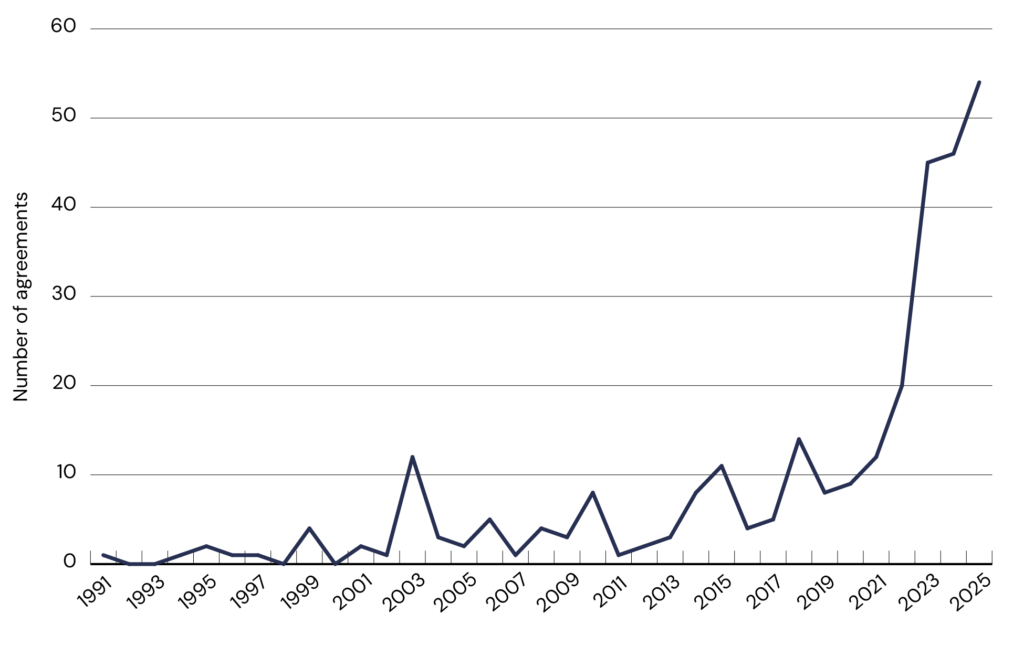
First, structural and political dynamics are forcing middle powers to reconsider the strategic status quo. Lots of factors have contributed to this recalculation, including the United States’ increasingly transactional approach to foreign policy, hyper-connected global networks, US–China power gridlock, global supply chain congestion induced by COVID–19, and the energy and food insecurity prompted by the Russia–Ukraine war. Crucially, the post–2021 jump predates the current Trump administration, so this is not only about one president or one crisis. It reflects something deeper.
Second, as the Egyptian minister of investment and foreign trade noted in January, “globalization is phasing out.”4In this world, strategies should not be about abandoning existing systems but about adapting to their limits. As the Singaporean president stated, for middle powers, adaptation requires everyone to “pitch in with the right burden sharing.”5The goal is not to outdo or even keep up with American and Chinese ambitions. It is “building competitiveness through collaboration” despite these economic and power inequalities.6
Third, the world is experiencing a loss of trust in and decreasing self-constraint by great powers. Relevant changes here include:
- Blatantly weaponizing trade dependencies for strategic goals, including but not limited to those involving critical minerals and high-tech supply chains (e.g., semiconductors);
- zero-sum thinking in technology development and use, for instance in the race to develop national full-stack artificial intelligence, or AI, technology and encourage exclusive use of the same by partners; and
- a simultaneous loss of US soft power and legitimacy worldwide alongside China’s increasing economic influence and willingness to use coercive measures.
Fourth, the multilateral system is increasingly ineffective. This is not a new problem, but it is quickly getting worse.7The United Nations expects to run out of cash in July.8The World Trade Organization’s, or WTO’s, Turning Point Ministerial in Cameroon in March made reform a priority but achieved little.9 The Treaty on the Non-Proliferation of Nuclear Weapons, or NPT, has been weakened as nuclear states refuse to disarm and established nuclear norms erode. Meanwhile, the last remaining arms control agreement limiting strategic nuclear weapons, the New START agreement between the US and Russia, expired in February.
Finally, “minilateralism” — that is, informal and issue-based collaborations among small groups of countries — is on the rise.10Outcomes from these multiplying minilateral partnerships indicate that minilateralism can help establish some stability and secure preferred outcomes for participating states despite the geopolitical tumult.11One recent example is the use of drone production partnerships between Ukraine, other European states, and Gulf states to address acute security threats.12
Combined, these developments suggest a decline in expectations for global governance and a proliferation of persistent and permanent challenges for national governments. The issue is no longer only whether the US or China will lead. It is how to keep functioning as great power competition, regional war, and alliance paralysis disrupt structures and systems that most of the world relies on. Minilateral cooperation could help, but it requires sophisticated diplomatic coordination and may strain states’ resources. It also does little to protect less powerful states from exploitation by more powerful partners.
Such challenges are particularly severe for middle powers, which have long considered a stable multilateral order and constraining great power ambitions via global rules to be central foreign policy aims.13Middle powers must search for ways to navigate in a less rule-oriented context. But they must do so in a strategic space constrained by both great power competition, especially in the field of technology, and by their own limited resources.
Workarounding can help fill this gap. Workarounds create additional layers of cooperation to shield middle powers from the next geopolitical shock or technological disruption without relying on great power protection or multilateral rules. They also raise barriers against great power coercion by improving middle power capabilities outside US or Chinese oversight and by prioritizing relationships and projects that align with middle powers’ own most pressing problems. Workarounding consequently seems an invaluable tool to both achieve middle power preferences and to address evolving threats to middle powers’ strategic autonomy, digital sovereignty, and wealth.14
Transforming the global order in a networked age
Workarounding across the Middle East both prior to and as a result of the Iran war illustrates this logic clearly. The Gulf states and Israel are collaborating with India, Japan, South Korea, European countries, and Southeast Asian partners on energy, ports, logistics, AI, cybersecurity, food security, and digital infrastructure. These arrangements do not replace arrangements with Washington or Beijing. They sit alongside them, creating a more flexible regional architecture. That flexibility is increased, and middle powers’ reach extended, via cross-regional initiatives like the India–Middle East–Europe Economic Corridor, or IMEC.
Hence, part of workarounding’s potential for shaping the new global order appears related to the complex, networked nature that tech middle power workarounds demonstrate. Three network features seem important.
Issue networks: Workarounding extends far beyond simple tech collaborations. Of the 186 instances of tech middle power workarounding identified between 2020 and July 2025, 51 percent involved cross-sectoral cooperation, from digital trade and innovation to cybersecurity, energy, or health, and 42 percent involved cooperation in three or more sectors.15This highlights the expansiveness and complexity of technology’s role in contemporary geopolitics. It also shows how workarounding builds on existing middle power skills, here, using linkages to push progress, as middle powers have long done in international organizations and in instances of minilateral cooperations that do include the US and China.16
Partner networks: This networked nature of workarounding is also evident in who is workarounding with whom. Figure 2 plots tech middle power cooperation since 1991, with colors indicating groups of states that collaborate frequently.17Tech middle powers primarily workaround among themselves (opaque circles), albeit not exclusively. This reinforces relationships among tech middle powers while also extending the benefits of middle powers’ technological progress to a broader community of states (faded circles). Doing so can additionally boost the tech capabilities of partner states. In other words, workarounding not only holds the potential to facilitate a broader and more diverse set of technologically capable states. It also provides frameworks within which these states can identify and pursue tech and tech governance goals, collectively and alone.
Figure 2. Network of tech middle power workarounding, 1991–July 2025
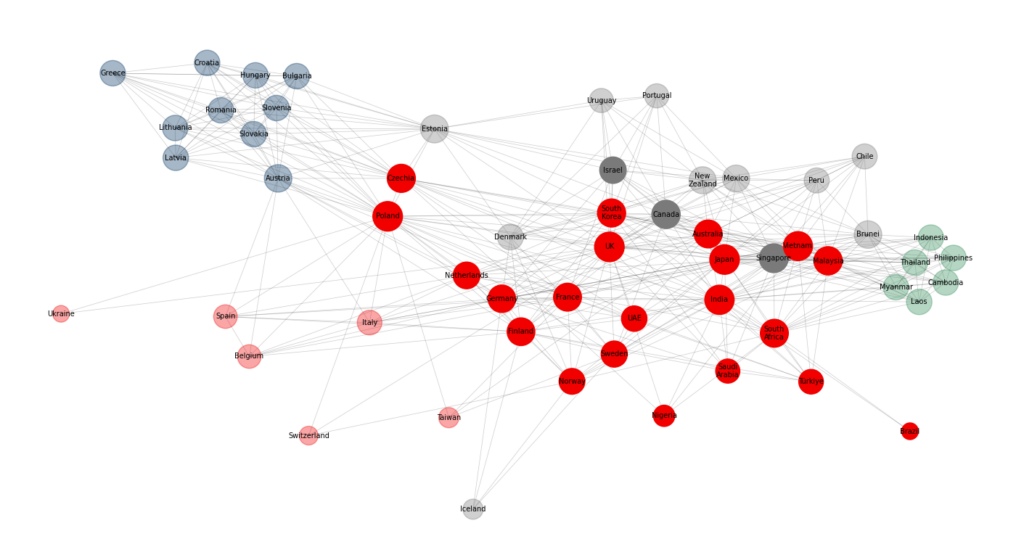
Partner networks also demonstrate that workarounding is neither geographically motivated nor does it primarily take the form of regional cooperation. While tech middle powers do workaround with regional groups and partners (illustrated by the blue and green circles in Figure 2), workarounding is primarily a transregional phenomenon. This expands the breadth of workarounding’s geographical imprint on global affairs, particularly if individual collaborations lead to even more workarounding, as some expect.18
Strategic networks: Workarounding is just one of many strategies tech middle powers use to pursue their national goals, and it often occurs simultaneously with middle power-great power cooperations. This is evident today in the field of semiconductors and critical minerals. Several tech middle powers — most recently, Norway, Finland, and India — signed up for the US’s Pax Silica initiative earlier this year, which aims to diversify semiconductor supply chains. A few weeks after joining, India also eased restrictions on acquiring Chinese tech and enabled Chinese investment in previously restricted sectors, such as electronics and solar cells.19At the same time, India has been engaging in critical minerals workarounding, reaching bilateral agreements with four other tech middle powers (Germany, Brazil, South Korea, and Canada) in 2026 already, with more deals allegedly on the way.20
Workarounding’s strategic networking is also evident in attempts to balance cooperation and competition among tech middle powers themselves — a type of relationship characterized as “coopetition.”21For example, Japanese and South Korean firms are accelerating their entry into India’s semiconductor ecosystem, focusing on back-end manufacturing in order to diversify supply chains away from China.22To avoid potential competition, an India–Japan–South Korea trilateral partnership is being explored.23Similarly, India pivoted toward a $8 billion deal with Germany for six advanced conventional submarines while moving away from purchasing additional French–designed Scorpène boats. The German deal, for the first time, includes substantial technology transfer, which is a key part of India’s negotiations to advance its indigenous manufacturing sector.24South Korea is also part of India’s naval modernization plan, building shipyards and jointly producing high-tech vessels.25These examples demonstrate how workarounding is integrated with other strategic approaches to achieve goals despite competitive pressures.
The overlapping connection points of strategies, partners and issues boost workarounding’s power as a driver of global transformation too. Issue networks, evident in the dominance of multi-sectoral workarounding, amplify tech middle powers’ opportunities to pursue their own interests and may create benefits that encourage more cooperation. Partner networks geographically extend tech middle powers’ global engagement in tech and tech governance, generating material and influence gains. And strategic networks enhance tech middle powers’ autonomy by boosting their technological capacities, demonstrating their ability to act, and creating buffers to the strategic vulnerabilities of cooperating with China or the US.
But will it have an effect?
The answer is yes. Workarounding is already changing how states build resilience, shape markets, and manage technological dependence and autonomy. The argument is not that middle powers can escape the power of the United States or China. They cannot. The argument is that they can make dependence less one-sided, fragile, and politically costly. It is not about achieving abstract notions of a more multipolar world. It is focused on increasing practical capacity: who can keep energy moving, ports functioning, data secure, supply chains open, air defense systems efficient, and societies operating under pressure.
As such, workarounding can have long-term implications for international cooperation, technological progress, and the global economy. The impact is cumulative. One agreement will not change the international order. But dozens or hundreds of agreements across energy, technology, ports, data, defense, finance, and industrial policy begin to create a different reality. They give middle powers more options and more bargaining power.
Just as critically: Different workarounds shape different things. Some build capacity via technology transfer, coproduction, or joint industrial projects. Others create redundancy by opening alternative routes, suppliers, payment channels, or data systems. Some shape rules and standards, especially in digital trade, AI, cyber, and digital public infrastructure, or DPI. Others are political, creating small coalitions that allow middle powers to act without waiting for Washington, Beijing, or global governance. The effect does not occur because one of these types has a particularly strong impact; it occurs because these layers overlap and reinforce each other.
Some of these changes have already materialized:
- Creating new trade structures and rules: Headliners here include the recent trade deals among the European Union and emerging markets like India and the states of the Southern Common Market, or Mercosur. But workarounding’s influence is evident in international organizations as well. One example is the Interim Agreement on E-Commerce, signed at the March 2026 WTO ministerial in Yaoundé, which was led by Australia, Japan, and Singapore. The agreement not only gained signatures from 17 of the 24 tech middle powers that we tracked in our 2025 workarounding dataset but it also secured China’s signature while retaining the US as a non-signatory participant in the negotiations.26
- Reshaping supply chains via tech and industrial partnerships: Commentary published by the European Council on Foreign Relations this January argued that tech middle power cooperation could prove to be a “foundational part of a new era of global economic cooperation,” providing alternatives to increasingly coercive relationships with China and the US.27Tech middle powers already control central nodes in tech supply chains, with implications for energy, defense, and tech policy. Workarounding enables them to explore the offensive and defensive capabilities of these positions. This can happen even in US–led initiatives like Pax Silica, which facilitate additional dialogue among tech middle powers and offer opportunities to discuss collaboration — regardless of whether doing so aligns with US interests. For example, while the Gulf countries’ nearly $2.5 trillion investment pledge during President Donald Trump’s visit to the region in 2025 grabbed attention, other ventures are developing in parallel. The UAE–France tech cooperation deal signed the same year includes provisions to build large-scale AI data centers in France, invest in the bilateral AI ecosystem, develop semiconductor manufacturing, and nurture AI talent.28It may also result in the creation of Europe’s largest AI infrastructure, if bilateral plans to build 1 gigawatt AI data center campuses in France materialize.29All of this could contribute to more diversified AI supply chains and infrastructure — without involving the US.
- Shifting industrial capacities and innovation dynamics: Workarounding is also shifting who supplies whom and how those relationships can create and reinforce innovation. For instance, in an evolving role reversal, India is now supplying rail equipment like propulsion systems, bogies, and locomotives, not just to South Asian and African countries but even Saudi Arabia, the United Kingdom, France, Germany, Spain, Mexico, and Australia, among others.30Cooperation between Türkiye and Saudi Arabia is another telling example. In 2023, Saudi Arabia signed a $3 billion agreement to purchase high-altitude drones from Baykar, dubbed the biggest defense contract in Türkiye’s history. In line with the capacity-building dynamics of workarounding, the joint statement underlined how “cooperation on technology transfer and joint production [would] advance the high technology development capability of the two countries.”31An additional $6 billion defense agreement could involve sales of tanks, missiles, and warships and see Saudi Arabia involved in Türkiye’s fighter jet development program, with over 70 percent of Türkiye’s Akıncı drones expected to be manufactured in Saudi Arabia by the end of this year.32
- Developing alternatives to US defense technology: Tech middle power-led shifts in manufacturing of defense equipment are likely to gather momentum amid the Iran war, where many Gulf countries are using expensive American missile defense equipment to defend themselves. The unsustainability of doing so in the long term was highlighted by Ukrainian President Volodymyr Zelenskyy, who recently toured the Gulf region, offering Ukraine’s low-cost alternatives and signing preliminary deals.33The UAE also became the first customer for South Korea’s Cheongung–IImedium-range air defense system and has already used it to counter Iranian missiles and drones.34Swedish–Canadian cooperation is another example of a military workaround excluding US defense technology.35While Canada is considering the Swedish company Saab’s Gripen fighter jet as an alternative to the American F–35, NATO has selected Saab and Bombardier Sweden to replace the older fleet of Boeing–built warning and control aircraft. Such developments offer cost and autonomy benefits to tech middle powers but also possess potential to erode US alliances in the long term, as middle powers’ defense dependence decreases.
- Modernizing core state functions: Tech middle powers like India are leading the way in developing DPI through workarounding with other middle powers, such as France’s 2024 adoption of India’s Universal Payments Interface, and with other smaller countries, such as the 23 DPI memorandums of understanding that India has signed as of Feb. 2026.36These activities are accompanied by new, tech middle power-created public goods like the Global Digital Public Infrastructure Repository, which aims to provide information and promote cooperation.37In contrast, despite the Trump administration’s prioritization of economic and government efficiency and despite substantial economic and political costs related to not having a functioning DPI, DPI discussions are all but absent in Washington.38This opportunity to shape how DPIs develop around the world is being seized via tech middle power workarounding and national DPI initiatives but missed entirely by the US.
- Diversifying payment infrastructures: Joint decisions, such as the 2023 agreement between the UAE and Indian central banks to allow businesspeople to invoice and pay in their respective domestic currencies, are another example of how workarounding can upend US interests and systemic advantages.39Alternative local currency systems enable tech middle powers to bypass the US–managed and dollar-rooted Society for Worldwide International Financial Telecommunication, or SWIFT, at least bilaterally. While this seems like a move toward de-dollarization at one level, it may just as well be motivated by ease-of-doing-business gains and cheaper intermediary costs for resource-limited tech middle powers. Either way, it weakens tech middle powers’ dependence on the US system and could encourage other countries to do the same in the future.
Policy implications
The workarounds profiled in this brief are shaping economic markets, transactions, and regulations as well as how citizens and governments interact. While some of these activities may be small in scope, their cumulative impact is significant.
And this is just a very limited preview of the workarounding to come. The current US administration’s policies will facilitate more workarounding and related outcomes. Path dependencies will reinforce this dynamic, ensuring that workarounding remains strong even after President Trump leaves office. As such, workarounding will have significant implications for the US and for tech middle powers going forward.
For the US, tech cooperation among middle powers could shrink US control by reducing reliance on American technology stacks. Supply chain risks associated with US export controls are encouraging new “tech triangles,” like the one among India, Canada, and Australia. These enable tech middle powers to develop capabilities in AI, critical minerals, and quantum technology that can help them minimize the centrality of US–dominated ecosystems in current and future projects.40Ultimately, this could challenge US attempts to maintain a single, secure technological alliance, as middle powers’ collaboration enhances their autonomy to prioritize policies that support their own economic resilience and strategic agency.
Washington may be tempted to see this as a problem. Some workarounds will reduce US leverage. Some will include countries that work closely with China. But trying to block them in the current atmosphere would only push partners to diversify faster. It would make American leadership look more like pressure than partnership. A smarter US approach would be to work with these coalitions where and when they strengthen resilience, trusted supply chains, energy security, digital standards, and regional stability.
Another implication of workarounding stands out for the US: Workarounding’s proliferation demonstrates that US foreign policy’s exclusive focus on China is a mistake. China remains central, but middle powers are not simply waiting to choose between Washington and Beijing. Rather, they are pressing ahead and achieving their goals despite floundering multilateralism. Simultaneously, most continue to value (or need) Chinese collaboration in some areas. This is evident in the high-profile bilateral arrangements between Canada and China, which are now one of many factors complicating the ongoing review of the US–Mexico–Canada Agreement, or USMCA.41Middle powers’ choices, like China’s, are likely to have strong impacts on how the transitioning global order looks in the medium term.
To affect how that order develops, the US must engage with middle powers on the basis of interest rather than framing non–US collaborations as a threat or a rejection of US partnership. The US should also consider a more flexible approach to technology transfer. If Washington makes access too difficult, capable partners will simply look (and buy) elsewhere.
Ideally, the US would encourage multi-alignment and minilateral approaches that allow middle powers to gain from US technology while simultaneously building alternative markets. This means leveraging regional technology leaders to diversify supply chains and codevelop advanced tech and military systems.
Numerous examples of workarounding show how this model can lead to mutually beneficial outcomes. One project that the US could observe is the Global Combat Air Programme, a trilateral defense initiative that the United Kingdom, Japan, and Italy launched in 2022 in order to develop a sixth-generation stealth fighter jet within 13 years.42The project faces challenges of interoperability with US technology, opening a comparatively low-cost avenue for the US to participate and help its allies increase their own national defense capabilities in line with the Trump administration’s strategic preferences.
Put differently, securing technological leadership in an increasingly competitive milieu will require the US to adopt nuanced, transactional, and collaborative policies rather than just attempting to impose its tech supremacy via cooptation or coercion. It requires shifting from a “hub-and-spoke” alliance model to a networked, coproduction-focused strategy in which tech middle power workarounding can create benefits for the US as well as middle powers.
For middle powers, workarounding is not just another option anymore but an existential necessity in order to tap newer and cheaper alternatives, avoid reliance on unpredictable superpowers like the US under President Trump, and steer clear of superpower rivalries. While the jury is still out on whether geopolitical relations are now multipolar, multicentric, or bipolar, workarounding serves as a buffer against rising insecurity and uncertainty in the economic and tech spheres. This “transitional world order” will continue to require intense diplomacy between and among middle powers in the future.43Workarounding is not going away.
To be sure, workarounding has its limitations. It will not replace alliances, multilateral institutions, or great power diplomacy in the short term, but it is increasingly becoming the connective tissue between them. In a world marked by uncertainty, alliance strain, infrastructure vulnerability, and technological competition, middle powers are building the next layer of global politics through dense and flexible networks of practical, strategic cooperation. States that understand this networked shift will gain influence. States that ignore it will keep looking for leadership in the old places, while new coalitions quietly workaround their way toward the future landscape.
Appendix: The tech middle power cooperation and workarounding dataset
This dataset contains cooperation initiatives among 24 tech middle powers and an additional 32 partner countries between 1990 and July 2025. Data entries include collaborations spanning eight world regions but exclude any cooperation with the United States, China, or both, in line with the above definition of workarounding. The dataset is a valuable resource for scholars and students hoping to better understand how international technological cooperation is evolving in relation to economic, development, innovation, infrastructure, and (cyber)security issues outside the world’s technopoles.
Data was collected between May and July 2025 via targeted internet searches. Only cooperation initiatives involving at least two tech middle powers were included in the dataset. Agreements involving only one tech middle power, exclusively non-tech middle power countries, the United States, or China were excluded. Agreements between a single tech middle power and the European Union were also excluded.
The data spans the following variables: agreement name, number and names of participating countries, bi-/tri-/minilateral classification, type of agreement, degree of formality, geographic scope and regions involved, year(s) of founding/entry/expansion or modification, sectors covered, technologies covered, sub-agreements, details of cooperation, official sources, and media sources.More detailed information and the dataset itself are available in Maximilian Mayer et al., “Tech Middle Power Cooperation and Workarounding (Version 3.0),” Harvard Dataverse, 2025, https://doi.org/10.7910/DVN/CDUVJN. Current work focuses on updating and expanding the dataset and employing it to gain a better understanding of how workarounding works, which motivations are most relevant for engaging in workarounding, and how workarounds affect geopolitical developments, such as technology development or alliances structures.
Related
Ukraine Peace Talks and the Pitfalls of Maximalism in a Multipolar World
How to bring the Ukraine War to a close in a multipolar world.

Europe and the Crisis in Transatlantic Relations
European experts discuss Greenland, Venezuela, and what the future of U.S.-European relations looks like.
A Post-US Regional Order? The Shifting Security Architecture in MENA Amid the Iran War
Join us a for discussion of the future of the Middle East’s security architecture.
Program
Topics
Authors

Laura Mahrenbach is a non-resident fellow at the Quincy Institute and an adjunct professor at the Technical University of Munich. Her current research explores how global power shifts and technology interact, with a special focus on AI and big data…

Dr. Gedaliah Afterman is head of the Asia Policy program at the Abba Eban Institute for Diplomacy & International Relations, Reichman University. His work focuses on Asian regional security, Chinese foreign policy, superpower competition, and the growing role of middle…

Dr. Maximilian Mayer is junior-professor of international relations and global politics of Technology at the University of Bonn. He was assistant professor at the University of Nottingham in Ningbo, China (2019–2020).

Dr Narayanappa Janardhan is the director of research and a professor at the Anwar Gargash Diplomatic Academy, United Arab Emirates. He offers post-graduate diploma, masters, and executive training courses on Gulf and Asian foreign policies.
Citations
“Davos 2026: Special Address by Mark Carney, Prime Minister of Canada,” World Economic Forum, Jan. 20, 2026, https://www.weforum.org/stories/2026/01/davos-2026-special-address-by-mark-carney-prime-minister-of-canada. ↩
Data from Maximilian Mayer et al., “Tech Middle Power Cooperation and Workarounding (Version 3.0),” Harvard Dataverse, 2025, https://doi.org/10.7910/DVN/CDUVJN. ↩
Maximilian Mayer et al., “Tech Middle Power Cooperation and Workarounding (Version 3.0),” Harvard Dataverse, 2025, https://doi.org/10.7910/DVN/CDUVJN. While this dataset features prominently in this brief, we will also refer to workarounds announced since its July 2025 compilation which are not included in the tech middle power dataset to ensure up-to-date coverage of the phenomenon. ↩
Quoted in Pooja Chhabria, “Davos 2026: How Middle Powers Are Reading the Global Moment,” World Economic Forum, Jan. 22, 2026, https://www.weforum.org/stories/2026/01/davos-2026-how-middle-powers-are-reading-the-global-moment. ↩
Quoted in Chhabria, “Davos 2026.” ↩
Paraphrasing the Egyptian minister in Chhabria, “Davos 2026.” ↩
Risto Penttilä, Multilateralism Light: The Rise of Informal International Governance (London: Centre for European Reform, 2009), https://www.cer.eu/publications/archive/essay/2009/multilateralism-light-rise-informal-international-governance. ↩
“Amid Record UN Cash-Flow Challenges, Budget Committee Begins Resumed Session with Calls to Modernize Financial Regulations, Human Resource Policies for Greater Efficiency,” UN General Assembly, GA/AB/4508, Feb. 24, 2026, https://press.un.org/en/2026/gaab4508.doc.htm. ↩
“Director-General Updates Members on Final Preparations for ‘Turning Point’ Ministerial,” World Trade Organization, March 12, 2026, https://www.wto.org/english/news_e/news26_e/gc_10mar26_322_e.htm. ↩
Husain Haqqani and Narayanappa Janardhan, “The Minilateral Era,” Foreign Policy, Jan. 10, 2023, https://foreignpolicy.com/2023/01/10/minilateral-diplomacy-middle-power-india-israel-uae. ↩
Maximilian Mayer and Gedaliah Afterman, “Do More Clubbing: How Forming Partnerships Can Help Tech Middle Powers Survive the Escalating US–China Tech War,” in Governing Artificial Intelligence, ed. Laura Mahrenbach (Durham: Global Policy Journal, 2023), https://www.globalpolicyjournal.com/sites/default/files/pdf/Mahrenbach%20-%20Governing%20Artificial%20Intelligence.pdf. ↩
Maksym Beznosiuk and William Dixon, “Drone Diplomacy: Ukraine Strengthens Security Role in Europe and the Gulf,” Atlantic Council, April 16, 2026, https://www.atlanticcouncil.org/blogs/ukrainealert/drone-diplomacy-ukraine-is-now-key-security-partner-in-europe-and-the-gulf. ↩
Adam Chapnick, “The Middle Power,” Canadian Foreign Policy Journal 7, no. 2 (1999): 73–82, https://doi.org/10.1080/11926422.1999.9673212; Andrew F. Cooper, “Testing Middle Power’s Collective Action in a World of Diffuse Power,” International Journal 71, no. 4 (Dec. 2016): 529–44, https://doi.org/10.1177/0020702016686384. ↩
Laura Mahrenbach, “The Strategic Effectiveness of Workarounding for Tech Middle Powers,” in Workarounding: Tech Middle Power Cooperation in a Turbulent World, ed. Maximilian Mayer et al. (Singapore: Palgrave Macmillan, forthcoming), https://link.springer.com/book/9789819576289. ↩
Mayer et al., “Tech Middle Power Cooperation.” ↩
Christian Downie, “One in 20: The G20, Middle Powers, and Global Governance Reform,” Third World Quarterly 38, no. 7 (2017): 1493–510, https://doi.org/10.1080/01436597.2016.1229564. ↩
Data from Maximilian Mayer et al., “Tech Middle Power Cooperation and Workarounding (Version 3.0),” Harvard Dataverse, 2025, https://doi.org/10.7910/DVN/CDUVJN. Please note: Colors indicate states that frequently collaborate with one another. Opaque circles are tech middle powers tracked in the dataset. Faded circles are non-tech middle power collaboration partners. ↩
Aarshi Tirkey, “Minilateralism: Weighing the Prospects for Cooperation and Governance,” Observer Research Foundation, Sept. 2021, https://www.orfonline.org/research/minilateralism-weighing-prospects-cooperation-governance. ↩
Sarita Chaganti Singh and Nikunj Ohri, “India Relaxes Rules for Some State-Run Firms to Procure Critical Equipment from China,” Reuters, March 27, 2026, https://www.reuters.com/world/china/india-relaxes-rules-some-state-run-firms-procure-critical-equipment-china-2026-03-27; Nikunj Ohri, Aditi Shah, and Krishna N. Das, “India Approves Limited Easing of Chinese Investment Curbs after Years of Friction,” Reuters, March 10, 2026, https://www.reuters.com/world/china/india-eases-investment-norms-china-economic-times-reports-2026-03-10. ↩
Neha Arora, “India in Talks over Critical Minerals Deals with Brazil, Canada, France, Netherlands, Sources Say,” Reuters, Feb. 10, 2026, https://www.reuters.com/world/india/india-talks-over-critical-minerals-deals-with-brazil-canada-france-netherlands-2026-02-10. ↩
Rita Strohmaier and Andreia da Silva Rosa, “Can ‘Flagship Cooperation’ Between Tech Middle Powers Drive Green Lead Markets? Exploring a Triangular Partnership Among Regional Anchor Countries of the EU and the Mercosur,” in Workarounding, ed. Mayer et al. ↩
Jingyue Hsiao, “India Roundup: Japan, South Korea Deepen Push as Semiconductor and Tech Investments Expand,” DIGITIMES Asia, March 9, 2026, https://www.digitimes.com/news/a20260307VL200. ↩
Prateek Tripathi, “Semiconductors as the Spark for an India–Japan–South Korea Trilateral,” Observer Research Foundation, Oct. 16, 2026, https://www.orfonline.org/expert-speak/semiconductors-as-the-spark-for-an-india-japan-south-korea-trilateral. ↩
Pradip R. Sagar, “French Speed or German Precision? A Deep Dive into India’s Submarine Dilemma,” India Today, Oct. 14, 2025, https://www.indiatoday.in/india-today-insight/story/2803006-2025-10-14; Michael Nienaber, “Germany and India on Track to Seal Submarine Deal, Minister Says,” Bloomberg, April 22, 2026, https://www.bloomberg.com/news/articles/2026-04-22/germany-and-india-on-track-to-seal-submarine-deal-minister-says. ↩
Anmol Singla, “How Ships and Seas Are Redefining India–South Korea Ties,” Firstpost, April 21, 2026, https://www.firstpost.com/explainers/india-south-korea-shipbuilding-maritime-ties-president-lee-visit-14002699.html. ↩
“Members Adopt a Pathway to Bring E‑Commerce Agreement into Force via Interim Arrangements,” World Trade Organization, press release, March 28, 2026, https://www.wto.org/english/news_e/news26_e/mc14_28mar26_341_e.htm; Peter Ungphakorn, “In the WTO or Outside? Group Invents ‘Pathway’ for Their E-Commerce Pact,” Trade ß Blog, March 31, 2026, https://tradebetablog.wordpress.com/2026/03/31/in-the-wto-or-outside-group-invents-pathway-for-their-e-commerce-pact. ↩
Andrew Small and Janka Oertel, “Band of Brothers: Why Like-Minded Powers Need to Hold the Line on China,” European Council on Foreign Relations, Jan. 29, 2026, https://ecfr.eu/article/band-of-brothers-why-like-minded-powers-need-to-hold-the-line-on-china. ↩
“UAE, French Presidents Discuss Bilateral Ties in Paris, Witness Signing of UAE–France Framework for Cooperation in Artificial Intelligence,” Emirates News Agency, Feb. 7, 2025, https://www.wam.ae/article/15ep5zv. ↩
“UAE, France to Build 1–Gigawatt AI Data Centre: What We Know about This Mega Tech Project,” Khaleej Times, Feb. 9, 2025, https://www.khaleejtimes.com/business/tech/uae-france-to-build-1-gigawatt-ai-data-centre-what-we-know-about-this-mega-tech-project. ↩
“Varanasi Becoming Railway Locomotive Export Hub,” Republic of India, Ministry of Railways, press release, Dec. 16, 2025, https://www.pib.gov.in/PressReleasePage.aspx?PRID=2204768. ↩
“Saudi Drone Deal Entails Technology Transfer, Joint Production — Baykar,” Reuters, July 18, 2023, https://www.reuters.com/business/aerospace-defense/saudi-drone-deal-entails-technology-transfer-joint-production-baykar-2023-07-18. ↩
“Türkiye Reportedly Eyes $6B Defense Deal with Saudi Arabia,” Türkiye Today, Jan. 28, 2025, https://www.turkiyetoday.com/turkiye/turkiye-reportedly-eyes-6b-defense-deal-with-saudi-arabia-112059. ↩
“Ukraine’s Zelenskyy Signs Air Defence Deals with UAE, Qatar on Gulf Tour,” Al Jazeera, March 28, 2026, https://aje.news/gi3wry. ↩
Lami Kim, “Mind the Air-Defence Gap: South Korea’s Burgeoning Role in Air and Missile Defence,” International Institute for Strategic Studies, March 27, 2026, https://www.iiss.org/online-analysis/military-balance/2026/03/mind-the-air-defence-gap-south-koreas-burgeoning-role-in-air-and-missile-defence. ↩
David Pugliese, “NATO Looking at Canadian Aircraft for Its New Airborne Warning Fleet,” Ottawa Citizen, April 29, 2026, https://ottawacitizen.com/public-service/defence-watch/nato-canadian-aircraft-warning-fleet; Tim Martin, “Saab Shares ‘Detailed Information’ on Gripen with Canada as Part of ‘Dual Fleet’ Pitch,” Breaking Defense, Feb. 5, 2026, https://breakingdefense.com/2026/02/saab-shares-detailed-information-on-gripen-with-canada-as-part-of-dual-fleet-pitch. ↩
“India Has Signed MoU/Agreements with 23 Countries for Cooperation on Digital Public Infrastructure (DPI),” Republic of India, Ministry of Electronics and IT, press release, Feb. 6, 2026, https://www.pib.gov.in/PressReleasePage.aspx?PRID=2224505. ↩
“Global DPI Repository,” Republic of India, Ministry of Electronics and IT, accessed May 21, 2026, https://www.dpi.global. ↩
Mitul Jhaveri, “A Digital Public Infrastructure Act Should Be America’s Next Public Works Project,” Federation of American Scientists, Dec. 8, 2025, https://fas.org/publication/digital-public-infrastructure-act; “Showcasing Global Progress Towards Building Safe and Inclusive DPI for Societies,” UN Office for Digital and Emerging Technologies, accessed April 12, 2026, https://www.dpi-safeguards.org/countriesshowcase. ↩
“Going Beyond $: India, UAE Sign Rupee–Dirham Trade Pact,” Times of India, July 16, 2023, https://timesofindia.indiatimes.com/india/going-beyond-india-uae-sign-dirham-trade-pact/articleshow/101789527.cms. ↩
Krishna Vohra, “Australia–Canada–India: The Tech Trilateral Reshaping Green Supply Chains,” Observer Research Foundation, Jan. 6, 2026, https://www.orfonline.org/expert-speak/australia-canada-india-the-tech-trilateral-reshaping-green-supply-chains. ↩
Eleanor Mueller, J. D. Capelouto, and Ben Smith, “US Commerce Secretary Lashes Out at Canada Ahead of Trade Talks: ‘They Suck . . . Is This Nuts?’” Semafor, April 17, 2026, https://www.semafor.com/article/04/17/2026/us-commerce-secretary-lutnick-lashes-out-at-canada-ahead-of-trade-talks-they-suck-is-this-nuts. ↩
Oue Sadamasa, “What the Trilateral Fighter Jet Program Means for Japan,” Institute of Geoeconomics, Aug. 7, 2023, https://instituteofgeoeconomics.org/en/research/2023083150425. ↩
Simon Koschut and Janne Mende, “Transitional Orders in World Politics,” Global Studies Quarterly 6, no. 1 (Jan. 2026), https://doi.org/10.1093/isagsq/ksaf123. ↩