
A Blueprint for US Policy Toward the In-Between States
This brief is a part of the Quincy Institute’s ongoing project focused on redesigning US policy toward the in-between states.
Executive Summary
Since the end of the Cold War, America’s poorly calibrated approach to former Soviet states like Ukraine has had disastrous consequences, in part precipitating the West’s geopolitical crisis with Russia. While Washington may hope to shift its focus toward competition with Beijing, this pivot is bound to fail so long as America maintains the same misguided approach to other states on Russia’s periphery like Armenia, Azerbaijan, Belarus, Georgia, and Moldova.
Past calls for integrating Ukraine and Georgia into NATO, for example, created dangerous geopolitical gray zones that contributed to Russian aggression while failing to secure Western military commitments to defend these so-called “in-between states.” The best way to advance America’s interests in Europe — avoiding war, promoting stability, and supporting economic development — is to take a different approach to these states, based on four strategic principles:
1.) Rejecting further NATO expansion or other US military guarantees to states along Russia’s border.
2.) Promoting economic connectivity projects across the in-between states.
3.) Encouraging the in-between states to maintain and pursue foreign and trade policy flexibility that permits positive relations with both Western and non–Western partners.
4.) Pairing US regional engagement with targeted confidence-building measures with Russia to prevent dangerous security spirals.
Securing a negotiated compromise settlement in Ukraine that guarantees Kyiv a viable economic path into the European Union while establishing formal Ukrainian military neutrality would greatly aid the United States in successfully developing and executing a new blueprint for its approach in Eurasia. Such a deal would offer Washington an opportunity to transform the in-between states into valuable economic partners that directly bolster long-term American industrial competitiveness.
The Trump Route for International Peace and Prosperity, or TRIPP, between Armenia and Azerbaijan, is a positive example that could be expanded on. Continued US support for strategic geoeconomic projects, like TRIPP or the development of Black Sea port infrastructure in Georgia, would not only help the region but also secure Western access to critical minerals and offer alternatives to supply chain choke points. In addition, targeted US diplomatic actions in the region — such as supporting Moldova’s EU integration while helping resolve the Transnistria dispute, advancing dialogue with Belarusian President Alexander Lukashenko, and reestablishing a strategic partnership with Georgia — can play a key role in refocusing US engagement on America’s core interests in the region.
By discarding Washington’s open-door policy toward NATO enlargement and embracing prudent, interest-driven economic diplomacy, the United States can safeguard European stability, secure vital resource supply chains, and free up critical national security resources that are necessary for managing greater challenges.
Introduction
Russia’s Feb. 2022 invasion of Ukraine definitively marked the end of the unipolar post–Cold War era. The United States now confronts a rapidly shifting international system, marked most clearly by an increasingly competitive relationship with China. As a part of effectively managing this transition and best positioning itself for the years ahead, Washington requires a policy reassessment toward former Soviet countries, caught effectively “in between” the North Atlantic Treaty Organization, or NATO, and Russia. This policy reassessment, alongside preventing escalation of the Ukraine war and rebalancing NATO and the transatlantic alliance more broadly, will be the key task before American policymakers focusing on Eurasia.1
Thus far in the Trump administration’s second term, with regard to the in-between states, the United States has pursued a pragmatic approach that seeks to alleviate Eurasian regional tensions while pursuing America’s broader interests. Although some elements of this approach had begun during the Biden administration, the current administration has driven these processes further ahead.2
Early on, for example, the second Trump administration prudently accepted that the NATO alliance should close its door to future enlargement into former Soviet states, mostly notably Ukraine.3At the same time, the administration recognized that it maintains limited, but important, interests across Eurasia and an ability to help advance stability and prosperity there. Acknowledging that the United States can pursue its economic and political interests across the in-between states without expanding its security commitments and military footprint has proven both shrewd and fruitful.
Over the past year and a half, the United States has made important progress through its engagements in Eurasia: Restarting dialogue with Belarus led to the release of hundreds of political prisoners and is slowly reawakening Minsk’s multi-vector foreign policy approach, while supporting the Armenia–Azerbaijan peace process through economic connectivity projects is helping lay the groundwork for diversified US supply chains.4
As a result of the significant upheavals ongoing across Eurasia and beyond, a unique moment exists for the United States to solidify consensus behind a new, more prudent policy toward the in-between states that can drive Washington’s engagement for years to come. The key to its success will rest on sensibly and consistently managing relations with Russia while promoting Eurasian regional stability and prosperity.
Therefore, one of the most critical factors in ensuring that US policy can succeed and the Eurasia region can thrive will be avoiding escalation of the Ukraine war that risks drawing the West into more direct conflict with Russia. Achieving a negotiated settlement to the war is the most comprehensive method available to preclude the dangers of horizontal and vertical escalation, though the window for such an agreement is narrowing. Absent a negotiated resolution, advancing a new US policy toward the in-between states will be more complicated but just as important. The strategic principles and recommendations in this brief can serve as important guides for avoiding future Ukraine–like scenarios.
The Ukraine war’s reverberation
The Ukraine war is the clearest indicator to date of Russia’s failure to prevent former Soviet republics from deepening strategic ties with the United States and European Union, thus limiting Moscow’s influence in its so-called “near abroad.” Nevertheless, the war has also shown Russia’s willingness to engage in and endure a years-long conflict leading to hundreds of thousands dead and a near-total economic and political break with the West.
While Ukraine has resisted Russian military domination through a combination of bravery, ingenuity, and crucial Western support, it has not been able to significantly reverse Russia’s military advances over four years of fighting. As long as the war continues and US–Russia relations remain on ice, the potential for additional conflicts across Eurasia will grow, as will the risks for US engagement in the region. Bringing the Ukraine war to a compromise end, therefore would help facilitate Washington’s successful pursuit of a more sensible policy toward the in-between states.
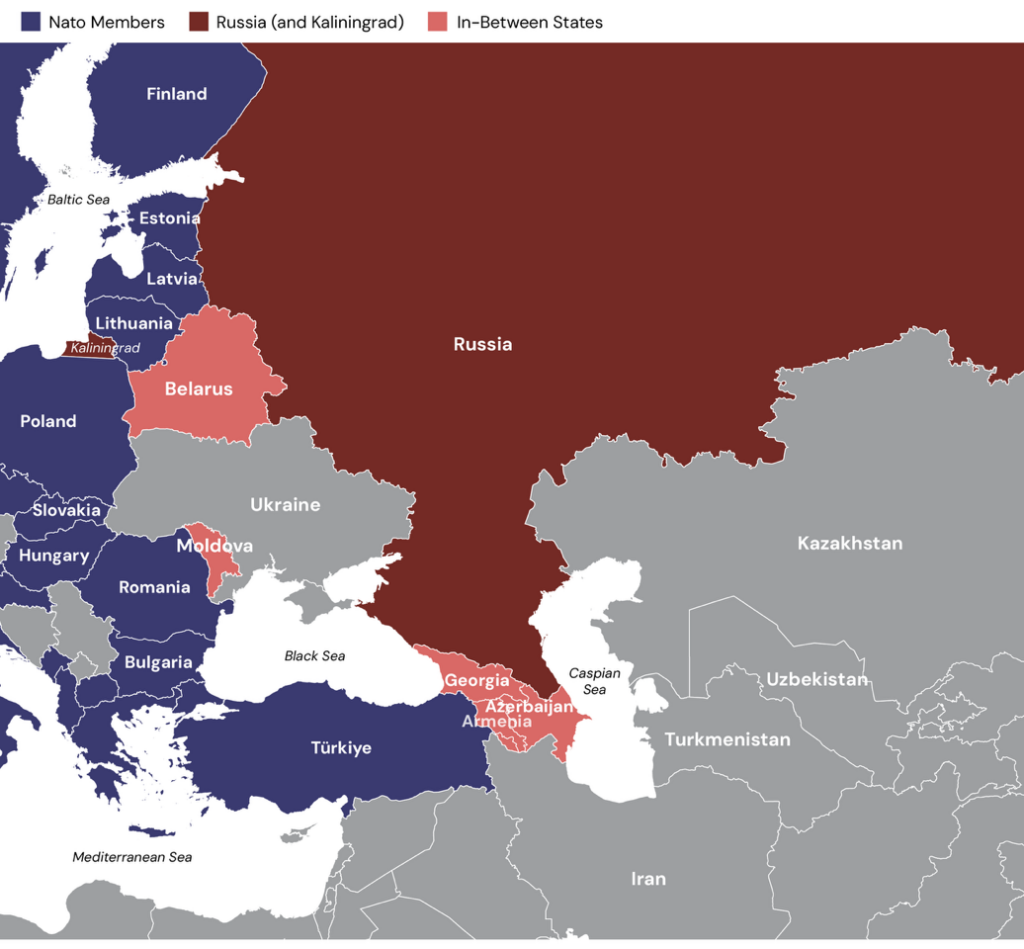
Indeed, beyond Ukraine, the war has had reverberating consequences across the other in-between states, as Armenia, Azerbaijan, Belarus, Georgia, and Moldova each have adapted their grand strategies to account for this new, more uncertain era. Notwithstanding each of these states’ unique history, geographic reality, governance structure, economic foundation, and national security priorities, the Ukraine war has affected their fundamental calculations:
- In Armenia, the ruling party utilized shifting realities to deepen ties with non–Russian partners (most notably the European Union and its member-states, the United States, and India) and vigorously pursue, through its “peace agenda,” the normalization of relations and opening of borders with Azerbaijan and Türkiye.5
- The war and its repercussions effectively facilitated Azerbaijan’s total reconquest of the Karabakh region, home of the Armenian–ruled (until 2023) breakaway statelet referred to as the Nagorno–Karabakh Republic.6The war has also renewed attention on Baku as an energy provider to Europe and a linchpin of East–West connectivity routes that avoid both Russian and Iranian territory.7
- Belarus’s role in providing passage and logistical support to Russia in the invasion of Ukraine heightened a US and European maximum pressure campaign against Minsk that closed the door on its capacity, which was already curtailed by the international fallout from the 2020 Belarusian presidential election, to pursue a multi-vector foreign policy, rendering it increasingly dependent on Moscow. That dynamic began to change, however, when the second Trump administration undertook a significant effort to reengage Belarus.8
- In Georgia, many feared that the Ukraine war would spread across the Caucasus mountains, where two breakaway statelets from Georgia, South Ossetia and Abkhazia, have hosted a few thousand Russian troops since Moscow’s 2008 recognition of their independence. Tbilisi thus adopted a strategy aimed at not poking the proverbial Russian bear and instead pursuing pragmatic relations focused on economic growth.9
- Russia’s laser-like focus on Ukraine and Kyiv’s largely successful defense have created greater space for maneuverability by Moldova, which is pursuing integration with the European Union as a means to accelerate economic growth and foreign investment while seeking to resolve its decades-old territorial dispute with the breakaway statelet of Transnistria.10
While there is no one-size-fits-all approach, it is possible to distill a set of strategic principles conducive to Washington’s effective engagement with the in-between states in this new era. Utilizing these strategic principles as guideposts in crafting policy toward Eurasia will be essential in ensuring American interests are met, stability and prosperity are secured, and new wars are avoided.
1) The United States has no direct, vital interests at stake that necessitate it to take on the costs and risks of becoming a security guarantor or provider of first resort to the in-between states.
2) The United States has an interest in promoting and supporting economic connectivity projects and political normalization efforts as drivers of Eurasian regional stability.
3) The United States should encourage an emphasis by the in-between states on multi-vector foreign and trade policies that seek productive relations with Western as well as non–Western countries.
4) US engagement in Eurasia must be accompanied by broader confidence-building measures with Russia, aimed at mitigating the risk of security spirals and misunderstandings writ large.
The successful incorporation of these principles into US policy toward the in-between states will go a long way in support of Washington’s broader objectives of decreasing America’s conventional military obligations in Europe and more effectively pursuing a policy of deterrence in the western Pacific.
Figure 1: The In-Between States
Past is prologue
Whatever one may think of Washington’s present approach, it is clear that a new American strategy from that of earlier efforts in the post–Cold War era is necessary, given that the latter failed to prevent the outbreak of regional wars and may have even contributed to them. A focal point of this new policy must be toward the in-between states themselves, which remain one of the greatest sources of tension with the potential for direct conflict between NATO and Russia.
When the Cold War ended, the United States and its allies pursued a dual-track approach toward the former Soviet Union and its former satellites. This policy coupled engagement with Moscow in the hopes of transforming it into a responsible stakeholder in an American–led global order with undertaking strategic moves to balance against any future intransigence by Russia’s leaders. While this policy succeeded in bringing former Soviet satellites in Central Europe and the three Baltic republics into the Western fold during a period of West–Russia cordiality and Russian disarray, the situation began to change by the mid–2000s. Ultimately, this approach failed, as Western hedging fed into deeply rooted Russian paranoia and insecurities, which contributed to the very outcomes Washington had hoped to avoid.
As then–Ambassador to Russia William Burns wrote to Washington in Feb. 2008:
Ukrainian entry into NATO is the brightest of all redlines for the Russian elite (not just [Russian President Valdimir] Putin). In my more than two and a half years of conversations with key Russian players, from knuckle-draggers in the dark recesses of the Kremlin to Putin’s sharpest liberal critics, I have yet to find anyone who views Ukraine in NATO as anything other than a direct challenge to Russian interests. At this stage, a MAP [i.e., membership action plan] offer would be seen not as a technical step along a long road toward membership, but as throwing down the strategic gauntlet. Today’s Russia will respond. Russian–Ukrainian relations will go into a deep freeze … It will create fertile soil for Russian meddling in Crimea and eastern Ukraine. … On Georgia, the combination of Kosovo independence and a MAP offer would likely lead to recognition of Abkhazia, however counterproductive that might be to Russia’s own long-term interests in the Caucasus. The prospects of subsequent Russian–Georgian armed conflict would be high.11
Only a few months later in 2008, this incongruity became apparent for all to see, and Burns’s analysis began to prove true. That April, NATO’s then–26 member states included language in the Bucharest Summit Declaration that the alliance “welcome[d] Ukraine’s and Georgia’s Euro–Atlantic aspirations” and “agreed today that these countries will become members of NATO.”12While failing to reach consensus on offering Ukraine and Georgia a MAP, the vague wording the United States and its allies ultimately agreed to positioned the two countries in a dangerous gray zone.
In Aug. 2008, Russian troops repulsed a Georgian attack on their peacekeeping forces in the breakaway statelet of South Ossetia and subsequently overran Georgian forces, reaching the outskirts of Tbilisi in a matter of days.13The implications should have been clear: Moscow was willing to resort to force to preclude what it saw as a degradation of its strategic position in one of the in-between states; the West was not.
While the lessons of the 2008 war were learned by a new coterie of Georgian elites, policymakers in Washington and across European capitals strengthened their counterproductive approach toward Moscow and the in-between states.14Now, however, the disastrous consequences of the Ukraine war have laid bare the fundamental misalignment between Western ends and means across Eurasia.
While the United States has led an impressive effort to fund, support, and equip the Ukrainian armed forces, no NATO member has proved willing to have its soldiers fight and die on behalf of Ukraine. Given that NATO had sought to integrate Ukraine into the alliance, and thus obligate member states to defend it, the aversion by some of them to do exactly that exposed this underlying contradiction. Much like in Georgia, Russia proved willing to resort to the direct use of force in Ukraine, while NATO has not.
It is therefore eminently sensible that the United States, alongside several NATO allies, acknowledges that further enlargement of the alliance into the in-between states must be taken off the table. Not only will this help the alliance refocus on its most fundamental defensive tasks, but it will also go a long way toward removing a principal irritant in the West–Russia relationship.15In fact, eliminating that decades-old locus of tension may lead to a greater Russian willingness to make compromises on secondary issues, including in the in-between states themselves.
Such developments will not only help manage Russia’s expectations and paranoias regarding US policy in the in-between states but will also be an important factor in offering a counterbalance to Russia’s increasingly lopsided dependence on China.16The United States is unlikely to be able to peel Russia fully away from China, and it should not attempt to do so. However, Washington would be wise to ensure that its Eurasian policies do not unnecessarily lump Moscow and Beijing together and end up pushing the two Eurasian giants even closer.
Now that the United States has correctly identified what its policy should not be toward the in-between states, it is essential to develop a framework of what its interests are and what its strategy in pursuit of them ought to be.
A path forward
Previously, American policymakers have tended to view the in-between states as means to another end, namely policy goals vis-à-vis Russia, Iran, and other US competitors across Eurasia. This approach, however, is flawed. The United States would be better served by working with existing, long-standing allies on these goals.
Today, Washington ought to develop policy approaches toward these states that prioritize advancing bilateral relationships and mutual interests and promoting peace and prosperity. At the same time, Washington’s approaches should seek to limit the deleterious effects closer bilateral ties with the US may have on in-between states’ relations with Moscow. Recognizing and learning from past failures and missteps will be crucial to effectively pursuing this new approach well into the future.
Underlying any policy toward the in-between states must be an understanding of Russia’s interests, both vital and non-vital, along its western and southwestern peripheries. Since 2022, Russia’s sensitivities to developments in the in-between states have heightened at the same time that its willingness and, in some instances, ability to react to events has diminished. Nevertheless, Moscow maintains varying degrees of influence and control across the in-between states that cannot be wished away. In a post–Ukraine war environment, managing these realities will become more important as Russia will regain flexibility that was previously diminished due to its hyper-fixation on Ukraine.
As already mentioned, Moscow’s most acute concern remains the security component. Russia views the incorporation of the in-between states into NATO or the deep entrenchment of Western militaries in these states as a redline that must be resisted, up to and including through the use of force. This inevitably leads to a zero-sum reality. NATO would be wise to accept that further enlarging the alliance into the in-between states would not enhance Western security, but would instead contribute to greater insecurity across Eurasia.
In the economic and political spheres, however, the in-between states likely have greater room for maneuver.17Russia has looked favorably upon trade networks and transit routes through the South Caucasus and Central Asia as means by which to evade sanctions and ensure stable import and export flows.18The Russian–led Eurasian Economic Union serves a key role as the region’s commercial facilitator, helping tie several former Soviet states to Moscow through a customs bloc. Nevertheless, as long as Russia’s most important economic interests are taken into account, Moscow’s approach has historically not been zero-sum when it comes to trade. Therefore, if also given sufficient room for geoeconomic maneuver by Western partners, the in-between states should be able to deftly build out their trade links with a range of partners.
On the political front, Moscow is loath to see overtly “anti–Russian” governments in power across the in-between states. Thankfully, there is a large spectrum between the often simplistic “pro–Russian” and “anti–Russian” characterizations of Eurasian governments, especially in countries with such complex and intertwined histories with Russia as the in-between states.
The populations of the in-between states are often quite divided when it comes to their views of Russia. While perceptions of Moscow as a potentially threatening actor have grown and are compounded in some cases by historical scars, many of these states and their industries remain dependent on Russia for market access and other economic benefits, and they continue to maintain a wide array of sociocultural links despite seeking good relations with the West.19Whether such pressure comes from Russia or the West, exacerbating polarization by forcing near-civilizational-level choices on the in-between states is likely to backfire, lead to greater instability, and threaten prosperity.
Therefore, it will be crucial for Western governments to discourage the in-between states from adopting positions that will lead to greater Eurasian instability. In particular, Washington should be transparent with its partners that it is neither feasible nor desirable, at a time of deepening retrenchment, for the American security umbrella to be extended over any state in Eurasia. However, the United States should continue to be open, on a case-by-case basis, to foreign military sales to the in-between states.20The focus should, therefore, be on supporting the states in pursuing multidirectional policies that create space for a more balanced set of political and economic relationships with Western and non–Western powers.
There is no example more tragic than the Ukraine war to exhibit the challenges that the strategic principles listed above seek to redress. Torn between Moscow and the West, with each side becoming increasingly zero-sum in their approach to not only Kyiv’s security alignment but its economic and political relations too, Ukraine ultimately became a battleground for the most dangerous and destructive war in Europe since 1945. As the Quincy Institute has written about extensively, resolving the Ukraine war and developing a new policy toward Kyiv will rest on many of the same strategic principles recommended toward the rest of the in-between states. Writing in early 2025, for example, George Beebe and Anatol Lieven described the broad geopolitical compromise necessary to achieve peace in Ukraine as follows:
The West and Kyiv agree that Ukraine will not be a part of NATO or host Western forces; in turn, Moscow agrees not to try to block Ukrainian accession to the European Union. Such a compromise would address Russia’s most significant security concern — that Ukraine might become a base that Western militaries could use against it. But this also would allow Kyiv a viable path toward its vital goal of becoming part of the West politically and economically.21
These proposals are likely to form the crux of any future peace agreement over Ukraine, and they will be crucial in ensuring the secure, prosperous, and Western–oriented future Ukrainians have fought for.
Pursuing the strategic principles laid out above will go a long way in averting a Ukraine–like scenario in the other in-between states while also advancing US interests in Eurasia. The detailed recommendations below would simultaneously promote closer cooperation between the United States and the in-between states, support economic development initiatives, and avoid the security spirals that previous Western policy toward the region contributed to.
Armenia and Azerbaijan
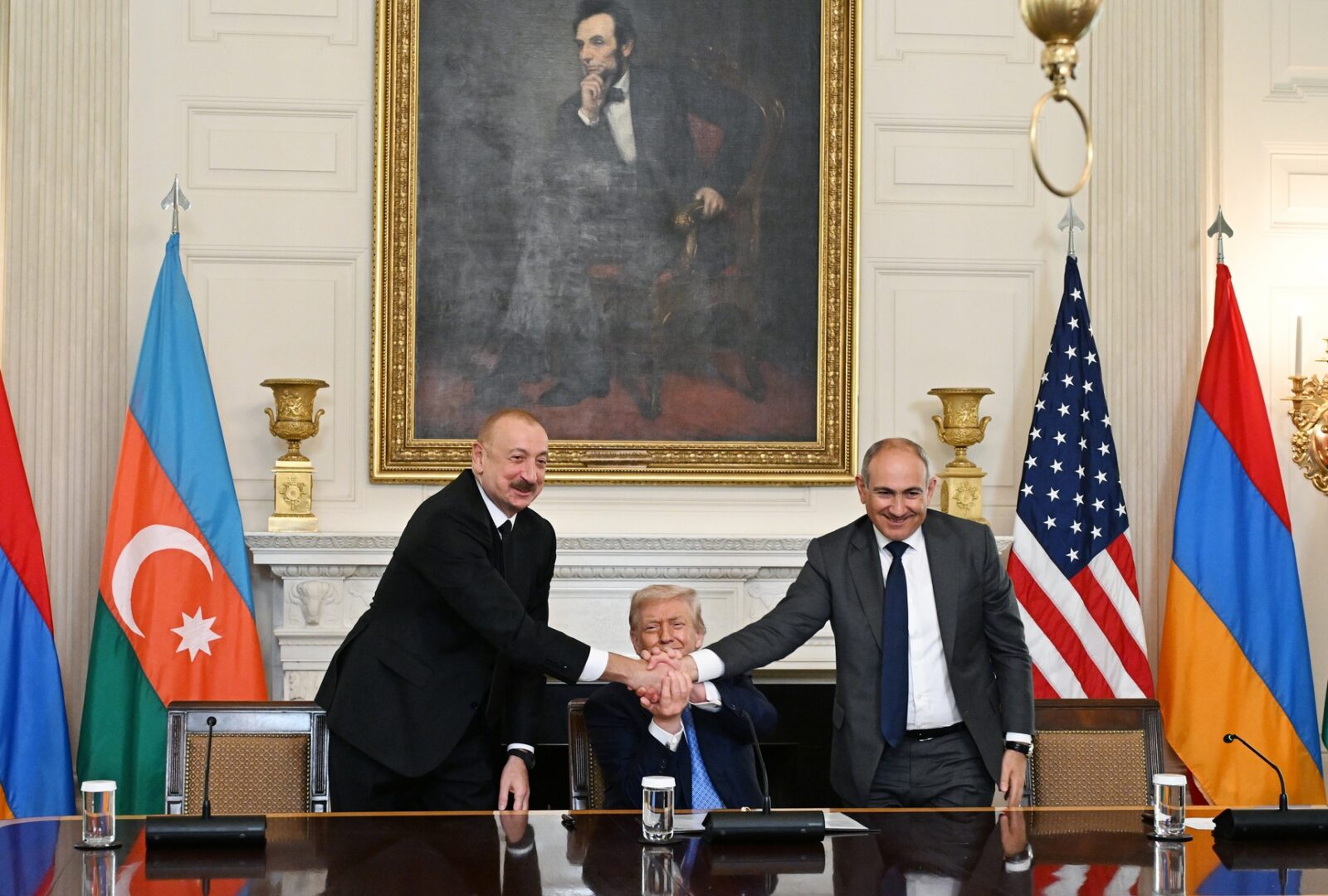
The Aug. 2025 White House summit between Armenian Prime Minister Nikol Pashinyan and Azerbaijani President Ilham Aliyev delivered Washington’s greatest success in the in-between states to date. The announced Trump Route for International Peace and Prosperity, or TRIPP, offers a useful model for Washington to pitch economic incentives as a means to advance durable peace processes.22TRIPP is expected to play an important role as a US–backed route connecting the upstream mineral and energy riches of the South Caucasus, Central Asia, and the Caspian Basin downstream to American and allied markets seeking more secure supply chains in an era of increasing high-tech competition with China. Furthermore, TRIPP will fit into the broader Middle Corridor project, a multi-modal transit initiative linking East and West through Central Asia, the Caspian Sea, and the South Caucasus.23
For Washington, a key task now is to ensure that its involvement in the process helps advance the peace agenda between Yerevan and Baku to a point where both sides sign and ratify the Agreement on Establishment of Peace and Inter-State Relations.24At such a stage, Armenia and Azerbaijan ought to be able to begin developing normalized relations and building upon newly developed regional economic interdependence while undertaking the difficult work of building a durable peace following many decades of conflict.
Vice President JD Vance’s trip to Armenia and Azerbaijan this February and Secretary of State Marco Rubio’s visit to Yerevan in late May were important, high-level signals of Washington’s commitment to the peace process and the US–Armenia and US–Azerbaijan relationships.25Washington should continue to expand its diplomatic engagement regarding TRIPP to include not only Yerevan and Baku but Ankara, Moscow, and Tbilisi. Given the project’s proximity to the Iranian border, maintaining at least indirect dialogue with Tehran on the matter will be important too; as will the nature of any resolution to the present conflict in the Persian Gulf.
Keeping the Russians informed about what the United States is doing and the limits of its interests in the region will be critical in assuaging Moscow’s greatest insecurities and ensuring that it does not work to actively sabotage TRIPP. A more challenging approach, but one that may be worth pursuing, would involve exploring opportunities for limited Russian involvement in elements of TRIPP where mutual benefits are on offer without affording Moscow the leverage to become domineering.26
Furthermore, the White House should ensure significant positive pressure is applied to advancing Armenia–Türkiye normalization and the opening and operationalization of border crossings, which are essential elements of broader regional interconnectivity.27If it is possible to delink this process from Azerbaijan’s continuing demands on Armenia to rewrite its constitution as a prerequisite for signing of the peace treaty, Washington should pursue it.28
Armenia’s selection as one of a few locations for an American–backed artificial intelligence, or AI, super-computing megaproject should not be overlooked.29Beyond helping accelerate Armenia’s transformation into an important technology and trade hub while advancing its already-impressive information technology sector, 80 percent of the center’s computing power will be dedicated to American companies.30Following the joint announcement with Armenia, other states in the region, including Azerbaijan, have sought their own AI and high-tech agreements with the United States as well.31Furthermore, the potential for greater US involvement in energy, critical mineral, and transportation projects in both Armenia and Azerbaijan is an important vector to consider alongside broader critical mineral initiatives in Central Asia and beyond, as Washington seeks to strengthen its position amid ongoing competition with Beijing.
Lastly, while the peace process between Armenia and Azerbaijan has largely been confined to elite-level engagements, no durable peace will be achieved without buy-in and participation from both societies.32Progress on the release of Armenian prisoners of war and political figures imprisoned in Azerbaijan would be an important gesture of goodwill that would be well received by Armenian society.33
Belarus
Belarus’s position as a key staging ground between Russia and the West makes it a regional security actor of outsized importance, yet the West has struggled to articulate a coherent policy that recognizes Minsk as a sovereign state actor distinct from Moscow.
The approach to Minsk since 1991 has, with only a few exceptions, been filtered through a paradigm of Euro–Atlantic integration and the overtly geopolitical confrontation between Russia and NATO that emerged after 2014.
Western attempts to democratize Belarus and peel it away from Russia through isolation have not achieved their intended effect. Far from forcing Minsk to pivot to the West, the maximum pressure campaign launched after Belarus’s 2020 presidential election impelled President Aleksandr Lukashenko to deepen his country’s ties with Russia, China, and other non–Western actors. Sanctions and diplomatic pressure from the United States and Europe have disincentivized the Belarusian government from entertaining domestic reforms and weakened Western channels for influencing Belarus. It also drove Lukashenko to reluctantly accept a greater degree of security dependence on Russia, culminating in Belarus being used by Russian troops for passage and logistical support during the initial stages of the Ukraine invasion. Belarus has been thus locked, since 2022, in an escalatory spiral with two of its neighbors, Poland and Lithuania, that undermines regional stability and engenders a potential military flashpoint on NATO’s eastern flank, most notably in and around Russia’s Kaliningrad exclave. These undesired outcomes stem from a geopolitical misdiagnosis that sees Belarus in binary terms, either as part of the Euro–Atlantic community or as an appendage of Moscow.
As laid out in previous Quincy Institute briefs, a better approach is within grasp.34Lukashenko built his political brand on the concept of a multi-vector foreign policy that seeks positive relations with Europe and the United States as a counterweight to what would otherwise be Belarus’s one-sided dependence on its larger Russian neighbor. The Trump administration has taken substantial steps in this direction by engaging Belarus as a sovereign country that, though tightly linked with Russia, seeks its own set of relationships with Western countries in line with its national interests.
Substantial progress has been made on humanitarian dialogue following several rounds of prisoner releases accompanied by sanctions relief, but there is more to be done in sketching out a comprehensive roadmap for bilateral economic, diplomatic, and security engagement that, in the long term, can turn Belarus into a US regional partner. Commercial and trade opportunities include joint projects on critical resources, foreign direct investment, and ventures on logistics and transit hubs. As previously laid out by Quincy Institute research, a deconfliction and security dialogue with Belarus, one of the few remaining countries in this region that is not integrated into the Euro–Atlantic community, could play a vital part in US measures to ensure stability on NATO’s eastern flank.
Belarus has taken concrete steps to support the White House’s Ukraine peace initiative and should continue to be engaged on that basis. These steps include acting as a platform for exchanges of prisoners and of the remains of military personnel killed in action, and as a prospective contributor to Ukraine’s postwar reconstruction. As part of an effort to advance West–Russia stability, the White House should encourage constructive dialogue between Belarus and its Polish and Lithuanian neighbors and consider Minsk’s potential role in any future talks on Europe’s security architecture. A key milestone on the roadmap to deeper bilateral engagement is full diplomatic normalization between the United States and Belarus, which would be a fitting deliverable for a future meeting between Presidents Trump and Lukashenko.
Georgia
Prior to Georgia’s 2024 parliamentary elections, Quincy Institute scholars wrote in a policy brief that “the claim that Georgia is already in the hands of a pro–Putin authoritarian government is, at best, highly exaggerated. A more nuanced perspective is justified based on the complexity of internal Georgian politics and the reality of Georgia’s geopolitical situation.”35
Since late 2025, Washington has pursued a normalization effort with Tbilisi, based on this nuanced reading of Georgia’s particularities, as evidenced by the elevating level of contacts and frequent mutual visits.36Given that West–Georgia relations soured to their lowest levels in decades in preceding years, Washington’s slow start in reengaging Tbilisi was understandable.37Nevertheless, now that senior level contacts are proceeding apace, the time is ripe to coherently and prudently advance engagement with what was once Washington’s closest partner in the South Caucasus.
One area of relatively low-hanging, but symbolically important, fruit is the suspended US–Georgia strategic partnership agreement.38Originally signed in 2009, it bore the hallmarks of a different era in both US and Georgian foreign policy thinking. Developing a new document to reinvigorate the relationship and give it a genuinely strategic impetus for the years ahead ought to be a key priority for the Department of State and White House. The United States, in recent years, has established strategic partnerships with Armenia and Azerbaijan, and completing this Caucasian triangle would be both an important symbolic as well as strategic accomplishment that will help better coordinate Washington’s regional policy.
Increased attention on trade, transit, and investment opportunities should be leading components of a revitalized US–Georgia strategic relationship. While disagreements surrounding projects such as the Anaklia Port remain due to previous experience and Chinese interests, both Washington and Tbilisi are rightly focused on exploring opportunities to expand trade, transit, and logistics ties.39As cargo loads across the Middle Corridor are expected to increase, greater US–Georgia cooperation on developing infrastructure capacity and quality would be a win-win for both countries as well as wider regional prosperity.40The recently announced $25 million Development Finance Corporation loan supporting the construction of a new berth at the Poti Sea Port is an encouraging signal, building upon an earlier $50 million loan agreement.41
Although a focus on strengthening democracy and human rights occupied a central part of the 2009 strategic partnership agreement, its prevalence in a future document can be less pronounced. Nevertheless, if Tbilisi is as serious about pursuing EU accession as it says it is, then it will have to undertake domestic reform, as noted in the Quincy Institute’s 2024 report.42
It is high time that Washington and Tbilisi make good on their earlier promises to explore the possibility of a free trade agreement. Although current US–Georgia trade is relatively limited, total China–Georgia trade has increased some 2.5 times since 2018, when the two countries signed their free trade agreement.43The opportunity to strengthen US–Georgia ties at limited cost should not be overlooked.
On the whole, the United States and its European allies would be wise to recognize and accept that most of the in-between states have and will continue to maintain significant trade ties with Russia. These ties are the result of not only historic links and geographic proximity but also the realities of limited access to other markets, like the European Union. Western efforts to curtail in-between states’ trade with Russia and other neighbors without offering meaningful compensation or alternatives is a self-defeating strategy that must be avoided.
It should not be forgotten that the crisis in Ukraine originated over a decade ago due in part to the zero-sum approach by Brussels concerning Kyiv’s proposed EU association agreement and its repercussions for trade with Russia.44Avoiding a similar approach today will be critical to a successfully executed policy toward the in-between states.
The issue of Georgia’s breakaway statelets of Abkhazia and South Ossetia remains an extremely sensitive issue in Moscow and Tbilisi. As noted above, however, a negotiated settlement to the Ukraine war and a binding agreement to suspend further enlargement of NATO into former Soviet republics may present a unique opportunity to redress Georgia’s ethno-political and territorial disputes. Washington could begin to explore how it might practically assist Tbilisi in diplomatically addressing the issue of Abkhazia and South Ossetia, including through reinvigorating multilateral efforts such as the Geneva International Discussions. Though this will be neither a quick nor easy process, innovative proposals, pragmatic engagement with Russia and local actors, and a sustained interest in the region are likely to prove essential in pushing the process forward.
Moldova
US policy toward Moldova has traditionally centered on the support for, and promotion of, the country’s (often fluctuating) Western and democratic aspirations. Today, Washington should leave the bulk of that effort to Moldova’s European neighbors, especially given that Chisinau is predominately reliant on Brussels for financial support and investment.45
For the European Union, Moldova represents a critical component of the continental map that ought to be integrated into the bloc once it meets all accession criteria. So far, Moldovan authorities have shown a great propensity to address EU stipulations. Chisinau is likely to continue to do so under its current pro–Western leadership and following a narrowly passed 2024 referendum on the country’s EU aspirations.46Given Moldova’s limited geostrategic value for the United States, Washington would be wise to support Chisinau’s EU aspirations while endorsing its continued constitutional neutrality as a positive force for West–Russia stability. If the United States can play a narrow role in supporting the positive development of Moldova’s infrastructure and investment climate, that may offer mutual benefits and be worth pursuing.47
Moldova’s political-territorial dispute with the breakaway statelet of Transnistria, however, is one area where the United States might be able to help play a constructive role. Chisinau’s March 2026 non-paper proposal on a resolution framework for the Transnistria question was met with a cold shoulder, including by Brussels.48As an observer to the 5+2 format for resolving the Transnistria question, the United States can and should play a greater role in helping all involved parties come to an acceptable diplomatic understanding.49
An important, security-focused objective may be to bring together the relevant participating states to finally complete the task begun over two decades ago in the Transnistrian village of Cobasna, where around half of the arms in an outdated but significantly sized Russian depot were removed under the auspices of the Organization for Security and Co-operation in Europe, or OSCE, in the early 2000s.50Successfully carrying out the on-site destruction of the remaining arms may now be likely given that Washington succeeded in appointing former Deputy Assistant Secretary of State for Eastern Europe Christopher Smith to lead the OSCE’s Mission to Moldova.51Much like with Georgia’s territorial disputes, continuing this process and building upon its momentum are especially likely to be helped along by a negotiated settlement to the Ukraine war and renewed engagement with Moscow on European security matters.
Conclusion
Conducting a policy reassessment toward the in-between states and implementing its findings remains one of the few critical tasks for US policymakers focusing on Eurasia alongside preventing escalation of the Ukraine war and rebalancing the transatlantic alliance. A successful reassessment will be expedited by the incorporation of the four strategic principles detailed in this brief. Promoting and supporting economic connectivity and political normalization efforts will help decrease the risks of regional instability while offering win-win opportunities for the Eurasia region and the United States. Avoiding taking on new security commitments will not only prevent further strain on already-limited American military capabilities, but will also avoid encouraging morally hazardous behavior by the in-between states. Encouraging multi-vector foreign and trade policies will contribute to regional prosperity and successful interconnectivity efforts. Devising confidence- and security-building measures with Russia will help to ensure American engagement with the in-between states does not lead to further Ukraine–like crises that risk dragging the United States into a dangerous military escalation.
Despite having no vital interests in the in-between states that would necessitate the deployment of US troops or the further enlargement of NATO, Washington can and should continue to pursue its economic and political interests across Eurasia. Most importantly, these efforts ought to focus on identifying, extracting, and processing the critical minerals and energy resources essential to a modern economy and military while ensuring that they can flow along secure supply chains.
As American foreign policy attention continues to shift toward the challenges posed by competition with China, ensuring a managed recalibration of the US approach to NATO’s eastern flank is essential. Avoiding a simultaneous two-theater conflict is of paramount concern. Mitigating the chances of further conflict arising across the in-between states remains a key policy objective and will require active and prudent engagement from Washington, especially if a durable resolution to the Ukraine war remains elusive.
As stated, achieving a negotiated settlement to the Ukraine war remains the best means available to decrease the growing risks of a direct NATO–Russia clash in Eurasia. A compromise resolution there would go a long way in setting the stage for the implementation of the recommendations we lay out above. However, even if fighting continues, the guiding principles and many of the recommendations we propose will still be worth pursuing as the United States maintains and strengthens its engagement with the in-between states.
The United States has a unique opportunity to reformat its engagement with Armenia, Azerbaijan, Belarus, Georgia, and Moldova to better serve Washington’s interests while advancing stability and prosperity across Eurasia. Taking advantage of this opportunity will have benefits for US grand strategy and help better position American policymakers for the challenges posed by a changing international system with increasing competition with China at its core.
Program
Authors

Artin DerSimonian is a reseach associate in the Eurasia program at the Quincy Institute for Responsible Statecraft. He earned a Masters of Science in Russian, East European, and Eurasian studies from the University of Glasgow in 2022.

Mark Episkopos is a research fellow in the Quincy Institute’s Eurasia Program. He is also an Adjunct Professor of History at Marymount University and was formerly the National Security Reporter at The National Interest.
Citations
George Beebe and Anatol Lieven, “A US Peace Plan for Ukraine,” Quincy Institute for Responsible Statecraft, May 21, 2025, https://quincyinst.org/research/a-u-s-peace-plan-for-ukraine; Mark Episkopos, “Revitalizing the Transatlantic Alliance: Principles for a Balanced NATO,” Quincy Institute for Responsible Statecraft, June 30, 2026, https://quincyinst.org/research/revitalizing-the-transatlantic-alliance-principles-for-a-balanced-nato. ↩
Jim O’Brien, “Peace in the Caucasus: Ensuring Europe Plays a Role after Trump’s Ceremony,” European Council on Foreign Relations, Aug. 14, 2025, https://ecfr.eu/article/peace-in-the-caucasus-ensuring-europe-plays-a-role-after-trumps-ceremony. ↩
“National Security Strategy of the United States of America, November 2025,” The White House, 2025, https://www.whitehouse.gov/wp-content/uploads/2025/12/2025-National-Security-Strategy.pdf. ↩
Andrius Sytas and Mark Trevelyan, “Lukashenko Frees 250 Belarusian Prisoners as US Removes More Sanctions,” Reuters, March 19, 2026, https://www.reuters.com/world/trumps-envoy-coale-meets-belarus-leader-lukashenko-seeking-win-more-prisoner-2026-03-19; “Joint Declaration by the President of the Republic of Azerbaijan and the Prime Minister of the Republic of Armenia on the Outcomes of Their Meeting in Washington DC, United States of America,” US Department of State, Aug. 8, 2025, https://www.state.gov/wp-content/uploads/2025/08/2025JointDeclaration.AzerbaijanArmenia.pdf; “Framework Agreement between the United States of America and the Republic of Armenia on Strategic Cooperation Concerning the Trump Route for International Peace and Prosperity (TRIPP),” US Department of State, May 26, 2026, https://www.state.gov/wp-content/uploads/2026/06/TRIPP-Framework-Agreement-United-States-and-Armenia-June-2026-HRC1418739-Accessible-6.8.2026.pdf. ↩
Artin DerSimonian, “Trump’s Gambit for the Elusive South Caucasus Peace Deal,” Responsible Statecraft, Aug. 8, 2025, https://responsiblestatecraft.org/armenia-azerbaijan-white-house. ↩
Artin DerSimonian, “Armenians’ Fate in Nagorno–Karabakh Hangs in the Balance,” Responsible Statecraft, Sept. 19, 2023, https://responsiblestatecraft.org/armenia-azerbaijan-nagorno-karabakh-2665639680. ↩
“Statement by President von der Leyen with Azerbaijani President Aliyev,” European Commission, July 18, 2022, https://enlargement.ec.europa.eu/news/statement-president-von-der-leyen-azerbaijani-president-aliyev-2022-07-18_en. ↩
Mark Episkopos, “Can Belarus Be Turned?” National Interest, June 12, 2025, https://nationalinterest.org/feature/can-belarus-be-turned. ↩
Anatol Lieven, “Stop Treating Georgia as a Creature of the US and the West,” Responsible Statecraft, July 31, 2024, https://responsiblestatecraft.org/georgian-elections. ↩
Artin DerSimonian, “Moldova ‘Survives’ Russian Pull as Elections Move It Closer to EU,” Responsible Statecraft, Sept. 29, 2025, https://responsiblestatecraft.org/moldova-elections-russia. ↩
William J. Burns to Robert S. Beecroft et al., “Russia Strategy,” email, Feb. 8, 2008, available via the Carnegie Endowment for International Peace at https://ceipfiles.s3.amazonaws.com/pdf/back-channel/2008EmailtoRice1.pdf. ↩
“Bucharest Summit Declaration,” NATO, April 3, 2008, https://www.nato.int/en/about-us/official-texts-and-resources/official-texts/2008/04/03/bucharest-summit-declaration. ↩
See the EU–commissioned “Report of the Independent International Fact-Finding Mission on the Conflict in Georgia,” Sept. 2009, via the European Court of Human Rights website at https://www.echr.coe.int/documents/d/echr/HUDOC_38263_08_Annexes_ENG. ↩
David Cadier, “The Geopoliticisation of the EU’s Eastern Partnership,” Geopolitics 24, no. 1 (2019): 71–99, https://doi.org/10.1080/14650045.2018.1477754; Bidzina Ivanishvili, “How I’d Build Peace in the Caucasus,” Wall Street Journal, Aug. 2, 2012, https://www.wsj.com/articles/SB10000872396390443687504577562820249636592. ↩
“Remarks by Under Secretary of War for Policy Elbridge Colby at the NATO Defense Ministerial (As Prepared),” US Department of Defense, Feb. 12, 2026, https://www.war.gov/News/Speeches/Speech/Article/4404801/remarks-by-under-secretary-of-war-for-policy-elbridge-colby-at-the-nato-defense. ↩
Lingling Wei and Thomas Grove, “Putin Was Xi’s Role Model. Now He’s the Junior Partner,” Wall Street Journal, July 13, 2026, https://www.wsj.com/world/x-putin-junior-partner-df611b88. ↩
Samuel Charap, Alyssa Demus, and Jeremy Shapiro, eds., Getting Out from “In-Between”: Perspectives on the Regional Order in Post–Soviet Europe and Eurasia (Santa Monica: RAND Corporation, 2018), https://www.rand.org/pubs/conf_proceedings/CF382.html. ↩
Nigar Hasanova, “The South Caucasus Route: How Sanctioned Goods Still Reach Russia,” OC Media, July 9, 2026, https://oc-media.org/the-south-caucasus-route-how-sanctioned-goods-still-reach-russia. ↩
Zachary Fabos, “Georgians Are Split on Economic Relations with Russia,” OC Media, April 10, 2024, https://oc-media.org/datablog-georgians-are-split-on-economic-relations-with-russia; Denis Cenusa, “The Nature of the Azerbaijan–Russia Relations: Through Crisis to More Symmetry,” Geopolitics and Security Studies Centre, July 8, 2025, https://www.gssc.lt/en/publication/the-nature-of-the-azerbaijan-russia-relations-through-crisis-to-more-symmetry; Ani Avetisyan, “Russia Heads for Showdown with Armenia Over Europe Outreach,” Bloomberg, May 29, 2026, https://www.bloomberg.com/news/articles/2026-05-29/russia-heads-for-showdown-with-armenia-over-european-ambitions. ↩
See, for example, Gevorg Tosunyan, “Vance Announces First-Ever Major US Military Technology Sale to Armenia Worth $11 Mn,” Civilnet, Feb. 9, 2026, https://civilnet.am/en/news/1001514. ↩
Beebe and Lieven, “A US Peace Plan for Ukraine.” ↩
TRIPP will, in a narrow sense, connect Azerbaijan with its Nakhichevan exclave through southern Armenia, a key Azerbaijani demand throughout negotiations. See “Joint Declaration,” US Department of State. See also Anatol Lieven and Artin DerSimonian, “Engineering Peace?” New Left Review, Sept. 19, 2025, https://newleftreview.org/sidecar/posts/engineering-peace. ↩
“Middle Trade and Transport Corridor: Policies and Investments to Triple Freight Volumes and Halve Travel Time by 2030,” World Bank, Nov. 27, 2023, https://www.worldbank.org/en/region/eca/publication/middle-trade-and-transport-corridor. ↩
“Publication of the Initialed Agreement between Armenia and Azerbaijan,” Ministry of Foreign Affairs of the Republic of Armenia, Aug. 11, 2025, https://www.mfa.am/en/press-releases/2025/08/11/Initialed Arm-Az Peace Agreement text/13394. ↩
Artin DerSimonian, “VP Vance’s Timely TRIPP to the South Caucasus,” Responsible Statecraft, Feb. 11, 2026, https://responsiblestatecraft.org/trump-tripp; Michael Martina and Lucy Papachristou, “US and Armenia Sign Partnership Agreement Ahead of Armenian Election,” Reuters, May 26, 2026, https://www.reuters.com/world/us-armenia-sign-strategic-partnership-agreement-ahead-armenian-elections-2026-05-26. ↩
Artin DerSimonian, “Armenia’s Most Critical Elections Since Independence,” Responsible Statecraft, June 9, 2026, https://responsiblestatecraft.org/armenia-parliamentary-elections. ↩
Benyamin Poghosyan, “Sustaining Momentum in Armenia–Türkiye Normalization After Armenia’s Parliamentary Elections,” Global Panorama, July 28, 2026, https://www.globalpanorama.org/en/2026/07/sustaining-momentum-in-armenia-turkiye-normalization-after-armenias-parliamentary-elections-benyamin-poghosyan. ↩
“Armenia and Azerbaijan: The Hard Road to a Lasting Peace,” International Crisis Group, Sept. 5, 2025, https://www.crisisgroup.org/brf/europe-central-asia/caucasus/armenian-azerbaijani-conflict/98-armenia-and-azerbaijan-hard-road-lasting-peace; Arshaluys Barseghyan, “Armenian Government Faces Uphill Battle Over New Constitution Following Election Results,” OC Media, June 11, 2026, https://oc-media.org/armenian-government-faces-uphill-battle-over-new-constitution-following-election-results. ↩
Firebird, “Firebird and US Government Announce Phase 2 of Armenia AI Megaproject, Scaling It to $4 Billion and 50,000 GPU in 2026,” PR Newswire, Feb. 10, 2026, https://www.prnewswire.com/news-releases/firebird-and-us-government-announce-phase-2-of-armenia-ai-megaproject-scaling-it-to-4-billion-and-50-000-gpu-in-2026–302683715.html. ↩
Dina Bass, “AI Startup Firebird Gets US Approval to Use Nvidia Chips in Armenian Data Center,” Bloomberg, Nov. 19, 2025, https://www.bloomberg.com/news/articles/2025-11-19/ai-startup-firebird-gets-us-approval-to-use-nvidia-chips-in-armenian-data-center. ↩
Nariman Gizitdinov and Greg Sullivan, “Kazakhstan, Firebird Ink $10 Billion AI Deal with Nvidia Support,” Bloomberg, June 15, 2026, https://www.bloomberg.com/news/articles/2026-06-15/kazakhstan-firebird-ink-10-billion-ai-deal-with-nvidia-support; “Charter on Strategic Partnership Between the Government of the United States of America and the Government of the Republic of Azerbaijan,” US Embassy in Azerbaijan, Feb. 11, 2026, https://az.usembassy.gov/us-azerbaijan-charter. ↩
For example, the “Peace Bridge” initiative, backed and approved by the governments in both Yerevan and Baku. See Nadira Tudor, “Armenia and Azerbaijan Civil Societies Hold New Round of Broad Talks to Advance Peace Process,” Euronews, April 11, 2026, https://www.euronews.com/2026/04/11/armenia-and-azerbaijan-civil-societies-hold-new-round-of-broad-talks-to-advance-peace-proc. ↩
“US Lawmakers Advance Bipartisan Measure Demanding Azerbaijan Release All Armenian POWs,” Armenpress, June 11, 2026, https://armenpress.am/en/article/1252693. ↩
Mark Episkopos, “Desecuritizing the Belarusian Balcony: Principles for US–Belarus Relations,” Quincy Institute for Responsible Statecraft, Aug. 5, 2025, https://quincyinst.org/research/desecuritizing-the-belarusian-balcony-principles-for-u-s-belarus-relations; Mark Episkopos, “Rethinking the US–Belarus Relationship,” Quincy Institute for Responsible Statecraft, May 13, 2024, https://quincyinst.org/research/rethinking-the-u-s-belarus-relationship. ↩
Anatol Lieven, Almut Rochowanski, and Artin DerSimonian, “The West and Georgia’s Crisis,” Quincy Institute for Responsible Statecraft, Oct. 17, 2024, https://quincyinst.org/research/the-west-and-georgias-crisis. ↩
“State Department Representative Jonathan Askonas’ (Senior Advisor) Visit to Georgia,” US Embassy in Georgia, Nov. 18, 2025, https://ge.usembassy.gov/state-department-representative-jonathan-askonas-visit-to-georgia; “Secretary Rubio’s Call with Georgia Prime Minister Kobakhidze,” US Department of State, March 30, 2026, https://www.state.gov/releases/office-of-the-spokesperson/2026/03/secretary-rubios-call-with-georgia-prime-minister-kobakhidze; “Maka Botchorishvili Meets with the US Deputy Assistant Secretary of State,” Republic of Georgia, Ministry of Foreign Affairs, May 8, 2026, https://mfa.gov.ge/en/news/705530-maka-botchorishvili-amerikis-sheertebuli-shtatebis-sakhelmtsipho-mdivnis-tanashemtsis-moadgiles-shek. ↩
Giselle Ruhiyyih Ewing and Gabriel Gavin, “US Suspends Strategic Partnership with Georgia after EU Membership Talks Halted,” Politico, Nov. 30, 2024, https://www.politico.com/news/2024/11/30/us-suspends-partnership-georgia-00192044; Lieven, Rochowanski, and DerSimonian, “The West and Georgia’s Crisis.” ↩
“United States–Georgia Charter on Strategic Partnership,” US Department of State, Jan. 9, 2009, https://2009-2017.state.gov/p/eur/rls/or/121029.htm. ↩
Brawley Benson, “International Arbitration Court Rules in Favor of Georgian Government on Port Development Case,” Eurasianet, July 30, 2024, https://eurasianet.org/international-arbitration-court-rules-in-favor-of-georgian-government-on-port-development-case. ↩
“Middle Trade and Transport Corridor,” World Bank. ↩
Note that the original loan was announced under the Overseas Private Investment Corporation, or OPIC, the partial predecessor to the Development Finance Corporation. See “OPIC Announces Investment in Poti,” Civil Georgia, Feb. 4, 2019, https://civil.ge/archives/275583; “New Berth Set to Be Constructed at Poti New Sea Port under US Loan,” Civil Georgia, June 27, 2026, https://civil.ge/archives/742685. ↩
Lieven, Rochowanski, and DerSimonian, “The West and Georgia’s Crisis.” ↩
Natiko Taktakishvili, “Georgia–China Trade Surges by 45% in Early 2026,” Business Media (Georgia), June 11, 2026, https://bm.ge/en/news/georgia-china-trade-surges-by-45-in-early-2026. ↩
“EU Rejects Russia ‘Veto’ on Ukraine Agreement,” BBC, Nov. 29, 2013, https://www.bbc.com/news/world-europe-25154618. See also Philip Short, Putin: His Life and Times (London: Bodley Head, 2022), 568–75. ↩
Arina Codreanu, “More than 72% of Foreign Investments in Moldova Come from the EU,” Logos Press, May 9, 2026, https://logos-pres.md/en/news/more-than-72-of-foreign-investments-in-moldova-come-from-the-eu; Arina Codreanu, “Romania Remains the Main Market for Moldovan Exports,” Logos Press, July 29, 2026, https://logos-pres.md/en/news/romania-remains-the-main-market-for-moldovan-exports. ↩
DerSimonian, “Moldova ‘Survives’ Russian Pull.” ↩
See, for example, “US Government Supports High-Voltage Moldova Transmission Line,” US Embassy in Moldova, Sept. 17, 2025, https://md.usembassy.gov/moldova-transmission-line. ↩
Vladimir Solovyov, “Moldova Floats a New Approach to Its Transnistria Conundrum,” Carnegie Russia Eurasia Center, March 31, 2026, https://carnegieendowment.org/russia-eurasia/politika/2026/03/moldova-transnistria-new-plan. ↩
Per the OSCE, “the 5+2 format includes representatives of the Sides, mediators and observers in the negotiation process – Moldova, Transdniestria, the OSCE, the Russian Federation, Ukraine, the European Union and the United States. The goal of the 5+2 talks is to work out the parameters of a comprehensive settlement based on the sovereignty and territorial integrity of the Republic of Moldova within its internationally recognized borders with a special status for Transdniestria within Moldova.” See “Press Releases and Statements Related to the 5+2 Negotiations on the Transdniestrian Settlement Process,” OSCE Mission to Moldova, accessed Aug. 7, 2026, https://moldova.osce.org/mission-to-moldova/119488. ↩
“OSCE Submits Plan to Dispose of 40,000 Tons of Russian Munitions in Moldova,” OSCE Mission to Moldova, Oct. 4, 2001, https://moldova.osce.org/moldova/53861. ↩
Smith played a key role in advancing Washington’s recent reengagement with Minsk and is a trusted diplomatic operator across the region. ↩