
Unquestioning Support for Israel Will Only Deepen America’s Problems in the Middle East
Overview
The U.S. is in danger of being further captured by Israel’s foreign policy agenda. Continuing military support for Israel without exercising leverage to constrain Israel’s actions will draw the U.S. into ever-greater military and political commitments in the Middle East, at a major cost to American resources, prestige, and interests.
U.S. assistance to Israel is the crucial enabling factor for Israel’s aggressive military posture. U.S. military aid to Israel has at least tripled since the Oct. 7, 2023, attacks. According to the Congressional Research Service, the U.S. directly provided one-third of Israel’s own defense budget in 2024. U.S. military operations in the region since the start of the Gaza war have indirectly added billions of dollars to the amount the U.S. has spent on behalf of Israel.
Yet Israel’s security doctrine directly threatens the long-term American interest in establishing a stable, self-sustaining security order in the Middle East, which would help enable a significantly lower U.S. military presence and level of involvement in the region. Israel’s current course in its conflicts will require more U.S. military engagement, not less, with no clear end in sight.
Israeli intentions seem to include the destruction of the current regime in Iran, a permanent disarmament of Hezbollah in Lebanon, the occupation of territory within Syria, a mass forced expulsion of the millions of remaining civilians in Gaza, and an annexation of the West Bank. But none of these, let alone all of them, can be achieved without considerably expanded long-term U.S. military and political support.
Unless and until the U.S. demonstrates that it can withhold military support for Israeli actions that do not align with U.S. interests, Israel faces no clear incentive to change its policies. The history of the Middle East shows that even military victories such as the 1967 Six-Day War or the 1990–91 Gulf War do not create peace and stability unless they are accompanied by creative diplomacy and mutual restraint. Israel must be a participant in such diplomacy. But it is highly unlikely that Israel will show the needed restraint so long as U.S. support is unconditional.
Discussion
Since the Oct. 7 Hamas attacks, Israel has engaged in continuing reprisals against Gaza and launched a wider regional war that has featured tactical military successes against the “Axis of Resistance” in Iran and Lebanon, but without a discernible ability to date to translate these successes into permanent strategic wins.
- As the Gaza war approaches two years, the senior Hamas leaders involved in the decision to launch the Oct. 7 attack have all been killed, and Gaza has been laid waste, with almost 80 percent of its buildings destroyed. Yet Hamas remains in Gaza and the desire for Palestinian resistance against Israeli occupation has grown.
- After attacking Israel post–Oct. 7, Hezbollah has lost its senior leadership as well as thousands of fighters, up to one million civilians have been displaced from Hezbollah–controlled areas in southern Lebanon, and Israeli Prime Minister Benjamin Netanyahu claims Israel has “pushed them decades back.” Yet Hezbollah remains an armed, hostile force.
- Combined Israeli and U.S. attacks on Iran have reportedly set back Iran’s nuclear program, killed many senior Iranian military commanders and nuclear scientists (including civilian nuclear scientists), and appear to have temporarily wiped out Iranian air defenses. Yet Israel failed to achieve its core objective of regime collapse, and both Israeli officials and U.S. President Donald Trump have indicated that the war will continue.
While much of this was carried out by the Israeli military, increased U.S. military assistance has been critical. The figure below draws on Congressional Research Service, or CRS, figures of direct U.S. military aid to Israel, which show that direct U.S. aid more than tripled from 2023 to 2024. When indirect costs of U.S. military operations in the Middle East in support of Israel during 2023 and 2024 are included, Brown University researchers calculate that U.S. assistance to Israel in the year following the Oct. 7 attacks reached $22.8 billion. According to CRS analysis, U.S. military assistance accounted for fully one-third of Israel’s 2024 military spending. While full 2025 figures are not yet available, direct U.S. military operations in support of Israel were even more extensive in 2025.
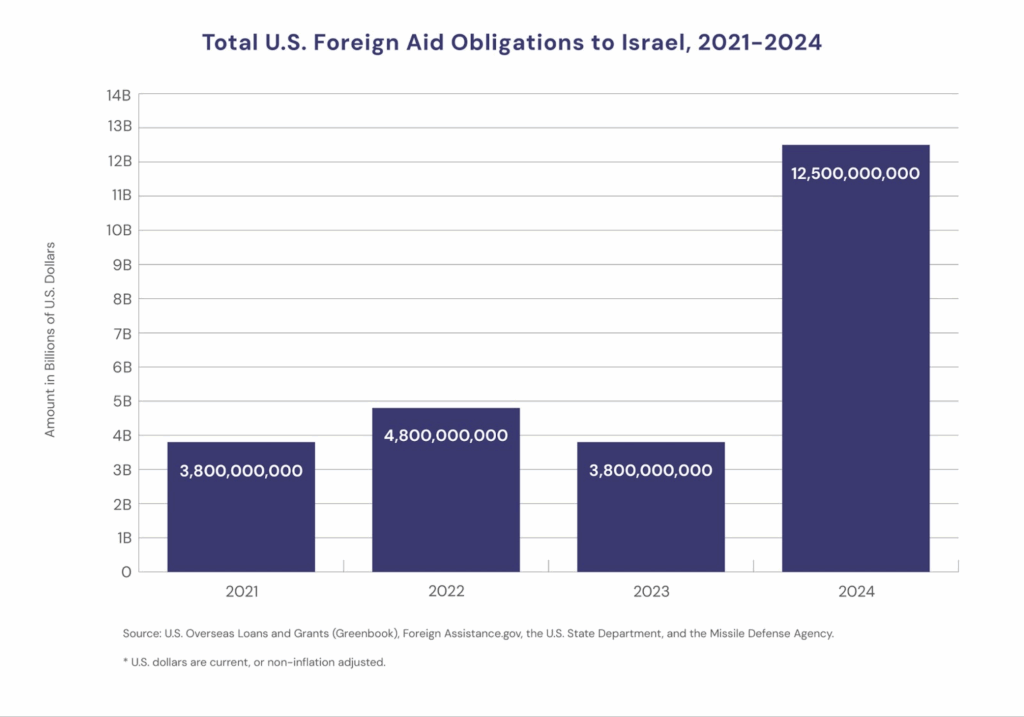
As the figure above demonstrates, there is no doubt that U.S. assistance has been a critical and indispensable component of Israeli military operations. Not only has the U.S. directly financed a substantial component of Israel’s military forces, but the U.S. has also directly intervened with its own forces for operations including the bombing of Iran’s uranium refining facilities at Fordow with B–2 bombers. The U.S. also drained much of its own stock of missile interceptors to protect Israel from Iranian retaliation for Israel’s attacks. The Wall Street Journal has reported that up to one-quarter of all high-end missile interceptors ever purchased by the Pentagon were fired to protect Israel during its 12-day conflict with Iran.
In this context, the distinction between “defensive” and “offensive” assistance lacks meaning. Even U.S. assistance that is nominally defensive enables offensive actions by Israel. This is perhaps clearest in the Israeli strikes on Iran in June 2025, where Israel could strike offensively against Iran in part because it relied on the U.S. provision of missile interceptors to defend against Iranian retaliation. But the sheer scale of U.S. military assistance to Israel means that such assistance frees Israeli resources for offensive actions.
Despite Israel’s short-term military success, the strategic challenges it faces have arguably grown deeper. For example, Israel is much further from achieving the strategic objective of normalizing relations with Saudi Arabia than before. It is possible to win battles and lose wars, and there are many examples of this in Israel’s history. There is a risk that both the U.S. and the Netanyahu government will sacrifice the long-term security and legitimacy of Israel on the altar of a false sense of what military force, no matter how devastating, can achieve.
In the absence of a clear diplomatic path to reconciling with its enemies, a strategy of purely militarily subjugating Israel’s enemies will require a level of military and political backing that can only come from the United States, which does not align with the American interest in avoiding permanent coercive commitments in the Middle East.
Israel’s bombardment of Gaza continues, with a brutal toll on civilians, the creation of an engineered famine, widespread war crimes, and no indication that the situation is improving. These horrific events, along with Israel’s plans to expand the war by occupying Gaza City, are drawing ever-growing international condemnation. Less than one-third of the American public now supports Israel’s actions in Gaza. Besides conflicting with the views of American voters, the continuing U.S. involvement in the conflict damages the standing of the U.S. in the world. Despite this, Israel is apparently relying on U.S. assistance in the ethnic cleansing of Gaza’s population to an as-yet-unspecified foreign location, as well as assistance in the rebuilding of Gaza.
In Lebanon, Hezbollah has been damaged but not destroyed, and the ceasefire is fragile. Efforts to fully disarm Hezbollah have failed so far, leaving a substantial military and strategic challenge in place. Israel once again appears to be relying on U.S. assistance should outside military intervention be required to achieve full disarmament.
Israel’s June attacks on Iran did not fully achieve Israel’s war aims. Israel’s apparent goal of regime collapse did not occur and, despite Iran’s military being weakened, it remains a force. Iran still retains its ballistic missile program and, even though Iran’s civilian nuclear program has experienced a significant setback, it still maintains an unknown amount of enriched uranium, which could form the basis for a clandestine weapons program in the future.
In light of this, it seems likely that Israel will renew its attacks on Iran, perhaps by the end of this year. The Israeli military itself has stated that the June attack was only the first phase of an extended campaign.
Any such campaign will almost certainly require substantially expanded U.S. assistance. Israel’s limited population of 7.5 million Jewish citizens (as opposed to a total population of 90 million in Iran) and its lack of any land border with Iran mean that Israel would require expanded U.S. military involvement, possibly including ground troops, to accomplish durable regime change in Iran or to completely destroy its military capacity. Such involvement would dwarf the demands of the 2003 Iraq War. Iran has over triple the population that Iraq had in 2003 (90 million versus 25 million) and almost four times the land area.
It is not apparent that Israel has any plan or intention to seek a partner for peace in these continuing conflicts, and the ability to rely on large amounts of unrestricted U.S. assistance greatly lessens any incentive to do so. Left unanswered is the question of how letting Israel set the direction in these conflicts contributes to the American interests of avoiding a long-term military presence in the Middle East and being seen as an independent political influence in the region as opposed to simply the facilitator of an Israeli agenda.
The history of the Middle East shows that military victory alone does not lead to peace. After Israel’s crushing victory in the 1967 war, it absorbed the West Bank and Gaza and their associated Palestinian refugee populations — a problem that plagues the region to this day. Egypt, humiliated in 1967, attacked Israel to devastating effect in 1973. Israel required a massive emergency airlift of U.S. military aid in order to survive that war. It was not until the U.S. brokered a diplomatic settlement between Israel and Egypt at Camp David in 1978 that lasting peace was achieved. Likewise, the military defeat of Saddam Hussein in the 1990-91 Gulf War did not lead to lasting peace with Iraq, and later led to the agonizingly long, expensive, and destructive U.S. invasion and occupation of Iraq beginning in 2003.
Conclusion
A lasting and stable regional peace is the best way to remove the threat of the U.S. being dragged into an expanded conflict in the Middle East. Such a peace requires creative diplomacy and restraint from all sides, including the U.S. and Israel. Such restraint is unlikely to occur as long as the U.S. shows no willingness to put conditions on military assistance to Israel and demand that Israel shift from military aggression to a search for a peaceful settlement.
The most effective path to achieve a stable peace would be for Washington to support regional efforts to create a security architecture and body for the region that would include Israel. The region does not have an equivalent to the Organization for Security and Co-operation in Europe, Association of Southeast Asian Nations, or any other inclusive, standing security body.
Not only has the absence of any such body contributed to the region’s perpetual instability, but it also makes it difficult for the United States to engage in burden-shifting since there is no independent infrastructure to shift the security burden to. Such an inclusive body could also offer Israel the strongest security guarantees to date, going far beyond the mutual recognition the Arab Peace Plan of 2002 offered or the normalization agreements the Abraham Accords proposed. Most importantly, it would help the United States to finally free itself from the prospect of endless war in the Middle East.
Related

Book Talk | From Apartheid to Democracy: A Blueprint for Peace in Israel-Palestine
Join our discussion of the new book “From Apartheid to Democracy: A Blueprint for Peace in Israel-Palestine”.
Program
Authors

Trita Parsi is co-founder and executive vice president of the Quincy Institute. He is an award-winning author and the 2010 recipient of the Grawemeyer Award for Ideas Improving World Order.

Marcus Stanley is director of studies at the Quincy Institute for Responsible Statecraft. Prior to joining the Quincy Institute, he spent a decade at Americans for Financial Reform. He has a Ph.D. in public policy from Harvard, with a focus…