
US—Africa Trade and the National Interest: Why AGOA Is a Sound Long-Term Bet
Executive Summary
The African Growth and Opportunity Act, or AGOA, a central pillar of US trade relations with sub–Saharan Africa since its signing in 2000, is set to expire at the end of 2026. AGOA’s expiration would expedite American retrenchment from Africa by ending the preferential trade status that enables countries in sub–Saharan Africa to sell approximately 7,000 products in the United States duty-free. With the clock ticking, Congress should move quickly to pass a modified AGOA renewal in advance of its expiration. Once signed by the president, an appropriately modified act would facilitate trade between the United States and sub–Saharan countries, increase American exports to Africa, and help direct the US–China rivalry on the continent away from security escalation and toward a positive-sum economic competition.
AGOA’s renewal should be part of a broader “trade for aid” reorientation of US–African relations, which shifts assistance away from direct aid toward a commercial relationship that connects trade expansion with local infrastructure projects and other investments.
A renewed AGOA should expand the rules of origin for duty-free trade with North Africa, allowing American–partnered supply chains to span the entire continent. The act’s extension should also be decoupled from US negotiations about reciprocal trade with individual African countries, preserving the act as a stable and reliable base for long-term US investments in Africa.
The human rights and governance requirements that are currently part of AGOA should be removed, given that such requirements have failed to improve conditions in the banned countries and have limited the act’s effectiveness. In particular, South Africa, a major economic force and gateway for American firms operating throughout the continent, should not be subject to restrictions based on alleged human rights abuses.
This new and improved AGOA would enhance the relationship between the United States and African countries, keep the US relevant on the continent with the world’s fastest growing population, create opportunities for new business partners for American firms, and provide American consumers with more, and cheaper, options. This framework offers a practicable, long-term plan for advancing American interests in Africa in a post-unipolar world.
Overview
The African Growth and Opportunity Act, or AGOA, is a preferential trade agreement passed by Congress and signed into law in 2000 by President Clinton.1The act provides eligible countries in sub–Saharan Africa with preferential access to sell around 7,000 products to the United States duty-free. Countries can be removed from AGOA eligibility if the United States deems that they violate certain requirements, including on vague and subjective human rights and governance issues. Following months of uncertainty about AGOA’s future after it expired on Sept. 30, 2025, President Trump signed into law a short-term AGOA renewal bill on Feb. 2, 2026, keeping it effective until the end of this year.2
Meanwhile, the Trump administration has expressed interest in passing a long-term AGOA extension, but the president is interested in a new law that would include reciprocal tariff reductions on the part of sub–Saharan countries.3Although a long-term AGOA should be altered in some ways and, though reciprocal trade negotiations should take place as a corollary, the now-reauthorized act itself provides sufficient benefits to American industry already. Thus the dangers of having AGOA lapse again, while negotiations take place over a plethora of reciprocal trade considerations, would risk severely diminishing the agreement’s value to sub–Saharan partners, which would reduce trade and risk sinking it entirely.
Even in its current form, AGOA is beneficial to the United States and, with certain modifications, should be renewed for at least 10 years. The act’s very existence aligns with the Trump administration’s emphasis of “trade not aid” with Africa; it provides benefits to American firms looking to trade across sub–Saharan Africa, thus facilitating the increase of American exports to the continent; and it helps the United States recast the Washington–Beijing rivalry away from a zero-sum security dynamic toward positive-sum economic competition.
The recent policy debate surrounding AGOA’s future has included some concerning potential changes or adjustments. In response to broader policy discussions about the act’s future, the following recommendations should be applied to AGOA’s long-term renewal:
- An AGOA extension should not include a provision demanding the review of the bilateral relationship between the United States and South Africa, as some policy advocates have proposed.
- President Trump should exempt AGOA–eligible products from his tariffs on sub–Saharan African countries.
- Human rights and governance requirements for eligibility should be dropped.
- North African value additions should be included in AGOA’s rules-of-origin provisions.
- AGOA should remain a preferential trade agreement, with any reciprocal efforts between the US and sub–Saharan countries coming in the form of other, supplemental agreements.
AGOA is meant to be an agreement that not only boosts trade between the US and sub–Saharan Africa but also serves as a tangible representation of American interests in Africa’s economic growth and, by consequence, its overarching health. These recommendations embrace this conceptual framework, fine-tuning AGOA for a deepened, more complex US–Africa trade relationship.
Analysis on the benefits of renewing AGOA for the long haul
Even in its current form, AGOA provides enough benefits to the United States for it to receive a long-term renewal. But, as with any complex trade agreement, AGOA is imperfect and could be improved if certain changes are made. This analysis section addresses both the advantages that AGOA brings the United States and a consideration for how to think about what changes should be made in a long-term renewal.
AGOA aligns well with the Trump administration’s emphasis of “trade not aid”
The Africa section of the Trump administration’s National Security Strategy, or NSS, released in Dec. 2025, emphasizes a desire to “transition from an aid-focused relationship with Africa to a trade- and investment-focused relationship” with the continent.4
Given the major reduction in American foreign aid commitments during Trump’s second term so far, in order for the United States to remain a relevant financial actor in Africa, it ought to actively seek deeper trade with the continent.5Although not sufficient to improve African trade relations with the United States on its own, AGOA is a necessary part of a broader American effort to enhance trade with the region.
This is particularly important given Africa’s economic potential. The continent’s population is projected to grow from its current size of 1.5 billion to around 2.4 billion by 2050, while the continent’s gross domestic product, or GDP, is expected to nearly triple in size by the middle of the century.6
The continent is also home to important critical resources that play a key role in helping modern economies progress through technological innovations. As outlined in the NSS, the Trump administration is deeply interested in accessing Africa’s critical mineral deposits, particularly those essential for a host of high-demand products and new technologies used in a wide variety of industries, from electric vehicles to smartphones. Although rare earth minerals are generally tariffed at a lower rate than other imports by default, the fact that they receive tariff preferences through AGOA provides these minerals the further advantage of being exported from African countries to the United States entirely duty-free, allowing Americans to source many of the world’s most critical minerals cheaper than would be the case without AGOA.7
Though the United States has largely been slow to invest in Africa’s economic potential over the past few decades, it has, in recent years, tried to deepen its financial commitment to the continent through some government-sponsored investments. The best example of this is the Lobito Corridor, a partially American–funded transportation corridor of rail and feeder roads connecting mining sites to Angola’s Lobito shipping port.8
An improved AGOA that avoids some of the pitfalls faced by the act’s most recent renewal could in fact be a catalyst for sourcing lower-cost resources from Africa and enabling African exports to the United States. The Lobito Corridor can be readily used as a launching pad for natural resource exports. If this were to occur, AGOA could help ensure that America’s heavy investment in the corridor pays off as Africa’s economy balloons in the decades to come.
AGOA provides benefits to American businesses looking to take advantage of opportunities in Africa
A common misconception is that AGOA offers no benefit to American firms looking to sell to African markets, thus necessitating a total transformation of AGOA from a preferential agreement to a two-way reciprocal free trade agreement. Although, as a preferential deal, AGOA’s primary objective is to provide sub–Saharan countries with tariff-free access to American markets, as outlined in Figure 1, to remain AGOA–eligible, a country must reduce barriers faced by American exporters, thus benefiting American industry looking to trade in sub–Saharan Africa.9
Figure 1: Trade Barrier Eligibility Requirements for AGOA
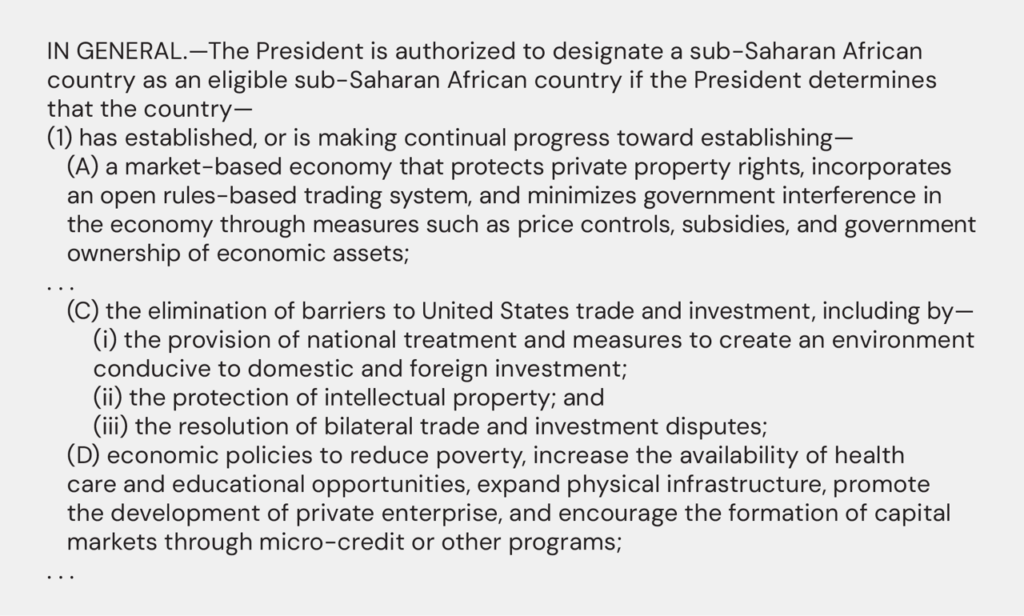
President Trump took advantage of this provision during his first term. In 2018, he opened an investigation into an import ban that Tanzania, Uganda, Kenya, and Rwanda implemented on exporters of used clothing and footwear to their countries.10Fearing losing access to AGOA’s duty-free benefits, Tanzania, Uganda, and Kenya each removed their bans on American exporters. Rwanda, on the other hand, refused to do so and was partially suspended from AGOA as a result.11
AGOA provides an opportunity for President Trump to use more targeted “carrots” in the form of providing (and then removing) duty-free access to American markets for noncompliance with trade commitments, rather than the heavy “sticks” of trade barriers — sanctions, tariffs, and export restrictions — that he has already used extensively in his second term in an ostensible effort to revitalize American manufacturing.12Relying on carrots to get countries to ease their trade restrictions with the United States reduces friction and is less likely to push those that are unhappy with American trade demands closer to the tariff-free trade opportunities offered by America’s rivals.
This is particularly important in the current geopolitical context. The United States is not the unipolar power that it once was. Washington’s ability to use coercive measures to unilaterally force countries in the Global South to bend to its desire is counterbalanced by rivals that can offer partner countries strong, and sometimes better, economic alternatives to what the Americans can offer.
American firms also benefit from AGOA’s rules of origin. Under the act’s current rules, most products are eligible for preferential trade benefits, as long as 35 percent of “direct costs of processing operations” are performed in an AGOA–eligible country.13But, in an effort to benefit American businesses, the preferential trade agreement allows 15 of that 35 percent to come from the United States. This naturally incentivizes African firms to purchase American inputs for their products, since American inputs can count toward a product’s rules-of-origin requirements.
Although different rules of origin apply to the textile industry, these rules also benefit American companies. For apparel to qualify for AGOA eligibility, 90 percent of a textile’s fabric, by weight, must come from either an AGOA country or the United States. Up to 25 percent (by weight of the total product) of the added components to a textile product — such as zippers, labels, and buttons — are allowed to come from any country in the world.
It should be noted that AGOA has an important provision allowing textiles from sub–Saharan Africa’s Least-Developed Countries, or LDCs, to qualify for AGOA no matter where the inputs come from. Eligibility under this provision is capped at seven percent of total annual apparel imports to the United States. Known as the third-country fabric provision, this rule supports textile trade from poorer countries that are unable to support the required supply chain locally, thus necessitating that they tap into a global supply network for their textiles.
Given these rules, both LDCs and other AGOA–eligible countries incentivize African firms to do business with American inputs (up to 100 percent for textile goods), thus benefitting the American textile industry.
AGOA helps to move the US–China rivalry toward positive-sum economic competition
Shifting the inevitable US–China rivalry from hard security toward more economic competition, rooted in enhanced US trade with countries across the Global South, helps to promote restraint in American foreign policy and decreases the likelihood of US–China armed conflict. Doing so requires American policymakers to shift their focus away from zero-sum security competition centered around an overreliance on deterrence — as is currently the case in the South China Sea, for example — toward a more positive-sum competition, where China and the United States are instead competing economically, including by enhancing their trade relations with states across the world.14
Looking at trade figures through the years gives insight into the extent to which the United States is slipping behind in its trade relationship with Africa. American trade with the continent has struggled in recent years. Trade data over the decades show that, despite AGOA’s preferential trade benefits, American trade with sub–Saharan Africa in 2023 (the most recent year with full data) decreased by 49 percent from its 2011 peak of $96.7 billion in total trade.15Clearly, then, AGOA cannot single-handedly increase trade between sub–Saharan countries and the US.
Although AGOA alone has been unable to increase this trade, trade between sub–Saharan countries and the US would be even lower without it, with American imports through AGOA estimated in 2023 to have been nearly $10 billion.16A major reason for the United States’ decrease in imports from AGOA–eligible countries over the years has had to do with its diminished reliance on foreign oil. While oil imports through AGOA have fallen massively (from $48.7 billion in 2011 to $1.9 billion in 2024), since 2002, American imports through AGOA in all other sectors combined have increased by $4.5 billion.17The low volume of imports from Africa means that there is room here for imports to the US to grow quite a bit without the risk of an “Africa shock” where American workers lose jobs.
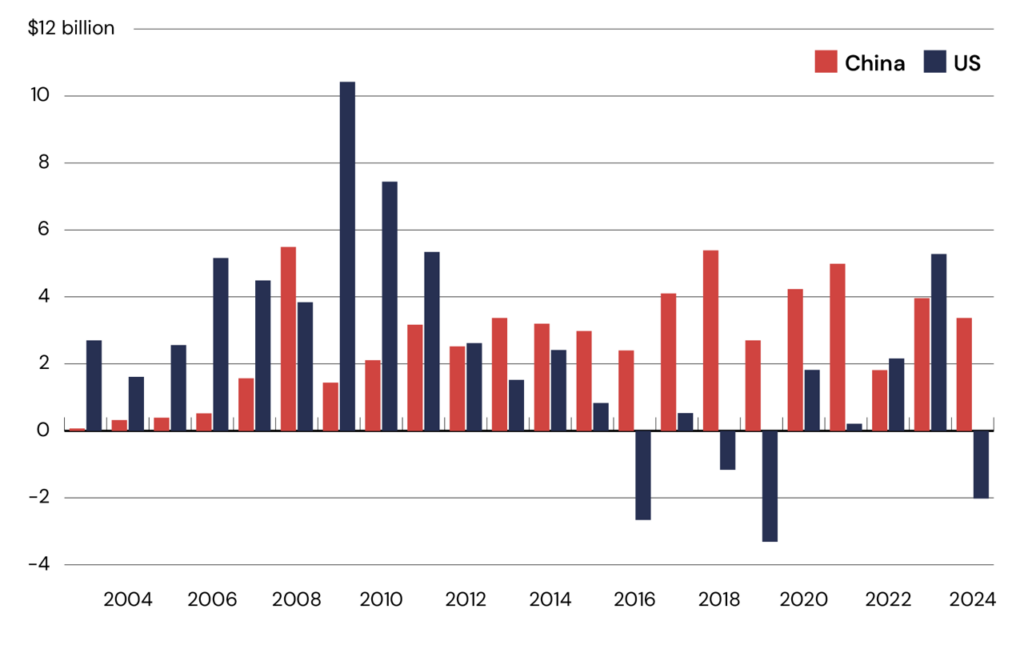
The importance of AGOA in advancing this positive-sum policy is magnified by the fact that for decades, the US government has done little else to enhance its economic relations with Africa, in stark contrast to China. While the US has prioritized counterterrorism, security, and improved governance as its principal foreign policy objectives in Africa over the past years, China has injected high levels of capital into Africa to help advance the continent’s infrastructure development. Since 2005, China has put $59.7 billion worth of Foreign Direct Investment, or FDI, into Africa, compared to US FDI flows of $47.5 billion during that time (see Figure 2).18
Figure 2: Chinese and US FDI to Africa (2003–24)
While American trade with sub–Saharan Africa has decreased over the past quarter century, sub–Saharan trade with China has increased exponentially at the same time. In 2023, the most recent year with full data, total Chinese trade with the region amounted to $234 billion, with $131 billion in exports to sub-Saharan countries and $103 billion in imports.19That is a stunning increase of 2,560 percent from China’s trade numbers with the region in 2000 ($8.89 billion in total trade, with $3.55 billion in exports and $5.34 billion in imports).20Figure 3 visualizes these figures.
Figure 3: US and Chinese Imports and Exports to Africa
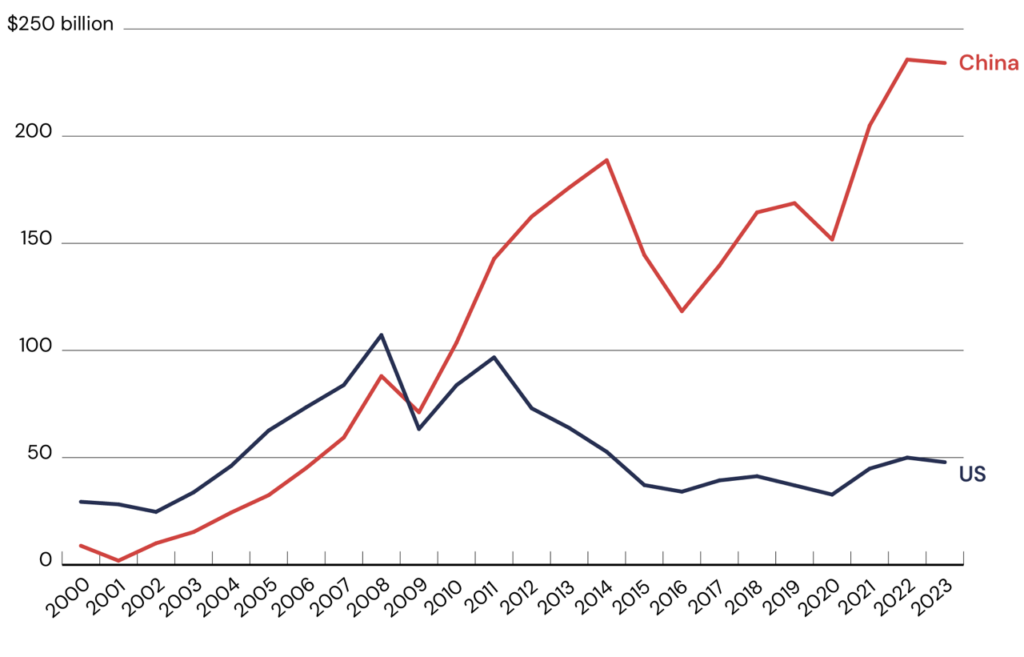
The United States now trades far less with sub–Saharan Africa than China does, with total trade between the region and the US in 2023 being $47.9 billion ($18.0 billion in exports and $29.9 billion in imports).21Although this represents a 59.5 percent increase from 2000, when total US trade with sub–Saharan Africa stood at$29.4 billion ($5.92 billion in exports and $23.5 billion in imports), it still marks a dramatic decline from its peak in 2011 ($96.7 billion).22
The stunning rise in China’s trade with sub–Saharan Africa relative to American trade with the region is the result of a concerted effort by Beijing to use its financial strength to advance the economic interests of African countries and to connect China’s consumers and producers with Africans eager to tap into global markets. Doing so has helped enhance China’s geoeconomic and geopolitical influence on the continent.
In the face of shrinking trade between the US and sub–Saharan Africa, AGOA plays an important role in being the only substantial American trade measure that seeks to improve this trade relationship. AGOA’s loss or decline would almost certainly expedite America’s retrenchment from Africa. By contrast, AGOA’s long-term renewal would serve as an indication of America’s continued interest in the economic affairs of the continent and a US commitment to promoting commerce between American and African private sector actors.
Analysis on how certain changes to a long-term AGOA could further enhance trade between the United States and sub–Saharan Africa
Building deeper trade ties through AGOA
According to a 2016 report, in the first decade-and-a-half after the act’s implementation, numerous efforts to “go beyond AGOA” by building more reciprocal and comprehensive trade agreements between the United States and Africa made little progress.23
Another decade later, it is the Trump administration’s turn to try its hand at it. Upon signing the act’s short-term renewal this February, US Trade Representative Jamieson Greer said, “AGOA for the 21st century must demand more from our trading partners and yield more market access for US businesses, farmers, and ranchers to build upon the benefits it has historically provided to Africa and the United States.”24
Indeed, the US government should take assertive steps to deepen trade with sub–Saharan Africa, including by ensuring that American firms have less trouble accessing African markets. But this should happen as a corollary to AGOA, rather than as part of an effort to completely overhaul the act and shift it from being a preferential trade agreement to a more complex one in the months before it expires at the end of 2026.
Among the biggest threats facing AGOA’s long-term success is the uncertainty about whether or not it will remain in force for an extended period.25For any trade agreement to be successful, firms need assurance that the agreement will remain active long enough to ensure sustained profitability from investments. If this certainty is not there, firms preemptively reduce their levels of trade to protect against the possibility that the trade advantages that business deals depend on disappear before sufficient profitability is achieved.
AGOA’s long-term viability is threatened by the litany of tariffs that President Trump has placed on otherwise-eligible countries. As of the most recent tariff rates, released in Aug. 2025, all sub–Saharan countries are now tariffed at 10 percent, while South Africa is tariffed at 30 percent.26
AGOA–eligible goods are not exempt from these tariff rates. As a result, though the 2025 tariffs stack on top of the previous US rates (therefore, an AGOA country tariffed by the US under Trump is still going to face a lower tariff than if it were not AGOA–eligible), the value of AGOA to these tariffed countries has severely declined.27As long as these tariffs apply to goods that would otherwise be AGOA–eligible, companies will refrain from making expensive cross-border investments at the risk that their AGOA eligibility suddenly evaporates at the whim of the American president’s subjective tariff interests.
If AGOA’s long-term authorization is held up again while negotiations continue on reciprocal trade arrangements for potentially hundreds or even thousands of product lines, the uncertainty over AGOA’s future will lead African firms to reduce their exports to the United States, which could risk a decline in the political will on both sides to renew AGOA at all, consequently hurting US–African trade overall.
Given this, the Trump administration should decouple any negotiation about reciprocal trade with sub–Saharan countries from negotiations over AGOA’s long-term future. Instead, the administration should seek to negotiate trade agreements with each country or groups of countries — such as Regional Economic Communities, or RECs — separately from AGOA negotiations. It should take the necessary time to ensure these supplemental agreements are comprehensive and sufficiently benefit both American and African profit-seeking interests. The few months’ time before AGOA expires at the end of this year is not enough for the United States to complete complex negotiations with African partners on reciprocal trade for all the product lines in question.
But then the question arises: If sub–Saharan governments already receive tariff-free access to the American market through a long-term AGOA, what is their incentive to lower trade barriers facing American products during supplemental negotiations over reciprocal trade deals?
The answer is that the United States should broaden negotiations in these supplemental trade agreements and strike deals that form more comprehensive partnerships — beyond simply duty-free trade — between American and African industries and governments.
A good reference for these types of agreements comes from the European Union, which has struck several Economic Partnership Agreements, or EPAs, with groups of states across the Global South, including in Africa.28While providing immediate duty-free access to goods being exported from partner countries to the EU, the EPAs allow partner countries to gradually remove tariffs over the course of several years, thus achieving reciprocal trade on many product lines.
Importantly, the EPAs also include other elements beyond tariff reductions to help facilitate trade between the EU and partner countries, which further cement trade relationships and economic partnerships between the various sides. Among the most effective of these is something known as “aid for trade,” which is a series of services provided by the EU to help partner countries improve operational and bureaucratic processes in order to improve efficiency with the aim of providing downstream benefits for international trade. The EU does this, in part, by offering training and other forms of assistance, like blended finance, in order to help partner countries and their firms tap into global markets and increase exports. EU aid includes services to help partner countries harmonize laws and support the financing of and provide expertise for the construction of infrastructure projects that can then help facilitate cross-regional and global trade. Other forms of aid include providing logistical, operational, and financial support to better integrate local and regional value chains.29
It is important to underline that such aid is specifically geared toward increasing trade between the EU and partner Global South countries. A similar program offered by the United States would squarely fit into the Trump administration’s desire to expand two-way trade between the US and Africa. This would indeed be aid for trade — not aid despite trade, nor aid in place of trade.
The US government can do this in part by leaning on the Development Finance Corporation, or DFC, to enhance America’s trade and financial relationship with sub–Saharan countries. The DFC has several tools at its disposal by which it can support the expansion of US–African trade and investment, including through equity and debt investments, which it can use to help improve the investment climate for international and local firms looking to build complex, intra–African value chains that require heavy capital investment.
AGOA has an opportunity to tap into greater intra–African trade
For years, Africa has been working to better integrate continental trade through the creation of the African Continental Free Trade Area, or AfCFTA.30Although still in the process of being formed, the AfCFTA aims to eventually eliminate tariff barriers on 90 percent of goods and services and further consolidate intra–African trade.31
Over the coming years, as new provisions of the AfCFTA are ratified by African states and as intra–African trade becomes increasingly liberalized as a result, AGOA will need to tap into the benefits brought forth by heightened levels of intra–African trade, which, according to the United Nations Economic Commission for Africa, is expected to increase by 35 percent over the next 20 years.32One way to ensure AGOA can benefit from the increased trade liberalization of the AfCFTA is to ensure its rules of origin expand to include North African countries.
Whereas AGOA only provides preferential trade access for the countries of sub–Saharan Africa, the AfCFTA encompasses the entire continent, including the North African countries whose geographic location makes them ineligible for AGOA benefits. As the AfCFTA solidifies over the coming years, and as intra–African commerce expands across the continent, trade between companies in sub–Saharan Africa and those in North Africa will almost certainly increase substantially. If AGOA’s rules of origin are not adapted for the increased trade between the two regions, AGOA will fail to maximize its potential.
Human rights and governance standards
Among the biggest debates surrounding a potential AGOA renewal has to do with the parameters that can lead a country to be deemed ineligible for AGOA’s preferential trade benefits.33Figure 4 lists the original 2000 law’s human rights and governance requirements for eligibility.34
Figure 4: Trade Barrier Eligibility Requirements for AGOA
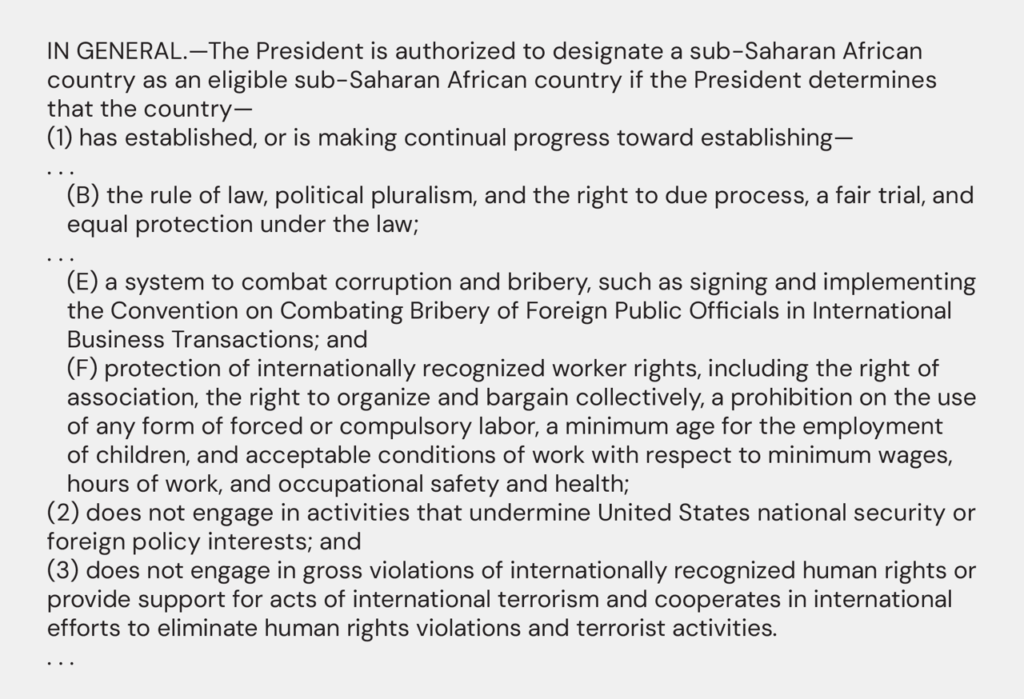
A quarter century of AGOA has proven that the act’s human rights requirements have done little in practice to improve Africa’s human rights or governance situation. Instead, they have only served to limit trade by kicking countries out of AGOA and disincentivizing businesses from making long-term investments due to uncertainty about a country’s future AGOA status.
Currently, 15 sub–Saharan countries (out of 47; almost one-third) are deemed ineligible to receive any AGOA benefit for their failure to abide by subjective human rights or governance standards.35
Although there are a few cases where countries that had previously been deemed ineligible for AGOA benefits for failing to meet human rights or governance standards have since been reinstated after making improvements, the majority of countries suspended have not made the progress deemed necessary to regain eligibility. And many of those that were previously suspended and then reinstated have since been suspended again, often for governance backsliding. Examples include Mali, Niger, Guinea, and the Central African Republic.36
An example of the slippery slope created by arbitrarily linking a trade agreement with human rights and governance standards is the case of South Africa. A bill introduced by Senator John Kennedy, Republican of Louisiana, in Sept. 2025 for AGOA’s short-term renewal included a provision that demanded the review of the bilateral relationship between the United States and South Africa, with the possibility that this review would lead to South Africa’s removal from AGOA entirely.37
This bill came in the wake of months of tense relations between President Trump and South African President Cyril Ramaphosa, during which Trump accused the South African government of supporting a genocide against the country’s white population and unjustly expropriating land from white South Africans.38Ramaphosa denied the accusations but is now forced to deal with an antagonistic Trump administration, which disinvited South Africa from this year’s G20 meeting in Florida.39
The short-term AGOA renewal that was signed this February does not include any reference to South Africa, but debate continues over whether the country will be afforded preferential trade status in a long-term AGOA renewal or whether ill-defined governance and human rights standards will be used to argue for its expulsion from AGOA.40
Recommendations for long-term AGOA renewal
Renewal and timeline. As the analysis section of this brief has shown, AGOA is too important to lapse again. As many in the private sector advocate, the act should be extended for at least one decade in order to provide assurance to businesses making expensive foreign investments that it will remain in force long enough for them to see substantial returns.41If not renewed for at least 10 years, businesses will lack the economic certainty to commit expensive, long-term investments, which will likely lead to less investment and trade between the United States and sub–Saharan Africa.
Exempt AGOA beneficiaries from US tariffs. The Trump administration’s widespread and arbitrary tariffs on AGOA–eligible countries are detrimental to the act’s purpose and counterproductive for American efforts to improve trade with the region. Only about one percent of goods imported to the United States come from sub–Saharan Africa, making any revenue gain from tariffing these countries negligible.42In contrast, Trump’s widespread tariffs risk severely hurting American goodwill in Africa, rendering AGOA practically irrelevant for tariffed countries.
In order to allow AGOA to retain its strength and achieve its objective of increasing export flows from Africa to the United States, its renewal should exempt all products from sub–Saharan countries that receive the act’s preferential trade benefits from facing Trump’s tariffs.
Remove human rights and governance standards from AGOA. Instead of advancing human rights and good governance, the AGOA’s requirements for countries to achieve certain levels in both have severely limited the act’s success as a trade agreement by cutting countries out of the deal and causing uncertainty among businesses looking to make long-term investments. These parameters have also worsened labor conditions and increased unemployment in the countries that have been suspended from the agreement.43
Human rights and governance monitoring requires entirely different metrics of measurement and tracking than trade does. Conflating the two leads to an agreement that gets bogged down by matters that have nothing to do with trade, while leading to a perception that Americans are patronizing Africans about human rights issues that, in many cases, the US does not apply to itself. In a post-unipolar world, this is neither sustainable nor practical.
Retain South Africa as an AGOA–eligible country. As a corollary to the above recommendation, South Africa’s AGOA eligibility should be maintained and should never be threatened by arbitrary human rights and governance considerations.
As Africa’s largest economy and the largest African trade partner with the United States, South Africa is a major economic force and a gateway for American firms looking to deepen trade with the continent.44More than 600 American businesses operate in South Africa, with many housing their regional headquarters in the country. Removing South Africa from AGOA would hurt the act’s credibility, weaken US–Africa trade overall, and increase the difficulty that American firms face when looking to access African markets through one of the continent’s main entryways.45
Expand AGOA’s rules of origin to include value addition coming from North Africa, thereby better aligning the agreement with intra–African integration trends. As intra–African trade through AfCFTA further integrates over the coming years, AGOA needs to adapt so that it can take advantage of the deepening continental value chains coming from AfCFTA. Modernizing AGOA’s rules of origin is an easy first step to take.
To allow products that rely on supply chains that crisscross sub–Saharan Africa to qualify for preferential status, AGOA’s rules of origin currently allow for “regional accumulation,” where the 35 percent local value-add requirement for most products to qualify for AGOA eligibility can be achieved by stacking value additions from various AGOA–eligible countries. So, if 10 percent of a product’s value is made in one AGOA–eligible country, 10 percent in another, and 15 percent in a third (thus, 35 percent in total), that product would qualify for AGOA eligibility, as each country’s value-addition percentage can be stacked on top of the others.
But one key difference between AGOA and AfCFTA is that the latter applies to the whole continent, whereas North African states are automatically omitted from AGOA purely because of their geographic location. Thereby, under AGOA’s current rules of origin, a firm looking to trade a product through AGOA cannot count any value addition that its product receives from North Africa as local value addition.
In order to ensure AGOA eligibility for goods is not hindered by the increased trade that will exist between the countries of sub–Saharan Africa and North Africa as the AfCFTA’s provisions widen in the coming years, AGOA’s rules of origin should be updated to allow for value addition from North African countries to count as part of the “stacked” 35 percent local value-add required for an item to be AGOA–eligible.
The question of whether to include North African countries in AGOA as full participants is a broader discussion and could be considered as well; but, as a key first step, a renewed act’s rules of origin should include North African countries.
Keep AGOA as a preferential trade agreement, and have all negotiated reciprocal trade agreements be supplemental trade and investment deals. The potential that AGOA might lapse again, as negotiations over its long-term future get bogged down by demands over reciprocal trade preferences, is too great a risk to take. With just over eight months until AGOA’s expiration, there is not enough time to enter into the complex debates surrounding reciprocal trade for thousands of goods across all of sub–Saharan Africa.
This is not to say that the United States should not seek more advantageous access to African markets; indeed, it should. But this access should come in agreements that work in tandem with but are separate from AGOA, so that any potential breakdown in these negotiations does not lead to AGOA’s demise. These supplemental agreements should be deeper than just reciprocal trade preferences and should consider mirroring the Economic Partnership Agreements that the EU has struck with countries across the Global South on a range of issues with the ultimate objective of further integrating EU–Global South trade.
The DFC, which President Trump has repeatedly lauded for its ability to use capital to improve American foreign policy interests as well as the interests of the US private sector across the world, could play a role in potential supplemental trade agreements between the two sides.46
The DFC could be used to help finance private sector investments as part of broader trade agreements, helping sub–Saharan states improve logistical operations and deepen local value chains to make it both easier for local firms to export to the United States as well as for American firms to export to Africa.
Using the Development Finance Corporation to support American–African trade and investment. The DFC has several tools to help support companies of various sizes looking to invest in developing countries across sub–Saharan Africa. Long-term investment projects that replicate the Lobito Corridor across Angola, the Democratic Republic of Congo, and Zambia could help consolidate infrastructure across sub–Saharan Africa, which can help AGOA–eligible goods reach American markets while also facilitating the delivery of American goods to African markets.
Meanwhile, the DFC can provide critical political risk insurance to companies seeking to do business in parts of sub–Saharan Africa where the chances of political interference or the sudden change of a country’s governance structure risks hindering their profitability. Providing political risk insurance is a far better way to respond to governance threats locally than by forcing countries to live up to arbitrary standards and unilaterally determining which countries to remove from AGOA eligibility. Loans and equity investments in both local African companies and foreign companies can also reduce the risk of doing business and help provide financing for firms struggling to match the heavy capital demands required to build transnational portfolios.
The DFC also provides project development support through a range of different activities, including supporting the creation of feasibility studies, environmental and social impact studies, and front-end engineering design work. All of this could be included as part of potential supplemental agreements in the vein of the EU’s EPAs.
Conclusion
A long-term AGOA renewal is essential for the relationship between the United States and Africa, as it helps to retain American economic engagement with a growing continent whose markets are thirsty for international goods and whose sellers are looking to reach consumers far beyond Africa’s shores. But AGOA alone is not enough to sufficiently integrate trade between the United States and Africa. Supplementing the act with additional trade agreements that resemble the EU’s Economic Partnership Agreements would help to “go beyond AGOA” and significantly deepen trade and financial relations between the United States and sub–Saharan countries. And expanding AGOA’s rules of origin to include value addition from North African countries could also serve as a first step to an expanded act that eventually allows the entire continent to receive all of the act’s trade preferences.
While the long-term future for US–Africa trade should run deeper and seek ways to augment and expand what AGOA has started, the immediate focus must be on moving quickly to renew the preferential trade agreement by ensuring it protects the interests of the American and Africans looking to trade with each other.
As such, the following should be considered as part of AGOA’s renewal debate:
- AGOA should be renewed for at least a decade to allow for companies to make long-term investments in US–African trade.
- To protect AGOA’s value to the region, the Trump administration should remove tariffs on all AGOA–eligible goods.
- A long-term AGOA renewal should not include any human rights or governance standards.
- South Africa should not lose its AGOA eligibility for issues that have nothing to do with trade.
- To better integrate with intra–African trade through AfCFTA, AGOA should allow local value addition to include all added value from North Africa.
- AGOA should remain a preferential trade agreement, and any effort to expand reciprocal trade should come in the form of supplemental agreements that are negotiated and agreed to independently.
- The US government should use the DFC to augment its offerings as part of these supplemental trade and economic agreements between the United States and Africa.
A discussion of a new QI brief on U.S.-Cuban relations. We discuss the future of the USMCA. Related
Getting to a Pragmatic Cuba Policy for the United States
The USMCA Review: What Future for North American Economic Integration?
Program
Countries/Territories
Entities
Authors

Dan M. Ford is a research associate in the Global South Program at the Quincy Institute for Responsible Statecraft (QI). He primarily researches and writes about US foreign policy towards Africa, with a particular focus on the intersection of critical…
Citations
Trade and Development Act of 2000, Pub. L. No. 106-200, 114 Stat. 251 (2000), available via the Library of Congress website at https://www.congress.gov/106/statute/STATUTE-114/STATUTE-114-Pg251.pdf. ↩
Akisa Wander, “Thousands of Workers in Limbo as US–Africa Trade Deal Set to Expire,” BBC, Sept. 30, 2025, https://www.bbc.com/news/articles/c1kwrv9k4eno. ↩
“Statement by Ambassador Jamieson Greer on the Reauthorization of the African Growth and Opportunity Act,” Office of the US Trade Representative, press release, Feb. 3, 2026, https://ustr.gov/about/policy-offices/press-office/press-releases/2026/february/statement-ambassador-jamieson-greer-reauthorization-african-growth-and-opportunity-act. ↩
“National Security Strategy of the United States of America,” The White House, Dec. 2025, https://www.whitehouse.gov/wp-content/uploads/2025/12/2025-National-Security-Strategy.pdf. ↩
Jennifer Kates, Anna Rouw, and Stephanie Oum, “US Foreign Aid Freeze & Dissolution of USAID: Timeline of Events,” KFF, Oct. 24, 2025, https://www.kff.org/global-health-policy/u-s-foreign-aid-freeze-dissolution-of-usaid-timeline-of-events. ↩
“Human Development,” African Development Bank Group, https://www.afdb.org/en/knowledge/publications/tracking-africa’s-progress-in-figures/human-development; NJ Ayuk, “Africa’s Demand for Refined Products to Surge into 2050,” African Energy Chamber, Nov. 30, 2025, https://energychamber.org/africas-demand-for-refined-products-to-surge-into-2050. ↩
Gracelin Baskaran, “Why Is Renewing AGOA Strategic for US–Africa Minerals Diplomacy?” Center for Strategic and International Studies, Sept. 3, 2025, https://www.csis.org/analysis/why-renewing-agoa-strategic-us-africa-minerals-diplomacy. ↩
“Connecting the Democratic Republic of Congo, Zambia, and Angola to Global Markets through the Lobito Corridor,” European Commission, https://international-partnerships.ec.europa.eu/policies/global-gateway/connecting-democratic-republic-congo-zambia-and-angola-global-markets-through-lobito-corridor_en. ↩
Trade and Development Act of 2000. ↩
Allan Olingo, “Tanzania, Uganda Survive as Rwanda Is Removed from AGOA Beneficiaries List,” tralac, April 3, 2018, https://www.tralac.org/news/article/12904.html. ↩
2018 Biennial Report on the Implementation of the African Growth and Opportunity Act (Washington, DC: USTR, 2018), 12, https://ustr.gov/sites/default/files/2018_AGOA_Implementation.pdf. ↩
Karthik Sankaran, “Linking Tariff ‘Deals’ to US Security Interests Is Harder than It Looks,” Responsible Statecraft, Aug. 5, 2025, https://responsiblestatecraft.org/trump-tariffs-2673858212; Keigh E. Hammond and William F. Burkhart, Presidential 2025 Tariff Actions: Timeline and Status, CRS report R48549 (Washington, DC: Congressional Research Service, 2026), https://www.congress.gov/crs-product/R48549. ↩
“Summary of AGOA Textile, Apparel, and Footwear Provisions,” US Department of Commerce, Office of Textiles and Apparel, https://www.trade.gov/sites/default/files/2023-06/OTEXA website summary of AGOA provisions 04_04_2019.pdf. ↩
Sarang Shidore, “Defending Without Provoking: The United States and the Philippines in the South China Sea,” Feb. 12, 2025, https://quincyinst.org/research/defending-without-provoking-the-united-states-and-the-philippines-in-the-south-china-sea. ↩
“United States Trade Balance, Exports and Imports, by Country and Region 2023,” World Bank, World Integrated Trade Solution, https://wits.worldbank.org/CountryProfile/en/Country/USA/Year/2023/TradeFlow/EXPIMP. ↩
2024 Biennial Report on the Implementation of the African Growth and Opportunity Act (Washington, DC: USTR, 2024), 8, https://ustr.gov/sites/default/files/2024 AGOA Biennial Report 6-27-2024 PDF.pdf. ↩
Michael H. Gary and Hugh Grant-Chapman, “What’s Next for AGOA?” Center for Strategic and International Studies, Nov. 6, 2025, https://www.csis.org/analysis/whats-next-agoa. ↩
“Chinese Investment in Africa,” Johns Hopkins School of Advanced International Studies, China–Africa Research Initiative, https://www.sais-cari.org/chinese-investment-in-africa. ↩
“China Trade Balance, Exports and Imports by Country and Region 2023,” World Bank, World Integrated Trade Solution, https://wits.worldbank.org/CountryProfile/en/Country/CHN/Year/2023/TradeFlow/EXPIMP. ↩
“China Trade Balance, Exports and Imports by Country and Region 2000,” World Bank, World Integrated Trade Solution, https://wits.worldbank.org/CountryProfile/en/Country/CHN/Year/2000/TradeFlow/EXPIMP. ↩
“United States Trade Balance … 2023,” World Bank. ↩
“United States Trade Balance, Exports and Imports by Country and Region 2000,” World Bank, World Integrated Trade Solution, https://wits.worldbank.org/CountryProfile/en/Country/USA/Year/2000/TradeFlow/EXPIMP; “United States Trade Balance … 2023,” World Bank. ↩
Beyond AGOA: Looking to the Future of the US–Africa Trade and Investment (Washington, DC: USTR, 2016), https://ustr.gov/sites/default/files/2016-AGOA-Report.pdf. ↩
“Statement by Ambassador Jamieson Greer,” Office of the US Trade Representative. ↩
Oge Onubogu, “AGOA’s Uncertain Future: What’s at Stake for US–Africa Trade,” Center for Strategic and International Studies, Oct. 1, 2025, https://www.csis.org/analysis/agoas-uncertain-future-whats-stake-us-africa-trade. ↩
Karen Mathiasen and Nico Martinez, “US Tariff Tyranny and Africa: An Update,” Center for Global Development, Aug. 13, 2025, https://www.cgdev.org/blog/us-tariff-tyranny-and-africa-update. ↩
Wolfgang Britz, Zoryana Olekseyuk, and Tim Vogel, “Killing AGOA Softly? The Impact of Trump’s Tariffs for Sub–Saharan Africa,” German Institute of Development and Sustainability, Sept. 2025, https://doi.org/10.23661/ipb9.2025. ↩
“Economic Partnerships,” European Commission, https://policy.trade.ec.europa.eu/development-and-sustainability/economic-partnerships_en. ↩
The European Union’s Cooperation with the Southern African Development Community: Working Together for a Better Future (Gabarone: EU, 2021), https://www.sadc.int/sites/default/files/2021-08/EU-SADC_leaflet..pdf. ↩
“The African Continental Free Trade Area,” African Union, https://au.int/en/african-continental-free-trade-area. ↩
Caroline Kende-Robb, “6 Reasons Why Africa’s New Free Trade Area Is a Global Game Changer,” World Economic Forum, Feb. 9, 2021, https://www.weforum.org/stories/2021/02/afcfta-africa-free-trade-global-game-changer. ↩
Francis Mangeni and Andrew Mold, hosts, Foresight Africa, podcast, “The Promise of Free Trade and Integration across Africa’s Nations,” Brookings Institution, Oct. 2, 2024, https://www.brookings.edu/articles/the-promise-of-free-trade-and-integration-across-africas-nations. ↩
Milkee Bekele, “Establishing the Link: How Human Rights Preservation Impacts AGOA Eligibility,” Wilson Center, March 29, 2024, https://www.wilsoncenter.org/blog-post/establishing-link-how-human-rights-preservation-impacts-agoa-eligibility. ↩
Trade and Development Act of 2000. ↩
“AGOA Eligible and Ineligible Countries — 2025,” Office of the United States Trade Representative, Dec. 21, 2024, https://ustr.gov/sites/default/files/2025 List of AGOA Eligible and Ineligible Countries 12212024.pdf. ↩
“US Terminates AGOA Trade Preference Program for Ethiopia, Mali and Guinea,” Office of the United States Trade Representative, press release, Jan. 1, 2022, https://ustr.gov/about-us/policy-offices/press-office/press-releases/2022/january/us-terminates-agoa-trade-preference-program-ethiopia-mali-and-guinea; Gloria Aradi, “US to Remove Uganda and Three Other African Countries from AGOA Trade Deal,” BBC, Oct. 31, 2023, https://www.bbc.com/news/world-africa-67236251. ↩
AGOA Extension and Bilateral Engagement Act of 2025, S. 2958, 119th Cong. (2025), available via the Library of Congress website at https://www.congress.gov/bill/119th-congress/senate-bill/2958. ↩
“Watch: President Trump Clashes with South African President Ramaphosa in Oval Office Meeting,” posted May 21, 2025, by CNBC Television, YouTube, https://youtu.be/ytJA8fwP728. ↩
Dan M. Ford, “Boycott of G20 Is Shortsighted and Hurts US Just as Much,” Responsible Statecraft, Nov. 19, 2025, https://responsiblestatecraft.org/us-boycott-g20. ↩
Yinka Adegoke, “South Africa’s AGOA Uncertainty Still Looms,” Semafor, Jan. 14, 2026, https://www.semafor.com/article/01/14/2026/south-africas-agoa-uncertainty. ↩
Laura Husband, “Explainer: Why US Should Renew AGOA for Over Decade before 2025 Expiry,” Just Style, June 12, 2024, https://www.just-style.com/features/explainer-why-us-should-renew-agoa-for-over-decade-before-2025-expiry. ↩
“Trade in Goods with Sub Saharan Africa,” US Census Bureau, https://www.census.gov/foreign-trade/balance/c0019.html. ↩
Milkee Bekele, “Establishing the Link: How Human Rights Preservation Impacts AGOA Eligibility,” Wilson Center, March 29, 2024, https://www.wilsoncenter.org/blog-post/establishing-link-how-human-rights-preservation-impacts-agoa-eligibility; Martin K.N Siele, “Biden’s AGOA Decision Will Hurt Ugandan Exporters,” Semafor, updated Nov. 2, 2023, https://www.semafor.com/article/10/31/2023/biden-suspends-uganda-niger-gabon-and-car-from-agoa-trade. ↩
“GDP (Current US$): Africa,” World Bank, https://data.worldbank.org/indicator/NY.GDP.MKTP.CD?locations=A9&most_recent_value_desc=true; “US Relations with South Africa,” US Department of State, Bureau of African Affairs, fact sheet, Jan. 19, 2022, https://2021-2025.state.gov/u-s-relations-with-south-africa. ↩
“US Relations with South Africa,” US Department of State, Bureau of African Affairs. ↩
Joe Deaux and Loukia Gyftopoulou, “Trump’s Push for a US Sovereign Wealth Fund Transforms an Agency,” Bloomberg, Feb. 24, 2026, https://www.bloomberg.com/news/articles/2026-02-24/us-lending-agency-wants-to-be-more-like-a-sovereign-wealth-fund; Karthik Sankaran and Dan M. Ford, “Investing in the National Interest: The DFC and American Statecraft,” Quincy Institute, Nov. 21, 2025, https://quincyinst.org/research/investing-in-the-national-interest-the-dfc-and-american-statecraft. ↩