
Rebuilding and Restraint: The DFC and the Global Energy System after the Iran War
Executive Summary
In choosing to go to war with Iran, the United States caused significant damage to many countries in the Global South. The Development Finance Corporation, or the DFC, offers a mechanism for the United States to revitalize economic ties with these countries while helping to facilitate a more dynamic global energy system built to withstand disruption and conflict.
The US and Israeli war against Iran has fundamentally changed the global energy landscape. Countries in the Global South once dependent on oil flows out of the Persian Gulf are now reconsidering their strategy and seeking alternative energy pathways, energy sources entirely outside the Middle East, and greater investment in domestic energy production.
The United States has a productive role to play in alleviating the burden of this crisis. The DFC can offer an investment-oriented approach to the Global South that both bolsters opportunities for American investment and exports and helps these countries become more resilient to external energy shocks by boosting refining capacity and building infrastructure necessary to transport and liquefy locally available natural gas. Since global energy markets reflect the balance of supply and demand around the world, such measures would also help protect American consumers from increases in the prices of fuel and refined products.
Beyond their commercial value, such projects foster diplomatic goodwill for the United States — as long as they are done transparently and without American coercion. The DFC should avoid placing conditions on investment that require coercive expulsion of the United States’ competitors, such as China, from local markets and should not use investment assistance in tandem with actions that appear to compromise local sovereignty. And while investments should increase US and global economic resilience, they should not be guided by a desire to enable American military coercion. Competing by offering better terms as a good faith investment partner, rather than seeking to use US coercive power, is the best path forward for vigorous and healthy US competition with China in the Global South.
The war against Iran has also reinforced the need to diversify energy supply beyond fossil fuels, including nuclear and geothermal. The DFC should invest in conventional geothermal technology throughout the Global South, funding the initial exploratory phase needed to identify geothermal drill sites. The Philippines, a key US ally and a China–balancer state, should be a particular point of emphasis. By tapping its massive unexploited geothermal potential, the Philippines could move toward energy independence, addressing a significant security vulnerability and helping to stabilize the Indo–Pacific region in a non-militarized manner.
Introduction
More than eight months after it began, the Iran war continues with little clarity about what will come next. But the shocks from the war mean that countries around the world, including the Global South, will seek to diversify in regional, technological, and geopolitical terms, launching projects costing tens or even hundreds of billions of dollars.
Participation in this process will gain investment opportunities and markets for US firms and bolster US national security through more resilient supply chains. And the war has demonstrated that energy markets are global, so shocks in these markets can feed back into the broader US economy. Consequently, creating a more resilient global energy system in the aftermath of the war is in the interest of the United States.
Meanwhile, China is seen not only as distant from the causes and the conduct of the war but also as a leader in many key alternative technologies that countries will seek in the conflict’s wake. China is therefore likely to play a big part in the reordering of global energy systems. This in turn means that the United States needs to be present in strength as a commercial competitor of China, giving the International Development Finance Corporation, or the DFC, a key role in enhancing American influence and securing American interests. American absence from this process could heighten US–China and other bilateral tensions if the United States feels “boxed out” from some parts of such reordering. Conversely, US efforts to exclude China could do the same if countries feel their economic and diplomatic autonomy is being threatened. Instead, transposing such rivalry to the field of commerce would keep such competitive impulses alive but sublimate them in ways less threatening to peace.
Therefore, participation in the above processes of reconstruction (and redesign) of global energy and industrial infrastructures would serve America’s economic, security, and diplomatic interests. But the DFC will need to be attentive to certain key principles in this process. While its activities should be grounded in America’s diplomatic and commercial interests, projects that either follow in the wake of military coercion or are intended to enable such coercion will increase financial and political risks for both the DFC and for America.
The DFC will also need to be alert to the pace of technological change. Pursuing a strategy of “American Energy Dominance” grounded solely in fossil fuel expertise and exports could not only miss out on commercial (and diplomatic) opportunities in alternative energy sources but also carry financial costs. Projects should be pursued in a spirit of open competition rather than one that seeks to demand the preemptive exclusion of strategic rivals; a step that could lead to increased tensions with countries that might balk at American diktats against their commercial or technological choices. Insisting on such exclusion as a condition of financing could cost the DFC business opportunities and undermine both America’s competitive standing and its soft power.
Finally, extractive and opaque structures would be counterproductive, as they would be at odds with the now-customary framing of the DFC as a superior alternative to extractive and opaque practices from the United States’ strategic rivals (a claim that itself plays better in Washington than in other capitals).
Landscape of US development finance
President Donald Trump has significantly shifted the US development landscape since taking office in Jan. 2025, turning to methods of development finance that emphasize trade and investment in place of foreign aid.
Most notably, the administration pushed heavily for a significant expansion of the DFC and, in January, signed into law a renewed DFC whose maximum contingent liability was increased from $60 billion to $205 billion.1The DFC’s toolkit was also widened with the creation of a revolving fund that will enable it to take equity stakes.
Over recent years, the US government has primarily focused its development finance footprint on enhancing supply chains to ease American access to critical minerals and other commodities seen as necessary to advance US technological innovation.2Much of this investment has been centered around projects to develop transportation corridors, enhance telecommunications infrastructure, and build ports to help goods reach international markets.
With the demand for development finance skyrocketing since the start of the Iran war, US offerings need to expand beyond a narrow focus on critical minerals, seemingly the most oft-cited rationale for the expansion of the DFC.3
Instead, there will be both economic and diplomatic opportunities for the DFC in assisting the Global South to rebuild and diversify after the war. The industries most damaged by the war — and, thus, most in need of American development finance — include physical infrastructure used in the energy sector as well as the many petrochemical industries that run downstream of oil and gas.4The ill-conceived war in Iran has caused direct and indirect damage to a number of industries across the Persian Gulf and broader Global South, which will need to be rebuilt. Many of these projects will also be profitable for US businesses, as the hard-hit sectors that require reconstruction are also linchpins of the global economy.
While doing so, American development financing should help countries build technologically advanced energy systems that can withstand future geopolitical crises. This will include investment in both fossil fuel sources and alternative energy options (including nuclear and renewables), consistent with the “all of the above” energy strategy pursued by many Global South states.
The DFC and the postwar reconstruction of global energy markets
The experience of the Iran war has scarred countries of the Global South, pushing them to seek both increased resilience and further development opportunities by diversifying away from excessive dependence on Persian Gulf energy. This sentiment is particularly pronounced in Asia, the region that has most depended on oil and gas from the Middle East.5
Figure 1: World oil trade
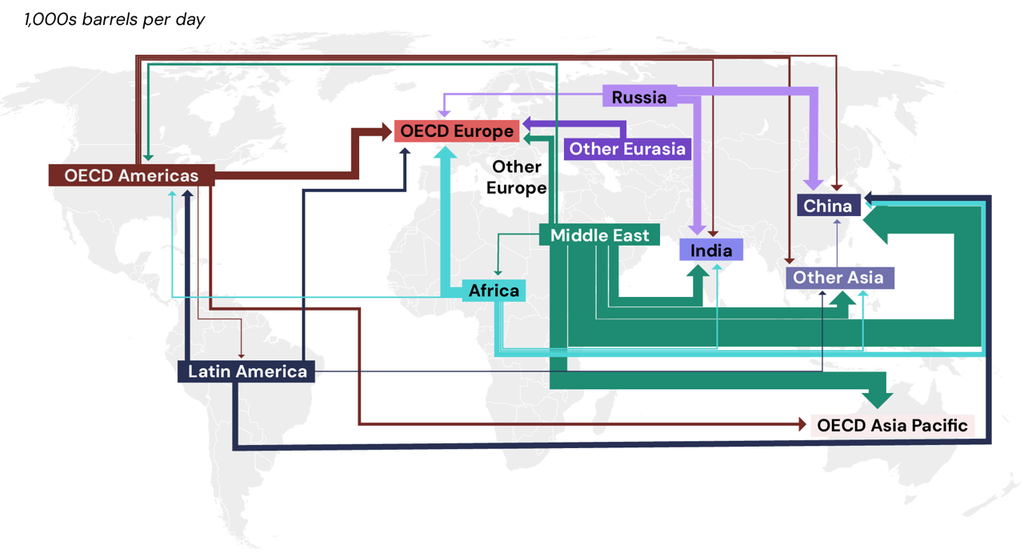
The effects of the war come amid projections of substantial increases in global energy demand, driven by increasing global prosperity and rapid technological change. The Organization of the Petroleum Exporting Countries, or OPEC, sees global energy demand rising by 23 percent through 2050, with increased electrification being a key factor, and projects an 86 percent increase in electricity demand.6
Patterns of supply are also likely to look very different as countries seek resilience by diversifying the geography of fossil fuel sources, energy transportation routes, and energy technologies. These shifts will provide opportunities for the United States, but they need to be navigated carefully given different possibilities for the future of the global energy mix.
One important point to note from OPEC’s own World Oil Outlook is that, while the organization’s base case foresees continuing increases in the demand for oil and gas through 2050, alongside a sharp reduction in coal use, it also anticipates dramatic increases in nonfossil energy sources.7The United States will need to be present in arenas other than oil and gas to capitalize on the opportunities that arise in a reshaping of the global energy landscape.
This is particularly the case as China has increasingly become the dominant power in the international alternative energy trade, exporting $290 billion of clean energy technologies in the 12 months through August 2026.8The United States could react to this development by treating imports of such technologies as an unfriendly act that is to be condemned or sanctioned; a stance that would increase tensions with countries of the Global South at the receiving end of such measures. Alternatively, it could develop competitive offerings in specific areas of US alternative energy expertise.
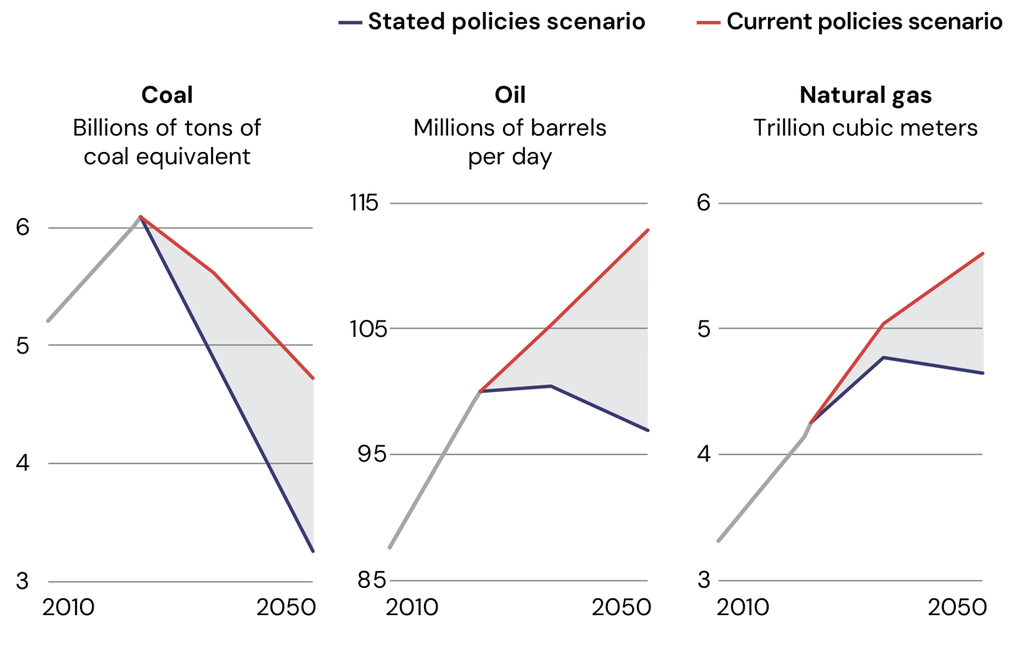
The figure below shows OPEC’s projections for demand from different sources of energy through 2050. The International Energy Agency, or the IEA, concurs with OPEC’s projections in its scenario where countries make no change in their current policies beyond what is already in place. However, under its alternate “stated policies” scenario, which is based on policies formally tabled but not yet adopted, and other indications of future policy, the IEA sees oil demand peaking at 102 million barrels per day in 2030 and then flattening out through 2050.9A broad point of commonality between OPEC and the IEA is that both see substantial additions to global energy demand over the next quarter-century being met to a greater degree by renewables than by fossil fuels, but with oil and natural gas largely persisting and coal suffering the deepest decline in demand.10
Figure 2: Global growth in demand by fuel type, 2025–50
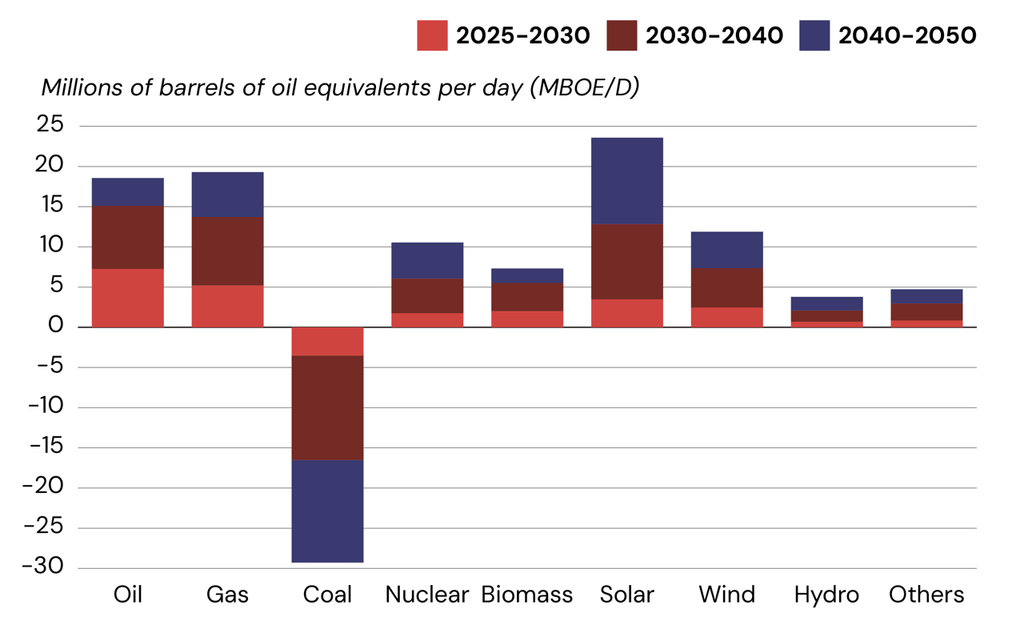
Figure 3: Growth in primary energy demand by region, 2025–50
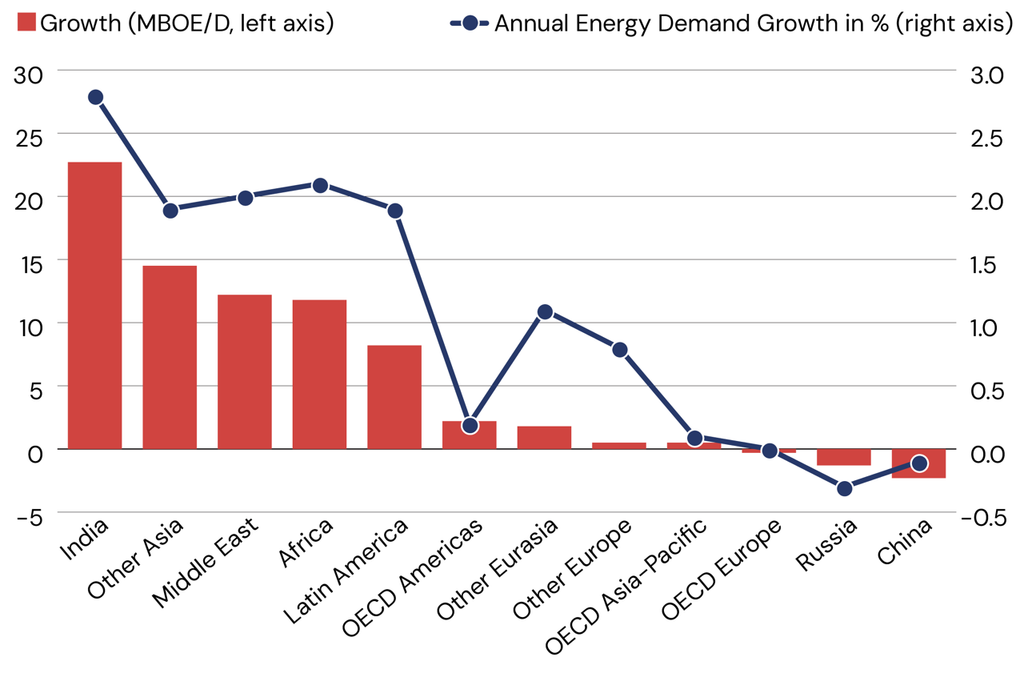
These trends, combined with countries’ moves to reduce dependence on Persian Gulf supply, will create opportunities to expand US energy production and exports, as laid out in President Trump’s agenda of Energy Dominance.11At the same time, the United States will need to be mindful of other countries’ desires to avoid excessive dependence, not just on any single external supplier but also on any single source of energy.
So, American financial and diplomatic interests will be best served by the DFC supporting a broader palette of sources and technologies at different points in energy production, storage, transmission, and use supply chains.
All this is happening against a backdrop of the IEA projecting massive increases in energy demand over the next 25 years, even as the United States has become the world’s largest producer of oil, where it accounts for a fifth of global oil production, and of gas, where it accounts for roughly 30 percent of global gas production and 26 percent of global exports of liquefied natural gas, or LNG, according to the Energy Institute.12
This extraordinary switch in the US energy balance over a little more than a decade owes to the shale revolution in oil extraction technology, which in turn has become a key DFC talking point. America’s interests are seen in making new areas available for its oil companies to explore and produce fuel and building out the infrastructure that enables more countries to import LNG.
Within the Global South, there are many regions looking to expand domestic production of fossil fuels. The United States is extremely supportive of such efforts, particularly in Latin America. DFC CEO Ben Black said in early June that, by 2030, 44 percent of all new global demand was going to be met by the Western Hemisphere, with Argentina, Brazil, Venezuela, and Guyana all needing a build-out of infrastructure to enable this.13
Since the United States jailed former Venezuelan President Nicolás Maduro and installed a new government led by Vice President Delcy Rodríguez, extensive opportunities exist for Washington to invest in Caracas’s oil industry.
But Venezuela embodies both opportunities and the potential perils to US agencies, like the DFC, if they are employed as a foreign policy tool of coercion or domination rather than one grounded in the goal of pursuing investments that lead to bilateral economic benefits and enhance American soft power. The United States is claiming long-term exclusive access to an estimated 65 billion barrels of Venezuela’s oil reserves via a 100–year contract with 20 percent of production from covered wells being made available to America “at cost” and also giving it first call on the remaining 80 percent of production. But it remains unclear whether several of the provisions are consistent with the laws of both countries.14For example, Rodríguez, as “interim president” of Venezuela, may not have the authority to sign such an agreement, let alone one for 100 years; the Department of Defense does not have the authority to take equity stakes; and the role of Washington’s Venezuelan counterparty in the deal — North American Blue Energy Partners, or NABEP — might not conform with that country’s constitution, which gives state oil company PdVSA the authority to control the oil industry.15 Meanwhile, in his address to the United Nations General Assembly, President Trump said of Venezuelan oil, “To the victor belong the spoils.”16
The Venezuelan episode raises many questions about how best to position the DFC as a powerful financial tool that could serve US interests. Although the equity investment in the above instance did not come from the DFC but, rather, from the Defense Department (through so-called penny warrants that allow the acquisition of an equity stake at minimal cost), the administration has formally asked for a waiver that would permit the DFC to resume activities in Venezuela.17
One such activity might be to provide political risk insurance, but transactions and rhetoric like the above may actually raise, rather than lower, political risk over the medium term for American enterprises in Venezuela. An economic reopening of Venezuela might be welcome to the country’s citizens but less so if seen as the result of an intervention in the country’s sovereignty, with control of its resources being transferred under circumstances of limited transparency and American extractive triumphalism. Since public diplomacy around the DFC routinely invokes its superiority over an alleged Chinese model that is both opaque and exploitative, such claims would look significantly weaker if the United States engaged in imperialist rhetoric (or, worse yet, practices).
These sensitivities could be particularly acute in Latin America and the Caribbean, where the United States has been most insistent on its prerogatives under the so-called Donroe Doctrine.18America might have slightly more leeway in Africa, a continent where European powers are more associated with colonialism, and where the Iran war has exposed the vulnerabilities to external shocks from the Middle East and the economic opportunities for the continent to develop its infrastructure in energy and downstream sectors. OPEC projects that Africa’s electricity usage will increase by 2.5 times in the next 25 years, to roughly 2,500 terawatt-hours (which would still be only about one-fourth of China’s electricity usage in 2025).19
It is also critical to note that, despite the spectacular increase in domestic energy production, the United States has an interest in ensuring that energy supply outside the country increases alongside demand. This jump in prices as a result of the Iran war is a reminder that energy is a global market and that disruptions anywhere can raise prices at American pumps. The United States is a vastly more diversified economy than those of petrostates, with mining, quarrying, and oil and gas extraction accounting for only 1.2 percent of gross domestic product, or GDP, in 2025, according to the Bureau of Economic Analysis. This means that, while they might benefit America’s trade balance, high energy prices are a shock to the real incomes of those workers and households not associated with the energy industry.20
Several African countries that have deep oil and natural gas reserves also need development financing to improve infrastructure capacity, including logistical infrastructure, such as roads, railways, and pipelines. Helping develop their energy resources in parallel with other infrastructure could provide opportunities for US exporters to benefit from faster growth in African countries without increased demand leading to destabilizing increases in energy prices that spill back into the US economy.
Similarly, many African countries — particularly those in West Africa — have high-quality light-sweet oil, making the refining process less energy intensive.21Yet, other than the Dangote refinery in Nigeria, the continent lacks significant refining capacity. And here too, in a global marketplace for oil products, shortages of refining capacity outside the United States can feed back into price increases in US markets. As of this writing, events in the Persian Gulf and in the Russia–Ukraine war (where refineries have become targets of drone attacks) have pushed diesel prices to all-time highs, pressuring American farmers and truckers.22Linkages across global product markets are another argument to help build out refining capacity outside the United States.
The war has also led oil and gas producers currently dependent on the Strait of Hormuz to explore alternate pathways to export from the Persian Gulf. And the United States has just proposed an initiative that would include a $5 billion investment by the DFC (and a corresponding amount by Gulf Arab countries) to rebuild “infrastructure” in the region, with a particular focus on pipeline routes.23But Saudi Arabia’s pipeline to the Red Sea port of Yanbu has already come under attack, reportedly due to drone attacks from Iran–backed groups in Iraq.24And ports facing the Red Sea in Yemen have come under the control of Ansar Allah, better known as the Houthis, giving them the ability to harass shipping through that waterway, adding to the stress in global oil markets.25
There is also talk of refurbishing or building pipelines from Iraq through Syria (where sanctions have recently been lifted) to the Mediterranean coast. But even if such a project proceeds, it is expected to take at least four years and to cost roughly $15 billion.26Furthermore, a pipeline to the Mediterranean would service Europe, but the bulk of new demand for oil and gas is expected to come from Asia, and the projected pipeline would need to traverse areas marked by Islamic State and Iran–backed Shi`i militia activity.27Thus, while desires to diversify transit routes for energy out of the Persian Gulf might be rational, any US plans to “bypass” the strait as part of an economic pressure campaign against Iran will have to contend with the fact that the entire Gulf region is now marked by periodic outbreaks of instability, amplified by linkages across the multiple conflicts besetting it. Rather than using the DFC as a tool to facilitate conflict in an unstable Gulf, American interests would be better served by diplomatic engagement that addresses the causes of instability, creating an environment that sustains deeper economic engagement.
As noted above, a key factor helping to limit the economic impact of the war has been a dramatic increase in US energy production and exports. According to the IEA, increased production outside the Persian Gulf, led by the United States, has helped offset 70 percent of the drop in gas exports from the region.28Projections of rising gas demand and the opportunity to meet regional desires to diversify their sources of supply have also led the DFC to unveil its largest project to date: a $1.5 billion investment to build energy infrastructure in Southeast and South Asia, with a particular focus on expanding US LNG exports.29
But even as the Iran war has led to an increase in US energy exports, it has also accelerated the use of renewable energy, particularly in China. The shock from the war was muted, not just by increased energy supply from the Western Hemisphere but also by China’s ability to reduce oil demand. This points to another important consequence of the war: Countries will seek to diversify not just the geographies from where they source fossil fuels but also to diversify their energy technologies.30Sharp increases in the price of diesel have led to a surge in exports of Chinese e-trucks, for example.31
These dueling considerations will play a big part in determining an optimal strategy for the DFC’s portfolio after the war. On the one hand, gas is expected to play a key part as the global energy mix becomes increasingly dependent on electrification rather than combustion, particularly for transportation and temperature control in buildings. In addition, the technological revolution in artificial intelligence, or AI, is projected to lead to dramatic increases in electricity demand, particularly in the United States. But at the same time, there has also been a dramatic rise in projected increases in global gas supply, with the United States projected to add more than 50 percent of additional global capacity over the next five years.32
In conversations with experts, we often heard that expectations regarding broad-based Asian demand for increased US LNG supply may not be met fully. While LNG itself may be more plentiful, the costs and delays related to building LNG–fueled power plants appear to be rising. Explosive demand for power generation for data centers has led to significant increases in waiting times for gas turbines of up to three to five years.33Conversely, the Iran war has led to massive increases in Chinese exports of solar technologies. The war has also served as a reminder in some countries of the volatility of LNG pricing and the implications for balance of payments dynamics, currency performance, and inflation.34Vietnam’s largest conglomerate announced the cancellation of plans to build a large LNG–fired power plant and substituted it with renewable energy instead.35Thailand recently announced a dramatic reduction in its projected imports of LNG, doubling to 60 percent the share of energy it wishes to get from renewables and nuclear energy.36According to the consultancy Wood-Mackenzie, only one-third of planned LNG–fired power generation capacity is expected to come on line by the end of the decade.37
How should the DFC navigate the energy transition in the Global South?
This in turn suggests that, for both diplomatic and financial reasons, as countries of the Global South look to diversify their energy portfolio in the wake of the Iran war, the US development finance apparatus needs to play a larger role in financing renewable energy sources. And insofar as one of the stated rationales behind the DFC is to compete with China for diplomatic and economic influence in the Global South, the DFC needs to be present across energy technologies with compelling offerings that reflect American industrial prowess. Conversely, the absence of such offerings could cede such ground and heighten other tensions because a rival is perceived as making gains at America’s expense. The United States and the DFC should do this without treating countries of the Global South as contested terrain, with economic engagement being portrayed as a move in a “Great Game” redux.
The IEA built out projections in 2025 for what different energy source profiles might look like under two scenarios: one where countries continue on the present path, or CPS, and another where countries follow through with their commitments, or STEPS. These diagrams suggest the potential economic and diplomatic risks of an excessive focus on American or Western Hemisphere fossil fuel exports in its energy portfolio.38
Figure 4: Demand for coal, oil, and gas by scenario
These are the arguments for US development finance institutions to embrace other energy technologies, like nuclear and geothermal power, which could be particularly important in parts of Africa. Such an expansion of the technological offerings backed by the DFC (whether involving American or allied firms) would seem essential to compete with China for commercial influence, given that country’s current dominance of renewable energy industries and Russia’s major role in nuclear energy supply chains.39Among these, geothermal energy is the arena where the United States has firms with world-leading technologies, creating particular opportunities for the DFC to expand America’s role.40A case study later in this brief explores these in greater detail.
Another area of US expertise that could be backed by the DFC is electric grid management technologies, as described by Jigar Shah, former director of the Department of Energy’s Loan Program Office.41Somewhat paradoxically, this may be a result of dramatic expansions in AI–led demand colliding with local restrictions on capacity expansion. This has created incentives for better live monitoring of transmission limits and rerouting to optimize grid utilization.
Despite its attachment to fossil fuel expansion and skepticism regarding climate change, the Trump administration and Congress have both insisted that critical minerals be a strong focus of the DFC. Indeed, one of the DFC’s largest recent deals is a $565 million investment in Serra Verde, a Brazilian entity that operates the only heavy rare earth mine outside Asia.42While the US Geological Survey’s list of critical minerals includes many that are required for essential defense applications, several — including lithium, manganese, cobalt, and nickel (all of which are plentiful across the Global South) — are also mentioned as being important for batteries.43
The White House is conscious that battery technologies are key for other priorities, specifically helping provide electricity reservoirs for AI data centers and for military uses, including drones. Accordingly, as suggested in a recent report in the New York Times, the administration is supporting battery ventures to the tune of a few billion dollars.44Along similar lines, the DFC recently converted into equity a portion of a loan to the Australian miner Syrah, owner of a graphite mine in Mozambique and a graphite-processing plant in Vidalia, Louisiana, which will produce high-performance graphite anode materials for lithium ion batteries.45The current slate of DFC projects also includes project development support for a polysilicon project to allow Morocco to diversify away from Chinese suppliers, suggesting that the DFC remains interested in alternative energy technologies.46Retaining a footprint in key alternative energy technologies is essential from the point of the DFC’s diplomatic and economic goals.
Where the DFC should focus its investments moving forward
Ending gas flaring
With Global South countries looking to diversify energy options in the wake of the energy crunch brought on by the Iran war, governments are seeking to more efficiently tap into domestic energy resources.47Natural gas, which is found abundantly throughout Africa and Latin America, stands as a leading candidate.
Many Global South states, however, lack the infrastructure needed to transport and liquefy natural gas efficiently, leading to wasteful gas flaring and environmental degradation. While the estimated cost of upfront investments required to eliminate routine flaring is between $70 billion and $100 billion, the economic value of the gas flared in just a single year (2025) was an estimated $54 billion.48
Many of the world’s top flarers are in the Global South. Iran, Iraq, Venezuela, Mexico, Libya, Algeria, Nigeria, and Saudi Arabia are all among the top 10 countries in the world that flare the most gas. In 2025, gas flaring intensity (defined as the volume of gas flared per barrel of oil produced) was by far the highest in Venezuela, where nearly 40 cubic meters of gas (around 10,600 gallons) were flared per barrel of oil. The next two on the list are the Republic of Congo and Syria.49
The DFC could capitalize on the opportunities to meet energy demand across the Global South by supporting the capture, liquefaction, and energy generation of associated gas in areas where flaring is the most intense.
The conversion of gas that would otherwise be flared into usable energy does not necessarily mean using it in more traditional LNG formulations. Several other uses of gas make it worthwhile to capture and use it. For example, technology exists to convert natural gas to chemicals that have a wide range of industrial applications and can be sold on the international market. Gas can also be converted into electrical power for local power generation using small-scale generators.50DFC support in these areas could shift the economics on this issue, allowing companies to use the gas even if broader LNG demand fades over time.
According to the World Bank, 18 sites across the Global South outside the Middle East are classified as heavy gas flaring sites, defined as being over 50 million standard cubic feet (374 million gallons) per day. Six are in Venezuela, four in Mexico, three in Libya, one in the Republic of Congo, and one in Angola.51
Investments in technology required to stop flaring would benefit US interests in several ways. Geopolitically, such investments would enhance US soft power, particularly in Africa, where China is currently the dominant investor. It would also allow US energy companies to reach new markets that would otherwise be difficult or impossible to tap into. And it would do so without relying on hard security measures that risk creating a security spiral, potentially igniting a direct or proxy conflict between the United States and China, Russia, or other American rivals.
By directly supporting the electrification of the Global South, these projects would also benefit the United States by providing American exporters and importers with better access to resources and to markets. In Africa, where the United States is currently in negotiations to extend the African Growth and Opportunity Act, or AGOA — a US law offering preferential access to the US market for certain sub–Saharan exporters — improving the region’s electrification would help African goods reach American consumers, thereby enhancing AGOA’s value.52
Investing in geothermal energy
Geothermal energy is among the world’s most underutilized energy sources relative to its potential; found abundantly in many parts of the Global South but, due mostly to high cost, used rather sparingly for energy production and electricity generation.53
Next-generation geothermal systems have the capacity to produce more electricity than any renewable source, other than solar photovoltaic systems. Geothermal alone is capable of producing enough energy to create 140 times more electricity than is required by global demand.54
The United States is the global leader in geothermal energy technology, with about four gigawatts of installed geothermal capacity — equivalent to nearly a quarter of the world’s total.55These next-gen technologies allow geothermal energy to be accessed in places where traditional geothermal technology struggles to, such as sites outside high-heat fault line zones.
Across the Global South, huge opportunities exist for the exploitation of geothermal sites, particularly for countries located on fault lines, where geothermal energy is most abundant and most easily accessible.56Some countries, such as Kenya and Indonesia, have already built up strong energy generation from geothermal energy plants. In Kenya, geothermal sources currently provide enough energy to serve half of the country’s electricity needs. Meanwhile, Indonesia has installed more geothermal power than any other country in the world, save the United States. But even in these countries, massive amounts of unexplored geothermal resources exist with the potential to substantially increase power output. In Kenya, for example, about 90 percent of geothermal resources remain untapped.57
The main obstacle to expanding the construction of geothermal plants across the Global South is the up-front cost, which is often worsened by heavy red tape and bureaucratic hurdles that add expense, delay projects, and extend the time horizon for profitability.58
Specifically, exploration drilling, which can amount to about 60 percent of a geothermal project’s total costs, is the phase where capital is the scarcest to come by given the heavy financial risks involved in exploring new sites.59One of the biggest challenges facing the expansion of geothermal energy sites is that there is no way to ensure the profitability of a geothermal site until it has been drilled; an expensive proposition costing between $5 million and $20 million per well.60About 40 percent of all wells fail to provide a return, meaning many exploratory expenses end up as little more than sunk costs.61
DFC financing and project support during this exploratory early phase of project development can propel companies to take on shared early project financial risk that they would be unable to shoulder alone. Helping new projects during the early phase would allow them to get off the ground. Once a site has proven to generate sufficient levels of geothermal energy, high returns are likely to keep these projects going with minimal government support.
Successful geothermal sites using traditional extraction methods require high heat, water flow, and rock permeability; a combination most consistently found on the Earth’s fault lines. Given this geological reality, the regions across the Global South with proven high levels of geothermal capacity, and where the DFC should concentrate its investments of future geothermal projects, include the western coast of Central and South America, the Red Sea coast of Africa, and Southeast Asia.62
Although there is huge potential for next-generation geothermal technology, Noah Gordon and Liana Schmitter-Emerson of the Carnegie Endowment for International Peace argue that much of this technology will likely remain concentrated in the United States over the next decade, as costs remain prohibitively high.63
As a result, the DFC should focus on conventional geothermal technology in the near term while looking for opportunities to invest in certain next-generation technologies — such as enhanced geothermal systems and closed-loop systems — once they become viable for foreign markets. Indeed, DFC investments in these next-gen technologies could hasten their global reach.
Investing in the Philippines’ energy ambitions
The DFC should focus its energy investments in places where the confluence of high demand for new energy sources and geopolitical importance to the United States is particularly acute.
As a close US ally seeking to enhance its domestic energy portfolio amid geopolitical tension in Southeast Asia and the Middle East, the Philippines should be a priority country for DFC energy investments.64Deeper DFC development and commercial engagement in the Philippines would help enrich relations between the Southeast Asian country and the United States in the midst of growing security threats across that region in a way that is not centered on increased securitization or military engagement.
The Philippines is facing intense geopolitical and security challenges from intrusive Chinese behavior in its exclusive economic zone in the South China Sea as well as more general geopolitical disruptions caused by international crises such as the Iran war. This has created massive energy vulnerabilities for a country importing over half of its energy from abroad.65American efforts to address these vulnerabilities could make the Philippines more secure without fueling military conflict or further destabilizing the region.
Indeed, the Philippines’ energy prices have been significantly impacted by the Iran war. Although only about 13 percent of the country’s energy mix comes from oil, it imports about 90 percent of this oil from the Middle East.66The war has led to soaring gas and diesel prices, which cost businesses and public institutions across the Philippines an estimated $600 million over the first two months of the conflict.67
In an effort to protect itself from the economic and security implications of future supply chain disruptions in the energy sector caused by geopolitical crises, the Philippine government is aiming to build greater energy autonomy through a detailed plan to transition away from energy imports.68The plan calls for a massive focus on what the Philippines has — ample quantities of renewable resources. The aim is for these renewables to increase to over half of the country’s energy consumption by 2050; in 2023, about 29 percent of the country’s energy mix was renewable.69In a sign of the country’s strong desire to find global investments to enhance its domestic energy sector, it has altered its laws to allow 100 percent foreign ownership of domestic renewable energy projects.70
If the Philippines is going to meet its 2050 target, geothermal will play a major role as a sector where American technology and firms occupy a preeminent position. The Philippines is the third-largest producer of geothermal energy in the world, which accounts for approximately 14 percent of its total electricity generation.71Yet, a lot of the country’s geothermal reserves remain untapped, leaving substantial opportunities on the table for investment in new geothermal sites in support of the country’s effort to achieve greater energy autonomy.
Geopolitically, the United States would benefit from having one of its few treaty allies in the Global South achieve energy independence. The DFC should therefore back the Philippines in its effort to enhance its energy independence to support the expansion of domestic energy sources across the country.
Policy recommendations for the United States
- The DFC should actively support the efforts of countries in the Global South to strengthen their economic and financial resilience in the wake of the Iran war. These efforts will provide commercial opportunities for American firms, generate diplomatic benefits for the United States, and prevent economic and security spillbacks into the nation from stresses elsewhere in the global economy.
- The DFC should define its diplomatic goals in terms that serve to reduce, rather than increase, geopolitical tensions. The DFC should refrain from projects that emerge in the wake of US military coercion or seek to enable such coercion. Its approach to project countries should be grounded in a spirit of commercial competition, where American financial and technological prowess is shown to be superior to the alternatives presented by strategic rivals of the United States. Access to DFC offerings should not be made conditional upon the economic exclusion of America’s rivals from the economy of project countries.
- The DFC should be conscious that the Global South will seek to diversify its energy infrastructure through investment in production and consumption of both fossil fuels and alternative energy. America’s economic and diplomatic interests will be best served by a DFC presence across energy technologies that showcases not just natural gas or other fossil fuels but also geothermal and nuclear power, grid management, and batteries.
- The DFC should be cautious of invocations of “dominance” (energy or otherwise) and be aware that participation in opaque transactions can have negative diplomatic consequences for the United States and negative financial consequences for the DFC over the course of political cycles in project countries.
- The DFC should invest in boosting non-security linkages with countries across the Global South, with a particular focus on the geopolitically tense regions of Southeast Asia and East Africa. Doing so would create opportunities for greater US ties to these regions without having these connections be overly securitized.
Program
Countries/Territories
Entities
Authors

Karthik Sankaran is a senior research fellow in geoeconomics in the Global South program at the Quincy Institute for Responsible Statecraft. With a long background in financial markets and geopolitical consulting, Karthik’s interests include the structure of the international monetary…

Dan M. Ford is a research associate in the Global South Program at the Quincy Institute for Responsible Statecraft (QI). He primarily researches and writes about US foreign policy towards Africa, with a particular focus on the intersection of critical…
Citations
Ray Cai, “What Does the Development Finance Corporation Reauthorization Mean for Energy?” Center for Strategic and International Studies, Dec. 12, 2025, https://www.csis.org/analysis/what-does-development-finance-corporation-reauthorization-mean-energy. ↩
Karthik Sankaran and Dan M. Ford, “Investing in the National Interest: The DFC and American Statecraft,” Quincy Institute for Responsible Statecraft, Nov. 21, 2025, https://quincyinst.org/research/investing-in-the-national-interest-the-dfc-and-american-statecraft. ↩
“DFC CEO Ben Black Speaks on Economic Statecraft in an Age of US Energy Abundance,” Development Finance Corporation, press release, April 28, 2026, https://www.dfc.gov/media/press-releases/dfc-ceo-ben-black-speaks-economic-statecraft-age-us-energy-abundance. ↩
Spencer Kimball, “Iran War Damaged as Much as $58 Billion of Energy Infrastructure, Rystad Estimates,” CNBC, April 15, 2026, https://www.cnbc.com/2026/04/15/iran-war-energy-facilities-refinery-pipeline-lng.html. ↩
River Akira Davis, “Iran War Forces Energy Buyers to ‘Unshackle’ from Global Markets,” New York Times, July 27, 2026, https://www.nytimes.com/2026/07/27/business/natural-gas-lng-asia-exposure.html. ↩
OPEC, World Oil Outlook 2050: 2026 (Vienna: OPEC Secretariat, 2026), 6–7, https://publications.opec.org/woo/chapter/157/2942. ↩
OPEC, World Oil Outlook, 6–7. ↩
“China Cleantech Exports Data Explorer,” Ember, updated Nov. 4, 2026, https://ember-energy.org/data/china-cleantech-exports-data-explorer. ↩
IEA, World Energy Outlook 2025 (Paris: IEA Directorate of Sustainability, Technology and Outlooks, 2025), 152, 171. For text online, see the “Stated Policies Scenario” at https://www.iea.org/reports/world-energy-outlook-2025/stated-policies-scenario, and the “Current Policies Scenario” at https://www.iea.org/reports/world-energy-outlook-2025/current-policies-scenario. ↩
IEA, World Energy Outlook 2025, 171–72. ↩
“American Energy Dominance Is Back Under President Trump,” White House, press release, Feb. 24, 2026, https://www.whitehouse.gov/releases/2026/02/american-energy-dominance-is-back-under-president-trump. ↩
Energy Institute, Statistical Review of World Energy, 2026: 75th Edition (London: Energy Institute, 2026), 19, https://www.energyinst.org/statistical-review. ↩
“DFC’s Ben Black: Building Energy Infrastructure in Latin America Will Lead to More Jobs at Home,” posted June 11, 2026, by the Atlantic Council, YouTube, https://www.youtube.com/shorts/qWgNqTongkM. ↩
“Fact Sheet: President Donald J. Trump Announces Historic Oil Agreement to Secure American Energy Dominance and Drive Venezuela’s Economic Recovery,” White House, Aug. 31, 2026, https://www.whitehouse.gov/fact-sheets/2026/08/fact-sheet-president-donald-j-trump-announces-historic-oil-agreement-to-secure-american-energy-dominance-and-drive-venezuelas-economic-recovery. ↩
Jose Ignacio Hernández, “Understanding the Implications of the US–Venezuela Oil Deal,” Center for Strategic and International Studies, Sept. 4, 2026, https://www.csis.org/analysis/understanding-implications-us-venezuela-oil-deal. ↩
Rapid Response 47 (@RapidResponse47), “WATCH IN FULL: President Donald J. Trump delivers powerful remarks at the 81st session of the United Nations General Assembly in New York City,” X, Sept. 22, 2026, https://x.com/RapidResponse47/status/2102418866966253677. ↩
For more on the Fiscal Year 2026 supplemental funding request, see Russell T. Vought, Director, Office of Management and Budget, to Mike Johnson, Speaker of the House of Representatives, letter, June 24, 2026, via the White House website at https://www.whitehouse.gov/wp-content/uploads/2026/06/2026.06.24-Letter-to-the-Honorable-Mike-Johnson.pdf. ↩
Mariam Khan, “Trump’s ‘Donroe Doctrine’ Seeks Influence over Western Hemisphere, Citing Old US Policy,” ABC News, Jan. 6, 2026, https://abcnews.com/Politics/trumps-donroe-doctrine-seeks-influence-western-hemisphere-citing/story?id=12892639. ↩
OPEC, World Oil Outlook, 370 (or see figure 8.10 at https://publications.opec.org/woo/chapter/157/2948). ↩
“Real Gross Domestic Product: Mining, Quarrying, and Oil and Gas Extraction (21) in the United States,” Federal Reserve Bank of St. Louis, updated Sept. 30, 2026, https://fred.stlouisfed.org/series/USMINRQGSP. ↩
Achraf Tijani, “Libya, Congo, Algeria: Who Has the Best Oil in Africa?” Africa Report, Aug. 26, 2021, https://www.theafricareport.com/121618/libya-congo-algeria-who-has-the-best-oil-in-africa. ↩
Siddarth Cavale, “US Diesel Prices Hit Record High as Conflicts Intensify Supply Crunch,” Reuters, Sept. 3, 2026, https://www.reuters.com/business/energy/us-diesel-hits-record-5820-gallon-gasbuddy-says-2026-09-03; Shariq Khan, “US Diesel Crack Surpasses $100 a Barrel for First Time on Supply Disruptions,” Reuters, Aug. 17, 2026, https://www.reuters.com/business/energy/us-diesel-crack-surpasses-100-barrel-first-time-supply-disruptions-2026-08-17. ↩
Alexander Ward and Summer Said, “US Proposes $5 Billion to Kickstart Fund to Rebuild Gulf Energy Sites,” Wall Street Journal, Sept. 21, 2026, https://www.wsj.com/world/middle-east/trump-administration-proposes-5-billion-to-kickstart-investment-fund-to-rebuild-gulf-energy-sites-5b75cadf. ↩
Devika Krishna Kumar, “Saudi Shuts Oil Pipeline That Bypasses Hormuz after Attacks,” Bloomberg, Sept. 11, 2026, https://www.bloomberg.com/news/articles/2026-09-11/saudi-oil-pipeline-that-bypasses-hormuz-shut-after-attacks. ↩
Jonathan Yerushalmy, “Houthis Seize Strategic Red Sea Ports as Analysts Warn of Impending Oil Crunch,” Guardian, Sept. 15, 2026, https://www.theguardian.com/world/2026/sep/15/houthi-rebels-seize-red-sea-hanish-islands-saudi-oil-warning. ↩
Timour Azhari, Feras Dalatey, and Sheila Dang, “New Syria–Iraq Pipeline Still Years Away, Sources Say,” Reuters, Aug. 17, 2026, https://www.reuters.com/business/energy/new-syria-iraq-crude-pipeline-still-years-away-sources-say-2026-08-17. ↩
Andrew J. Tabler, “Syria’s Pipeline Dream Meets Hard Realities,” Washington Institute for Near East Policy, June 10, 2026, https://www.washingtoninstitute.org/policy-analysis/syrias-pipeline-dream-meets-hard-realities. ↩
Fatih Birol, “IEA Executive Director Statement on Oil Markets,” IEA, July 21, 2026, https://www.iea.org/news/iea-executive-director-statement-on-oil-markets. ↩
“DFC Board Approves $2.5 Billion in New Strategic Investments Advancing Infrastructure, Energy, and Supply Chain Security,” Development Finance Corporation, press release, June 3, 2026, https://www.dfc.gov/media/press-releases/dfc-board-approves-25-billion-new-strategic-investments-advancing. ↩
“China Is Now the World’s Great Oil Power,” Economist, Aug. 9, 2026, https://www.economist.com/finance-and-economics/2026/08/09/china-is-now-the-worlds-great-oil-power. ↩
Sam Li and Lewis Jackson, “Iran War a Boon for China’s E-Trucks, Fuelling Export Surge,” Reuters, Aug. 13, 2026, https://www.reuters.com/world/asia-pacific/iran-war-boon-chinas-e-trucks-fuelling-export-surge-2026-08-13. ↩
“Cumulative LNG Liquefaction Capacity Additions from Post–FID Projects,” IEA, updated Oct. 1, 2026, https://www.iea.org/data-and-statistics/charts/cumulative-lng-liquefaction-capacity-additions-from-post-fid-projects. ↩
Bobby Noble, “5–Year Waits and Rising Costs: How Demand Is Redefining the Gas Turbine Market,” Utility Dive, March 23, 2026, https://www.utilitydive.com/news/813385. ↩
“Chinese Solar Exports Double in a Month to Hit Record High amid Energy Crisis,” Ember, April 23, 2026, https://ember-energy.org/latest-updates/chinese-solar-exports-double-in-a-month-to-hit-record-high-amid-energy-crisis. ↩
Phuong Nguyen, “Vingroup Plans Taxi IPO, Scraps LNG Power Plant Project,” Reuters, April 22, 2026, https://www.reuters.com/world/asia-pacific/vietnams-vingroup-chairman-says-ev-unit-vinfast-break-even-2027-2026-04-22. ↩
Anuchit Nguyen, “Thailand to Shift from LNG toward Renewables in Wake of Iran War,” Bloomberg, Aug. 27, 2026, https://www.bloomberg.com/news/articles/2026-08-27/thailand-to-shift-from-lng-toward-renewables-in-wake-of-iran-war. ↩
“Southeast Asia to Deliver Less than One-Third of Planned Gas Power Capacity by 2030,” Wood Mackenzie, press release, Aug. 4, 2026, https://www.woodmac.com/press-releases/southeast-asia-to-deliver-less-than-one-third-of-planned-gas-power-capacity-by-2030. ↩
IEA, World Energy Outlook, 33. ↩
Emmy Sasipornkarn, “Beyond Oil and Gas: Russia’s Nuclear Leverage Explained,” DW, Feb. 26, 2026, https://www.dw.com/en/a-75949106; Will Brown, “Kenya Taps the Earth’s Heat,” International Monetary Fund, F&D Magazine, Dec. 2022, https://www.imf.org/en/publications/fandd/issues/2022/12/country-case-kenya-taps-the-earth-heat; David M. Hart, Alice C. Hill, and Lindsay Iversen, “China Is Planning Decades Ahead on Clean Energy. The US Has Other Priorities,” Council on Foreign Relations, March 27, 2026, https://www.cfr.org/articles/china-is-planning-decades-ahead-on-clean-energy-the-u-s-has-other-priorities. ↩
Brown, “Kenya Taps the Earth’s Heat.” ↩
Jigar Shah, “We Can Add Lots of Grid Capacity by 2032. We Just Need to Be Smart,” Energy Empire, May 18, 2026, https://energyempirepodcast.substack.com/p/we-can-add-lots-of-grid-capacity. ↩
“Serra Verde Secures US$565 Million Financing from US International Development Finance Corporation,” Serra Verde, press release, Feb. 5, 2026, https://www.serraverde.com/2026/02/serra-verde-secures-us565-million-financing-from-us-international-development-finance-corporation. ↩
“About the 2025 List of Critical Minerals,” US Geological Survey, Nov. 7, 2025, https://www.usgs.gov/programs/mineral-resources-program/science/about-2025-list-critical-minerals. ↩
Brad Plumer, “Trump Shuns EVs and Wind Power, but He’s Pouring Billions into Batteries,” New York Times, Aug. 24, 2026, https://www.nytimes.com/2026/08/24/climate/trump-administration-batteries-data-centers.html. ↩
“DFC Opens Pathway to Secure Strategic Equity Interest in Syrah, Owner of Balama Graphite Mine and Vidalia Anode Plant, to Advance US Critical Mineral Priorities,” Development Finance Corporation, press release, March 25, 2026, https://www.dfc.gov/media/press-releases/dfc-opens-pathway-secure-strategic-equity-interest-syrah-owner-balama-graphite. ↩
“Public Information Summary: Morocco, Sondiale, S.A.,” Development Finance Corporation, https://www.dfc.gov/sites/default/files/media/documents/9100000097.pdf. ↩
Dan M. Ford, “Vastly Dependent on Imports, Africans Scramble amid Oil Crisis,” Responsible Statecraft, March 31, 2026, https://responsiblestatecraft.org/africa-iran-war. ↩
Global Flaring Reduction Partnership (GFRP), Global Gas Flaring Tracker Report, June 2026 (Washington, DC: World Bank, 2026), 14, https://www.worldbank.org/en/programs/gasflaringreduction/publication/2026-global-gas-flaring-tracker-report. ↩
GFRP, Global Gas Flaring Tracker Report, 34–39. ↩
US Department of Energy, Flaring and Venting Reduction Research and Development Studies: Report to Congress, August 2021 (Washington, DC: DOE, 2021), https://www.energy.gov/sites/default/files/2021-08/Flaring and Venting Report to Congress Report.pdf. ↩
GFMR, “Global Gas Flaring Data,” World Bank, updated June 2026, https://www.worldbank.org/en/programs/gasflaringreduction/global-flaring-data. ↩
Dan M. Ford, “US–Africa Trade and the National Interest: Why AGOA Is a Sound Long-Term Bet,” Quincy Institute for Responsible Statecraft, April 27, 2026, https://quincyinst.org/research/us-africa-trade-and-the-national-interest-why-agoa-is-a-sound-long-term-bet. ↩
Madison Dapcevich, “Harnessing Earth’s Power, Part 1: An ‘Underutilized’ Energy Source,” Mountain Journal, Sept. 1, 2025, https://montanafreepress.org/2025/09/01/harnessing-earths-power-part-1-an-underutilized-energy-source; Ramal Ramadhan and Min Thura Mon, “Underused Geothermal Potential in Southeast Asia’s Net-Zero Transition,” Geoscience Frontiers 17, no. 4 (July 2026), https://doi.org/10.1016/j.gsf.2026.102331; Milo McBride et al., “Unlocking Global Geothermal Energy: Pathways to Scaling International Deployment of Next-Generation Geothermal,” Carnegie Endowment for International Peace, July 10, 2025, https://carnegieendowment.org/research/2025/07/unlocking-global-geothermal-energy-pathways-to-scaling-international-deployment-of-next-generation-geothermal. ↩
IEA, The Future of Geothermal Energy (Paris: IEA, 2024), 7, https://www.iea.org/reports/the-future-of-geothermal-energy. ↩
Dayo Akindape et al., 2025 US Geothermal Market Report (Denver: National Laboratory of the Rockies, 2026), vi, 2, https://www.nlr.gov/geothermal/2025-us-geothermal-market-report. See also “United States,” IEA Geothermal, https://www.iea-gia.org/our-members/united-states. ↩
McBride et al., “Unlocking Global Geothermal Energy.” ↩
Noah Gordon and Liana Schmitter-Emerson, “A Geothermal and Nuclear Strategy for the US International Development Finance Corporation,” Carnegie Endowment for International Peace, Aug. 17, 2026, https://carnegieendowment.org/research/2026/08/a-geothermal-and-nuclear-strategy-for-the-us-international-development-finance-corporation. ↩
Michael J. Coren, “You Asked: Why Is Geothermal Heating and Cooling So Expensive?” Washington Post, Nov. 9, 2023, https://www.washingtonpost.com/climate-environment/2023/11/09/geothermal-heating-cooling-cost. ↩
Mukhtar A. Kassem and Andrea Moscariello, “Geothermal Energy: A Sustainable and Cost-Effective Alternative for Clean Energy Production and Climate Change Mitigation,” Sustainable Futures 10 (Dec. 2025), https://doi.org/10.1016/j.sftr.2025.101247; IEA, Future of Geothermal Energy, 7. ↩
Gordon and Schmitter-Emerson, “A Geothermal and Nuclear Strategy.” ↩
Alexander Richter “Global Study on Success of Drilling Geothermal Wells by IFC,” Think GeoEnergy, June 13, 2023, https://www.thinkgeoenergy.com/global-study-on-success-of-drilling-geothermal-wells-by-ifc. ↩
Daevan Mangalmurti, Debbra Goh, and Milo McBride, “As Heat Waves Spike, the Global South Needs New Cooling Solutions,” Carnegie Endowment for International Peace, Aug. 11, 2026, https://carnegieendowment.org/research/2026/08/as-heat-waves-spike-the-global-south-needs-new-cooling-solution. ↩
Gordon and Schmitter-Emerson, “A Geothermal and Nuclear Strategy.” ↩
Sarang Shidore, “Defending without Provoking: The United States and the Philippines in the South China Sea,” Quincy Institute for Responsible Statecraft, Feb. 12, 2025, https://quincyinst.org/research/defending-without-provoking-the-united-states-and-the-philippines-in-the-south-china-sea. ↩
World Bank, “Energy Imports, Net (% of Energy Use): Philippines,” World Development Indicators, updated March 25, 2025 https://data.worldbank.org/indicator/EG.IMP.CONS.ZS?locations=PH. ↩
Sui-Lee Wee, “Philippines Declares National Emergency over High Fuel Prices,” New York Times, March 24, 2026, https://www.nytimes.com/2026/03/24/world/middleeast/philippines-national-emergency-high-fuel-prices.html; International Trade Administration (ITA), “Philippines Country Commercial Guide: Energy,” US Department of Commerce, updated May 8, 2026, https://www.trade.gov/country-commercial-guides/philippines-energy-0. ↩
Anton L. Delgado, “Price Shocks from the Iran War Power Solar Sales in Energy-Hungry Asia,” Associated Press, May 13, 2026, https://apnews.com/d3e44801e1700410d4ab81e4fa517007. ↩
Republic of the Philippines, Department of Energy, Philippine Energy Plan 2023–2050, three volumes (Manila: DOE, 2023). For full text, see the Climate Change Laws of the World database at https://climate-laws.org/documents/philippine-energy-plan-2023-2050-volume-i-ii-iii-merged_4192. ↩
ITA, “Philippines Country Commercial Guide.” ↩
United Nations Trade and Development, “Philippines Allows 100% Foreign Ownership in the Renewable Energy Sector,” Investment Policy Monitor, Nov. 15, 2022, https://investmentpolicy.unctad.org/investment-policy-monitor/measures/4130/philippines-allows-100-foreign-ownership-in-the-renewable-energy-sector-. ↩
International Monetary Fund (IMF), Renewable Energy Transition in the Philippines: Trends, Opportunities, Challenges, IMF Country Report no. 25/334 (Dec. 2025): 39, https://doi.org/10.5089/9798229033015.002.A002. ↩