
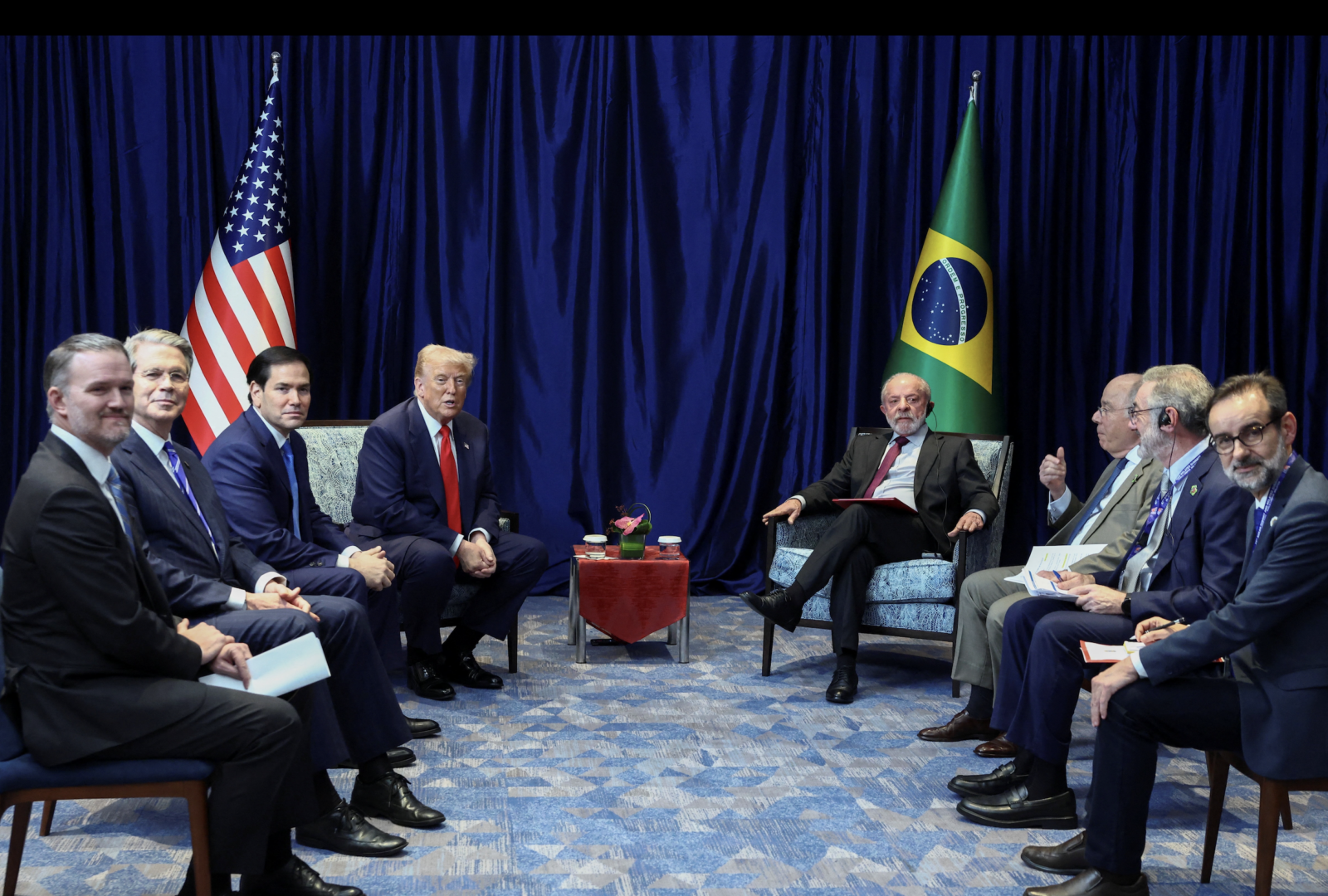
Structural Misalignment and the Limits of Pressure: Trump and Brazil’s 2026 Election
Executive Summary
A conservative wave is spreading across Latin America. Since 2025, Chile, Bolivia, Peru, Colombia, and Honduras have elected right-wing governments that have all largely deferred to President Trump. Now attention turns to the Oct. 4 election in Brazil, a neck-and-neck race in the region’s largest country. On the surface, a victory by right-wing candidate Flávio Bolsonaro would suggest Brazil will align with Trump administration policies. But Brazil’s diverse commercial relations and commitment to regional leadership complicate this narrative.
Washington should temper its expectations and recognize potential structural conflicts between US priorities — especially exclusionary policies toward China — and Brazil’s national interests. Throughout the 20th century and into the 21st century, Brazilian governments of all ideological persuasions have consistently resisted perceived subordination to the US. Regardless of who wins the presidency, we should expect Brazil to continue prioritizing national sovereignty. Ignoring this reality threatens to place the US and Brazil on a collision course, potentially harming both nations.
Brazil has increasingly attempted to triangulate its foreign policy with the United States and China. As Brazil’s largest trading partner, China is essential to Brazil’s economic standing, making decoupling from China unrealistic. The Trump administration should accept this reality and refrain from economic coercion aimed at forcing Brazil to cut ties with China. Coercive pressure on this or other issues would stoke nationalistic fervor across Brazil’s ideological spectrum — a reaction Washington would also provoke by meddling in the election process.
The United States should refocus diplomacy on security. It should lean into collaborative efforts to crack down on cartel violence in Brazil, which are broadly popular among Brazilians. Brazil should, in turn, reassure the United States that it has no intention to expand its relationship with China into a military partnership. Such security collaboration, paired with these reassurances, would let Brazil triangulate between the world’s two superpowers, putting its sovereignty in service of its citizens’ security and its economic vitality.
Cooperation between the United States and Brazil is possible if either Bolsonaro or Lula wins. But it would require each country to recognize the structural differences that exist between them and reach understandings accordingly. As a self-described nationalist, Trump should understand Brazil’s sovereigntist instincts and pursue a diplomatic path consistent with both his administration’s security aims in the Western Hemisphere and Brazil’s vital interests.
Introduction
Since July 2025, US policy toward Brazil has been extremely erratic, combining hostile trade measures with diplomatic pressure over the prosecution of former President Jair Bolsonaro and the conduct of Brazil’s Supreme Court.1The Trump administration has sanctioned prominent political figures, revoked their visas, and designated two of Brazil’s largest criminal organizations as foreign terrorist organizations, potentially creating a basis for US intervention.2It has also invoked Section 301, a provision of US trade law that allows the government to impose tariffs in response to unfair foreign trade practices, to target certain Brazilian exports.3Taken together, these measures mark a significant change in a relationship more than two centuries old. Washington is no longer simply contesting Brazilian trade or foreign policy, but is intervening directly in disputes over Brazil’s institutions and domestic politics.
Yet the approach has also been marked by striking reversals: The US lifted sanctions against Supreme Court Justice Alexandre de Moraes only to weigh reapplying them months later.4By all accounts, the occasional direct talks between Presidents Donald Trump and Luiz Inácio Lula da Silva have been surprisingly warm, but have not made it any easier to predict the administration’s broader strategy.5The underlying assumption, however, seems to be that enough sustained American pressure will eventually prompt the Brazilian government to bend on Trump administration priorities.
Having tested the limits of blunt instruments like tariffs and sanctions, the Trump administration appears to be learning that different forms of pressure produce very different political effects inside Brazil. Oscillation between escalation and reversal may be giving way to something more deliberate. Rather than applying maximum pressure uniformly, the Trump administration is more likely to concentrate on fronts where Lula’s government has the least room to resist without appearing indifferent to Brazilian concerns, particularly organized crime and public security, while treating trade and judicial disputes as more negotiable terrain. This calibrated approach might shift the burden of political costs, but it does not resolve the structural misalignment between the two countries.
On the issues each ranks highest, Brazil and the United States have divergent, if not incompatible, aims. This was increasingly the case even before Trump took office. As the world’s largest exporter of soybeans, beef, coffee, sugar, and orange juice, Brazil is today a key agricultural competitor to the United States, according to the US Department of Agriculture.6It wants to sell refined minerals, processed food, and manufactured goods, while Washington prefers Brazilian ore and grain to remain unprocessed, at the bottom of American supply chains. Brazil has also spent 80 years campaigning for a permanent seat on the UN Security Council and works through multilateral institutions to dilute the ability of great powers to act unilaterally at their discretion, while Washington insists on primacy in the Western Hemisphere and beyond.7
Differing positions on China most clearly highlight the countries’ competing priorities. China has been Brazil’s largest trade partner since 2009, and no Brazilian government would sacrifice that relationship.8Washington’s alarm about China’s role in the hemisphere, meanwhile, is bipartisan and apparently consolidated. SOUTHCOM commanders under Democratic and Republican administrations have warned Congress that Chinese ports and telecommunications across the region could be turned to military use.9During the Biden administration, Senate Democrats sold the Americas Partnership for Economic Prosperity as a deliberate counter to “China’s increasingly aggressive efforts to grow its influence in the Western Hemisphere.”10In April 2026, a Republican and a Democrat on the Senate Foreign Relations Committee filed a joint resolution on the same topic.11Washington has often treated Brazil’s efforts to preserve its room for maneuver on the world stage as ideological hostility. That simplistic misreading, applied to China, bakes an unproductive ultimatum into the relationship of the hemisphere’s biggest democracies. It is likely to persist in some form even after Trump leaves the stage without a deeper reconsideration of the critical partnership between Brasília and Washington.
Much of this dynamic is self-reinforcing. Each time Washington reaches for coercive instruments, Lula responds by calling on Beijing to secure another trade agreement or investment announcement, which in turn deepens the anxiety in Washington that drove the original pressure. Brazil seems to be caught in a triangulation trap of its own making, in which the tool it uses to blunt American coercion is the same one that all but guarantees more of it. How to get out of it?
In this sense, the current stakes are structural, larger than any particular tariff, sanction, or diplomatic quarrel. The United States and Brazil increasingly disagree about the very nature of their relationship. Washington wants alignment from the hemisphere’s largest democracy at the very moment Brasília has acquired greater capacity and greater reason to resist it. Pressure may produce concessions, but it cannot settle the underlying question of how much autonomy Brazil will accept and how much Washington is willing to tolerate. Push too hard, and a relationship that has survived two centuries could be reorganized around suspicion rather than cooperation. The danger is not simply a rupture over Trump. It is that the two largest countries in the Americas emerge from this period seeing each other in fundamentally oppositional terms.
A partnership with limits
Brazil’s turn toward the United States predates the American century. In 1905, the Baron of Rio Branco, then Brazil’s foreign minister, raised the Brazilian legation in Washington to an embassy. The move reflected a calculation that closer ties with the rising hemispheric power would enhance Brazil’s international standing, but the United States never fully reciprocated its hopes for a closer partnership. During the commodity disputes of the interwar period, Washington emphasized the commercial aspect of the bilateral relationship rather than treating it as a genuine strategic alliance.
President Getúlio Vargas (1930–45, 1951–54) learned to exploit that imbalance. During the late 1930s, he cultivated ties with Germany while negotiating with Washington, helping secure American financing for the steel complex at Volta Redonda. During World War II, Brazil granted the United States access to Natal, a crucial base for the North African campaign, and was the only Latin American country to commit ground troops to the war effort. Yet wartime cooperation did not produce lasting alignment. Vargas returned to power after the war with a nationalist program centered on state control of strategic resources. The campaign for national control of petroleum, in particular, became one of the era’s defining political causes.
Similar tension appeared under President Juscelino Kubitschek (1956–61). In 1958, Kubitschek proposed Operation Pan–America, arguing that endemic poverty, rather than subversion, posed the greater long-term threat to Latin America. Washington offered limited support until the Cuban Revolution spurred US policymakers to reconsider development efforts in the region.
The lesson for Brazilian policymakers was straightforward: American support was valuable, but Washington could not be counted on to share Brazil’s interests. That history matters to the present dispute. Brazil has generally been willing to cooperate when the terms of bilateral bargaining are clear. It has been less willing to accept the proposition that cooperation entails political alignment.
Brazilian leaders consequently learned to distinguish partnership from dependence, a distinction that has survived major changes in ideology and international conditions. Brazil’s search for autonomy has not meant rejecting the United States, but rather resisting a relationship in which cooperation becomes synonymous with accepting American definitions of Brazil’s interests.
The history of Brazil’s dictatorship (1964–85) makes the point especially clear. The United States supported the forces that overthrew President João Goulart (1961–64), a reform-minded nationalist, in 1964. The new military government quickly established close relations with Washington. Yet by the mid–1970s, President Ernesto Geisel (1974–79) and Foreign Minister Antônio Francisco Azeredo da Silveira were pursuing a foreign policy defined by “responsible and ecumenic pragmatism.”12In March 1977, Geisel’s government terminated a military assistance agreement with Washington after the Carter administration attached what Brasília saw as inappropriate human rights conditions to military aid. By then, Brazil had signed a nuclear technology agreement with West Germany over US objections, recognized the Marxist government of Angola, and declined to sign the Nuclear Non–Proliferation Treaty. A regime that came to power with US backing and initially aligned with Washington had concluded that American preferences were constraining its own.
The same dynamic arose in the 1980s, this time over economic policy. Brazilian law restricted foreign participation in the domestic computer market while its patent regime denied product and process protection for pharmaceuticals. The Reagan administration opened Section 301 investigations into both, sanctioning the informatics policy in 1987 and imposing 100 percent duties on select Brazilian exports over pharmaceutical patents in 1988.13
Washington eventually got much of what it wanted. President Fernando Collor (1990–92) dismantled the market reserve for computers after 1990, and Brazil signed the World Trade Organization’s intellectual property agreement in 1994. Two years later, President Fernando Henrique Cardoso (1995–2003) enacted Law No. 9.279, granting pharmaceutical product patents. Alignment in that instance took the better part of a decade and only arrived after a shift in domestic Brazilian politics. It also occurred once the dispute ceased to be a bilateral matter and moved into a multilateral framework. Alignment was not total. Cardoso was the most Washington–legible president Brazil had produced in decades, fluent in macroeconomic orthodoxy and personally close to American and European leaders. He still spent eight years slowing the Free Trade Area of the Americas, or FTAA, to a crawl.14Brazilian negotiators never openly denounced the agreement, but they insisted that American farm subsidies be on the table.
President Luiz Inácio Lula da Silva (2003–11, 2023–present) carried that position into the 21st century, joining his Southern Common Market, or Mercosur, counterparts at Mar del Plata in 2005 to block a new timetable for the FTAA.15Sixteen months later, he signed an ethanol partnership with George W. Bush.16The contrast was instructive. Brazil resisted a trade agreement it considered unfavorable while cooperating with Washington in an industry where Brazilian expertise gave it leverage.
President Jair Bolsonaro (2019–23) ceded more to Washington than any Brazilian president in living memory. In March 2019, for example, he agreed to relinquish Brazil’s developing-country status at the World Trade Organization, which had given it longer timelines and greater flexibility in trade negotiations, in exchange for the Trump administration backing its candidacy for the Organization for Economic Co-operation and Development.17The Trump administration then gave Argentina and Romania priority over Brazil anyway, reversing itself in January 2020.18Bolsonaro also revised Brazil’s traditional reciprocity policy to grant Americans visa-free entry and signed the Alcântara agreement giving American firms access to Brazil’s equatorial launch site.19Yet these concessions delivered few tangible gains for Brazil. In December 2019, Trump placed steel and aluminum tariffs on Brazil, citing a currency devaluation he said was hurting American farmers.20Bolsonaro said he would telephone his friend in the White House and was almost certain he would listen.21Trump ultimately backed down after their call, but the episode exposed the limits of Bolsonaro’s strategy. Even after making significant concessions to Washington and cultivating an unusually close personal relationship with Trump, Bolsonaro could not deliver a single policy breakthrough. His attempts expose the limits of counting on the United States to support Brazil’s long-term strategic aims.
The limits of American leverage become even clearer when pressure moves beyond discrete commercial disputes and into questions of sovereignty. When American pressure concerns a specific trade or economic dispute, Brazilian governments can negotiate, retaliate, or eventually concede. The politics change when Washington turns pressure into a judgment on how Brazil should run its institutions or conduct its foreign policy. Such pressure inevitably raises questions of sovereignty, making it harder for domestic opponents to side openly with the United States, exposing the limits of Washington’s leverage. In response to the Trump administration’s aggressive stance, for example, Brazil’s National Congress passed the Economic Reciprocity Law unanimously in 2025, giving any president authority to retaliate against tariffs unilaterally applied by foreign governments.22
The lesson is not that Brazil is immune to pressure, but that a heavy American hand becomes less effective when it gives Brazilian leaders an opportunity to transform a policy dispute into a national cause. More fundamentally, it points to the structural misalignment that now characterizes the relationship: Washington still seeks a degree of political and strategic deference from Brazil that Brasília has little incentive to provide going forward.
Trump and the 2026 Brazilian elections: The politics of calibrated pressure
There is little doubt that the Trump administration intends to influence the Brazilian presidential election. But that does not mean Washington will simply increase pressure on President Lula until election day in the hope of elevating his opponent, Flávio Bolsonaro (Jair Bolsonaro’s son). The election is one part of a broader strategy. Trump has explicitly embraced a muscular revival of the Monroe Doctrine that is aimed at countering Chinese influence in the hemisphere while seeking to exploit divisions both among Latin American governments and within them.23In Brazil, domestic polarization is therefore more than an obstacle to American policy; it is also a political opening that Washington can use to advance its broader aims.
Those broader aims help explain why Brazil has become such an important arena for this strategy. No country better illustrates the scale of the challenge that China’s growing presence poses to Washington’s ambitions in Latin America.24Bilateral trade with China reached $171 billion in 2025 (7.5 percent of Brazilian gross domestic product, or GDP), a record and more than double the $83 billion Brazil traded with the United States (3.6 percent of Brazilian GDP).25China bought $100 billion of Brazilian exports, roughly 28 percent of the total, against $37.6 billion for the United States, and accounted for 27.2 percent of all Brazilian trade flow.26In the first half of 2026, Brazilian exports to the United States fell 12.2 percent, while exports to China rose almost 20 percent.27Rather than deterring Brazil’s deepening relationship with China, American tariffs have accelerated it.
Figure 1: Brazil’s trade relationship with China, 2025
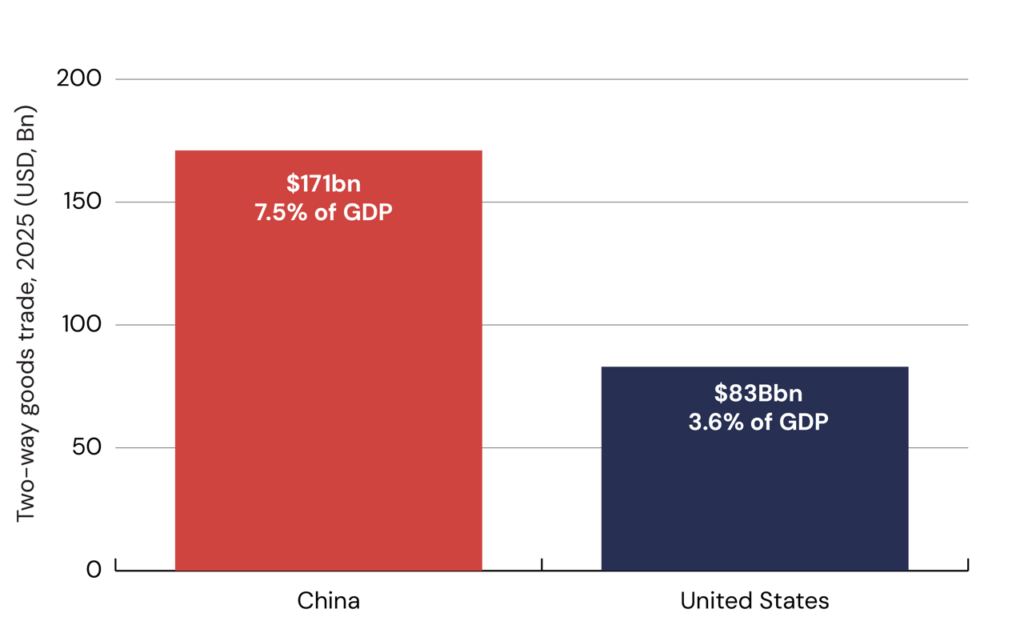
Figure 2: China’s share of Brazil’s 2025 exports of each commodity, by volume (%)
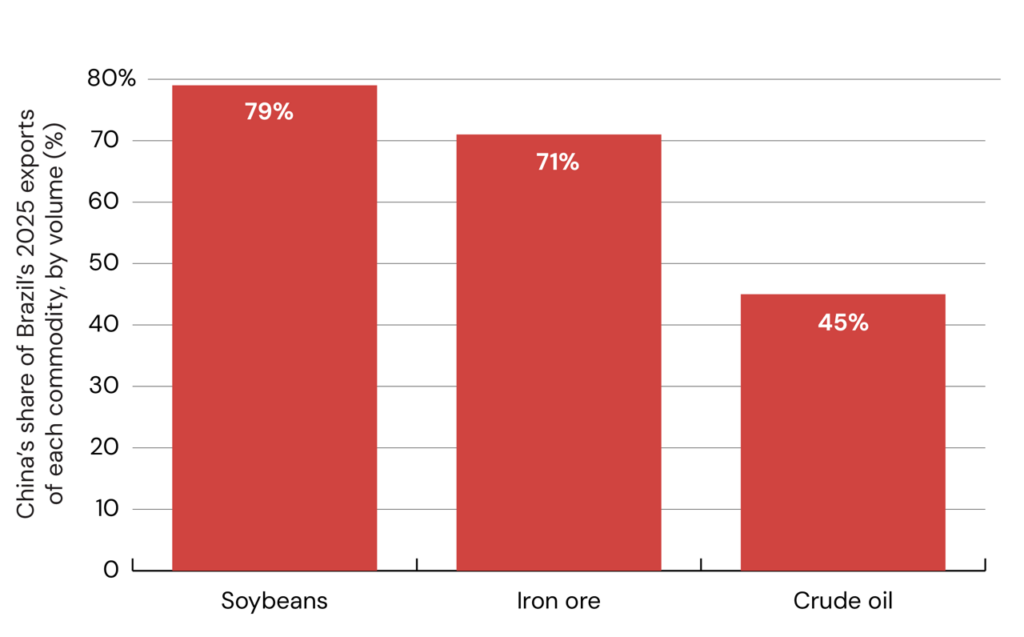
The Trump administration might see replacing Lula with a friendlier leader as a major geopolitical victory, but the sectoral concentration of Brazilian trade illustrates why no Brazilian government is likely to cut China off. In 2025, soybeans, iron ore, and crude oil accounted for 74.2 percent of Brazilian exports to China.28China buys roughly 80 percent of Brazil’s soybean exports, 70 percent of its iron ore, and nearly half of its crude.29Finding alternative markets for those volumes would be extraordinarily difficult. The interests bound up in that trade are also politically powerful, from soybean producers in Mato Grosso to mining communities in Minas Gerais, extending well beyond the traditional base of the incumbent Workers’ Party.
The Trump administration’s efforts to exploit Brazil’s domestic polarization may shape the election at the margins, but they cannot resolve the underlying conflict.30Its early pressure campaign exposed the limits of coercion. Tariffs and sanctions gave Lula an opportunity to turn American pressure into a question of Brazilian sovereignty. Washington can adjust its tactics, and Brasília may change governments, but the deeper disagreements over China, trade, sovereignty, and Brazil’s place in the world will remain under a US strategy that demands political subservience. The structural misalignment between the two countries is therefore unlikely to disappear with Brazil’s 2026 election or the next US presidential election two years later. How that misalignment plays out politically, however, will depend on where and how Washington chooses to apply pressure. External influence can ultimately produce very different domestic political effects depending on the issue to which it attaches its leverage.
Security is particularly important in this regard. Actions such as the US designation of the Comando Vermelho and Primeiro Comando da Capital cartels as terrorist organizations create a much more difficult political environment for Lula than tariffs or sanctions against a Supreme Court justice. Lula’s government can reject American interference, but it cannot dismiss the problem of crime, which ranks among the top concerns of Brazilian voters.31If Lula resists the American approach too strongly, his opponents can accuse him of being soft on organized crime. His government has therefore tried to stress its willingness to deepen cooperation in the fight against criminal organizations while resisting Washington’s decision to classify them as terrorists.32
Other measures fit the same pattern. Sending American diplomats to observe the Brazilian election or cultivate ties with political groups that question its institutions, imposing visa restrictions, or expanding cooperation in the security field all offer Washington ways to exert pressure without necessarily stoking the nationalist backlash provoked by tariffs and sanctions. But they also underscore the larger problem: Washington may become more sophisticated about where and how it applies pressure, yet no tactical adjustment can eliminate the underlying differences between the two countries. The line between influence and intervention matters here. The United States does not need to endorse a candidate or directly interfere with the administration of an election to shape its political environment. Once American involvement itself becomes visible, however, it can become another source of nationalist mobilization and another point of contention unproductive to US interests. Even under a future Democratic administration, Washington can recalibrate its pressure on Brazil but it cannot easily overcome the structural misalignment.
This also means the election cannot be reduced to a choice between a pro–American and an anti–American Brazil. Brazilian governments of different ideological stripes have defended the country’s agricultural interests, industrial ambitions, energy policy, and diplomatic autonomy even while cooperating closely with Washington in other areas. The question is not whether the next president will move Brazil categorically toward or away from the United States, but where cooperation will prove possible and where the structural differences between the two countries will reassert themselves. Those differences will persist regardless of which political coalition governs Brazil, making it especially important that both countries distinguish foreign-policy disagreements from attempts to influence Brazil’s domestic political trajectory.
The relationship’s durability will depend in part on whether both governments can make that distinction. For the United States, this means recognizing that Brazil’s political future will be determined through Brazilian institutions and political processes, even when their outcomes conflict with American preferences. Recognition of election results is one part of this broader challenge. Disputes over the conduct or outcome of an election can become another source of friction and leverage in the bilateral relationship, particularly when outside pressure is perceived as an effort to influence Brazil’s domestic deliberations. Whoever governs Brazil, and whoever occupies the White House, will continue to confront an underlying disagreement over Brazil’s place in the hemisphere and the wider world. The relationship therefore needs something more ambitious than a settlement of its latest disputes. It needs a new understanding of where American and Brazilian interests genuinely converge, where they do not, and which red lines each country must learn to respect, including Brazil’s right to conduct its own political deliberations, rely on its own institutions, and resolve its domestic political disputes through its own democratic processes.
Escaping a triangulation trap
Brazil’s dilemma is not simply that Washington and Beijing pull it in different directions, but that the two pressures reinforce each other in a self-defeating cycle. When Washington reaches for coercive instruments like tariffs or sanctions, Lula has increasingly looked to China as a counterweight. During Lula’s visit to Beijing in May 2025, for example, Chinese companies announced roughly $4.7 billion in planned investments in Brazil, as the two leaders discussed expanding cooperation in infrastructure and trade. “China is behaving as an example of a country that is trying to do business with countries that have been forgotten over the last 30 years by many other countries,” the Brazilian president declared on that occasion.33In August 2025, days after Washington imposed a 50 percent tariff on Brazilian exports, Lula called Xi Jinping. In July 2026, after months of American pressure, Xi and Lula again spoke by telephone about a possible China–Mercosur trade agreement and expanded cooperation in artificial intelligence, satellites, critical minerals, and fertilizer. China also endorsed Brazil’s opposition to external interference.34
That response may be rational for Brazil in the moment, but it risks reinforcing precisely the anxiety that drives American policy. By turning to China to offset US pressure, Brazil can confirm Washington’s suspicion that coercion is pushing it further into Beijing’s orbit, inviting still more pressure in return. Yet Brazil’s relationship with China is not the product of improvisation; it is rooted primarily in deep economic ties, while its growing defense relationship has proceeded cautiously. As a study of Brazil–China defense cooperation notes, military ties have expanded and become more institutionalized since the early 2000s, but they remain constrained by differences in strategic interests and political outlook.35Brazil has good reason to preserve those limits. As international relations scholars Joel Atkinson and Rute Ester Brasileiro da Silva have argued, Brazil’s search for autonomy through China can itself create forms of dependency that constrain the very autonomy it is pursuing.36Its interest, therefore, is not in replacing dependence on Washington with dependence on Beijing, but in maintaining enough room to deal with both. Brazil is thus caught in a trap of its own making: The very tool it uses to blunt American pressure is the one that seems to guarantee more of it.
Escaping that trap would require a deliberate triangular strategy rather than a reactive one. Brazil could establish, and visibly respect, a small set of self-imposed red lines with each side. This might include, for instance, foreclosing the acquisition of Chinese weapons systems while refusing to let Washington dictate the terms of its commercial relationship with Beijing. Credibly held, such limits would not eliminate the underlying structural misalignment, but they would change its dynamics. They would give Washington reason to believe Brazil is not drifting irreversibly into China’s strategic camp, easing the anxiety that fuels further coercion. They would also reassure Beijing that Brazil would not leverage its relationship with the United States to force a rupture with China. In other words, establishing acceptable red lines on both sides would substitute a game of escalating suspicion with one of mutual, if limited, predictability.
The immediate prospects for such a strategy will depend on the outcome of the Brazilian presidential election. A Lula victory would likely preserve the language and broad orientation of the current government’s foreign policy. His administration has already offered a possible model for how his next term might navigate the rivalry more deliberately. In August 2026, the Lula government announced a major artificial intelligence initiative that split projects between Chinese and American firms.37Huawei and iFlytek will both participate in a supercomputing project in Rio de Janeiro, with Nvidia involved in a separate project for another high-performance machine. The government presented both projects as part of a broader effort to build Brazilian technological capacity rather than a reaction to having to choose between competing foreign partners. Brazil does not need to treat every American demand as a reason to move closer to Beijing or every Chinese offer as an opportunity to distance itself from Washington. It can, at least in some sectors, deal with both while making the development of domestic capacity its overriding principle.
A Bolsonaro victory would almost certainly change the political atmosphere without necessarily resolving the underlying problem. His family’s relationship with Trump and his own place on the Brazilian right could make an accommodation with Washington easier, particularly while Trump remains in office. Yet a Brazilian government visibly inclined toward the United States would face its own constraints. China would remain Brazil’s largest trading partner and an indispensable market and source of investment. Flavio Bolsonaro’s father discovered as much during his presidency, when an initially hostile posture toward Beijing gave way to the practical demands of governing a country whose economic relationship with China could not simply be subordinated to ideological posturing.38After campaigning against Chinese influence, Jair Bolsonaro’s government ultimately moderated its position, with Bolsonaro visiting Beijing in 2019 and backing away from efforts to exclude Huawei from Brazil’s 5G auction, despite pressure from both the Trump and Biden administrations.39A Bolsonaro government might therefore shift Brazil’s rhetoric and diplomatic priorities without executing a lasting geopolitical realignment.
The 2028 American presidential election could prove equally consequential. A successor administration — either Democratic or Republican — that abandoned Trump’s personal and coercive approach to Brazil would not eliminate the longstanding disagreements between Washington and Brasília, especially over China, but it could make the triangulation problem easier to manage. A United States willing to accept Brazilian autonomy as a durable feature of the relationship, rather than evidence of problematic strategic drift, could remove, or at least temper, one of the principal incentives pushing Brasília to accelerate its search for strategic geopolitical alternatives. Conversely, if the assumptions driving the current approach survive beyond Trump, whether through a like-minded successor or a broader conviction in Washington that hemispheric partnership requires greater strategic discipline toward China, Brazil could face the same pressures under a different American president.
Brazil can refine its own strategy, but escaping the trap ultimately requires a corresponding adjustment in Washington. The United States will keep searching for leverage as long as it assumes the right Brazilian government might finally produce the alignment it has sought for more than a century. Time and again, however, governments that initially seemed to promise just that have disappointed Washington.
Stop expecting a junior partner in Brasília
For more than a century, Washington has periodically searched for the Brazilian government that might finally make alignment durable. At different moments, it placed its hopes in Vargas, the military regime, Fernando Henrique Cardoso, and Bolsonaro. Each seemed, for a time, to offer the prospect of a relationship more closely aligned with American preferences. None did for long. Ultimately, Brazilian governments of very different ideological persuasions have reached the same conclusion about the country’s place in the world: Brazil benefits from cooperation with the United States, but it also needs the freedom to pursue interests that do not always coincide with Washington’s. Strategic autonomy is not a doctrine peculiar to the Brazilian left. Anti–communist generals, market-oriented presidents, and politicians personally sympathetic to the United States have all defended it in one instance or another.
That history should temper expectations about any future election. A new president might cooperate more closely with Washington, reverse some of Lula’s policies, or prove personally more congenial to an American administration. But no Brazilian president can be expected to simply sidestep economic ties to China and the political costs of appearing to take instructions from Washington.
The lesson for Washington is not to disengage from Brazil but to stop confusing influence with alignment. The United States can pursue its interests without making Brazilian sovereignty itself a subject of negotiation. It can object to Brazilian trade, environmental regulations, and anti-corruption policies without turning those disagreements into campaigns against Brazilian institutions. Doing so is counterproductive. The dispute over Brazil’s judiciary should be removed from the bilateral agenda. The Section 301 provisions aimed at domestic Brazilian policy should likewise be separated from legitimate trade disputes rather than used as instruments of political pressure.
Washington should also invest in the less conspicuous machinery of the relationship. A functioning diplomatic channel, a serious defense dialogue, and institutions capable of resolving commercial disputes would accomplish more over time than personal relationships between presidents. The nuclear dispute of the 1970s offers an instructive precedent. When Washington sought to constrain Brazil’s nuclear ambitions, the Carter administration worked through private diplomatic channels, allied governments, and export controls rather than relying solely on public confrontation, even as Brazilian officials fiercely resisted what they saw as an infringement on the country’s technological autonomy.40The episode did not eliminate the underlying disagreement, but diplomatic channels gave both sides ways to manage it without allowing the dispute to overwhelm the broader relationship.
The same machinery proved valuable more recently. During the 2022 election, the Biden administration repeatedly signaled, through both public statements and private diplomatic channels, that Washington would not support an attempt by Bolsonaro to remain in power if he lost the presidential race. Those signals complemented broader US engagement with Brazilian civilian and military officials, helping reinforce the expectation that Brazil’s political transition would be governed by its constitutional institutions.41Taken together, these episodes illustrate why the less visible infrastructure of diplomacy matters. The history of US–Brazil relations is full of moments when governments disagreed sharply but still found ways to cooperate because officials had the means to air and contain serious disputes.
None of this requires Washington to abandon leverage or accept every Brazilian position. States bargain, pressure one another, and defend their interests. The question is whether the objective is one that pressure can realistically achieve. Trade disputes can be negotiated. Security cooperation can be expanded. Technology and energy partnerships can be built around interests both countries recognize. These are areas where bargaining can produce durable gains because neither side has to surrender control over its own political order to participate.
China presents the same problem in its clearest form. Brazil is not going to sever or substantially downgrade its relationship with Beijing because Washington regards China as a strategic threat. The economic relationship is too large and Brazil’s interest in maintaining multiple partnerships is too deeply embedded. If the United States wants to compete for greater influence in Brazil, it will have to offer something Brazil considers worth having through investment, technology, trade, energy, and security cooperation.
Escaping the triangulation trap described earlier in this brief will require more than rhetorical restraint on Washington’s part. It will require Brazil itself to hold a small set of credible red lines with both powers, replacing its current improvisational balancing act with a conscious decision to foreclose certain forms of alignment with Beijing while refusing to let Washington dictate the terms of its commercial relationships. If Brazil consistently maintains such limits, it would likely do more to ease Washington’s anxiety about drift toward Beijing, and Beijing’s apprehension about drift toward Washington, than any amount of unilateral pressure from either side.
This requires a different conception of the relationship than the one that has repeatedly guided Washington. The question, then, is not how to ensure a Brazilian government friendly enough to align with the United States. It is how two large democracies with overlapping but often conflicting interests can identify what they can build together, what they will continue to contest, and where neither should expect the other to yield. The sooner Washington accepts that Brazil is not waiting for the right president to become a reliable junior partner, the better the chance both countries have of building a relationship that can survive any head of state.
Related
Ukraine Peace Talks and the Pitfalls of Maximalism in a Multipolar World
How to bring the Ukraine War to a close in a multipolar world.
Program
Countries/Territories
Entities
Authors

Andre Pagliarini is a non-resident fellow at the Quincy Institute, an assistant professor of history and international studies at Louisiana State University, and a fellow at the Washington Brazil Office.

Feliciano de Sá Guimarães is a non-resident fellow at the Quincy Institute, associate professor at the Institute of International Relations of the University of São Paulo, and director of the Brazilian Center for International Relations, or CEBRI.
Citations
Gabriela Sá Pessoa and Nicholas Riccardi, “Trump’s Politically Motivated Sanctions against Brazil Strain Relations among Old Allies,” Associated Press, Aug. 5, 2025, https://www.ap.org/news-highlights/spotlights/2025/trumps-politically-motivated-sanctions-against-brazil-strain-relations-among-old-allies. ↩
Eric Bazail–Eimil, “US Sanctions Brazilian Judge for Prosecuting Trump Ally Bolsonaro,” Politico, July 30, 2025, https://www.politico.com/news/2025/07/30/us-sanctions-brazilian-judge-for-prosecuting-trump-ally-bolsonaro-00484538; Jasper Ward and Kanishka Singh, “US to Impose Visa Restrictions on Officials, Alleging Ties to Cuban Labor Program,” Reuters, Aug. 14, 2025, https://www.reuters.com/world/americas/us-impose-visa-restrictions-officials-alleging-ties-cuban-labor-program-2025-08-13/; Matthew Lee and Mauricio Savarese, “Trump Administration Revokes Visa of Brazil’s Ambassador to US in Spat with Lula,” Associated Press, Aug. 4, 2026, https://apnews.com/article/trump-brazil-lula-ambassador-diplomats-4d7f64110fff5dda2ffd374d5e52c682; Marcela Ayres, “Tensions Rise as Lula Blasts US over Visa Sanctions Tied to Bolsonaro Trial,” Reuters, July 19, 2025, https://www.reuters.com/world/americas/tensions-rise-lula-blasts-us-over-visa-sanctions-tied-bolsonaro-trial-2025-07-19/; Associated Press, “US Government Labels Brazil’s Two Biggest Drug Gangs as Foreign Terrorist Organizations,” PBS, May 29, 2026, https://www.pbs.org/newshour/world/u-s-government-labels-brazils-2-biggest-drug-gangs-as-foreign-terrorist-organizations; João Pedro Bitencourt, “Amorim: Classificar PCC e CV Como ‘Terroristas’ Abre Caminho Para Intervenção Dos EUA” [“Amorim: Labeling PCC and CV as ‘Terrorists’ Opens the Door to US Intervention”], Amado Mundo, Aug. 12, 2026, https://amadomundo.com/amorim-pcc-cv-terroristas-intervencao-eua-america. ↩
“Fact Sheet: President Trump Directs USTR Section 301 Action in Response to Brazil’s Unreasonable Acts, Policies, and Practices,” Office of the United States Trade Representative, July 15, 2026, https://ustr.gov/node/14362. ↩
Kayla Epstein, “US Lifts Sanctions against Brazilian Judge in Bolsonaro Case,” BBC, Dec. 13, 2025, https://www.bbc.com/news/articles/c5yqq8w2yw9o; Michael Pooler, Amy Mackinnon, and Beatriz Langella, “US Considers Sanctions on Brazil Judge in New Test of Diplomatic Ties,” Financial Times, Aug. 16, 2026, https://www.ft.com/content/4bfa3d64-cf64-448d-823e-44c4577370b4?syn-25a6b1a6=1. ↩
Stephen Quillen, “Trump Meets Brazil’s Lula at ASEAN Summit, Touts ‘Pretty Good Deals,’” Al Jazeera, Oct. 26, 2025, https://www.aljazeera.com/news/2025/10/26/trump-meets-brazils-lula-at-asean-summit-touts-pretty-good-deals; João Fellet and Rute Pina, “Trump and Lula’s Private Oval Office Meeting Signals Lingering Strain — and Effort to Avoid Tension,” BBC, May 8, 2026, https://www.bbc.com/news/articles/c8r8gxjxz10o; “Brazil’s Lula Urges Tariffs Resolution in Call with Trump,” France24, Aug. 21, 2026, https://www.france24.com/en/live-news/20260821-brazil-s-lula-urges-tariffs-resolution-in-call-with-trump. ↩
Constanza Valdes, Kim Hjort, and Ralph Seeley, “Brazil’s Agricultural Competitiveness: Recent Growth and Future Impacts Under Currency Depreciation and Changing Macroeconomic Conditions,” US Department of Agriculture, Economic Research Service, September 2020, https://www.ers.usda.gov/media/8932/err-276.pdf. ↩
Daniel Buarque, Feliciano de Sá Guimarães, and Miguel Mikelli Ribeiro, “Hindered Reform: How Brazil’s Failed Bid for a Permanent UNSC Seat Reflects the Council’s Immutability,” Global Studies Quarterly 5, no. 3 (July 2025), https://academic.oup.com/isagsq/article/5/3/ksaf072/8250827. ↩
Matias Spektor, Guilherme Fasolin, and Enrico Recco, “China Buys Brazil’s Soy and Beef — Not Its Loyalty,” Americas Quarterly, July 6, 2026, https://www.americasquarterly.org/article/china-buys-brazils-soy-and-beef-not-its-loyalty. ↩
John Grady, “SOUTHCOM Commander Warns of Risk of Chinese Investment in South America, Caribbean,” USNI News, March 12, 2024, https://news.usni.org/2024/03/12/southcom-commander-warns-of-risk-of-chinese-investment-in-south-america-caribbean. ↩
Senator Robert Menendez, “Chairman Menendez Statement on Launch of Americas Partnership for Economic Prosperity,” US Senate Committee on Foreign Relations, Jan. 27, 2023, https://www.foreign.senate.gov/press/dem/release/chairman-menendez-statement-on-launch-of-americas-partnership-for-economic-prosperity. ↩
Senator Ted Budd and Senator Jeanne Shaheen, “Budd, Shaheen Introduce Bipartisan Resolution to Counter the PRC’s Growing Influence Across Latin America and the Caribbean,” Ted Budd: US Senator for North Carolina, April 30, 2026, https://www.budd.senate.gov/2026/04/30/budd-shaheen-introduce-bipartisan-resolution-to-counter-the-prcs-growing-influence-across-latin-america-and-the-caribbean. ↩
Matias Spektor, “Origens e Direção do Pragmatismo Ecumênico e Responsável (1974–1979)” [“Origins and Direction of Ecumenical and Responsible Pragmatism”], Brazilian Journal of International Politics 47, no. 2 (2004): 191–222, https://www.scielo.br/j/rbpi/a/QYSn8t6CDB9GKtmWFwJznTP/?lang=pt. ↩
Peter Evans, “Declining Hegemony and Assertive Industrialization: US–Brazil Conflicts in the Computer Industry,” International Organization 43, no. 2 (1989): 207–38, https://www.cambridge.org/core/journals/international-organization/article/abs/declining-hegemony-and-assertive-industrialization-usbrazil-conflicts-in-the-computer-industry/42BBE3E3790EE4A760D0CD39854C6DB7; Fábio Tozi, “Intellectual Property Protection and Drug Patents in Brazil,” Mercator 19 (2020): 1–15, https://www.researchgate.net/publication/346940050_INTELLECTUAL_PROPERTY_PROTECTION_AND_DRUG_PATENTS_IN_BRAZIL. ↩
See Jeffrey Cason, “Democracy Looks South: Mercosur and the Politics of Brazilian Trade Strategy,” in Democratic Brazil: Actors, Institutions, and Processes, eds. Peter R. Kingstone and Timothy J. Power (Pittsburg: University of Pittsburgh Press, 2000), 204–16, https://upittpress.org/books/9780822957140. ↩
J. F. Hornbeck, “A Free Trade Area of the Americas: Major Policy Issues and Status of Negotiations,” Congressional Research Service, July 15, 2008, https://www.everycrsreport.com/files/20080715_RS20864_42b692df53f9103f862f89a06c49656f858ec062.pdf. ↩
“President Bush and President Lula of Brazil Discuss Biofuel Technology,” The White House, March 9, 2007, https://georgewbush-whitehouse.archives.gov/news/releases/2007/03/20070309-4.html. ↩
William Alan Reinsch and Jack Caporal, “Trade Outcomes from the Trump–Bolsonaro Meeting: More Than Meets the Eye,” Center for Strategic and International Studies, March 19, 2019, https://www.csis.org/analysis/trade-outcomes-trump-bolsonaro-meeting-more-meets-eye. ↩
Samy Adghirni, “US to Prioritize Brazil over Argentina in OECD Bid, Reversal,” Bloomberg, Jan. 15, 2020, https://www.bloomberg.com/news/articles/2020-01-15/u-s-to-prioritize-brazil-over-argentina-in-oecd-bid-reversal. ↩
Nora Walsh, “Brazil Eases Visa Requirements for US Travelers,” New York Times, July 4, 2019, https://www.nytimes.com/2019/07/04/travel/brazil-eases-visa-requirements-for-us-travelers.html; “Brazil to Sign Accord with US on Space Technology Next Week,” Reuters, March 11, 2019, https://www.reuters.com/article/us-space-brazil-usa/brazil-to-sign-accord-with-u-s-on-space-technology-next-week-idUSKBN1QS2T2. ↩
Andrea Shalal and Gabriel Stargardter, “Trump, Citing US Farmers, Slaps Metal Tariffs on Brazil, Argentina,” Reuters, Dec. 2, 2019, https://www.reuters.com/article/usa-trade-trump/update-4-trumps-metals-tariff-tweet-roils-brazil-argentina-idUSL8N28C2M8. ↩
“Brazil’s Bolsonaro Says Confident Trump Will Listen to Tariff Concerns,” Reuters, Dec. 2, 2019, https://www.reuters.com/article/business/brazils-bolsonaro-says-confident-trump-will-listen-to-tariff-concerns-idUSKBN1Y61JE. ↩
United Nations Conference on Trade and Development, “Economic Reciprocity Law Allows Countermeasures, Including on Investment, in Response to Unilateral Trade Actions,” Investment Policy Monitor, April 11, 2025, https://investmentpolicy.unctad.org/investment-policy-monitor/measures/5099/economic-reciprocity-law-allows-countermeasures-including-on-investment-in-response-to-unilateral-trade-actions. ↩
Donald J. Trump, “America 250: Presidential Message on the Anniversary of the Monroe Doctrine,” The White House, Dec. 2, 2025, https://www.whitehouse.gov/presidential-actions/2025/12/america-250-presidential-message-on-the-anniversary-of-the-monroe-doctrine; Monica de Bolle, “Trump’s Latter–Day Monroe Doctrine Is Aimed at China,” Peterson Institute for International Economics, Feb. 17, 2026, https://www.piie.com/blogs/realtime-economics/2026/trumps-latter-day-monroe-doctrine-aimed-china. ↩
See Figures 1 and 2. Figure 1: CEBC bilateral trade reports (goods trade only); GDP shares calculated against World Bank GDP for 2025. Figure 2: China–bound volumes reported by CEBC over Brazil’s total 2025 export volumes reported by Seccex/MDIC. Soybeans: 85.4 of 108 million tonnes; iron ore: 294.5 of 416 million tonnes; crude oil: 44.2 of 98 million tonnes. All CEBC figures drawn from Comex stat. See “Comércio Brasil–China Atinge Recorde de US$ 171 bilhões em 2025” [“Brazil–China Trade Reaches Record High of US$ 171 billion in 2025”], CEBC Alerta, 2026, https://static.poder360.com.br/2026/01/Comercio-Brasil-China-atinge-recorde-de-US-171-bilhoes-em-2025-CEBC-Alerta.pdf; “GDP (current US$) – Brazil,” World Bank, https://data.worldbank.org/indicator/NY.GDP.MKTP.CD?locations=BR. ↩
Igor Patrick, “Brazil–China Trade Hits Record US$171 Billion in 2025 as US Tariffs Prompt Export Pivot,” South China Morning Post, Jan. 15, 2026, https://www.scmp.com/news/china/diplomacy/article/3339924/brazil-china-trade-hits-record-us171-billion-2025-us-tariffs-prompt-export-pivot. ↩
(( “Brazil–China Trade Hits Record in 2025, Reaching $171 Billion,” Global Times, Jan. 14, 2026, https://www.globaltimes.cn/page/202601/1353165.shtml. ↩
David Averre, “Why a Blood Feud Will Test Trump’s Donroe Doctrine,” Newsweek, Aug. 20, 2026, https://www.newsweek.com/trump-donroe-doctrine-brazil-bolsonaro-lula-election-12345246. ↩
Gabriel Malheiros, “Brazil Widens Surplus with China as Deficit with US Surges,” Datamar News, March 18, 2026, https://datamarnews.com/noticias/brazil-widens-surplus-with-china-but-deficit-with-u-s-surges. ↩
Martin Brown, “Has Brazil Given China Too Much Economic Control?” The Diplomat, June 11, 2025, https://thediplomat.com/2025/06/has-brazil-given-china-too-much-economic-control. ↩
Tom Phillips, “Echoes of Cold War as US Accused of Meddling in Another Brazilian Election,” Guardian, Sept. 1, 2026, https://www.theguardian.com/world/2026/sep/01/us-trump-rubio-meddling-brazil-election. ↩
Anna Satie, “A Principal Preocupação do Eleitor Brasileiro, Segundo Pesquisa” [“Brazilian Voters’ Main Concern, According to a Survey”], Veja, July 27, 2026, https://veja.abril.com.br/brasil/a-principal-preocupacao-do-eleitor-brasileiro-segundo-pesquisa. ↩
Leticia Moreira and Pedro Penteado, “Brasil Está Preparado Para Trabalhar com EUA Contra Narcotráfico, Diz Lula” [“Brazil Is Prepared to Work with the US against Drug Trafficking, Says Lula”], CNN Brasil, Aug. 27, 2026, https://www.cnnbrasil.com.br/eleicoes/brasil-esta-preparado-para-trabalhar-com-eua-contra-narcotrafico-diz-lula. ↩
Lisandra Paraguassu, “Brasil Aposta em Visita de Lula a Pequim Para Atrair Investimentos Chineses” [“Brazil Banks on Lula’s Visit to Beijing to Attract Chinese Investment”], UOL, May 12, 2025, https://noticias.uol.com.br/ultimas-noticias/reuters/2025/05/12/brasil-aposta-em-visita-de-lula-a-pequim-para-anuncios-de-investimentos-chineses-em-infraestrutura.htm. ↩
“Xi Tells Lula China Backs Brazil in Rejecting External Interference, Xinhua Reports,” Reuters, July 27, 2026, https://www.reuters.com/world/asia-pacific/xi-tells-lula-china-backs-brazil-rejecting-external-interference-xinhua-reports-2026-07-27. ↩
Pedro Henrique Batista Barbosa and Danilo Marcondes, “Brazil–China Defense Cooperation: A Strategic Partnership in the Making,” Journal of Latin American Geography 17, no. 2 (2018): 140–66, https://www.jstor.org/stable/44861540. ↩
Joel Atkinson and Rute Ester Brasileiro da Silva, “Outsourcing Anti–Dependency: Brazil’s Fraught Embedded–Autonomy Approach to China,” Review of International Studies (2025): 1–22, https://www.cambridge.org/core/journals/review-of-international-studies/article/outsourcing-antidependency-brazils-fraught-embeddedautonomy-approach-to-china/F12834830A6E22E8598CD8AAF74E6D95. ↩
Marcela Ayres, “Brazil Launches AI Supercomputer Push, Splits Projects between Chinese, US Firms,” Reuters, Aug. 20, 2026, https://www.reuters.com/world/americas/brazil-launches-ai-supercomputer-push-splits-projects-between-chinese-us-firms-2026-08-20. ↩
Richard Lapper, “Bolsonaro Took Aim at China. Then Reality Struck,” Americas Quarterly, April 23, 2019, https://www.americasquarterly.org/article/bolsonaro-took-aim-at-china-then-reality-struck. ↩
Jeff Mason and Michael Martina, “US Warned Brazil That Huawei Would Leave It ‘High and Dry’ on 5G,” Reuters, Aug. 9, 2021, https://www.reuters.com/technology/us-warned-brazil-about-chinas-huawei-5g-network-white-house-official-2021-08-09. ↩
William Glenn Gray, “Commercial Liberties and Nuclear Anxieties: The US–German Feud over Brazil, 1975–77,” The International History Review 34, no. 3 (2012): 449–74, https://www.jstor.org/stable/24701278. ↩
Robbie Gramer, “How Team Biden Tried to Coup–Proof Brazil’s Elections,” Foreign Policy, Oct. 28, 2022, https://foreignpolicy.com/2022/10/28/brazil-elections-bolsonaro-democracy-biden. ↩