
The 2025 NSS and Restraint: Experts React
Overview
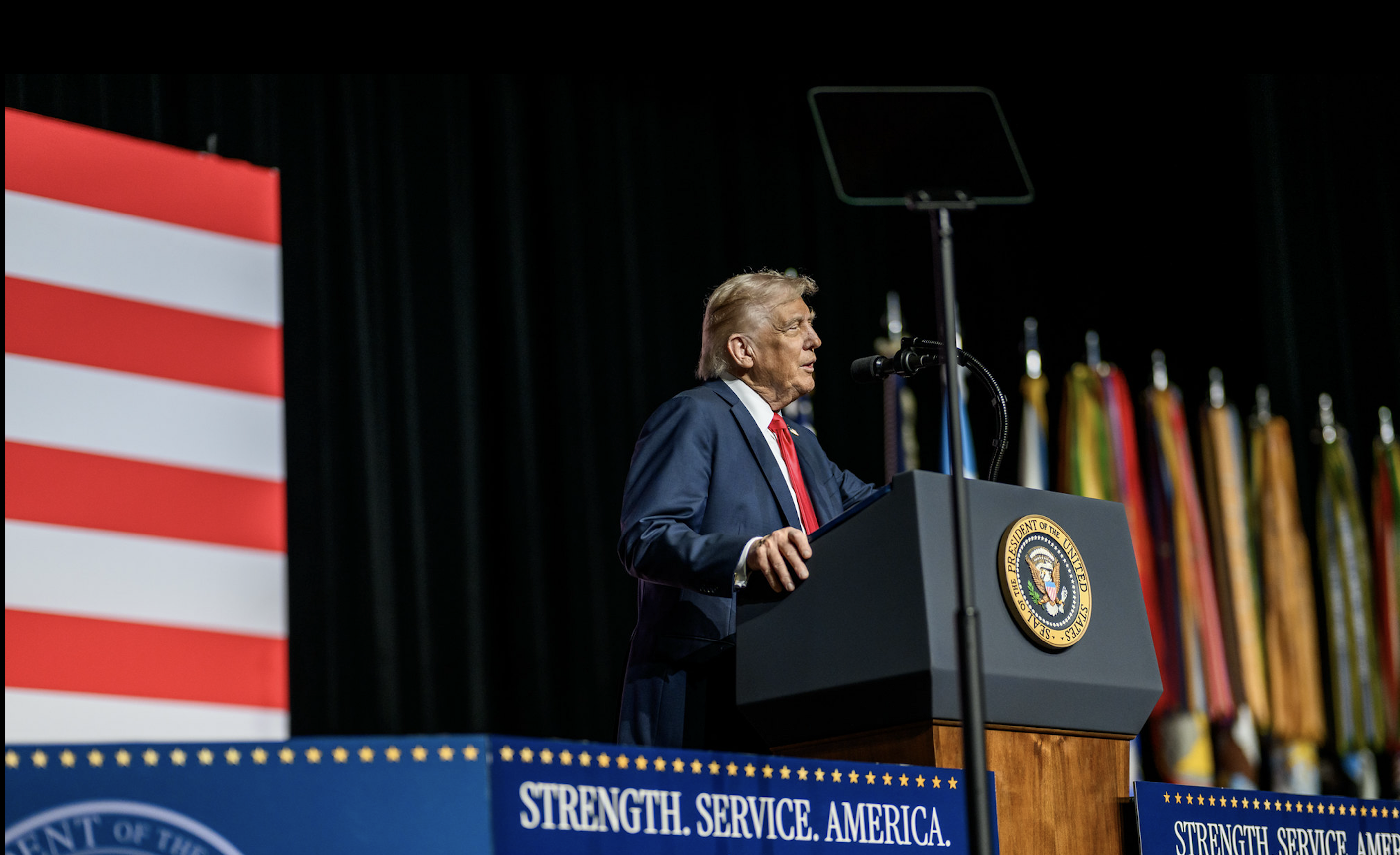
On Dec. 4, 2025, the Trump administration published the 2025 National Security Strategy, or NSS. Mandated by the Goldwater–Nichols Department of Defense Reorganization Act of 1986, the NSS is used to communicate the executive branch’s national security vision to the legislative branch. Below, Quincy Institute experts offer their individual assessments of this latest version.
Discussion
Grand Strategy, George Beebe
Viewed through the prism of Restraint, the new National Security Strategy appears to be exactly what its opening section claims: “pragmatic without being ‘pragmatist,’ realistic without being ‘realist,’ principled without being ‘idealistic,’ muscular without being ‘hawkish,’ and restrained without being ‘dovish.’”
Those who have long called for an end to endless wars should welcome the NSS’s explicit endorsement of peacemaking to end conflicts. Similarly, those who have long bemoaned Washington’s quick resort to military force should be gratified by its emphasis on diplomacy and economic means as America’s primary tools for advancing its interests in the world. Many of the strategy’s core principles, including its “Predisposition to Non-Interventionism,” are things that Restrainers have advocated for years.
Most of all, the strategy corrects two of the biggest erroneous assumptions that have driven American foreign policy into the ditch for the past three decades: first, that the United States has near limitless resources and capabilities, and therefore need not concern itself with limiting and prioritizing its objectives in the world; second, that America can only be secure when all or most of the world adopts liberal democracy. This unbridled universalism lay at the root of most of the U.S. foreign policy fiascos of the post–Cold War era. Restraint in American foreign policy is impossible unless those assumptions are corrected.
Still, Restrainers will certainly find some aspects of the strategy unappealing, including its call to use the American military in roles that have traditionally been the domains of the Coast Guard and law enforcement. Many will object to the NSS’s position that the United States has a stake in internal European political and societal issues and should support parties and policies in line with the Trump administration’s views on migration and cultural matters. The strategy’s casual attitudes toward international law and international organizations — two factors that tend to restrict American foreign adventurism — put it at odds with many Restrainers. And some will object that the strategy’s explicit revival of the Monroe Doctrine and its allusion to a Trumpian variation of the Roosevelt Corollary portend a new age of militaristic interventionism and unwelcome hegemony in Latin America.
On some of these matters, it might be useful to recall that John Quincy Adams — the namesake of the Restraint–focused Quincy Institute for Responsible Statecraft — was the intellectual father of the Monroe Doctrine and believed strongly that the United States must oppose the presence of foreign powers and what he regarded as alien ideologies in our immediate neighborhood. In 1823, Adams delivered a note verbale to Russia’s representative in the United States warning that Washington would not tolerate any attempt to transplant authoritarian rule to North or South America.
By today’s standards, Adams’ stance on these matters was not very Restraint–friendly, but one might be justified in calling it “restrained without being dovish.”
The NSS and Pentagon Spending, William D. Hartung
The Trump administration’s new National Security Strategy reads like two separate documents. The first is partisan, self-promoting, and divisive, overstating the administration’s achievements while denigrating all that has come before.
But there is a more sober strand of argument in the document that speaks about the importance of focusing on core interests, avoiding the temptation to commit to “laundry lists” of foreign commitments, expressing a predisposition against foreign military intervention, and pledging to “prevent military confrontation” with China. If this rhetoric is transformed into policy, it could set the stage for significant reductions in Pentagon spending.
Unfortunately, the current policies and plans of the Trump administration are not consistent with either a more restrained policy or a lower Pentagon budget.
Take, for example, the administration’s decision to double down on a militarized version of the Monroe Doctrine, which is setting the stage for a war with Venezuela. Not only could such an intervention impose huge costs in blood and treasure on all parties to the conflict, but it squarely contradicts the notion of focusing on “core interests.”
Drug trafficking causes great damage to Americans, but Venezuela is not the primary source of drugs entering the United States. Even if Venezuela were a major supplier, reducing the ravages of drug abuse in America is not a military mission. It will require change on the demand side, in the United States.
On the flip side of the buildup in the Western Hemisphere, the administration is contemplating reductions of U.S. troops in Europe, which, in theory, could open the way to reductions in the Pentagon budget. But a pullback from Europe could also just free up funds for other projects, like the enormously expensive Golden Dome initiative, which is pursuing the impossible dream of a leakproof defense against missiles of all sorts. Todd Harrison of the conservative American Enterprise Institute estimates that the cost of an expansive version of Golden Dome could reach $3.6 trillion.
In the Middle East, the administration’s all-in support for Israel’s Netanyahu government and firm embrace of the Gulf monarchies do not bode well for substantially reduced military commitments.
The strategy document’s suggestion of a less combative approach to China could also, in theory, lead to lower Pentagon spending. But it could also be combined with a military-focused notion of deterrence that supports a continued U.S. military buildup in the Pacific.
If there is to be a reduction in Pentagon spending in line with a more restrained strategy, the first job will be to press the administration to turn its rhetoric on restraint into reality. That will require a robust national debate on the U.S. role in the world. That discussion should include a careful assessment of how military power fits into a security posture that better promotes the safety and security of America and the world. If the new NSS provokes such a debate, that could be its most useful outcome.
Europe, Anatol Lieven
“Managing European relations with Russia will require significant U.S. diplomatic engagement, both to reestablish conditions of strategic stability across the Eurasian landmass, and to mitigate the risk of conflict between Russia and European states. It is a core interest of the United States to negotiate an expeditious cessation of hostilities in Ukraine, in order to stabilize European economies, prevent unintended escalation or expansion of the war, and reestablish strategic stability with Russia, as well as to enable the post-hostilities reconstruction of Ukraine to enable its survival as a viable state.”
This is right; and, had it not been for the Trump administration’s determined intervention, there would be no Ukraine peace process, and the war would continue indefinitely, with growing risks of direct clashes between NATO and Russia. Ukraine, the European Union, and leading European countries have only joined in peace talks because President Donald Trump compelled them to.
The NSS is also correct to call for an end to the further expansion of NATO. European governments are trying to draw the United States into giving security guarantees to countries that the Europeans themselves cannot and will not defend and that have never been vital to U.S. interests. All this brings is added danger, not least to the countries themselves. This reckless, irresponsible, and hypocritical process needed to be stopped, and the Trump administration is right to stop it.
But other elements of the discussion of Europe are more ideologically radical. The NSS identifies migration and domestic decay, rather than Russia, as the greatest threats to Europe. Those concerns flow from similar fears regarding the United States. On page 11, the NSS notes that “the era of mass migration must end. Border security is the primary element of national security.”
It applies those principles to Europe, stating later in the document that: “Should present trends continue, [Europe] will be unrecognizable in 20 years or less. As such, it is far from obvious whether certain European countries will have economies and militaries strong enough to remain reliable allies. Many of these nations are currently doubling down on their present path. We want Europe to remain European, to regain its civilizational self-confidence, and to abandon its failed focus on regulatory suffocation.”
The NSS therefore openly sides with right-wing populist parties, stating the need for the United States to “cultivate resistance to Europe’s current trajectory within European nations.” The United States taking sides in European domestic politics is not new. It did so against Communist parties in the late 1940s and 1950s. It is, however, unprecedented for a U.S. administration to undermine European establishments that trumpet their loyalty to NATO and to so explicitly tie common security to changes in economic rules to favor U.S. corporations.
This does not mean that the NSS is “hostile to Europe” or threatens withdrawal from NATO. On the contrary, it states that Europe remains strategically and culturally vital to the United States, and that is why Europe’s internal condition is important to America. The NSS does, however, suggest that, unless future elections in Europe and the United States lead to ideologically compatible right-wing populist governments on both continents, the future of transatlantic relations will be a deeply troubled one.
The Middle East, Trita Parsi
The 2025 National Security Strategy for the Middle East is contradictory: It proposes a strategic pivot away from regional entanglement but practically risks maintaining — or even increasing — America’s overextension.
The NSS’s explicit rhetorical pivot away from the Middle East is strongly welcomed. The strategy’s text and organization explicitly de-emphasize the region as the singular focus of U.S. security planning, noting that “America’s historic reason for focusing on the Middle East will recede.”
It contains the strongest rejection of global American hegemony ever seen in an official U.S. strategic document, stating that “the days of the United States propping up the entire world order like Atlas are over.” Instead, the focus shifts to preventing other states from achieving global or regional domination, a goal significantly different from establishing and maintaining American hegemony.
It welcomes — albeit prematurely — a new normal in which the security affairs of the region are primarily handled by regional states themselves. “[T]he days in which the Middle East dominated American foreign policy in both long-term planning and day-to-day execution are thankfully over.”
The NSS’s commendable noninterventionist emphasis and stricter standard for military force in the Middle East are appropriate, given the region’s diminished strategic importance to the United States. Moreover, the predisposition for noninterventionism helps shift U.S. policy toward encouraging reform rather than seeking to impose it from without. Crucially, the NSS rightly and explicitly disavows imposing “democratic or other social change” on foreign nations.
While these principles are strongly welcomed, the 2025 NSS also contains language on the Middle East that risks directly undermining their implementation and turning rhetorical retrenchment into episodic, high-risk interventions rather than steady, principled restraint.
For instance, the NSS’s continued framing of Iran as the singular or primary source of regional instability is highly problematic. Not only because it is false and that this puts the United States at odds with Arab partners who increasingly view Israel’s conduct as the primary threat in the region, but because “Iran–first” conceptions of Middle East disorder obscure the region’s far more complex drivers of conflict while further incentivizing U.S. military involvement. By casting Iran as the central threat, the strategy justifies forward deployments, extended deterrence commitments, and a readiness to use force that directly contradicts the stated goal of drawdown.
Meanwhile, elevating the Abraham Accords as a core pillar of regional strategy, particularly without resolving the core drivers of the Israel–Palestine conflict, signals continuity rather than a break with past, disastrous U.S. strategies in the region. Rather than enabling disengagement, this framework deepens U.S. responsibility for managing regional rivalries, reinforcing the very security dependencies that have kept Washington militarily embedded in the Middle East for decades.
In short, the 2025 NSS is an opportunity partially seized and partially squandered. The rhetorical reorientation away from unending Middle East prioritization is welcome; the failure is in the recommitment to ideas and policies that birthed America’s overextension in the Middle East in the first place.
As such, the NSS risks preserving the very cycle of intervention and unnecessary entanglements it purports to leave behind.
The Global South, Sarang Shidore
What does the new National Security Strategy imply for the arc of states stretching from Mexico City to Manila, also known as the Global South? While correcting serious interventionist errors of past strategies, the NSS opens the door to new blunders. Despite its contradictions, the document does hint at the sort of world order the United States would like to see. But, on balance, that order is not one that will help build mutually productive ties with Global South states, particularly in Latin America.
The NSS properly rejects the moralistic impulses of past administrations through its criticism of “fruitless ‘nation-building’ wars,” rejection of the “ill-fated concept of global domination,” and advocacy for “a high bar for what constitutes a justified intervention.” Over the decades, Washington’s crusaders of the neoconservative and liberal internationalist varieties have badly hurt U.S. interests with their disastrous projects of remaking sovereign states ostensibly in defense of “democracy promotion” and “human rights.” The damage caused by their bombs and bombast will take a long time to clean up. Global South states have their own journeys and ought to be able to undertake them based on their own histories and contexts (barring truly extreme cases).
The document’s jettisoning of the current foreign aid paradigm is also largely welcome. U.S. aid is crucial for the national interest (and ought to be restored) in a few areas, such as global health and disaster relief and resilience. But, for decades, top-down projects for longer-term development only created dependencies and enriched Western consultants while providing little long-term benefit to recipient countries. Developmental objectives in U.S. foreign policy are best pursued through commercially grounded agencies such as a reformed U.S. International Development Finance Corporation, or DFC.
But the document then stumbles badly. The NSS’s major innovation is a long-overdue pivot to the Western Hemisphere (i.e., Latin America). The United States lives in the Americas but has often treated the region as a strategic footnote.
But the real question is: what sort of prioritization? The NSS portrays the region in terms of fighting crime and stopping mass migration. These are (debatably) framed as among the greatest threats to national security. However, each state in Latin America has its own interests. A Restraint–oriented prioritization, while placing U.S. interests first, would also consider others’ interests and approaches to find win-win solutions. Unfortunately, the NSS makes little room for cooperative regionalism, and promotes a spheres-of-influence-type corollary to the Monroe Doctrine that can easily lead to militarization and associated blowback, as the current crisis over Venezuela is beginning to demonstrate.
Indeed, a spheres-of-influence vision runs implicitly throughout the NSS. The strategy accommodates Russia and China to a degree (with a welcome peace push on Ukraine and less hawkish security sections on China), leaving the Global South as an arena for a great power carve-up and coercive extraction. But spheres of influence are neither workable nor desirable in our time. They militate against Restraint and will open the door to new U.S. interventions and endless wars in weaker states, especially in Latin America.
Economic Policy, Marcus Stanley
The Trump administration’s National Security Strategy leads with a strong conceptual commitment to a much needed reorientation of U.S. foreign policy. The document repeatedly and correctly calls for a pivot away from the pursuit of global dominance to a more modest, realistic, and focused foreign policy approach that prioritizes key American national interests and avoids unnecessary interventionism.
But a deeper dive into the details of the NSS’s various sections shows that old habits are hard to break. In several cases the strategy implies vague, overly ambitious, and frankly interventionist approaches while failing to address difficult choices on how to best define and pursue national interests.
One example is the connection between foreign policy and economic prosperity. The pursuit of broadly based economic prosperity for American workers is announced as a core principle of the Trump foreign policy approach, and reindustrialization, balanced trade, and secure supply chains are listed as key specific goals. Elements here reflect a bipartisan consensus that is perhaps not far off from the Biden administration’s claim to pursue a “foreign policy for the middle class” and its policies aimed at reviving American manufacturing.
It is in the NSS’s details that potential contradictions appear. The strategy calls for “consolidating our alliance system into an economic group” (i.e., creating a trading system that excludes American rivals like China) as well as demanding “strategic alignment” and alignment with our export controls from allies. These demands for geoeconomic alignment with U.S. priorities will come at a time when, the strategy also informs us, the United States is also demanding costly “burden-sharing” in the military space.
Logically, the United States will have to offer economic benefits to foreign countries to adopt these potentially costly strategies. This could fly in the face of President Donald Trump’s aggressive pursuit of hardball trade deals with even American allies, and it may not assist the American middle class. The Trans–Pacific Partnership, the massively unpopular draft trade agreement that Trump opposed in 2016, was just the kind of attempt to consolidate our Asian alliance system into an economic group that this document calls for. There is no effort to address this potential contradiction.
Indeed, you will look in vain for any analysis or even acknowledgement of the potential contradictions between long-term economic prosperity and measures that seem to contemplate splitting the global economy into competing economic blocs. The frequently repeated emphasis on creating supply chains exclusive to the United States and close allies begs the question of whether such efforts can become excessively costly as compared to more open-ended systems of mutually beneficial trade. There is also no effort to grapple with the question of whether Trump’s seeming obsession with eliminating bilateral trade deficits through tariffs will actually lead to positive results for the middle class.
Some similar questions arose in the Biden administration’s efforts to craft anti–China economic alliances and pursue technological conflict. In economics as elsewhere, here, engrained ambitions for American dominance struggle with the nascent emergence of a new foreign policy paradigm.
China, Jake Werner
The National Security Strategy is a blueprint for spiraling U.S.–China conflict. But President Donald Trump demonstrably does not share its animating principles. The question is whether Trump will impose his will on his advisers or whether they will manipulate him into confrontation.
The idea of an aggressive NSS may come as a surprise when media depict it as a capitulation. True enough, in contrast to the 2017 and 2022 strategies — both of which specified zero-sum military and economic competition with China as central national security imperatives — the name of the country does not even appear in this year’s list of “core, vital national interests.” The NSS even drops the ideological fig leaf, in which the United States stood for freedom and its rivals for tyranny, that previously justified U.S. geopolitical supremacy.
Is the United States, then, abandoning efforts to contain Chinese power? Simply reading past the document’s top lines shows otherwise.
The central feature of this NSS is its promise to reassert U.S. domination over the Western Hemisphere. Far from stepping away from conflict with China, however, the “Trump Corollary” to the Monroe Doctrine fixates on extinguishing Chinese influence in the region: “We will deny non–Hemispheric competitors the ability to position forces or other threatening capabilities, or to own or control strategically vital assets.” The NSS tactfully avoids mentioning China, but no one will doubt which “adversarial outside influence” is targeted for a highly destabilizing form of exclusion.
But perhaps the NSS is articulating a spheres-of-influence approach to great power relations? The United States would dominate the Americas but give free rein to China in Asia. Leaving aside the doubtful viability of such an arrangement, and the likelihood China would rebuff it, the NSS squarely rejects the idea.
Instead, it defines Asia as one of the “next century’s key economic and geopolitical battlegrounds” and lays out an agenda of economic and security confrontation with China. The United States plans to consolidate an economic bloc in order to “safeguard our prime position in the world economy,” bringing other countries into aligned trade policies to force a new political economy on China.
Even more dangerous than coordinated economic coercion is the NSS’s discussion of Taiwan. The United States will build up its own military and induce its allies to join its planning, establishing the power “to deny any attempt to seize Taiwan.” Alongside its characterization of Taiwan as a strategic location — indicating the United States would not tolerate Taiwan’s unification with the mainland under any circumstances — the NSS threatens an even faster increase of military tensions than during the presidency of Joe Biden.
Trump’s own approach to China, however, points in a different direction. Trump reluctantly recognized that China, after years of copying U.S. techniques of weaponizing economic relations, now enjoys both the capacity and will to impose the kind of pain on the United States that Washington was heretofore free to impose on Beijing. The NSS shows Trump’s advisors intend to barrel forward, heedless of such costs. The future of the U.S.–China relationship and indeed the entire global system turns on how these tensions play out in 2026.
Related
Ukraine Peace Talks and the Pitfalls of Maximalism in a Multipolar World
How to bring the Ukraine War to a close in a multipolar world.
Trump vs. Harris: Whose Foreign Policy Will Win the 2024 Election?
Join us for a preview of foreign policy and the 2024 election.
Program
Topics
Entities
Authors

George Beebe is director of grand strategy at the Quincy Institute. He spent more than two decades in government as an intelligence analyst, diplomat, and policy advisor, including as director of the CIA’s Russia analysis and as a staff advisor on…

William D. Hartung is a senior research fellow at the Quincy Institute for Responsible Statecraft and an expert on the arms trade, Pentagon spending and strategy, and nuclear weapons policy. His books include The Trillion Dollar War Machine, and Prophets…

Anatol Lieven is the director of the Eurasia Program and the Andrew Bacevich chair in American Diplomatic History at the Quincy Institute for Responsible Statecraft. He was formerly a professor at Georgetown University in Qatar and in the War Studies…

Trita Parsi is co-founder and executive vice president of the Quincy Institute. He is an award-winning author and the 2010 recipient of the Grawemeyer Award for Ideas Improving World Order.

Sarang Shidore is director of the Global South Program at the Quincy Institute. He was also a member of the adjunct faculty at George Washington University, where he taught a class on the geopolitics of climate change.

Marcus Stanley is director of studies at the Quincy Institute for Responsible Statecraft. Prior to joining the Quincy Institute, he spent a decade at Americans for Financial Reform. He has a Ph.D. in public policy from Harvard, with a focus…

Jake Werner is director of the East Asia Program at the Quincy Institute. His research focuses on US–China economic relations and the global economy. He received his doctorate in history from the University of Chicago.