

Competition for US–China Talent Advantage and the US National Interest
Executive Summary
This brief treats the US–China talent competition as one between systems rather than a zero‑sum race for individual scientists. The systemic competitive edge in the American talent development system has been openness — its capacity to attract, integrate, retain, and productively deploy global talent within a high‑performing research ecosystem.
Recent policies adopted in the name of pursuing a zero-sum talent competition with China have narrowed this openness. While limiting access may weaken China (Chinese enrollment in US higher education peaked at 372,000 in 2019), as explained in this brief, such limitations risk weakening the US talent infrastructure more than they harm China.
For four decades, educational cooperation between the United States and the People’s Republic of China has been consequential yet contested. In Washington, these exchanges are often framed primarily as security risks: Did US universities “train China’s talent?” Did openness accelerate China’s rise?
This brief argues these questions miss the more policy-relevant issue: how much the United States has benefited from educational cooperation with China, and what it stands to lose by abandoning openness. The US talent system has been strengthened by decades of engagement with Chinese students and researchers. The American innovation ecosystem has demonstrated an exceptional “capture effect”: attracting high-performing foreign students, integrating them into US research networks, retaining many during their peak productive years, and converting their contributions into domestic scientific output and entrepreneurship.
Openness, of course, carries risks, such as IP theft and illicit technology transfer. These are real concerns requiring tighter controls in sensitive areas with dual-use applications. But overly broad restrictions reduce talent inflows, shrink US research capacity, push talent elsewhere, and accelerate China’s drive toward indigenous capacity outside US influence.
The brief advances a “smart openness” approach to talent, which combines openness to global talent inflows with targeted safeguards for clearly defined sensitive domains. Smart openness aligns security with competitiveness and centers US interests. An education system open to global talent is not charity but a historically proven source of American strength.
Introduction
This brief treats US–China talent competition as a competition between systems rather than a zero‑sum race for individual scientists. America’s enduring competitive edge has been openness — its capacity to attract, integrate, retain, and productively deploy global talent within a high‑performing research ecosystem. Recent policies adopted in the name of competition with China have narrowed this openness. While limiting access may weaken China, it ignores a core asymmetry: because openness is structural to the US research system, restrictions risk weakening US talent infrastructure more than they weaken China.
For four decades, educational cooperation between the United States and the People’s Republic of China, or PRC, has been consequential yet contested. In Washington, these exchanges are often framed primarily as security risks: Did US universities “train China’s talent?” Did openness accelerate China’s rise? This paper argues these questions miss the more policy-relevant issue: how much the United States has benefited from educational cooperation with China, and what it stands to lose by abandoning openness.
The US talent system has been strengthened by decades of engagement with Chinese students and researchers. The American innovation ecosystem has demonstrated an exceptional “capture effect”: attracting high-performing foreign students, integrating them into US research networks, retaining many during their peak productive years, and converting their contributions into domestic scientific output and entrepreneurship. Chinese nationals trained in US universities have sustained graduate programs in engineering and computer science, staffed laboratories, supported undergraduate teaching, advanced US publication and patent output, and seeded US technology firms. These effects occur alongside gains in soft power and strategic visibility from remaining the world’s premier destination for global talent.
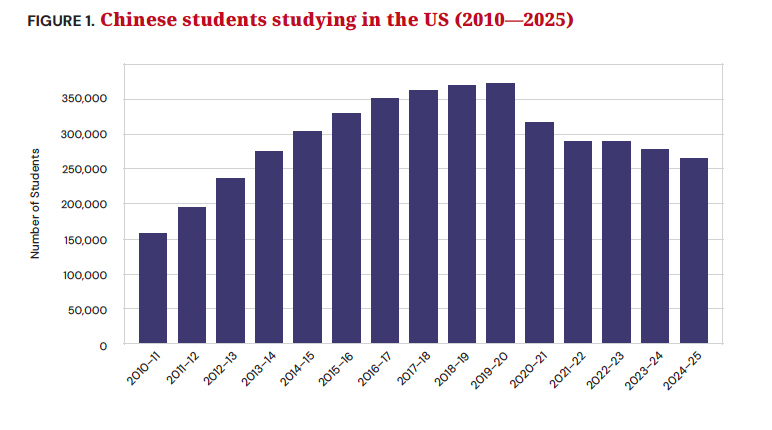
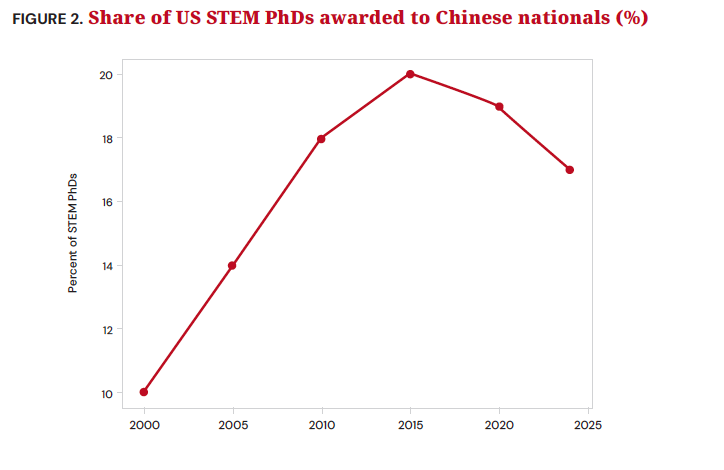
This does not mean ignoring risks. Intellectual property theft, illicit technology transfer, and undisclosed conflicts are real concerns requiring tighter controls in sensitive areas with dual-use applications. But sweeping restrictions or nationality-based exclusion produce strategic self-harm: reducing talent inflows, shrinking US research capacity, pushing talent elsewhere, and accelerating China’s drive toward indigenous capacity outside US influence.
This brief advances “smart openness”: sustaining openness as the default for education and fundamental research while applying targeted safeguards to clearly defined sensitive domains. Smart openness aligns security with competitiveness and centers US interests. Openness is not charity but a historically proven source of American strength.
Competing through closure would require major new investments to replace what openness historically supplied: graduate labor, postdoctoral capacity, laboratory throughput, interdisciplinary density, and global visibility. There is limited evidence that such an additive investment is occurring at scale, raising the risk of capacity erosion rather than strategic gain.
Reframing the talent advantage question around US interests
Talent advantage emerges only when skills are embedded in institutions and systems capable of converting human capital into knowledge, products, and scale. The relevant US–China talent competition is therefore between the systems of the two countries. The historical record suggests openness has been a decisive advantage for the US talent system.
Talent debates in US–China relations generate policy anxiety and conceptual confusion. “Talent” covers technological leadership, national security, competitiveness, immigration, research integrity, and collaboration. Recent debate has treated US universities as inadvertent training grounds for a competitor, yet the logic remains implicit.1The more fruitful question is not whether China benefits from US universities (it does), but whether the United States benefits more from openness in talent flows and under what conditions.
The United States has been the world’s most successful “talent capture” system. Its universities are global magnets; its research environment rewards initiative; its commercialization pathways convert ideas into products; its labor market absorbs specialized skill at scale. The US incorporates foreign students into its innovation ecosystem, benefiting students through enhanced research intensity, faculty through expanded lab capacity, firms through highly trained talent, and society through innovation-driven growth.
Chinese students have been significant participants. The PRC was long the largest source of international students and STEM doctoral candidates in the US. The US captured returns multiple ways: many graduates remained, contributing when most productive; even returnees spent years producing publications, patents, and products embedded in US institutions; and exchanges created professional networks supporting trade, investment, and US soft power.2
This brief, therefore, adopts a US–centered analytical lens. It situates China’s evolving talent system in context, but it treats China’s progress as only one variable in a broader strategic equation. The policy challenge is to protect legitimate security interests while preserving America’s structural advantages. The risk today is not simply that China builds an indigenous talent system. The more immediate danger is that the United States erodes the very conditions that have sustained its leadership through overbroad restrictions, politicization of university engagement, and the weakening of immigration pathways for the highly skilled.
PRC students’ and scholars’ contribution to the US economy and innovation system (2010–2025)
From 2010 to 2025, students and scholars from the PRC have been among the most consequential high-skill talent streams feeding the US economy and research enterprise. Their contribution is best assessed not merely by enrollment numbers but by measurable post-study retention, workforce participation, and integration into core US innovation sectors.
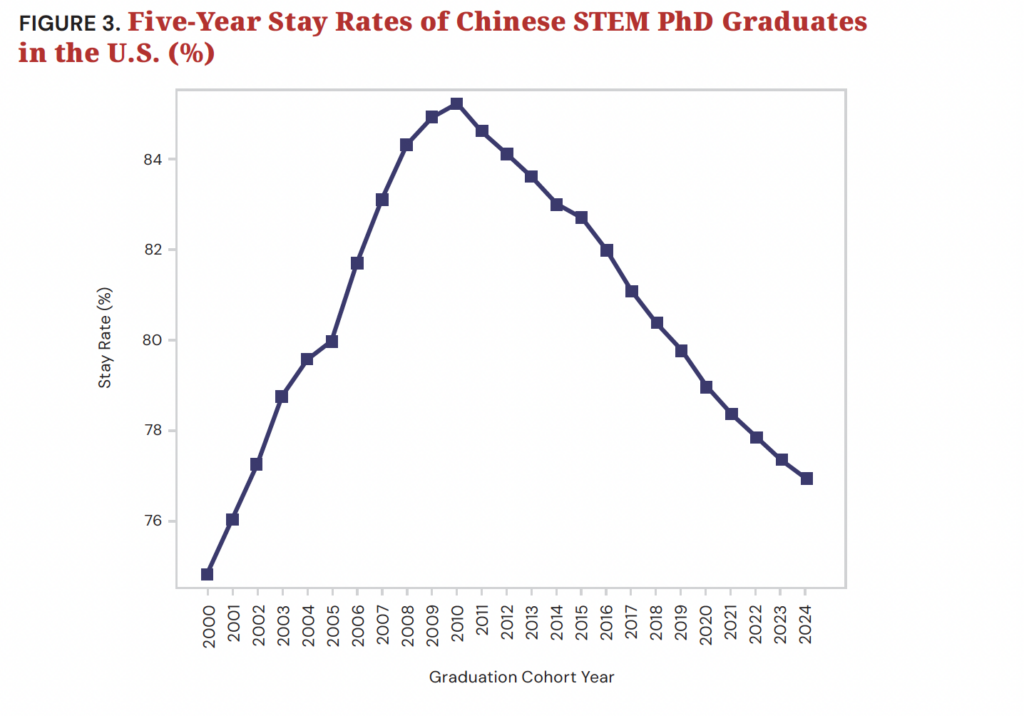
Retention outcomes for PRC doctoral talent are striking. National Science Foundation data show 85–95 percent of PRC–origin science and engineering PhD recipients remained in the US at least five years after graduation from the early 2000s to the late 2010s.3Even for 2017–19 graduates, 83 percent remained by 2023.4These rates — among the highest globally — mean US universities supply long-term contributors to the US research workforce. PRC–origin scientists and engineers, many now US citizens, are embedded across universities, federal laboratories, and industrial R&D centers.5
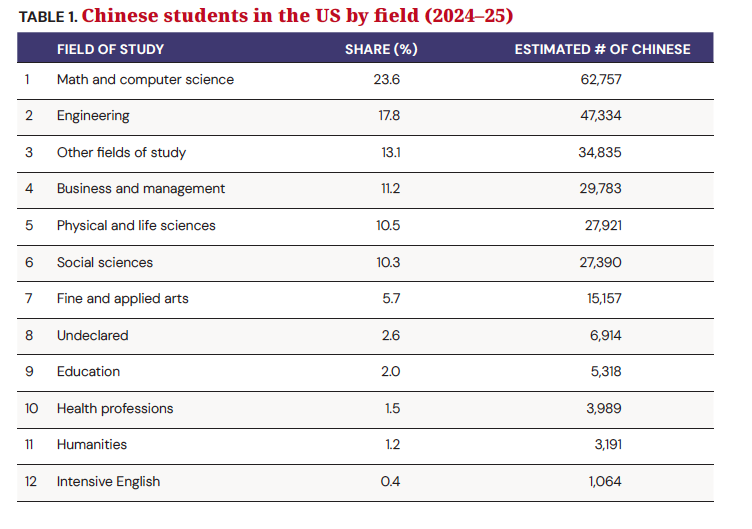
Beyond PhDs, PRC students sustain innovation-driven industries. China has consistently been the second-largest source of STEM optional practical training, or OPT, participants. In 2023, PRC nationals represented nearly one-quarter of STEM OPT participants.6US Citizen and Immigration Services reports PRC–born professionals made up 12 percent of approved H-1B workers in FY2023, second to India, with two-thirds in computer-related occupations — the backbone of US private-sector research and development, or R&D.7
The economic implications are substantial. Beyond billions in annual tuition and spending, PRC–origin, college-educated workers exceed 750,000, mostly in STEM roles.8They contribute disproportionately to patenting, startup formation, and federally funded research, addressing critical talent shortages.9
PRC students have not displaced US workers but amplified returns on US R&D investments, strengthened innovation capacity, and reinforced US leadership in attracting global scientific talent.
China’s STEM expansion: Scale, strategy, and persistent frictions
External restriction can accelerate internal adaptation. As access to US training and collaboration narrows, China has increased efforts to attract returnees and improve domestic research environments, potentially compressing the learning curve that US policymakers seek to slow.
China’s emergence as a scientific power stems from a dramatic expansion of higher education. Since the late 1990s, Beijing has invested in enrollment, laboratories, and research funding. Elite-university initiatives concentrated resources to build globally competitive universities and train high-level talent aligned with national priorities.10
This produced striking output: China now graduates far more STEM students annually than the US and produces large numbers of STEM doctorates.11Publication volume has increased substantially, and scientific infrastructure has expanded. Chinese industrial policy in artificial intelligence, renewable energy, electric vehicles, and advanced manufacturing has created strong domestic demand for engineers and researchers.12
Yet scale doesn’t automatically yield innovation leadership. Structural frictions persist: uneven quality, exam-oriented pedagogy, weak industry links to universities, administrative burdens reducing research autonomy, and labor-market mismatches. Bottlenecks remain where tacit knowledge and ecosystem maturity matter, such as in leading-edge semiconductors.
These constraints explain why Chinese students pursued advanced training abroad even as domestic capacity grew. US universities offered unique advantages: autonomy of inquiry, strong peer review, access to frontier research communities, interdisciplinary framing, and proximity to technology hubs. Chinese student mobility was demand-driven, and the US converted it into a significant advantage.
Since the 1980s, China has pursued a sequential, state-led strategy to raise university quality. Initial emphasis on overseas training evolved into concentrated domestic investment, international talent recruitment, doctoral expansion, and performance-based excellence under the “Double First-Class Initiative.” Many initiatives were accelerated through sustained interaction with US universities. By the late 1980s, China had abandoned Soviet–style higher education models to emulate the US R1 comprehensive research university model.
The US talent system’s “capture effect”: Mechanisms of benefit
Educational exchanges create domestic advantage through several pathways.
- Sustaining graduate education: US graduate programs rely heavily on international students. Doctoral education is labor-intensive research production — graduate students and postdocs power labs, write code, and co-author papers. When domestic supply is insufficient, international students fill structural gaps. Chinese candidates have been central in engineering, computer science, physics, and applied mathematics.
- Improving training for US students: Capable peers raise academic quality. Large cohorts enable advanced courses and ambitious research projects. Graduate teaching assistants and postdocs mentor undergraduates and help deliver courses at scale.
- Retention and labor contribution: Direct US gains occur when graduates remain and contribute to the labor force. High Chinese STEM PhD retention rates mean US employers capture returns from US–based training. Even temporary retention yields significant economic value in rapidly advancing fields.
- Innovation and commercialization: The US system — through IP rules, tech transfer, venture capital, and dynamic labor markets — has advantages in commercialization. Chinese–born scientists and engineers contributed to patents, startups, and technology scaling. Their contributions remain as codebases, patents, products, and organizational know-how.13
- Soft power and networks: Educational exchange creates enduring interpersonal networks. Alumni returning to China often retain US ties, facilitating trade, investment, and informal communication. These networks are strategic assets.
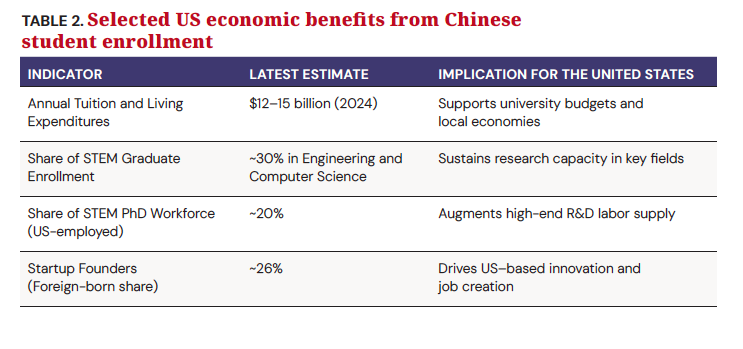
A simplistic “we trained China” narrative is incomplete and lacks explanatory power. The US used educational exchange to strengthen its own talent system in immediate, measurable ways tied to domestic R&D productivity. China’s “brain drain” was America’s “brain gain.”
How educational exchange strengthened US innovation capacity
Innovation leadership depends on people, institutions, and ecosystems. Educational exchange reinforced each element. First, Chinese students increased the supply of high-end labor. Labs are teams; breakthroughs emerge from iterative work. Expanding research teams enabled larger, more complex projects, increasing US scientific throughput — a direct innovation gain. Second, Chinese participation strengthened US leadership in fields where skilled researchers have substantial marginal impact, including AI, microelectronics, materials science, and biomedical engineering. High retention means the US gains both training outputs and subsequent productive years. Third, exchange complemented US advantages in interdisciplinary innovation, such as recombining computing with biology, materials with energy, or statistics with medicine. Fourth, exchange reinforced global university standing. Prestige attracts talent, supporting grants, philanthropy, and recruitment. Fifth, international inflows buffered the talent system during periods of fluctuating domestic interest in STEM.
These innovation gains do not negate legitimate concerns about specific sensitive research domains. But they demonstrate why broad restrictions are blunt instruments. If the United States restricts exchange in ways that reduce overall talent inflow, it risks undermining the research capacity that supports its own innovation leadership.
US economic benefits: Tuition, local economies, and the skilled workforce
The economic effects of educational exchange operate at multiple levels: university finances, local economies, and national productivity.
At the institutional level, international students contribute tuition revenue that supports academic programs, subsidizes research capacity, and, in many public universities, cross-subsidizes in-state educational missions. This revenue can fund faculty lines, maintain laboratory infrastructure, and support graduate student stipends. Chinese students were a major source of this revenue stream for many years. While universities should avoid overdependence on any single source country, it remains analytically accurate that Chinese student enrollment supported US higher education capacity in ways that benefited domestic students and communities across the US.
At the local level, international students are consumers. They rent housing, buy goods, and contribute to regional economies. College towns and metropolitan areas alike benefit from this spending. These effects are not merely financial; they sustain service-sector employment and stabilize local tax bases.
At the national level, the most significant economic benefit comes from the contributions of the skilled workforce. Advanced degrees in STEM are inputs to productivity growth. When graduates work in US firms, they contribute to R&D, product development, and the scaling of complex systems. This is especially valuable in sectors facing persistent shortages, such as AI engineering, advanced manufacturing, and semiconductor design. Talent shortages are not abstract; they shape whether firms locate R&D domestically, whether supply chains localize, and whether the United States can build the workforce required to implement key industrial policies such as CHIPS–related investments.
Optional practical training and other post-graduation work pathways have been important bridges. They allow US firms to hire graduates quickly and assess fit, while giving graduates time to contribute to projects and transition into longer-term roles. For the United States, the value of these pathways is not just employment; it is the retention of human capital already trained and socialized in US institutions.
This economic logic suggests that educational exchange has functioned as a complement to domestic talent development, not a substitute. A strong US policy approach should therefore combine investment in US–born talent with continued openness to international talent, including from China, where risks certainly can be managed.
Entrepreneurship and the US innovation economy
A major advantage of the US talent system is its ability to convert human capital into technological entrepreneurship. The United States has long benefited when foreign-born scientists and engineers establish companies, join startup ecosystems, and contribute to venture-backed innovation. Educational exchange has supported this pipeline by embedding students in US networks where they learn not only technical skills but also how to operate in a market-based innovation environment: how to pitch ideas, assemble teams, seek funding, and navigate intellectual property regimes.14
Chinese–born entrepreneurs educated in the United States have played visible roles in technology ecosystems. Their contributions are not limited to any single sector; they range from software and AI applications to biotech and clean technology. The US benefits when these firms are founded domestically, employ US–based workers, and keep core intellectual property within US jurisdiction. Even when founders maintain ties to global markets, the center of value creation can remain in the United States. Apple’s iPhone, for example, has printed on its box: “Designed by Apple in California, Assembled in China.”
The entrepreneurship channel is also a reminder that training is not the same as losing. A student trained in the United States who becomes an entrepreneur in the US has produced an unambiguous US benefit. The appropriate policy question is therefore how to maximize the probability that high-performing graduates remain and build within the US system — through clearer immigration pathways, predictable visa policies, and a welcoming environment — while applying targeted safeguards to sensitive domains.
This entrepreneurial benefit also interacts with broader US competitiveness. In fields like AI, where talent is mobile and in high demand, and innovation cycles are rapid, the location of teams matters. The United States has historically won because it has been the most attractive place to build. Educational exchanges contribute to that attractiveness, which is why they should be treated as a strategic asset rather than an optional luxury.
Soft power and strategic benefits: Influence through education
Educational exchanges have a strategic dimension that is often dismissed as “soft power” and therefore treated as secondary. In practice, they actually are a component of long-term influence. Leaders in academia, industry, and government are shaped by where they are educated and by the professional norms they internalize. Alumni of US universities often retain familiarity with US institutions and values and maintain professional relationships that can persist even when formal diplomacy is strained.
In the context of China, these network effects have been extremely important. Many Chinese scientists and engineers who trained in the United States became key nodes in international collaboration networks. Even after they returned to China, their research often remained embedded in global peer-review and publication systems. This does not mean the United States controls their choices, but it does mean that US educational engagement helped shape the norms of China’s scientific community in ways that favored openness, publication, and international benchmarking. For example, even taking into account some recent changes, the China National Natural Science Foundation is directly modeled on the structure and experience of the US National Science Foundation.15
There is also an intelligence and visibility dimension. Engagement provides a window into research directions and emerging priorities. When collaboration occurs in open science contexts — such as peer-reviewed publications, conferences, and joint workshops — the outputs are publicly visible and subject to global scrutiny. When collaboration stops, research can move into more closed environments where norms differ, and oversight is limited. A security posture that relies on blanket exclusion can paradoxically reduce situational awareness.16
Clearly, soft power is not a substitute for hard power, but it complements it. The United States benefits when it remains the system others want to join or emulate. Educational exchange, when managed responsibly, reinforces that gravitational pull in multiple respects.
Acknowledging risks without abandoning advantages
A US–centered argument for educational exchange must credibly address the risks. Concerns about IP theft, undisclosed funding, conflicts of commitment, and illicit technology transfer are real. US universities and research agencies have faced instances in which transparency norms were violated. Sensitive technologies — especially those relevant to military systems, critical infrastructure, or chokepoints in advanced manufacturing — require heightened scrutiny. The appropriate policy response, however, is not to treat all exchanges (and cooperation) as equally risky. It is to differentiate, define, and invest in capacity.
Three principles are especially important.
- First, distinguish fundamental research from sensitive applications. Much university research is published openly and does not provide a direct military advantage. Sensitive applications, by contrast, involve controlled technologies, classified programs, or clearly dual-use knowledge that can be operationalized. Policy should focus on the latter.
- Second, adopt risk-based screening rather than nationality-based exclusion. Nationality can be a variable in risk assessment, but it should not be the sole determinant. Project-level risk assessment, transparency requirements, and compliance infrastructure are more effective and less damaging than blanket restrictions.
- Third, fund institutional capacity. Universities cannot manage complex compliance demands without resources. Research security offices, export control expertise, training, and clear guidance are essential. Unfunded mandates lead institutions to over-correct and restrict legitimate collaborations out of caution, producing unnecessary harm to research and education missions. While initiatives such as the National Science Foundation–backed Safeguarding the Entire Community of the US Research Ecosystem, or SECURE, Initiative are a step in the right direction, they should not become a political football subject to ad hoc anxiety or ideologically driven interventions.
These principles reinforce the brief’s core claim: The United States can manage risk without destroying the benefits of openness. The challenge is governance, not abandonment.
The costs of over-restriction: Strategic self-harm
The most significant danger in current US policy debates is over-restriction. If the United States becomes less welcoming or more unpredictable, talent will go elsewhere. Canada, the United Kingdom, Australia, and other destinations have already expanded pathways to attract global researchers and students. Even countries in the Middle East have a welcome mat out for high-end talent. China itself is also working to recruit and retain talent domestically through incentives, infrastructure, and professional opportunities. It also has announced a series of policies to establish three global talent hubs in Beijing, Shanghai, and Shenzhen; these talent hubs are designed to recruit foreign talent to establish new ventures or secure employment within China’s government and enterprise R&D organizations.17China’s new “K” visa program is another example of a mechanism that China is using to bring high-end overseas talent into its efforts to build an innovation-driven economy. The K visa makes it much easier for foreigners to enter China if their aim is to create a business or join the Chinese research system.18
The consequences of over-restriction for the United States would be cumulative. Graduate programs would shrink in key STEM fields. Laboratory research capacity would decline. Faculty productivity would fall as research teams contract. US firms would face tighter labor markets and may expand R&D abroad. Over time, the United States would lose a structural advantage: its role as the central hub of global talent flows.
Moreover, over-restriction may accelerate China’s self-reliance. When access to US training and collaboration is curtailed, China’s xenophobia is raised; this creates stronger incentives to invest in domestic alternatives, often in more closed systems. This can reduce US access, minimize its influence over norms and standards, and diminish the value of engagement as a visibility tool. Without access, the possibilities for so-called “technological surprise” increase substantially.
The risk is therefore not only economic but strategic. A policy that undermines US universities and reduces the inflow of talent can weaken the foundations of American power. In a competition where talent is a primary currency, self-inflicted constraints have already become costly.
The ‘China Initiative’ and its lingering impact
The Department of Justice’s “China Initiative” — launched in 2018 and formally discontinued as a labeled program in February 2022 — sought to counter alleged PRC–linked economic espionage and technology transfer, but it had outsized effects on Chinese–American and Chinese–descent scientists and engineers working in US universities and labs.19In announcing the shift away from the “China Initiative” label, the DOJ acknowledged concerns that the program had fueled a “harmful perception” of bias against people of Chinese descent.20
Quantifying the number of cases is complicated; there is no single official definition of what counts as a China Initiative case. Independent tracking by MIT Technology Review found at least 77 cases and roughly 150 defendants during the program’s main period; its analysis also found that 88 percent of defendants charged were of Chinese ancestry. Critically, MIT’s 2021 review found that only 19 of 77 cases included charges tied to economic espionage or IP theft — far fewer than the public framing suggested.21
On outcomes, available public tallies suggest very mixed prosecutorial success: MIT’s investigation reported that by 2021, only about one-third of cases had produced convictions (including guilty pleas), with many research-integrity cases ending in dismissal or acquittal. Other scholars counting a narrower “prosecution” subset report even fewer convictions, underscoring definitional disputes.22Most successful cases involved violations of employment contracts and violations of IRS worldwide income policies, but not any type of industrial espionage.23
The deleterious effects on talent continue to be felt. A Stanford University Committee of 100 survey found 42 percent of US scientists of Chinese descent felt racially profiled by the US government, and approximately 38 percent reported difficulty obtaining research funding and other professional setbacks. Separately, Stanford research tracking mobility found departures of China–born, US–based scientists rose sharply after 2018 — up approximately 75 percent, with two-thirds of movers going to China — suggesting a measurable chilling effect on retention precisely where US innovation capacity is most reliant on advanced talent (see Appendix B).24
Smart openness: A strategy to secure benefits and manage risk
Smart openness is a pragmatic policy framework that recognizes two realities: the United States benefits substantially from educational exchanges, and it has legitimate security interests that require protection. Smart openness is built on three commitments.25
- Openness should be the default posture for education and fundamental research. The United States’ advantage depends on being the preferred destination. That requires predictability, transparency, and a welcoming environment for legitimate students and scholars.
- Targeted safeguards for clearly defined sensitive areas. When research involves advanced semiconductor manufacturing processes, military-relevant AI applications, or controlled technologies, additional measures are warranted. Clear definitions and regularly updated lists of sensitive areas reduce uncertainty and prevent overbroad chilling effects. The current situation remains largely untenable as it borders on excessive restriction due to a lack of well-designed regulations. Existing policies continue to be driven by excessive emphasis on risk and insufficient focus on lost opportunities.
- Investment in capacity. Federal support for research security infrastructure, standardized guidance, and training allows universities to comply without defaulting to unnecessary restrictions. The goal is not bureaucracy for its own sake but effective risk management.
Applied to a national talent policy, smart openness suggests that the United States should streamline visa processing for low-risk fields, improve visa predictability for graduate students and postdocs, and expand pathways for high-demand graduates to remain in the United States. At the same time, it should strengthen oversight in sensitive domains and enforce transparency requirements rigorously.26
Smart openness is not a compromise that splits the difference between engagement and restriction. It is a strategy that maximizes US advantage by preserving the structural features that have historically made the United States dominant in science and technology.
Policy implications: What an explicitly pro–US talent strategy should do
Since the early 1980s, US–China educational exchange has evolved through multiple phases: initial normalization-era academic contacts, rapid expansion during China’s reform period, large-scale PRC student flows in the 1990s and beyond, and the post-2010 era, in which Chinese enrollment became a defining feature of US graduate STEM education. Across these phases, the United States benefited in a consistent pattern: it attracted ambitious students, trained them in high-end research environments, and absorbed a significant share of their productive labor into US institutions and firms. The “advantage” was not the absence of Chinese gains; it was the American system’s greater ability to convert global talent into domestic outcomes. That advantage remains a strategic asset worth preserving.
A practical test of policy success is simple: Does the United States remain the world’s most attractive place for the best students and researchers to do serious work? If yes, the US continues to enjoy the compounding returns of openness. If not, the US risks losing a foundational pillar of its innovation ecosystem. Smart openness is designed to keep the answer “yes” while reducing the risks of engagement amid strategic competition.
A pro–US talent strategy should defend the comparative advantage of attracting and retaining global talent with three policy priorities: First, protect openness through predictable visa processing, stable pathways for study and postdocs, and avoiding politicized “visa anxiety.” The US should compete to remain the top choice. Second, raise talent capture returns by streamlining student-to-employment transitions, clearer paths to permanent residence for STEM graduates, and entrepreneurship-friendly visas. These are investments in national capacity. Third, sharpen security tools through targeted controls — such as project-based screening, controlled technology lists, or disclosure enforcement — rather than broad nationality-based restrictions that reduce benefits and encourage talent diversion.
Taken together, these steps operationalize smart openness, preserving the benefits of engagement for the United States while adapting governance to protect security and integrity. In a competition where talent is central, the United States wins by remaining the best platform for talent to flourish under rules that protect national interests.
Conclusion
Smart openness aligns security with competitiveness by preserving US structural advantages while managing risk precisely. Without substantial domestic replacement investment, broad closure risks self‑weakening. China’s scale, investment, and industrial policy mean intensifying competition, but openness has been a powerful source of American strength. Chinese students have strengthened US research capacity, university leadership, critical labor markets, technological entrepreneurship, and collaborative networks underpinning US influence. The central risk is forgetting these benefits and adopting policies that erode the United States’ comparative advantages.
Educational exchange should be treated as a strategic asset — governed intelligently, protected where necessary, and sustained where it strengthens American leadership. Smart openness — differentiating sensitive from non-sensitive domains, project-level risk management, and institutional compliance — protects security while capturing economic, scientific, and strategic returns from being the world’s premier talent destination.27
Appendix A
Below is a list of 15 specific ways the United States has benefited from education cooperation and student or scholar exchanges with China from 1979 through January 2026, with explicit mechanisms and examples in each case.
1. Expansion and stabilization of US STEM graduate programs
- How the US benefited: Chinese students filled structural gaps in US PhD programs where domestic supply was insufficient, allowing departments to remain viable and competitive.
- Concrete example: By the 2000s, Chinese nationals made up 25–35 percent of PhD enrollments in engineering, computer science, and physics at leading US universities, enabling programs to maintain cohort size, faculty lines, and specialized coursework.
2. Sustained US research productivity and publication output
- How the US benefited: Chinese PhD students and postdocs powered US–based labs as a core source of research labor.
- Concrete example: Thousands of high-impact journal articles in AI, materials science, nanotechnology, and biomedical engineering list US institutional affiliations, even when first authors were Chinese nationals.
3. High retention of US–trained Chinese STEM PhDs into the US workforce
- How the US benefited: The US captured the most productive career years of US–trained Chinese scientists and engineers.
- Concrete example: National Science Foundation data show 80–90 percent stay rates for Chinese science and engineering PhDs five years after graduation (2000s–2010s), among the highest of any nationality.28
4. Strengthening US industrial R&D and innovation capacity
- How the US benefited: US–trained Chinese engineers staffed R&D teams in critical sectors.
- Concrete example: Chinese–born engineers educated in the US became integral to firms such as Google, Intel, NVIDIA, and Qualcomm — contributing to chip design, AI systems, and wireless technologies.29
5. US gains through OPT and H-1B talent pipelines
- How the US benefited: Student-to-work transitions allowed US firms to hire already-trained talent with minimal onboarding costs.30
- Concrete example: Chinese nationals consistently ranked second (after India)in STEM OPT participation and H-1B approvals during the 2010s through the early 2020s, especially in software engineering and data science.31
6. Cross-subsidization of US higher education finance
- How the US benefited: Tuition and living expenditures from Chinese students supported US universities and domestic students.
- Concrete example: Prior to COVID, Chinese students contributed $12–15 billion annually to the US economy, helping public universities fund labs, faculty positions, and in-state tuition subsidies.32
7. Enhancement of undergraduate STEM education quality
- How the US benefited: Chinese graduate students served as teaching assistants and lab instructors on a large scale.
- Concrete example: Large engineering and computer science departments relied on Chinese teaching assistants to run labs, grade coursework, and mentor undergraduates — directly improving learning outcomes for US–born students.
8. Accelerated US patenting and applied innovation
- How the US benefited: Chinese–origin researchers increased US–based patent output.
- Concrete example: A significant share of US university and corporate patents in AI, nanomaterials, and biomedical devices list Chinese–born inventors trained in US institutions, with IP owned by US firms or universities.33
9. Startup formation and entrepreneurship in the United States
- How the US benefited: US–trained Chinese students founded or co-founded US–based startups.
- Concrete example: Foreign-born founders (including many Chinese nationals) account for 20-25 percent of US high-tech startups, particularly in Silicon Valley and Boston, creating US jobs and tax revenue.34
10. Reinforcement of US global university leadership
- How the US benefited: International enrollment sustained US dominance in global rankings and research prestige.
- Concrete example: Institutions such as the Massachusetts Institute of Technology and Stanford University leveraged international PhD talent to maintain research scale unmatched by foreign competitors.
11. Creation of durable US–centered scientific networks
- How the US benefited: Alumni networks anchored global science to US institutions.
- Concrete example: Chinese scientists who returned home often continued publishing with US collaborators, attending US–led conferences, and citing US research — keeping the US at the center of knowledge flows.35
12. Improved US visibility into China’s scientific and technological trajectory
- How the US benefited: Engagement provided transparency and situational awareness.
- Concrete example: Joint publications, conferences, and advisor-student relationships gave US scientists early insight into China’s emerging research strengths and priorities — knowledge unavailable through isolation.36
13. Norm diffusion favoring open science and peer review
- How the US benefited: US research norms influenced Chinese scientific practice.
- Concrete example: Chinese scientists trained in the US internalized expectations around peer review, disclosure, replication, and publication, helping keep parts of China’s research system interoperable with global science.
14. Buffering US talent shortages during demographic and pipeline gaps
- How the US benefited: International students offset weak domestic STEM pipelines.
- Concrete example: During periods of declining US–born PhD interest in physical sciences and engineering (1990s–2000s), Chinese students prevented the contraction of US research capacity.
15. Strategic leverage through attraction rather than exclusion
- How the US benefited: The US converted openness into a long-term advantage.
- Concrete example: For four decades, the US consistently benefited more than China from educational exchange because it retained talent, IP, firms, and institutional leadership — advantages now at risk as restrictions increase.
From 1979 to 2026, US–China educational exchange was not a one-sided concession. It functioned as a talent-capture system that strengthened US universities, firms, and innovation capacity, and enhanced US global leadership. The core US benefit was not denying China’s progress but embedding global talent inside the American innovation ecosystem, where the economic and strategic returns accrued primarily to the United States.
Appendix B
Below is a list of Chinese scientists once based in the US who left for jobs in China (2024–25).
1. Gao Huajian (engineering and mechanics)
- Former (US): Professor (emeritus), Brown University
- New (China): Chair professor, Tsinghua University
2. Wang Zhonglin, also known as Zhong Lin Wang (physics)
- Former (US): Regents’ professor and Hightower Chair, Georgia Institute of Technology
- New (China): Senior role, Beijing Institute of Nanoenergy and Nanosystems
3. Sun Song (geometry)
- Former (US): Professor of mathematics, University of California, Berkeley
- New (China): Professor, Institute for Advanced Study in Mathematics, Zhejiang University
4. Ma Donghan (chemical engineering)
- Former (US): Postdoctoral research, Purdue University
- New (China): Professor, Dalian University of Technology
5. Ma Dongxin (chemistry)
- Former (Canada): Postdoctoral research, University of Toronto
- New (China): Assistant professor, Tsinghua University
6. Kunliang Guan, also known as Kun-Liang Guan (biochemistry)
- Former (US): Distinguished professor, University of California, San Diego
- New (China): Chair professor, Westlake University
7. Zhang Xiangyu (energy engineering)
- Former (US): Professor of mechanical engineering, Northwestern University
- New (China): Chair professor, College of Energy, Zhejiang University
8. Sun Shao-Cong (immunology and cancer biology)
- Former (US): Director, Center for Inflammation and Cancer, University of Texas MD Anderson Cancer Center
- New (China): Distinguished investigator, Chinese Institutes for Medical Research
9. Hu Yijuan (biostatistics and biomathematics)
- Former (US): Professor of biostatistics, Rollins School of Public Health, Emory University
- New (China): Professor, Beijing International Center for Mathematical Research, Peking University
10. Chen Jing (computer science and blockchain)
- Former (US): US–based researcher
- New (China): Professor, Tsinghua University
11. She Yiyuan (statistics and data science)
- Former (US): Professor, Florida State University
- New (China): Chair professor, Westlake University
12. Fu Tianfan (AI for scientific discovery)
- Former (US): Assistant professor, Rensselaer Polytechnic Institute
- New (China): Associate professor, Nanjing University
13. Zhang Yitang, also known as Yitang Zhang (number theory)
- Former (US): Professor, University of California, Santa Barbara
- New (China): Professor, Institute of Advanced Studies, Sun Yat-sen University
14. Liu Jun (statistics)
- Former (US): Professor, Harvard University
- New (China): Chair and distinguished professorship, Tsinghua University
15. Hu Ye, also known as “Tony” Ye (biomedical engineering and nanomedicine)
- Former (US): Chair professor, Tulane University
- New (China): Founding dean, School of Biomedical Engineering, Tsinghua University
16. Lin Wenbin, also known as Wenbin Lin (chemistry and cancer drug science)
- Former (US): Professor, University of Chicago
- New (China): Chair professor, Westlake University
17. Qian Hong (mathematics)
- Former (US): Endowed professorship, University of Washington
- New (China): Chair professor, Westlake University
18. Fang Lei (chemistry and organic materials)
- Former (US): Deputy chair and professor of chemistry, Texas A&M University
- New (China): Chair professor and director, Center for Functional Organic Materials, Yongjiang Laboratory
19. Wan Daqing (mathematics)
- Former (US): Professor of mathematics, University of California, Irvine
- New (China): Professor, Chongqing University
Join us as we discuss the renewal of the U.S.-China science and technology agreement. Related
Rekindling the U.S.-China S&T Relationship: Challenges and Opportunities
Program
Topics
Countries/Territories
Entities
Authors

Denis Simon is a senior research fellow in the Quincy Institute’s East Asia program, focusing on global science and technology (S&T) issues and U.S.-China S&T relations. He also holds a senior faculty appointment at Schwarzman College at Tsinghua University in…
Citations
“Fox in the Henhouse: The US Department of Defense Research and Engineering’s Failures to Protect Taxpayer-Funded Defense Research,” The Select Committee on the Strategic Competition Between the United States and Chinese Communist Party, Sept. 5, 2025, https://chinaselectcommittee.house.gov/media/reports/fox-in-the-henhouse. ↩
William R. Kerr, “The Ethnic Composition of US Inventors,” Harvard Business School, 2008, https://www.hbs.edu/ris/Publication%20Files/Kerr%20WP08_EthMatch_f657d992-cf76-4b76-8b52-61cac126b5a8.pdf; William R. Kerr and William F. Lincoln, “The Supply Side of Innovation: H-1B Visa Reforms and US Ethnic Invention,” National Bureau of Economic Research, 2010, https://www.journals.uchicago.edu/doi/10.1086/651934; “Immigrant Inventors are Crucial for American National and Economic Security,” Economic Innovation Group, May 21, 2024, https://eig.org/immigrants-patents/; Stuart Anderson, “Immigrants and Billion Dollar Companies,” National Foundation for American Policy, 2022, https://nfap.com/research/new-nfap-policy-brief-immigrant-entrepreneurs-and-u-s-billion-dollar-companies/; AnnaLee Saxenian, The New Argonauts: Regional Advantage in a Global Economy (Cambridge: Harvard University Press, 2006), https://www.hup.harvard.edu/books/9780674025660. ↩
“Most US–Trained Science and Engineering Doctorate Recipients with Temporary Visas Stay in the United States after Graduation,” National Science Foundation, National Center for Science and Engineering Statistics, 2025, https://ncses.nsf.gov/pubs/nsf25325. ↩
“Most US–Trained Science and Engineering Doctorate Recipients,” National Science Foundation. ↩
Michael G. Finn, “Stay Rates of Foreign Doctorate Recipients from US Universities, 2011,” Oak Ridge Institute for Science and Education, 2014, https://www.osti.gov/servlets/purl/1303351. ↩
“SEVIS by the Numbers,” US Department of Homeland Security, 2024, https://www.ice.gov/doclib/sevis/btn/24_0510_hsi_sevp-cy23-sevis-btn.pdf. ↩
“SEVIS by the Numbers,” US Department of Homeland Security; “Characteristics of H-1B Specialty Occupation Workers,” US Citizenship and Immigration Services, 2024, https://www.uscis.gov/sites/default/files/document/reports/OLA_Signed_H-1B_Characteristics_Congressional_Report_FY2023.pdf; Carolyne Im, Alexandra Cahn, and Sahana Mukherjee, “What We Know About the US H-1B Visa Program,” Pew Research Center, March 4, 2025, https://www.pewresearch.org/short-reads/2025/03/04/what-we-know-about-the-us-h-1b-visa-program/. ↩
“Immigrant Inventors Are Crucial for American National and Economic Security,” Economic Innovation Group. ↩
Kerr, “The Ethnic Composition of US Inventors”; Kerr and Lincoln, “The Supply Side of Innovation”; “Immigrant Inventors Are Crucial for American National and Economic Security,” Economic Innovation Group; Anderson, “Immigrants and Billion Dollar Companies”; AnnaLee Saxenian, The New Argonauts. ↩
Initiatives include Project 211, Project 985, and the Double First-Class Initiative. See Huili Si, “Higher Education Evolution in China: A Systematic Internationalisation of Higher Education in China,” Higher Education Quarterly 80, no. 1 (Jan. 2026), https://doi.org/10.1111/hequ.70088; “‘World-Class’ Universities List Expanded,” State Council of the People’s Republic of China, Feb. 15, 2022, https://english.www.gov.cn/statecouncil/ministries/202202/15/content_WS620adfefc6d09c94e48a50be.html. ↩
Si, “Higher Education Evolution in China.” ↩
Zeyi Yang, “Four Things You Need to Know About China’s AI Talent Pool,” MIT Technology Review, March 27, 2024, https://www.technologyreview.com/2024/03/27/1090182/ai-talent-global-china-us/. ↩
Kerr, “The Ethnic Composition of US Inventors;” Kerr and Lincoln, “The Supply Side of Innovation”; “Immigrant Inventors are Crucial for American National and Economic Security,” Economic Innovation Group; Anderson, “Immigrants and Billion Dollar Companies”; AnnaLee Saxenian, The New Argonauts. ↩
Anderson, “Immigrants and Billion Dollar Companies.” ↩
Linlin Liu et al., “The Dominance of Big Teams in China’s Scientific Output,” Quantitative Science Studies 2, no. 1 (2021): 350-362, https://direct.mit.edu/qss/article/2/1/350/97566/The-dominance-of-big-teams-in-China-s-scientific. ↩
“Openness, International Engagement, and the Federally Funded Science and Technology Research Enterprise,” National Academies of Sciences, Engineering, and Medicine, 2023, https://doi.org/10.17226/27091. ↩
Author interview with Dr. Wang Huiyao, President of Center for China and Globalization, Beijing, June 2025. ↩
Qian Zhou, “China’s New K Visa: Opening the Door Wider for Young Foreign Talent,” China Briefing, Aug. 15, 2025, https://www.china-briefing.com/news/chinas-entry-exit-k-visa-rules-2025/. ↩
Bethany Allen-Ebrahimian, “The China Initiative Explained,” MIT Technology Review, December 2021, https://www.technologyreview.com/2021/12/02/1040656/china-initative-us-justice-department. ↩
“Assistant Attorney General Matthew Olsen Delivers Remarks on Countering Nation-State Threats,” US Department of Justice, Feb. 23, 2022, https://www.justice.gov/archives/opa/speech/assistant-attorney-general-matthew-olsen-delivers-remarks-countering-nation-state-threats; “The ‘China Initiative’ Failed US Research and National Security — Don’t Bring It Back,” Brennan Center for Justice, Sept. 23, 2024, https://www.brennancenter.org/our-work/analysis-opinion/china-initiative-failed-us-research-and-national-security-dont-bring-it; Yujia Zhai et al., “Reverse Brain Drain? Exploring Trends among Chinese Scientists in the US,” Stanford Center for International Security and Cooperation, 2024, https://sccei.fsi.stanford.edu/china-briefs/reverse-brain-drain-exploring-trends-among-chinese-scientists-us; Rebecca Trager, “Scientists of Chinese Descent Leaving the US at an Accelerating Pace,” Chemistry World, Aug. 2, 2023, https://www.chemistryworld.com/news/scientists-of-chinese-descent-leaving-the-us-at-an-accelerating-pace/4017831.article. ↩
Assistant Attorney General Matthew Olsen,” US Department of Justice; Allen-Ebrahimian, “The China Initiative Explained.” ↩
Allen-Ebrahimian, “The China Initiative Explained.” ↩
Allen-Ebrahimian, “The China Initiative Explained.” ↩
Julia Yoon, “Innovation Lightbulb: Foreign-Born Share of the US STEM Workforce,” Center for Strategic and International Studies, April 5, 2024, https://www.csis.org/analysis/innovation-lightbulb-foreign-born-share-us-stem-workforce. ↩
“Openness, International Engagement, and the Federally Funded Science and Technology Research Enterprise,” National Academies of Sciences, Engineering, and Medicine. ↩
“Openness, International Engagement, and the Federally Funded Science and Technology Research Enterprise,” National Academies of Sciences, Engineering, and Medicine. ↩
“Openness, International Engagement, and the Federally Funded Science and Technology Research Enterprise: Proceedings of a Workshop — in Brief,” National Academies of Sciences, Engineering, and Medicine, 2023, https://doi.org/10.17226/27091. ↩
“Most US–Trained Science and Engineering Doctorate Recipients with Temporary Visas Stay in the United States after Graduation,” National Science Foundation, National Center for Science and Engineering Statistics, 2025, https://ncses.nsf.gov/pubs/nsf25325; Finn, “Stay Rates of Foreign Doctorate Recipients from US Universities, 2011.” ↩
Victoria Bela, “How Chinese Engineers Helped Build the US Semiconductor Empire: A Timeline,” South China Morning Post, Sept. 3, 2024, https://www.scmp.com/news/china/science/article/3277015/how-chinese-engineers-helped-build-us-semiconductor-empire-timeline. ↩
“Characteristics of H-1B Specialty Occupation Workers,” US Citizenship and Immigration Services; Im, Cahn, and Mukherjee, “What We Know About the US H-1B Visa Program.” ↩
“SEVIS by the Numbers,” US Department of Homeland Security; “Characteristics of H-1B Specialty Occupation Workers,” US Citizenship and Immigration Services; Im, Cahn, and Mukherjee, “What We Know About the US H-1B Visa Program.” ↩
Bochen Han, “Chinese Student Numbers in US Continue to Fall as Gap With Indian Scholars Widens,” South China Morning Post, Nov. 17, 2025, https://www.scmp.com/news/us/diplomacy/article/3332899/chinese-student-numbers-us-continue-fall-gap-indian-scholars-widens. ↩
Kerr, “The Ethnic Composition of US Inventors”; Kerr and Lincoln, “The Supply Side of Innovation”; “Immigrant Inventors Are Crucial for American National and Economic Security,” Economic Innovation Group. ↩
Anderson, “Immigrants and Billion Dollar Companies”; Saxenian, The New Argonauts. ↩
Denis Simon and Caroline S. Wagner, “US–China Scientific Collaboration at a Crossroads: Navigating Strategic Engagement in the Era of Scientific Nationalism,” Quincy Institute, Nov. 4, 2025, https://quincyinst.org/research/u-s-china-scientific-collaboration-at-a-crossroads-navigating-strategic-engagement-in-the-era-of-scientific-nationalism/#h-introduction-the-transformation-of-global-scientific-cooperation ↩
Remco Zwetsloot, “US–China STEM Talent Decoupling: Background, Policy, and Impact,” John Hopkins Applied Physics Laboratory, 2020, https://www.jhuapl.edu/sites/default/files/2022-12/Zwetsloot-STEM.pdf. ↩