
Community Guidelines for Smart Openness In US Research Collaboration
Executive Summary
China was long perceived as the junior partner in the US–China scientific relationship, but is now at the cutting edge of scientific research in many areas. As China has reached new frontiers, an exclusive focus on security concerns has driven a stark decline in US–China cooperation. This has put the two countries on a path to scientific and research decoupling, which is throttling US visibility into China’s frontier work. It also cuts deeply into the US commitment to scientific openness at a time when US national interests would most benefit from some form of continued engagement.
Preventing further damage will require a new paradigm that balances beneficial scientific cooperation among the world’s foremost powers with appropriate attention to both opportunities and security concerns. In other publications, we have outlined the broad conceptual framework and argument for a “smart openness” framework. In this brief, we lay out a path to implementing it.
Implementing the smart openness framework, especially in the current atmosphere of mutual suspicion and hostility between Washington and Beijing, will require the participation and buy-in of the research community itself. Government cannot and should not define the frontiers of research. This brief begins the process by proposing an initial classification of field-specific standards for what’s in and what’s out in the major fields of international scientific research.
We develop and explain three categories of risk for this classification: a green (low risk) category, a yellow (manageable risk) category, and a red (high security-disqualifying risk) category. Such a categorization allows the research community to make informed, considered decisions about collaboration, rather than relying on vague federal advisories. The framework is intended as a starting point for deliberation among professional societies, research security officers, disciplinary experts, and government liaisons.
As we further explain in the brief, agreeing on a smart openness security classification can jump-start a process allowing the scientific community to self-monitor in a unified manner, curtailing the generalized suspicion of all US–China scientific collaboration.
Introduction
In a recent Quincy Institute paper and editorial for Science, the authors of this brief make the case for “smart openness” in US research policy.1We argue that blanket condemnation of US–China research collaboration — without clear guidance on what is genuinely risky and what is not — is producing a chilling effect that damages American science without proportionately improving security. The US–China scientific decoupling now underway was not the result of an evidence-based assessment. It emerged from an accountability vacuum in which the costs of engagement are dramatized and the costs of isolation are ignored.
In the Science editorial, we described the current state of scientific collaboration as follows:
“US–China scientific collaboration has declined sharply since 2017, even in fields far beyond military or space-based applications. In areas where China leads, continued cooperation could serve US interests. Yet no affirmative guidance is offered. Researchers are often left to guess, and guessing incorrectly can carry severe consequences…Coauthorship is treated as equivalent to capability transfer, and institutional affiliation as proof of malign intent.”
But diagnosing the problem is not the same as solving it. The US government has established disclosure requirements, funding restrictions, and penalty structures. What has not been done is to provide working scientists with actionable guidance on the full range of potential collaborations, including assurances for those that are clearly safe, and some guidance for the middle range of research that is neither clearly a security risk nor clearly harmless. Such guidance should seek to rationally balance the benefits of US research participation on global scientific frontiers with the real security threats that can emerge in US–China collaboration.
Properly implementing such a smart openness framework requires the participation of the research community itself. This includes professional societies, disciplinary experts, university research security officers, and scientists who understand their fields well enough to distinguish foundational research from work with genuine dual-use or national security sensitivity.
Engaging the broader scientific and academic community serves several essential purposes.
- First, it is unfair to ask individual scholars and even individual university research oversight divisions to risk the negative attention that could result from scientific contacts with China in an atmosphere of paralyzing suspicion and uncertainty. Following a process that represents a community consensus is a far more reasonable ask.
- Second, community expertise will enable the establishment of consensus on a clear security classification of research fields and subfields, with input from practitioners. Such a classification is critical for organizing scientific collaboration, and the issues surrounding the establishment of a consensus classification are further explored in the remainder of this brief.
- Finally, community resources will permit the creation of a unified registration mechanism to track research projects and personnel involved in collaborations that raise security concerns. Such a transparent registration mechanism will address concerns about any lack of clarity, information, or safeguards for US–China collaboration.
Community institutions that could be critical in this process may include academic associations such as the Association of American Universities, the AAU, and scientific associations such as the American Association for the Advancement of Science, the AAAS, and the National Academy of Sciences, the NAS.
This brief presents, for discussion, the steps to implement an actionable smart openness framework. The bulk of the brief is devoted to developing a key element of such a framework: a classification of the security risks across different scientific areas. The brief and appendix describe a detailed three-tier classification — green, yellow, and red — for research fields and subfields, drawing on existing government technology lists, recommended risk dimensions, and current data on where China (in this case) holds global scientific leadership.
A consensus on such a framework is essential for guiding any research collaboration. The purpose would be to give research security officers, professional societies, and institutional leaders a structured basis for making collaboration decisions — and to shift the locus of judgment from vague federal advisories to field-specific standards developed by people who know the science.
Second, the document discusses concrete next steps toward achieving community consensus on a voluntary smart openness process, including both a consensus classification scheme and a registration process for US–China research collaborations.
Proposed security classification scheme
The crucial innovation in this three-tier classification scheme is the middle yellow tier. Current policy is effectively binary: research is either classified and closed or unclassified and nominally open, but subject to unpredictable political scrutiny.
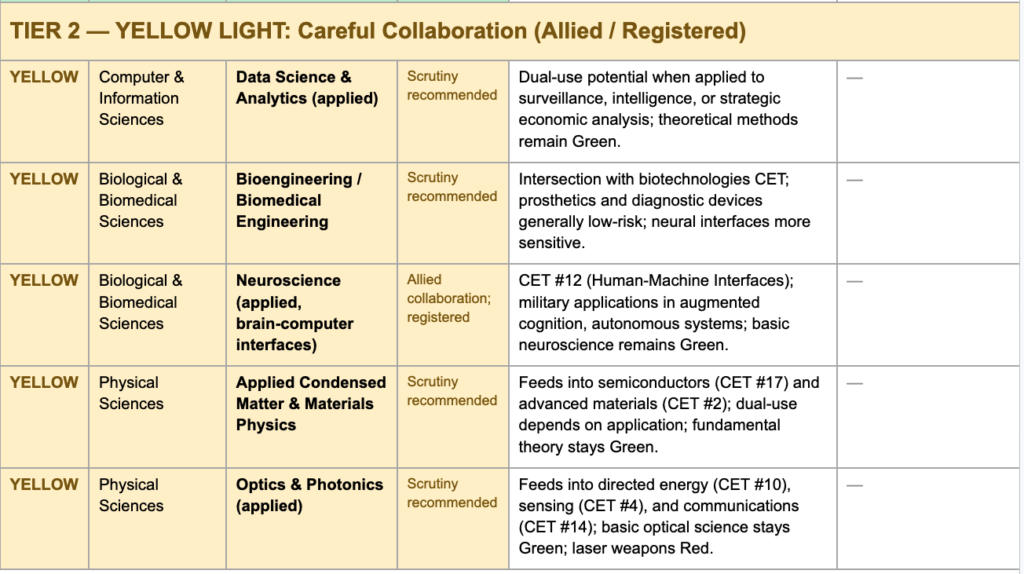
The yellow category creates a structured middle ground for fields that are unclassified but warrant guided consideration — areas where dual-use potential, strategic supply chain concerns, or active foreign targeting elevate risk above baseline without justifying outright prohibition. In these fields, decisions about specific collaborations would be made by institutional research security officers in consultation with relevant government agencies, using standardized criteria rather than ad hoc political judgment. The goal is to make the yellow zone a space of informed flexibility rather than defensive withdrawal.
The proposed categorization scheme is guided by the National Academies of Science, Engineering, and Medicine, or NASEM, which recommends three dimensions for assessing technology in the context of international cooperation:
- Nature of risk: What kind of harm? (e.g., military capability transfer, economic loss, erosion of technological lead, intelligence compromise)
- Likelihood of risk: How probable? (e.g., active targeting vs. theoretical vulnerability; track record of diversion in the field)
- Potential consequences: How severe if realized? (e.g., incremental improvement to adversary capability vs. strategic shift; reversible vs. irreversible)2
“Red light” categories are largely pre-defined by critical technologies lists, lists of militarily sensitive technologies, and other areas of national interest.3A field goes green when all three are low. It shifts to yellow when at least one is elevated. It hits red when two or more are high, or when consequences alone are catastrophic, regardless of likelihood.
Then, within these NASEM categories, we can factor and fold in existing lists, policies, and frameworks by detailing the categories for fields and subfields. Fields presented below are based upon the National Science Board list of science and engineering fields, and can be further refined based upon these fields or other lists, as detailed here.4The list may be subject to change based on a cooperation scorecard between the United States and foreign partners.
Existing US critical technology lists
Below are the primary government-issued lists in operation and the Department of Defense’s recently revised priorities:
• The US Office of Science and Technology Policy critical and emerging technologies list (February 2024):
- Advanced computing
- Advanced engineering materials
- Advanced gas turbine engine technologies
- Advanced and networked sensing and signature management
- Advanced manufacturing
- Artificial intelligence
- Biotechnologies
- Clean energy generation and storage
- Data privacy, data security, and cybersecurity technologies
- Directed energy
- Highly automated, autonomous, and uncrewed systems and robotics
- Human-machine interfaces
- Hypersonics
- Integrated communication and networking technologies
- Positioning, navigation, and timing technologies
- Quantum information and enabling technologies
- Semiconductors and microelectronics
- Space technologies and systems
• Defense Department critical technology areas (November 2025):
- Applied artificial intelligence
- Biomanufacturing
- Contested logistics technologies
- Quantum and battlefield information dominance
- Scaled directed energy
- Scaled hypersonics
This list was recently narrowed down from 14 to six. The prior 14 included biotechnology, quantum science, future generation wireless, advanced materials, trusted AI and autonomy, integrated network systems, microelectronics, space technologies, renewable energy, advanced computing, directed energy, hypersonics, integrated sensing and cyber, and human-machine interfaces.
- The Militarily Critical Technologies List, or MCTL, was developed by the Department of Defense’s Militarily Critical Technologies Program and intended to inform export control decisions, counterintelligence activities, and technology protection programs. However, a 2006 US Government Accountability Office report found the lists were “of limited value” because they were “not appropriately validated and largely out of date.”5The MCTL has not been meaningfully updated since.
The policy proposal for smart openness
The idea is to categorize these fields into three broad areas: green, yellow, and red. The proposed framework for field determination rests on National Security Decision Directive 189 (1985) — which establishes that fundamental research results should remain unrestricted “to the maximum extent possible” and that “where national security requires control, the mechanism for control is classification” — and the NSDD Federation of American Scientists policy directive on technology transfer.6
The core of the system would be a tiered technology list, such as that proposed below, distinguishing among the following:
- Tier 1 (Green): Fully open (NSDD-189 applies)
- Tier 2 (Yellow): Allied collaboration only (e.g., the Five Eyes intelligence coalition of Australia, Canada, New Zealand, the UK, and the US and select partners), registered with an approved entity
- Tier 3 (Red): Classified and/or US only
Complex considerations would be needed for a tier 2 assignment. This area would likely be the intersection of the following:
- Direct military application, where collaboration enhances US capacity
- High strategic value with dual-use potential, where collaboration enhances US capacity
- Active foreign intelligence targeting where care needs extra scrutiny and consultation
- Limited global supply chains that need extra scrutiny and consultation
- Fields where foreign expertise and access are in US interests.
This system would be supplemented by a notification mechanism that tracks yellow-light research projects, personnel, and international collaborations without imposing full export-control burdens.
Green light fields: Criteria for full NSDD-189 openness
For a field to qualify for unrestricted international collaboration under NSDD-189, it should meet most or all of these conditions:
1. It should address inherently transnational problems that cannot be solved within national boundaries, such as:
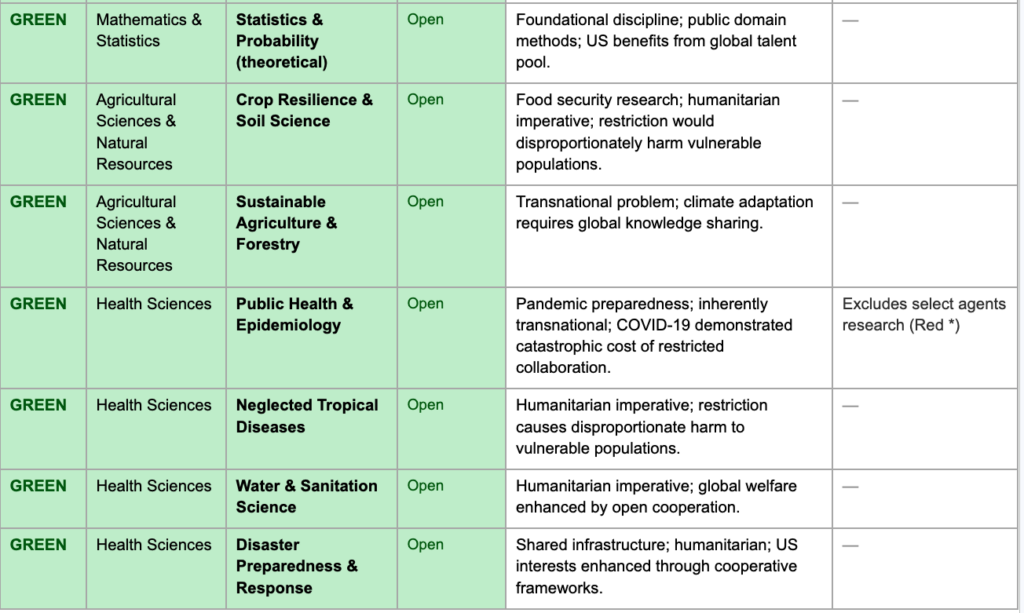
- Pandemic preparedness and infectious disease (excepting select agents and controlled pathogens)
- Climate science and atmospheric modeling
- Seismology and earthquake early warning
- Oceanography and marine ecosystems
- Biodiversity and conservation biology
2. There should be long-term horizons for application. This would involve basic science, where military or strategic relevance is distant and where US capacity is enhanced by openness, such as the following fields:
- Fundamental physics (e.g., cosmology, particle physics, condensed matter theory)
- Pure mathematics
- Evolutionary biology
- Paleontology and geology
- Astronomy and astrophysics (non-space systems)
3. If results are already in the public domain or are rapidly disseminated worldwide. This would mean no meaningful advantage from restriction or where restrictions do not inhibit the diffusion of knowledge or capacity, such as the following fields:
- Genomics and bioinformatics (excepting synthetic biology with dual-use potential)
- Ecology and environmental science
- Agricultural science (e.g., crop resilience, soil science, sustainable practices)
- Public health and epidemiology
4. If there are shared infrastructure dependencies. This type of collaboration improves US access rather than eroding advantage, and the US cooperates with other countries to sustain large-scale, single-point infrastructure that advances scientific research, such as:
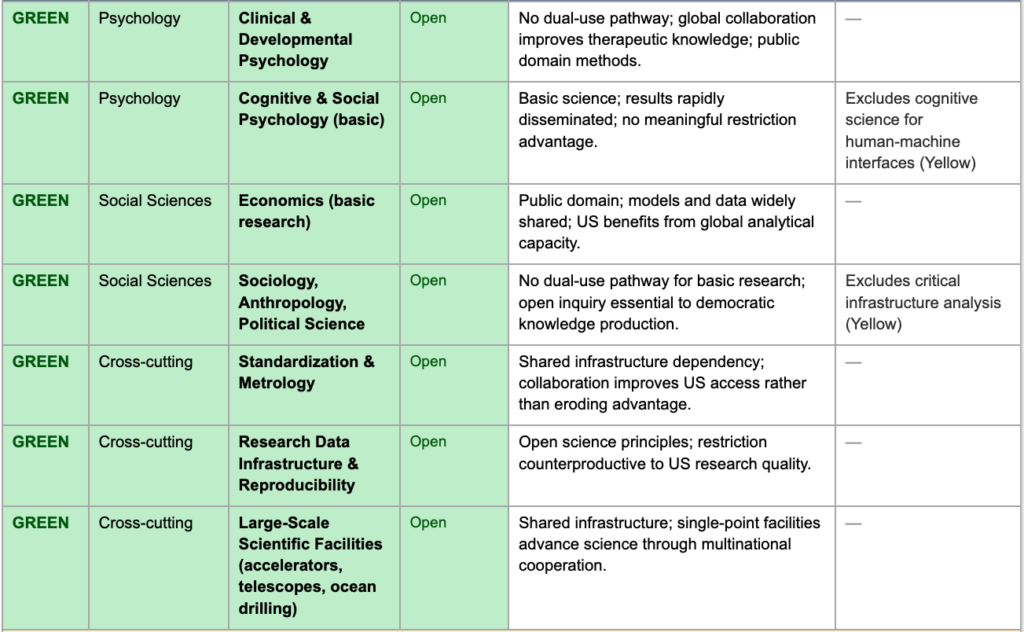
- Large-scale scientific facilities (e.g., particle accelerators, telescope networks, ocean drilling)
- Standardization and metrology
- Research data infrastructure and reproducibility methods
5. If there is a humanitarian imperative, meaning restriction would cause disproportionate harm to vulnerable populations, and US cooperation with other countries’ expertise or needs meets criteria for global welfare without transferring critical knowledge, including the following:
- Neglected tropical diseases
- Food security research
- Disaster preparedness and response
- Water and sanitation science
Yellow light fields
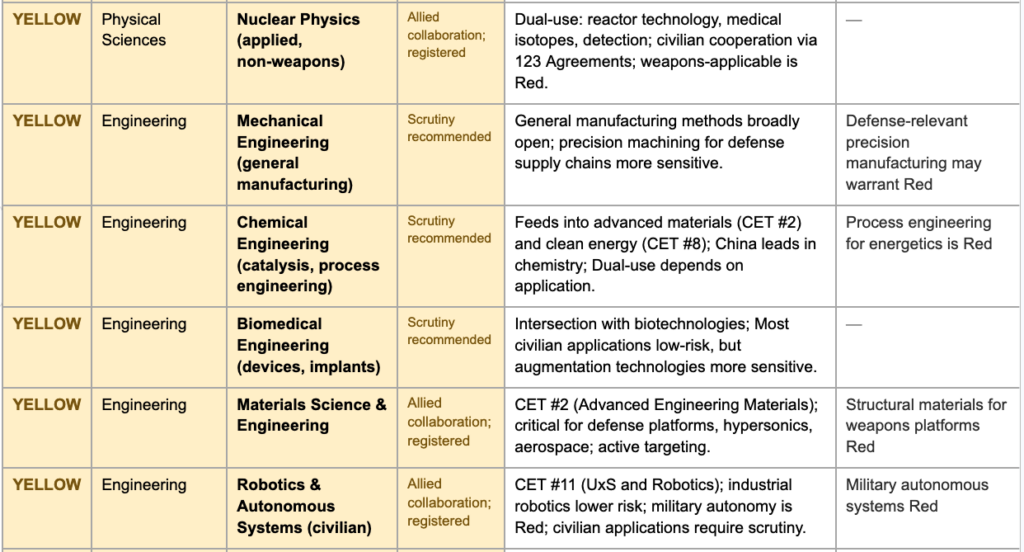
The smart openness yellow category creates a middle tier — unclassified but restricted or subject to consultation. Collaboration may be limited to allies or subject to safeguards. For the smart openness framework, the question becomes one of research imperative, where cooperation offers the United States a strong incentive to seek or welcome foreign partners because of the clear gain of function it provides. This yellow tier is unclassified but requires guided consideration, reciprocity verification, clear US interest, or Five Eyes restrictions.
Importantly, the US should target and actively engage in fields where a foreign entity, including China, is the acknowledged leader. The policy should specifically work with world leaders (defined by metrics) to ensure US access to world-class knowledge, with the goal of bringing frontier knowledge back to the United States for diffusion and absorption. Based upon the Nature Index, the section, “China’s global leadership,” presents the broad fields where China is currently considered to lead.7Researchers can identify specific subfields themselves and document and petition for collaboration with world leaders.
Red light fields
Rather than modify the classification for red light categories, we chose to maintain their existing qualities determined by current US critical technologies lists, lists of militarily sensitive technologies, and other areas of national interest.8As noted, a field goes green when all three are low. It shifts to yellow when at least one is elevated.
China’s global leadership
Nature Index data, as well as the inaugural applied sciences ranking, present bibliometric evidence of China’s leadership.9This list is highly aggregated and needs refinement. The Nature Index defines the fields where China leads as follows:
1. Chemistry
This is China’s most commanding lead. Chinese institutions occupy all 10 of the top positions in chemistry on the Nature Index, and the Chinese Academy of Sciences, or CAS — comprising over 100 research centers, three universities, and numerous “big science” facilities — dominates the field. Chemistry and physics together account for roughly 85 percent of China’s total Nature Index share. The US decline in the adjusted share in chemistry was the steepest of any subject area — an 11.6 percent drop — suggesting the gap is widening rapidly. Cooperation with China would keep US research apprised of advances at the scientific frontier.
2. Physical sciences
China holds eight of the top 10 institutional positions in physical sciences, with the US–adjusted share falling 10.6 percent in 2024. CAS ranks first globally in this category. South Korea’s rapid ascent (moving from sixth to fourth place in this subject) further underscores that the shift is not purely bilateral but rather reflects a broader Asian reorientation of research in the physical sciences.
3. Earth and environmental sciences
China similarly holds eight of the top 10 positions in earth and environmental sciences, with CAS again ranking first globally. Science Cities data reinforce this: Chinese cities are growing their adjusted share in this domain at rates exceeding 15 percent annually, far outpacing Western counterparts.
4. Applied sciences
The December 2025 Nature Index applied sciences table was perhaps the most striking result presented. Chinese institutions occupied all top-30 positions globally, and Chinese researchers accounted for 56 percent of total global output in the field, with the United States a distant second at approximately 10 percent. This reflects China’s strategic alignment of basic research with industrial policy — a point that the Nature Index editors explicitly linked to the “Made in China 2025” initiative and successive five-year plans.
5. Overall natural sciences
Taken in the aggregate across natural sciences, China topped the 2024 research leaders with a share of 32,122 compared to the United States’ 22,083 — a gap that is no longer marginal. China’s contribution increased by 17 percent over 2023, the highest growth rate among the top 20 countries.
Next steps in smart openness
The classification framework presented in this document is offered as a working hypothesis, not a finished product. Its purpose is to demonstrate that a principled, evidence-based three-tier architecture is achievable; it is designed to give the relevant communities (i.e., professional societies, research security officers, disciplinary experts, and government liaisons) a structured starting point for deliberation. Moving from working hypothesis to community consensus requires a process that is itself structured, legitimate, and insulated from the ad hoc political pressures that have generated the current chilling environment. What follows describes that process in five stages.
- Step 1: Convening a multi-society steering process. The immediate priority is to secure the convening authority of major institutions — for example, the AAAS, NASEM, and AAU — to aid a formal deliberative process. These institutions command the disciplinary breadth, reputational standing, and organizational capacity to give any resulting guidelines the legitimacy required for adoption by individual universities and research security offices. The credibility of the resulting guidelines depends critically on their being understood as community-generated standards rather than guidance handed down from above. Government representatives from relevant agencies could be invited as informants and observers — providing the threat intelligence and policy context that the scientific community needs to make informed determinations — without holding decision-making authority over the technical classifications themselves.
- Step 2: Constituting field-level expert panels for classification review. No generalist body can resolve the subfield-level classification questions that the framework requires. A dedicated panel of disciplinary experts is most qualified to undertake that work for each boundary domain. Each panel should be constituted with input from the relevant disciplinary societies (e.g., the American Chemical Society, Institute of Electrical and Electronics Engineers, the American Society for Microbiology, and their counterparts) and should include senior researchers and practitioners actively working at the dual-use boundary — those who understand, from direct experience, which research configurations pose genuine transfer risks.
- Step 3: Developing yellow-tier operational protocols for research security offices. The yellow tier is the framework’s core operational innovation, and the site where the gap between classification principle and institutional practice is most acute. A field designated yellow is not self-implementing; it requires administrators to have standardized protocols for evaluating specific collaboration proposals within yellow-tier domains, clear criteria for when to escalate to consultative review, and a structured pathway for engaging relevant government agencies when a collaboration warrants interagency input. A working group drawn from the community, perhaps convened under the multi-society steering structure, could produce a standard yellow-tier decision protocol.
- Step 4: Designing a registration mechanism. A transparent registration mechanism for yellow-tier collaborations may serve a dual purpose: providing the accountability signal that addresses legitimate concerns in research engagement and generating the data necessary to evaluate whether the framework is achieving its intended balance between openness and security. A design question is on the table. A third-party model has certain advantages: it could specify a lightweight registration process, capturing the field tier, institutional affiliation, collaboration partner, and general research domain — not the proprietary details of the research itself — and it could be designed from the outset with a data governance policy that prevents registration records from being repurposed as an enforcement or surveillance mechanism.
- Step 5: Establishing a standing review panel and bibliometric update process. The specific intent of the yellow-tier framework is not a static list. The bibliometric data underlying an external leadership assessment, drawn from the Nature Index or similar sources, are updated periodically. A standing expert panel, jointly administered by the multi-society steering body, could be tasked with conducting an annual review of the tier classifications. A petition mechanism operationalizes, at the system level, the same logic that animates the smart openness proposal at the policy level: the judgment of those who know the science should be structurally embedded in the governance of the science’s security boundaries.
The five steps described here constitute a governance architecture, not merely a to-do list. Their cumulative effect, if executed with fidelity to the community-generated principles, would be to shift the institutional locus of research security judgment from reactive, individual-level compliance decisions made under political pressure to proactive, field-level standards developed by those with the expertise to make them. The proposal asks something difficult of the scientific community: not merely to critique securitization as it has been practiced, but to take institutional responsibility for the alternative.
That is a demanding ask. It is also the only path to a system that is simultaneously more secure and more open than the one currently in place.
Appendix: Proposed categories for discussion
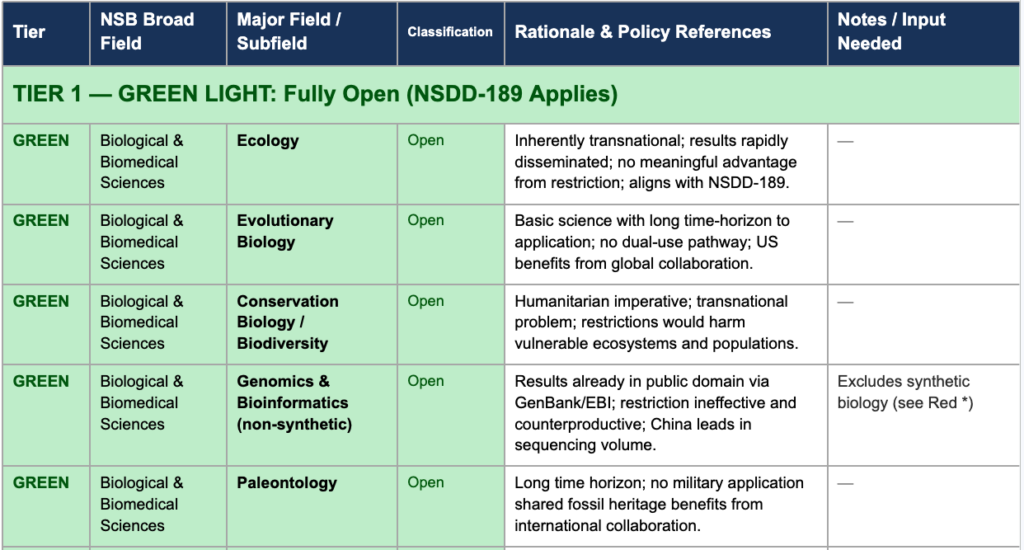
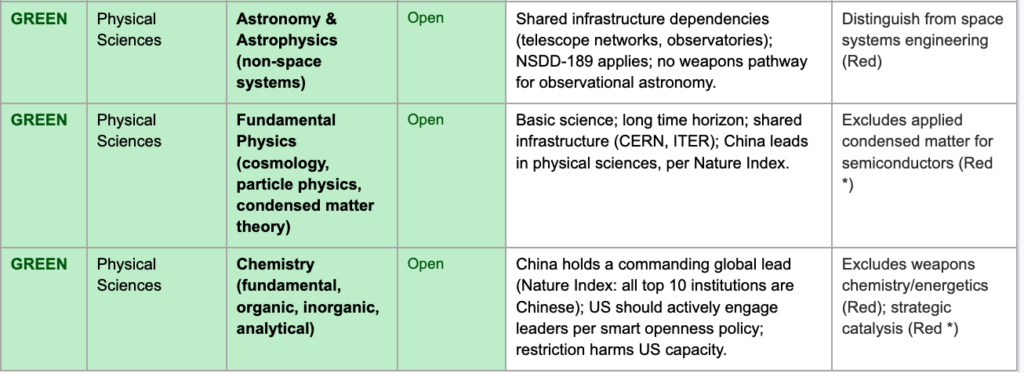
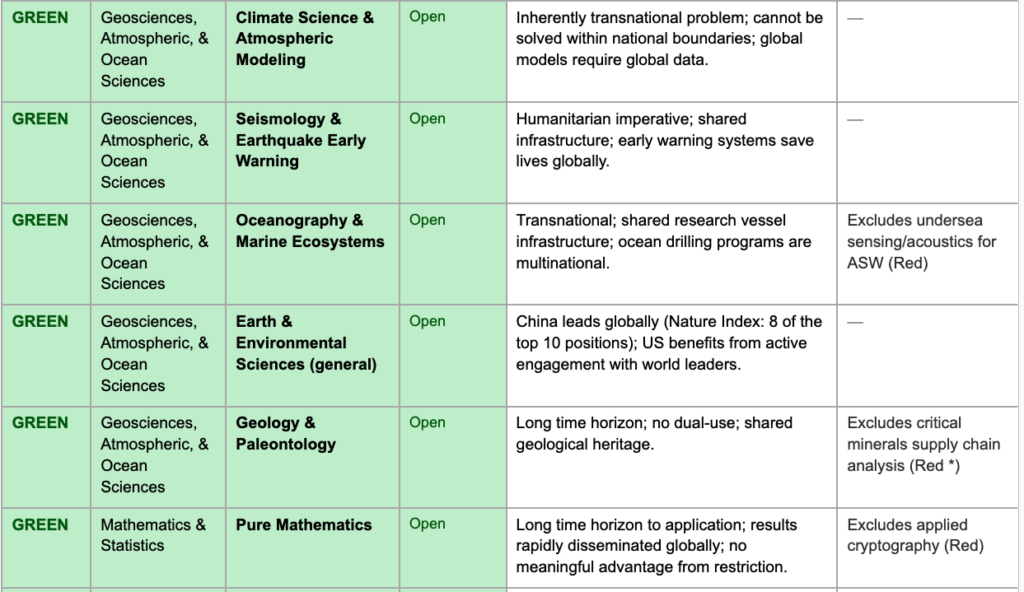
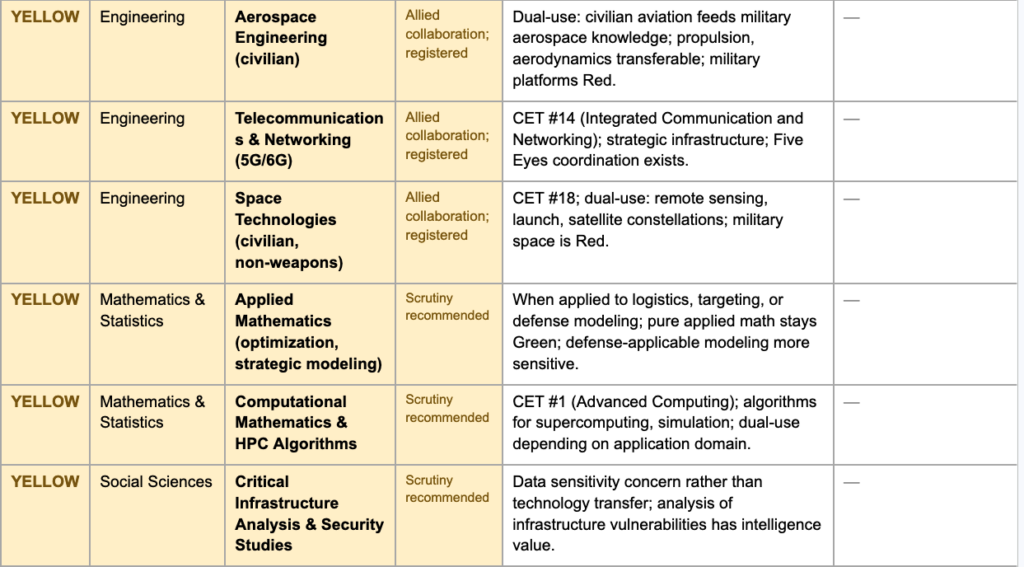
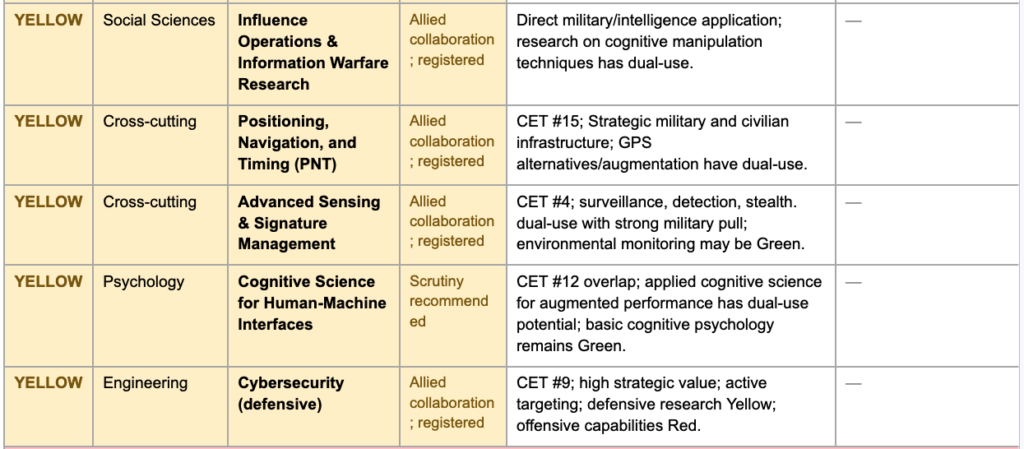
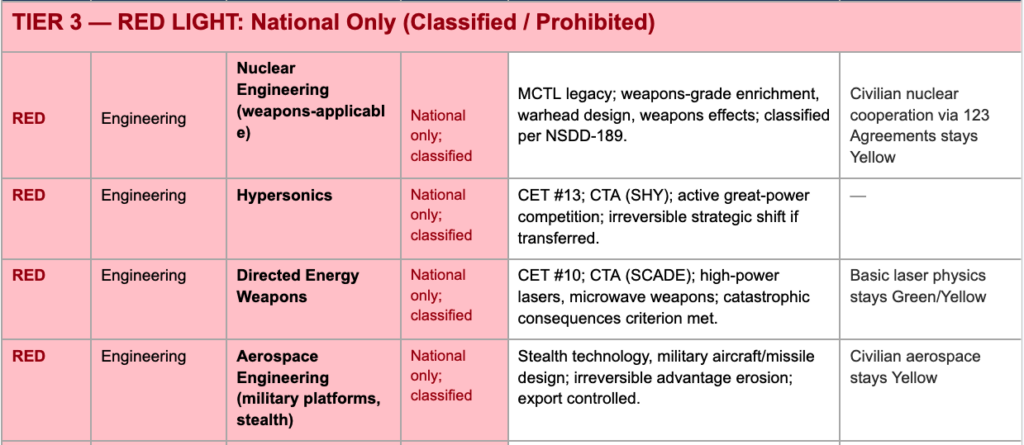
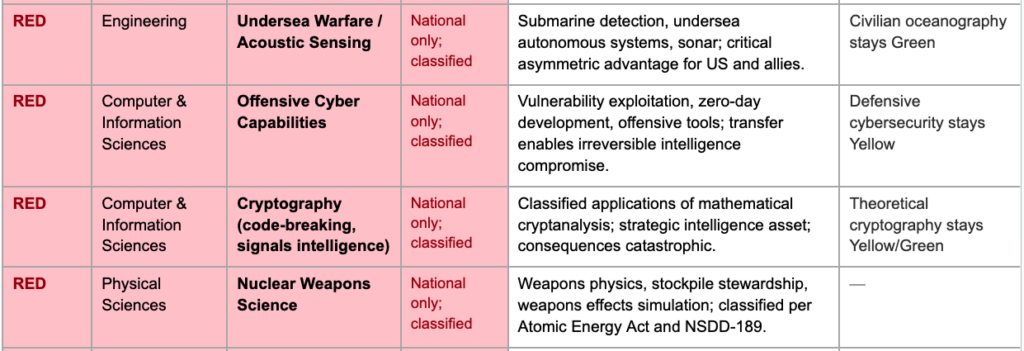
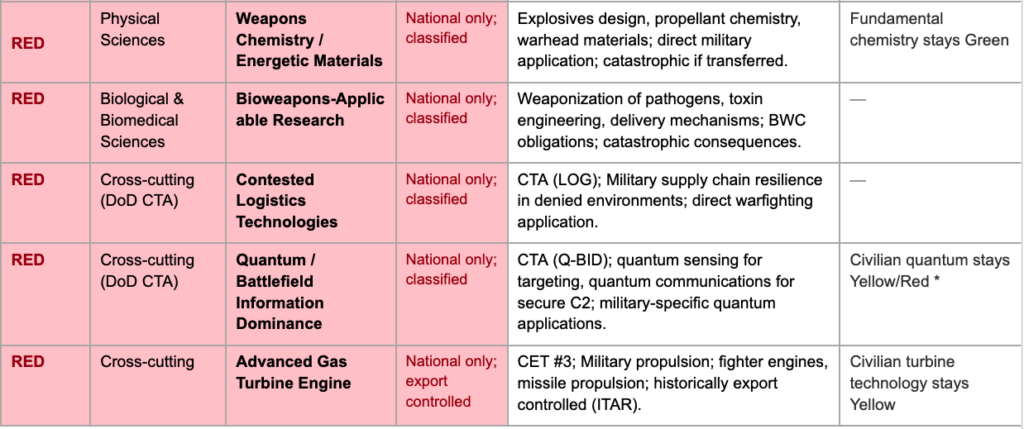
This table classifies science and engineering fields into three tiers based on the National Academies’ recommended dimensions: nature of risk (i.e., type of harm), likelihood of risk (i.e., probability of diversion), and potential consequences (i.e., severity if realized). Fields are drawn from the National Science Board Table A-1 taxonomy, augmented by the Office of Science and Technology Policy Critical and Emerging Technologies List, Department of Defense Critical Technology Areas, and Nature Index data on China’s global leadership positions.
Classification criteria: A field is GREEN when all three risk dimensions are low. It shifts to YELLOW when at least one dimension is elevated. It reaches RED when two or more are high, or when consequences alone are catastrophic, regardless of likelihood.
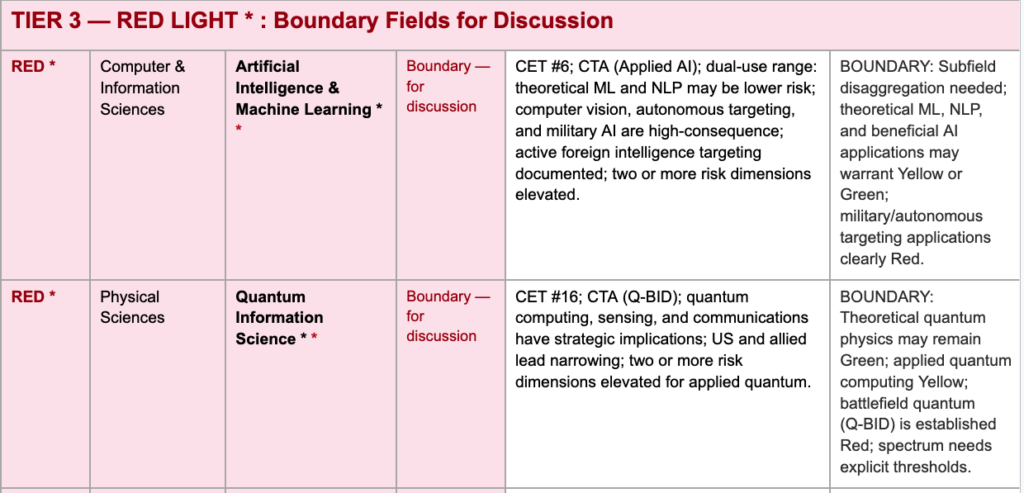
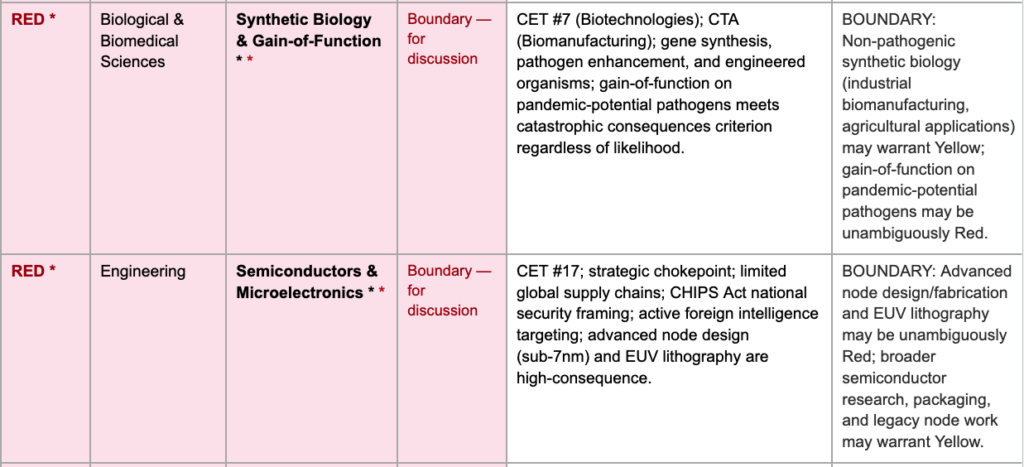
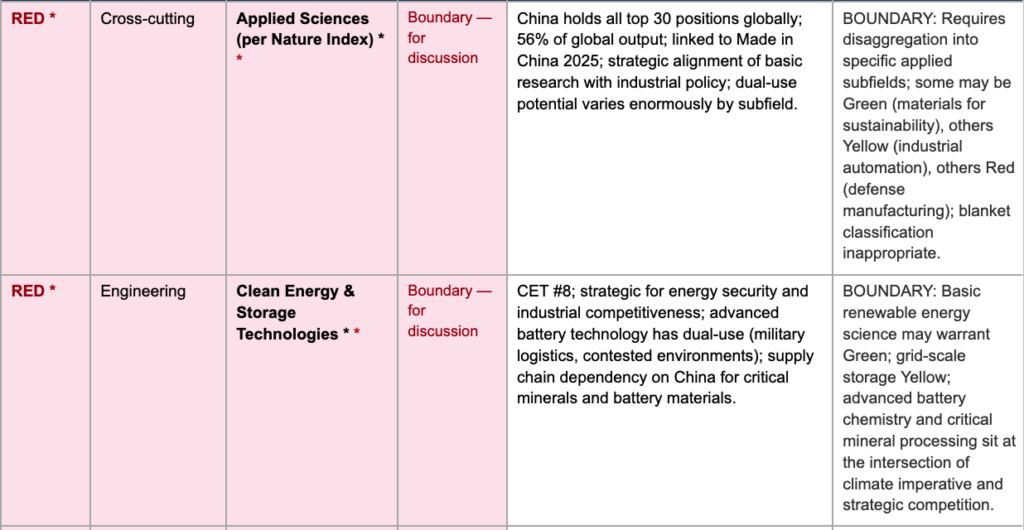
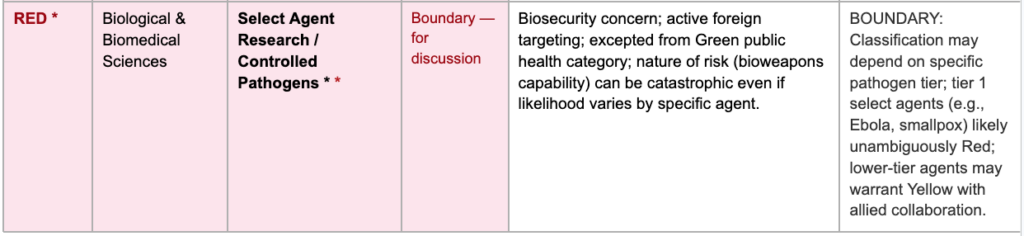
Starred entries (*): Seven boundary fields are provisionally placed in the red tier pending further deliberation. These fields contain subfield heterogeneity — portions may warrant reclassification to yellow or green upon disaggregation and expert input. They are visually distinguished with lighter shading and detailed discussion notes.
China engagement note: Fields where China is the acknowledged global leader (per Nature Index 2024) are flagged. Per the smart openness proposal, the US should actively engage with world leaders in these fields to access and absorb world-class knowledge, consistent with the tier classification.
Key to classifications
- Open: NSDD-189 applies fully. Unrestricted international collaboration. Professional societies may vet.
- Allied collaboration; registered: Unclassified but restricted to Five Eyes and select partners. Registered with the US Department of Commerce or designated body.
- Scrutiny recommended: Unclassified; requires case-by-case assessment of collaboration partner, application domain, and data sensitivity.
- National only; classified: Classified per NSDD-189 or restricted under export control (ITAR/EAR). No international collaboration outside cleared channels.
- Boundary — for discussion: Provisionally red. Contains subfield heterogeneity requiring disaggregation. Portions may be reclassified to Yellow or Green upon deliberation.
Policy reference key
- CET: Office of Science and Technology Policy Critical and Emerging Technologies List (February 2024), 18 categories.
- CTA: Department of Defense Critical Technology Areas (November 2025), six priorities.
- Nature Index: Nature Index 2024 Research Leaders; China’s global leadership in chemistry, physical sciences, earth & environmental sciences, applied sciences, and aggregate natural sciences.
- NSDD-189: National Security Decision Directive 189 (1985); fundamental research unrestricted; control mechanism is classification.
- CHIPS Act: CHIPS and Science Act (2022); semiconductor manufacturing and R&D investment with national security guardrails.
Starred (*) boundary fields — discussion guide
The following seven fields are placed in Red as the default-secure position, but each contains internal heterogeneity that warrants deliberation. The core question for each: at what subfield granularity does the tier boundary shift?
- Artificial Intelligence/Machine Learning*: Spectrum from theoretical ML and natural language processing (potentially yellow/green) through computer vision and autonomous decision systems (yellow) to autonomous targeting and military AI (red). The DoD’s Applied AI CTA covers the red end; the question is where the line falls for dual-use research.
- Quantum Information Science*: Theoretical quantum physics (green); quantum computing and communications (yellow); quantum sensing for targeting and battlefield C2 (red/Q-BID CTA). The challenge: quantum computing advances are dual-use by nature, and the boundary between civilian and military applications is porous.
- Synthetic Biology/Gain-of-Function*: Industrial biomanufacturing and agricultural synthetic biology (potentially yellow) vs. gain-of-function on pandemic-potential pathogens (red by catastrophic consequences criterion). The DoD Biomanufacturing CTA straddles this boundary.
- Semiconductors & Microelectronics*: Advanced node design (sub-7nm), EUV lithography, and advanced packaging (red) vs. legacy nodes, general IC design, and semiconductor materials research (yellow). CHIPS Act guardrails and export controls (Entity List) already draw de facto boundaries here.
- Applied Sciences (Nature Index category)*: China dominates with 56 percent of global output. This aggregate category spans subfields with vastly different security profiles. Requires disaggregation by a specific applied domain before meaningful classification is possible.
- Clean Energy & Storage Technologies*: Intersection of climate imperative (green impulse) and strategic supply chain competition (yellow/red impulse). Advanced battery chemistry and critical mineral processing have applications in both clean energy and military logistics. China’s supply chain dominance complicates the openness calculus.
- Select Agent Research/Controlled Pathogens*: Tier 1 select agents (ebola, smallpox, anthrax) likely unambiguously red given catastrophic bioweapons potential. Lower-tier agents with primarily public-health significance may warrant yellow with allied collaboration frameworks. Classification may need to follow the existing CDC/APHIS select agent tiers.
Note on allied scope: The definition of “allied collaboration” in the yellow tier remains to be determined. Options include Five Eyes, Five Eyes and Japan, South Korea, the European Union, and NATO, or a variable grouping depending on the field. This decision fundamentally shapes the practical effect of the yellow tier and should be addressed as a cross-cutting policy question.
Related
Smart Openness in U.S.–China Scientific Collaboration
A discussion of new frameworks that manage security risks while continuing to permit U.S.-Chinese scientific cooperation in an atmosphere that is not poisoned by political suspicion.
China – US Investment: A Security Threat or an Opening to Reform the World’s Most Important Economic Relationship?
Experts discuss the future of US-China economic ties.
Program
Countries/Territories
Authors

Caroline S. Wagner is academy professor at The Ohio State University John Glenn College of Public Affairs. Her research focuses on global research networks, international scientific collaboration, and science policy.

Denis Simon is a senior research fellow in the Quincy Institute’s East Asia program, focusing on global science and technology (S&T) issues and U.S.-China S&T relations. He also holds a senior faculty appointment at Schwarzman College at Tsinghua University in…
Citations
Denis Simon and Caroline S. Wagner, “US–China Scientific Collaboration at a Crossroads: Navigating Strategic Engagement in the Era of Scientific Nationalism,” Quincy Institute, Nov. 4, 2025, https://quincyinst.org/research/u-s-china-scientific-collaboration-at-a-crossroads-navigating-strategic-engagement-in-the-era-of-scientific-nationalism/#h-introduction-the-transformation-of-global-scientific-cooperation; Caroline S. Wagner and Denis F. Simon, “Research Security Policy Needs Clear Guidelines,” Science 391, no. 6791 (March 19, 2026): 1187, https://doi.org/10.1126/science.aef7935. ↩
Sara Frueh, “An Enduring Guide to Responsible Research Gets an Update,” National Academies, Sept. 2, 2025, https://www.nationalacademies.org/news/an-enduring-guide-to-responsible-research-gets-an-update. ↩
“Critical and Emerging Technologies List Update,” Fast Track Action Subcommittee on Critical and Emerging Technologies of the National Science and Technology Council, February 2024, https://www.govinfo.gov/content/pkg/CMR-PREX23-00185928/pdf/CMR-PREX23-00185928.pdf; “DoD Critical Technology Areas (CTAs),” Defense Technical Information Center, https://discover.dtic.mil/ctalist/; “Science in the National Interest,” Office of Science, US Department of Energy, March 28, 2022, https://www.energy.gov/science/articles/science-national-interest. ↩
Benjamin Schneider, Jeffrey Alexander, and Patrick Thomas, “Publications Output: US Trends and International Comparisons,” National Center for Science and Engineering Statistics, Dec. 11, 2023, https://ncses.nsf.gov/pubs/nsb202333/publication-output-by-region-country-or-economy-and-by-scientific-field. ↩
“Defense Technologies: DOD’s Critical Technologies Lists Rarely Inform Export Control and Other Policy Decisions,” US Government Accountability Office, July 28, 2006,https://www.govinfo.gov/content/pkg/GAOREPORTS-GAO-06-793/html/GAOREPORTS-GAO-06-793.htm. ↩
“NSDD 189: National Policy on the Transfer of Scientific, Technical, and Engineering Information,” FAS Intelligence Resource Program, Sept. 21, 1985,https://irp.fas.org/offdocs/nsdd/nsdd-189.htm. ↩
Nature Index tracks output in 145 select journals, which is a reputational rather than comprehensive sample — it captures a specific stratum of elite publishing rather than the full landscape. These counts presented are non-normalized in that they do not adjust for population, researcher headcount, or total publication volume. The measure of leadership is based on citations. Approximately 57 percent of citations to Chinese papers come from within China, compared to 37 percent for American papers, a pattern that raises ongoing questions about international impact versus domestic citation networks — though defenders note that the Nature Index journals themselves are inherently international in their review processes. Fourth, the US retains clear leadership in health sciences and biological sciences, where it holds seven to eight of the top 10 institutional spots. See “2025 Research Leaders: Leading Institutions,” Nature Index, https://www.nature.com/nature-index/research-leaders/2025/institution/all/all/countries-China; Caroline S. Wagner, “China’s Historic Rise to the Top of the Scientific Ladder,” Quincy Institute, Oct. 24, 2025, https://quincyinst.org/research/chinas-historic-rise-to-the-top-of-the-scientific-ladder/#. ↩
“Critical and Emerging Technologies List Update,” Fast Track Action Subcommittee on Critical and Emerging Technologies of the National Science and Technology Council; “DoD Critical Technology Areas (CTAs),” Defense Technical Information Center; “Science in the National Interest,” Office of Science, US Department of Energy. ↩
Benjamin Plackett, “China Accounts for More than Half of Leading Output in the Applied Sciences,” Nature, Dec. 3, 2025, https://doi.org/10.1038/d41586-025-03715-z. ↩